SUBSCRIBE TO OUR FREE NEWSLETTER
Daily news & progressive opinion—funded by the people, not the corporations—delivered straight to your inbox.
5
#000000
#FFFFFF
To donate by check, phone, or other method, see our More Ways to Give page.
Daily news & progressive opinion—funded by the people, not the corporations—delivered straight to your inbox.
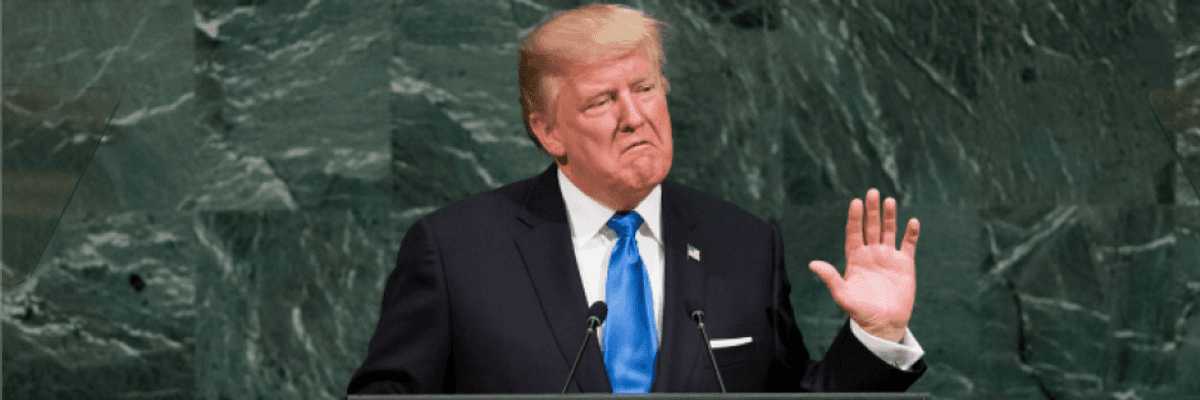
U.S. President Donald Trump addresses the United Nations General Assembly at U.N. headquarters, September 19, 2017 in New York City. (Photo: Drew Angerer/Getty Images)
As tensions between the U.S. and North Korea reached a fever pitch, hundreds of women leaders and organizations are calling for urgent de-escalation, emphasizing diplomacy over warmongering to bring greater security to the whole region.
A necessary step at this point, says Women Cross DMZ, a global peace movement, is for United Nations Secretary-General Antonio Guterres to appoint a special envoy to spearhead diplomacy and work towards an official end to the Korean War with a peace treaty.
The call from the organization was released after President Donald Trump and Kim Jong Un traded sharpened barbs this week. Speaking at United Nations General Assembly on Tuesday, Trump threatened to "totally destroy" North Korea. Jong Un said Friday that Trump is "mentally deranged U.S. dotard," Trump called Kim "obviously a madman" who "will be tested like never before!"
"I doubt the three generals in the White House approved President Trump's call 'to totally destroy North Korea,'" said Women Cross DMZ committee member Ann Wright, also a retired U.S. Army Colonel and former U.S. diplomat. "They know that there is no military solution to this crisis just as there hasn't been one in Iraq, Afghanistan, or Syria. U.S. military intervention will not and cannot solve a political problem."
Also among the nearly 300 women leaders urging restraint is Suzy Kim, professor of Korean History at Rutgers University. "Trump has been compared to President Truman for his Cold War rhetoric and willingness to use nuclear weapons," she stated. "Trump should not follow in Truman's footsteps and commit the United States to waging war again in Korea."
U.S. ally Japan has not been a boon for peace efforts either. The New York Times reported last month that Prime Minister Shinzo
Abe, a staunch conservative, has made a career of arguing for a tougher line against North Korea. The growing threat from the North has bolstered his drive to strengthen Japan's military, which has long been constrained by the country's war-renouncing Constitution.
Because of that, the latest escalation of tensions might seem to play into Mr. Abe's hands.
Deutsche Welle adds:
Abe has made it clear that he believes it is time that Japan needs to alter Article 9 of the Constitution, which stipulates that the Japanese people "forever renounce war" and that "land, sea and air forces, as well as other war potential, will never be maintained."
Butt according to Kozue Akibayashi, professor at Doshisha University in Kyoto, Japan, and International President of Women's International League for Peace and Freedom (WILPF), "The Japanese people do not support warmongering by Trump or Shinzo Abe, both of whom are using the North Korean nuclear threat to justify more militarization, such as revoking Article 9, which threatens the security of the entire region."
The statement also expresses support for a so-called freeze-freeze proposal that entails North Korea halting its missile tests in change for the U.S. to halt its military exercises with South Korea. U.S. Ambassador to the U.N. Nikki Haley has dismissed the proposal as "insulting."
Earlier this week, peace groups including CODEPINK and Win Without War demonstrated outside the White House demanding "diplomacy, not war with North Korea," and on the heels of the first legally-binding treaty prohibiting nuclear weapons opening for signature, with more than 50 U.N. member states signing on. The U.S. and other nuclear-armed states boycotted the signing ceremony.
This country and this world are at a monumental crossroads. US voters have an opportunity to beat back the forces of fascism and confront the billionaires who are rigging the economy, our media system, and our democracy, making it increasingly impossible for ordinary people to get by. We’re not just talking about the election. We’re talking about what must be done once these fascist elements are vanquished from power. We need a bolder set of solutions than what either major party has so far been willing to offer and a working-class movement ready to fight like hell for it. Trump didn't emerge from nowhere. The conditions that fueled MAGA authoritarianism were created by decades of radical neoliberal economic policies and a corrupt political system dominated by corporate interests. They slashed taxes on the super-rich, promising that the benefits would trickle down. They said giveaways to the corporate titans would make life more affordable for the rest of us. It was all bullshit. And when a bitter, betrayed populace searches for someone to blame, right-wing demagogues have little trouble finding scapegoats. People know when they're being lied to, but you won't hear any of this from the corporate media. Only independent journalism—powered and funded by people who believe in building a better world—can deliver truly trustworthy daily news. If you share our vision, please contribute whatever you can to sustain our work. |
As tensions between the U.S. and North Korea reached a fever pitch, hundreds of women leaders and organizations are calling for urgent de-escalation, emphasizing diplomacy over warmongering to bring greater security to the whole region.
A necessary step at this point, says Women Cross DMZ, a global peace movement, is for United Nations Secretary-General Antonio Guterres to appoint a special envoy to spearhead diplomacy and work towards an official end to the Korean War with a peace treaty.
The call from the organization was released after President Donald Trump and Kim Jong Un traded sharpened barbs this week. Speaking at United Nations General Assembly on Tuesday, Trump threatened to "totally destroy" North Korea. Jong Un said Friday that Trump is "mentally deranged U.S. dotard," Trump called Kim "obviously a madman" who "will be tested like never before!"
"I doubt the three generals in the White House approved President Trump's call 'to totally destroy North Korea,'" said Women Cross DMZ committee member Ann Wright, also a retired U.S. Army Colonel and former U.S. diplomat. "They know that there is no military solution to this crisis just as there hasn't been one in Iraq, Afghanistan, or Syria. U.S. military intervention will not and cannot solve a political problem."
Also among the nearly 300 women leaders urging restraint is Suzy Kim, professor of Korean History at Rutgers University. "Trump has been compared to President Truman for his Cold War rhetoric and willingness to use nuclear weapons," she stated. "Trump should not follow in Truman's footsteps and commit the United States to waging war again in Korea."
U.S. ally Japan has not been a boon for peace efforts either. The New York Times reported last month that Prime Minister Shinzo
Abe, a staunch conservative, has made a career of arguing for a tougher line against North Korea. The growing threat from the North has bolstered his drive to strengthen Japan's military, which has long been constrained by the country's war-renouncing Constitution.
Because of that, the latest escalation of tensions might seem to play into Mr. Abe's hands.
Deutsche Welle adds:
Abe has made it clear that he believes it is time that Japan needs to alter Article 9 of the Constitution, which stipulates that the Japanese people "forever renounce war" and that "land, sea and air forces, as well as other war potential, will never be maintained."
Butt according to Kozue Akibayashi, professor at Doshisha University in Kyoto, Japan, and International President of Women's International League for Peace and Freedom (WILPF), "The Japanese people do not support warmongering by Trump or Shinzo Abe, both of whom are using the North Korean nuclear threat to justify more militarization, such as revoking Article 9, which threatens the security of the entire region."
The statement also expresses support for a so-called freeze-freeze proposal that entails North Korea halting its missile tests in change for the U.S. to halt its military exercises with South Korea. U.S. Ambassador to the U.N. Nikki Haley has dismissed the proposal as "insulting."
Earlier this week, peace groups including CODEPINK and Win Without War demonstrated outside the White House demanding "diplomacy, not war with North Korea," and on the heels of the first legally-binding treaty prohibiting nuclear weapons opening for signature, with more than 50 U.N. member states signing on. The U.S. and other nuclear-armed states boycotted the signing ceremony.