SUBSCRIBE TO OUR FREE NEWSLETTER
Daily news & progressive opinion—funded by the people, not the corporations—delivered straight to your inbox.
5
#000000
#FFFFFF
To donate by check, phone, or other method, see our More Ways to Give page.
Daily news & progressive opinion—funded by the people, not the corporations—delivered straight to your inbox.
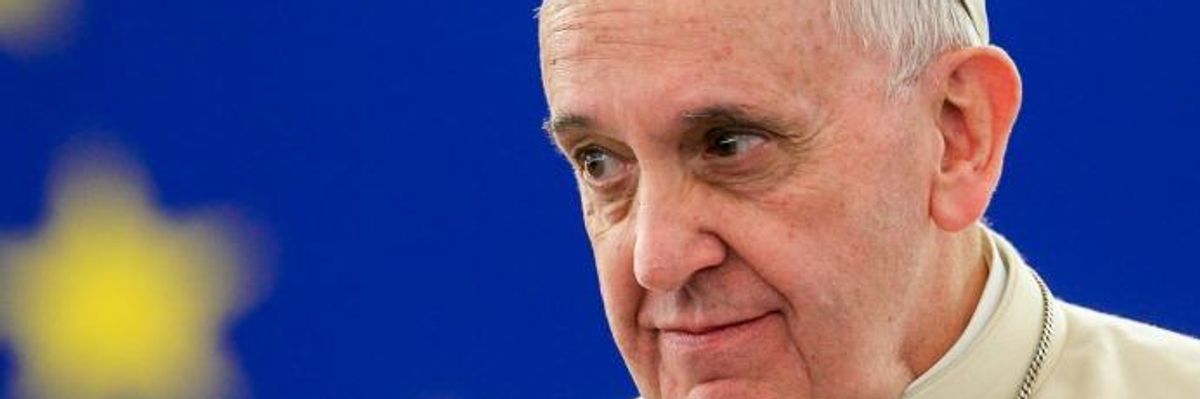
Pope Francis denounces climate denialism as Hurricane Irma leaves a path of destruction throughout the Caribbean and along Florida's west coast. (Photo: Martin Schulz/Flickr/cc)
Speaking with reporters as Hurricane Irma barreled up Florida's Gulf Coast on Sunday, Pope Francis bolstered his reputation as an outspoken advocate of addressing man-made global warming when he said aboard the papal plane that "history will judge" climate change deniers.
"If someone is doubtful that this is true, they should ask scientists. Then each person can decide and history will judge the decisions."
--Pope Francis
"You can see the effects of climate change, and scientists have clearly said what path we have to follow," he said, acknowledging scientists' suggestions that people across the world alter their activity, particularly by reducing their use of fossil fuels, in response to global warming.
"All of us have a responsibility, all of us, small or large, a moral responsibility. We have to take it seriously. We can't joke about it," he continued. "Each person has their own. Even politicians have their own."
"If someone is doubtful that this is true, they should ask scientists," the pope added, responding to questions about climate denialism. "These are not opinions made on the fly. They are very clear. Then each person can decide and history will judge the decisions."
The Independent characterized Pope Francis' comments as a "thinly veiled attack" on U.S. President Donald Trump, whom the pope has previously criticized for his promises to erect a wall along the Mexican border and his decision to withdraw from the Paris Climate Agreement.
The pope is known for speaking out in favor of climate action--most famously when he released a 2015 encyclical in which he called on Catholics worldwide to join in the fight against climate change.
"If we don't turn back," he concluded on Sunday, "we will go down."
"What do you think it means when your forests are on fire, your streets are underwater, and your buildings are collapsing?"
-- Bill McKibben, 350.org
In a Guardian op-ed published Monday, titled "Stop talking right now about the threat of climate change. It's here; it's happening," 350.org co-founder Bill McKibben also described North America's natural disasters this past week, exacerbated by man-made global warming, as a sign that people and politicians must reduce reliance on dirty energy sources to address climate change.
Pointing to Houston's recovery efforts following Hurricane Harvey, west coast forest fires, a "flash drought" in the northwest, and Hurricane Irma battering Florida this weekend after ravaging several Caribbean islands, McKibben wrote: "That one long screed of news from one continent in one week (which could be written about many other continents and many other weeks--just check out the recent flooding in south Asia for instance) is a precise, pixelated portrait of a heating world."
"Because we have burned so much oil and gas and coal, we have put huge clouds of CO2 and methane in the air; because the structure of those molecules traps heat the planet has warmed; because the planet has warmed we can get heavier rainfalls, stronger winds, drier forests and fields," he continued.
Calling upon humankind to take a stand against the fossil fuel industry to curb global warming, McKibben likened the ongoing battle against oil and gas companies to "going on a war-like footing: not shooting at enemies, but focusing in the way that peoples and nations usually only focus when someone's shooting at them."
"And something is," he concluded. "What do you think it means when your forests are on fire, your streets are underwater, and your buildings are collapsing?"
Dear Common Dreams reader, It’s been nearly 30 years since I co-founded Common Dreams with my late wife, Lina Newhouser. We had the radical notion that journalism should serve the public good, not corporate profits. It was clear to us from the outset what it would take to build such a project. No paid advertisements. No corporate sponsors. No millionaire publisher telling us what to think or do. Many people said we wouldn't last a year, but we proved those doubters wrong. Together with a tremendous team of journalists and dedicated staff, we built an independent media outlet free from the constraints of profits and corporate control. Our mission has always been simple: To inform. To inspire. To ignite change for the common good. Building Common Dreams was not easy. Our survival was never guaranteed. When you take on the most powerful forces—Wall Street greed, fossil fuel industry destruction, Big Tech lobbyists, and uber-rich oligarchs who have spent billions upon billions rigging the economy and democracy in their favor—the only bulwark you have is supporters who believe in your work. But here’s the urgent message from me today. It's never been this bad out there. And it's never been this hard to keep us going. At the very moment Common Dreams is most needed, the threats we face are intensifying. We need your support now more than ever. We don't accept corporate advertising and never will. We don't have a paywall because we don't think people should be blocked from critical news based on their ability to pay. Everything we do is funded by the donations of readers like you. When everyone does the little they can afford, we are strong. But if that support retreats or dries up, so do we. Will you donate now to make sure Common Dreams not only survives but thrives? —Craig Brown, Co-founder |
Speaking with reporters as Hurricane Irma barreled up Florida's Gulf Coast on Sunday, Pope Francis bolstered his reputation as an outspoken advocate of addressing man-made global warming when he said aboard the papal plane that "history will judge" climate change deniers.
"If someone is doubtful that this is true, they should ask scientists. Then each person can decide and history will judge the decisions."
--Pope Francis
"You can see the effects of climate change, and scientists have clearly said what path we have to follow," he said, acknowledging scientists' suggestions that people across the world alter their activity, particularly by reducing their use of fossil fuels, in response to global warming.
"All of us have a responsibility, all of us, small or large, a moral responsibility. We have to take it seriously. We can't joke about it," he continued. "Each person has their own. Even politicians have their own."
"If someone is doubtful that this is true, they should ask scientists," the pope added, responding to questions about climate denialism. "These are not opinions made on the fly. They are very clear. Then each person can decide and history will judge the decisions."
The Independent characterized Pope Francis' comments as a "thinly veiled attack" on U.S. President Donald Trump, whom the pope has previously criticized for his promises to erect a wall along the Mexican border and his decision to withdraw from the Paris Climate Agreement.
The pope is known for speaking out in favor of climate action--most famously when he released a 2015 encyclical in which he called on Catholics worldwide to join in the fight against climate change.
"If we don't turn back," he concluded on Sunday, "we will go down."
"What do you think it means when your forests are on fire, your streets are underwater, and your buildings are collapsing?"
-- Bill McKibben, 350.org
In a Guardian op-ed published Monday, titled "Stop talking right now about the threat of climate change. It's here; it's happening," 350.org co-founder Bill McKibben also described North America's natural disasters this past week, exacerbated by man-made global warming, as a sign that people and politicians must reduce reliance on dirty energy sources to address climate change.
Pointing to Houston's recovery efforts following Hurricane Harvey, west coast forest fires, a "flash drought" in the northwest, and Hurricane Irma battering Florida this weekend after ravaging several Caribbean islands, McKibben wrote: "That one long screed of news from one continent in one week (which could be written about many other continents and many other weeks--just check out the recent flooding in south Asia for instance) is a precise, pixelated portrait of a heating world."
"Because we have burned so much oil and gas and coal, we have put huge clouds of CO2 and methane in the air; because the structure of those molecules traps heat the planet has warmed; because the planet has warmed we can get heavier rainfalls, stronger winds, drier forests and fields," he continued.
Calling upon humankind to take a stand against the fossil fuel industry to curb global warming, McKibben likened the ongoing battle against oil and gas companies to "going on a war-like footing: not shooting at enemies, but focusing in the way that peoples and nations usually only focus when someone's shooting at them."
"And something is," he concluded. "What do you think it means when your forests are on fire, your streets are underwater, and your buildings are collapsing?"
Speaking with reporters as Hurricane Irma barreled up Florida's Gulf Coast on Sunday, Pope Francis bolstered his reputation as an outspoken advocate of addressing man-made global warming when he said aboard the papal plane that "history will judge" climate change deniers.
"If someone is doubtful that this is true, they should ask scientists. Then each person can decide and history will judge the decisions."
--Pope Francis
"You can see the effects of climate change, and scientists have clearly said what path we have to follow," he said, acknowledging scientists' suggestions that people across the world alter their activity, particularly by reducing their use of fossil fuels, in response to global warming.
"All of us have a responsibility, all of us, small or large, a moral responsibility. We have to take it seriously. We can't joke about it," he continued. "Each person has their own. Even politicians have their own."
"If someone is doubtful that this is true, they should ask scientists," the pope added, responding to questions about climate denialism. "These are not opinions made on the fly. They are very clear. Then each person can decide and history will judge the decisions."
The Independent characterized Pope Francis' comments as a "thinly veiled attack" on U.S. President Donald Trump, whom the pope has previously criticized for his promises to erect a wall along the Mexican border and his decision to withdraw from the Paris Climate Agreement.
The pope is known for speaking out in favor of climate action--most famously when he released a 2015 encyclical in which he called on Catholics worldwide to join in the fight against climate change.
"If we don't turn back," he concluded on Sunday, "we will go down."
"What do you think it means when your forests are on fire, your streets are underwater, and your buildings are collapsing?"
-- Bill McKibben, 350.org
In a Guardian op-ed published Monday, titled "Stop talking right now about the threat of climate change. It's here; it's happening," 350.org co-founder Bill McKibben also described North America's natural disasters this past week, exacerbated by man-made global warming, as a sign that people and politicians must reduce reliance on dirty energy sources to address climate change.
Pointing to Houston's recovery efforts following Hurricane Harvey, west coast forest fires, a "flash drought" in the northwest, and Hurricane Irma battering Florida this weekend after ravaging several Caribbean islands, McKibben wrote: "That one long screed of news from one continent in one week (which could be written about many other continents and many other weeks--just check out the recent flooding in south Asia for instance) is a precise, pixelated portrait of a heating world."
"Because we have burned so much oil and gas and coal, we have put huge clouds of CO2 and methane in the air; because the structure of those molecules traps heat the planet has warmed; because the planet has warmed we can get heavier rainfalls, stronger winds, drier forests and fields," he continued.
Calling upon humankind to take a stand against the fossil fuel industry to curb global warming, McKibben likened the ongoing battle against oil and gas companies to "going on a war-like footing: not shooting at enemies, but focusing in the way that peoples and nations usually only focus when someone's shooting at them."
"And something is," he concluded. "What do you think it means when your forests are on fire, your streets are underwater, and your buildings are collapsing?"