SUBSCRIBE TO OUR FREE NEWSLETTER
Daily news & progressive opinion—funded by the people, not the corporations—delivered straight to your inbox.
5
#000000
#FFFFFF
To donate by check, phone, or other method, see our More Ways to Give page.
Daily news & progressive opinion—funded by the people, not the corporations—delivered straight to your inbox.
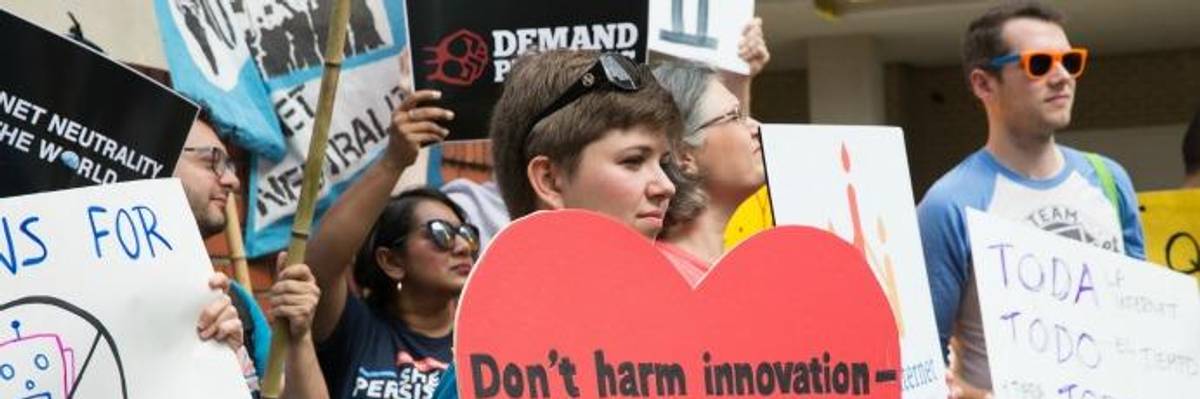
This summer, open internet advocates have organized events to raise awareness about net neutrality. (Photo: Maria Merkulova/Free Press/Free Press Action Fund/Flickr/cc)
Wednesday at midnight, Eastern Time, is the deadline to submit public comment on the Federal Communications Commission's plan to roll back net neutrality rules that prevent internet service providers (ISPs) from limiting or prioritizing customers' access to particular websites.
"Giant corporations shouldn't dictate how we use the internet. Most people agree with that principle."
--Trevor Timm, the Guardian
"Giant corporations shouldn't dictate how we use the internet. Most people agree with that principle, and that's why the Federal Communications Commission passed the incredibly popular net neutrality rules in 2015," writes Trevor Timm at the Guardian.
The 2015 ruling reclassified ISPs as under Title II authority, enabling the Federal Communications Commission (FCC) to regulate them as a public utility. Because of the ruling, telecommunications companies must treat all online content equally, and cannot slow down, speed up, or block content.
However, FCC Chairman Ajit Pai, a Trump appointee who wants to rescind the 2015 rules, "has dubbed the FCC's new proposal to rollback the Obama-era net neutrality rules the Restoring Internet Freedom Act, ostensibly trying to confuse consumers into supporting a proposal that certainly will leave corporations with vastly more power to control how we consume information online," Timm explains.
As public support for net neutrality has grown--a recent Politico/Morning Consult poll shows 60 percent of registered voters support the rules, and only 17 percent oppose it--open internet advocates have organized to raise awareness about the issue, including a national day of action last month, which advocacy group Free Press said was part of a long-term effort to "save the internet from Trump and his cronies," as Common Dreams reported.
This is the Trump administration's "second major policy shift with the potential to significantly erode online consumer rights," MapLight reports. In April, President Donald Trump signed a law that allows ISPs to sell customers' private browser histories, even though in a March HuffPost/YouGov poll, 83 percent of adults said it "should not be allowed."
Some, such as CALinnovates executive director Mike Montgomery, have argued: "It's time to end the slowest game of policy pingpong before it drags into another decade. It is high time for Congress to finally step up--after multiple decades of hibernation--and pass affirmative, bipartisan legislation that makes net neutrality the law of the land."
But, as with many regulations designed to protect consumers, proponents of net neutrality have to square off with well-heeled donors. In this case, four major ISPs that support the plan to eliminate net neutrality rules--Comcast Corp., AT&T, Verizon, and Charter Communications--have given more than $1.2 million to the Republican members of Congress who have scheduled a September 7 hearing to discuss legislative options for repealing the 2015 regulations, MapLight reports.
Earlier this week, the open internet group Fight for the Future unveiled crowdfunded billboards targeting representatives who have received contributions from telecom companies and support the rollback, encouraging constituents to contact their elected officials.
"Every member of Congress should take note: supporting the FCC's plan to allow censorship, throttling, and price gouging may get you a few extra campaign donations from big telecom companies, but it will infuriate your constituents, and will come with a serious political cost," said Fight for the Future campaign director Evan Greer.
Despite the telecom companies' push to kill net neutrality, the public is speaking out. While the popular 2015 proposal received more than 4 million public comments, the FCC has received nearly 22 million comments regarding Pai's new proposal--and even extended the comment period deadline to Wednesday night because of the outpouring of public opinion.
However, it's not just the sheer number of comments submitted and people opposed to scrapping the 2015 rules that could sway the upcoming decision. As Ars Technica reported, last month Pai said: "the raw number is not as important as the substantive comments that are in the record."
Pai has said he would be most convinced by economic arguments in favor of keeping the 2015 rules, as Ars Technica further reported:
In a Congressional hearing, a Democratic lawmaker pressed Pai to detail what kind of comments would change his mind about rolling back net neutrality rules. Pai responded that he could be persuaded by "economic analysis that shows credibly that there's infrastructure investment that has increased dramatically" since the net neutrality rules went into effect. Pai said he also would take evidence seriously if it shows that the overall economy would suffer from a net neutrality rollback or that startups and consumers can't thrive without the existing rules.
Both Ars Technica and Quartz have published guidance for how to write "a meaningful FCC comment supporting net neutrality," and Free Press has set up a user-friendly comment submission form with a sample letter. On Twitter, the organization has shared feedback from supporters to explain the various reasons why net neutrality protections are essential:
Dear Common Dreams reader, It’s been nearly 30 years since I co-founded Common Dreams with my late wife, Lina Newhouser. We had the radical notion that journalism should serve the public good, not corporate profits. It was clear to us from the outset what it would take to build such a project. No paid advertisements. No corporate sponsors. No millionaire publisher telling us what to think or do. Many people said we wouldn't last a year, but we proved those doubters wrong. Together with a tremendous team of journalists and dedicated staff, we built an independent media outlet free from the constraints of profits and corporate control. Our mission has always been simple: To inform. To inspire. To ignite change for the common good. Building Common Dreams was not easy. Our survival was never guaranteed. When you take on the most powerful forces—Wall Street greed, fossil fuel industry destruction, Big Tech lobbyists, and uber-rich oligarchs who have spent billions upon billions rigging the economy and democracy in their favor—the only bulwark you have is supporters who believe in your work. But here’s the urgent message from me today. It's never been this bad out there. And it's never been this hard to keep us going. At the very moment Common Dreams is most needed, the threats we face are intensifying. We need your support now more than ever. We don't accept corporate advertising and never will. We don't have a paywall because we don't think people should be blocked from critical news based on their ability to pay. Everything we do is funded by the donations of readers like you. When everyone does the little they can afford, we are strong. But if that support retreats or dries up, so do we. Will you donate now to make sure Common Dreams not only survives but thrives? —Craig Brown, Co-founder |
Wednesday at midnight, Eastern Time, is the deadline to submit public comment on the Federal Communications Commission's plan to roll back net neutrality rules that prevent internet service providers (ISPs) from limiting or prioritizing customers' access to particular websites.
"Giant corporations shouldn't dictate how we use the internet. Most people agree with that principle."
--Trevor Timm, the Guardian
"Giant corporations shouldn't dictate how we use the internet. Most people agree with that principle, and that's why the Federal Communications Commission passed the incredibly popular net neutrality rules in 2015," writes Trevor Timm at the Guardian.
The 2015 ruling reclassified ISPs as under Title II authority, enabling the Federal Communications Commission (FCC) to regulate them as a public utility. Because of the ruling, telecommunications companies must treat all online content equally, and cannot slow down, speed up, or block content.
However, FCC Chairman Ajit Pai, a Trump appointee who wants to rescind the 2015 rules, "has dubbed the FCC's new proposal to rollback the Obama-era net neutrality rules the Restoring Internet Freedom Act, ostensibly trying to confuse consumers into supporting a proposal that certainly will leave corporations with vastly more power to control how we consume information online," Timm explains.
As public support for net neutrality has grown--a recent Politico/Morning Consult poll shows 60 percent of registered voters support the rules, and only 17 percent oppose it--open internet advocates have organized to raise awareness about the issue, including a national day of action last month, which advocacy group Free Press said was part of a long-term effort to "save the internet from Trump and his cronies," as Common Dreams reported.
This is the Trump administration's "second major policy shift with the potential to significantly erode online consumer rights," MapLight reports. In April, President Donald Trump signed a law that allows ISPs to sell customers' private browser histories, even though in a March HuffPost/YouGov poll, 83 percent of adults said it "should not be allowed."
Some, such as CALinnovates executive director Mike Montgomery, have argued: "It's time to end the slowest game of policy pingpong before it drags into another decade. It is high time for Congress to finally step up--after multiple decades of hibernation--and pass affirmative, bipartisan legislation that makes net neutrality the law of the land."
But, as with many regulations designed to protect consumers, proponents of net neutrality have to square off with well-heeled donors. In this case, four major ISPs that support the plan to eliminate net neutrality rules--Comcast Corp., AT&T, Verizon, and Charter Communications--have given more than $1.2 million to the Republican members of Congress who have scheduled a September 7 hearing to discuss legislative options for repealing the 2015 regulations, MapLight reports.
Earlier this week, the open internet group Fight for the Future unveiled crowdfunded billboards targeting representatives who have received contributions from telecom companies and support the rollback, encouraging constituents to contact their elected officials.
"Every member of Congress should take note: supporting the FCC's plan to allow censorship, throttling, and price gouging may get you a few extra campaign donations from big telecom companies, but it will infuriate your constituents, and will come with a serious political cost," said Fight for the Future campaign director Evan Greer.
Despite the telecom companies' push to kill net neutrality, the public is speaking out. While the popular 2015 proposal received more than 4 million public comments, the FCC has received nearly 22 million comments regarding Pai's new proposal--and even extended the comment period deadline to Wednesday night because of the outpouring of public opinion.
However, it's not just the sheer number of comments submitted and people opposed to scrapping the 2015 rules that could sway the upcoming decision. As Ars Technica reported, last month Pai said: "the raw number is not as important as the substantive comments that are in the record."
Pai has said he would be most convinced by economic arguments in favor of keeping the 2015 rules, as Ars Technica further reported:
In a Congressional hearing, a Democratic lawmaker pressed Pai to detail what kind of comments would change his mind about rolling back net neutrality rules. Pai responded that he could be persuaded by "economic analysis that shows credibly that there's infrastructure investment that has increased dramatically" since the net neutrality rules went into effect. Pai said he also would take evidence seriously if it shows that the overall economy would suffer from a net neutrality rollback or that startups and consumers can't thrive without the existing rules.
Both Ars Technica and Quartz have published guidance for how to write "a meaningful FCC comment supporting net neutrality," and Free Press has set up a user-friendly comment submission form with a sample letter. On Twitter, the organization has shared feedback from supporters to explain the various reasons why net neutrality protections are essential:
Wednesday at midnight, Eastern Time, is the deadline to submit public comment on the Federal Communications Commission's plan to roll back net neutrality rules that prevent internet service providers (ISPs) from limiting or prioritizing customers' access to particular websites.
"Giant corporations shouldn't dictate how we use the internet. Most people agree with that principle."
--Trevor Timm, the Guardian
"Giant corporations shouldn't dictate how we use the internet. Most people agree with that principle, and that's why the Federal Communications Commission passed the incredibly popular net neutrality rules in 2015," writes Trevor Timm at the Guardian.
The 2015 ruling reclassified ISPs as under Title II authority, enabling the Federal Communications Commission (FCC) to regulate them as a public utility. Because of the ruling, telecommunications companies must treat all online content equally, and cannot slow down, speed up, or block content.
However, FCC Chairman Ajit Pai, a Trump appointee who wants to rescind the 2015 rules, "has dubbed the FCC's new proposal to rollback the Obama-era net neutrality rules the Restoring Internet Freedom Act, ostensibly trying to confuse consumers into supporting a proposal that certainly will leave corporations with vastly more power to control how we consume information online," Timm explains.
As public support for net neutrality has grown--a recent Politico/Morning Consult poll shows 60 percent of registered voters support the rules, and only 17 percent oppose it--open internet advocates have organized to raise awareness about the issue, including a national day of action last month, which advocacy group Free Press said was part of a long-term effort to "save the internet from Trump and his cronies," as Common Dreams reported.
This is the Trump administration's "second major policy shift with the potential to significantly erode online consumer rights," MapLight reports. In April, President Donald Trump signed a law that allows ISPs to sell customers' private browser histories, even though in a March HuffPost/YouGov poll, 83 percent of adults said it "should not be allowed."
Some, such as CALinnovates executive director Mike Montgomery, have argued: "It's time to end the slowest game of policy pingpong before it drags into another decade. It is high time for Congress to finally step up--after multiple decades of hibernation--and pass affirmative, bipartisan legislation that makes net neutrality the law of the land."
But, as with many regulations designed to protect consumers, proponents of net neutrality have to square off with well-heeled donors. In this case, four major ISPs that support the plan to eliminate net neutrality rules--Comcast Corp., AT&T, Verizon, and Charter Communications--have given more than $1.2 million to the Republican members of Congress who have scheduled a September 7 hearing to discuss legislative options for repealing the 2015 regulations, MapLight reports.
Earlier this week, the open internet group Fight for the Future unveiled crowdfunded billboards targeting representatives who have received contributions from telecom companies and support the rollback, encouraging constituents to contact their elected officials.
"Every member of Congress should take note: supporting the FCC's plan to allow censorship, throttling, and price gouging may get you a few extra campaign donations from big telecom companies, but it will infuriate your constituents, and will come with a serious political cost," said Fight for the Future campaign director Evan Greer.
Despite the telecom companies' push to kill net neutrality, the public is speaking out. While the popular 2015 proposal received more than 4 million public comments, the FCC has received nearly 22 million comments regarding Pai's new proposal--and even extended the comment period deadline to Wednesday night because of the outpouring of public opinion.
However, it's not just the sheer number of comments submitted and people opposed to scrapping the 2015 rules that could sway the upcoming decision. As Ars Technica reported, last month Pai said: "the raw number is not as important as the substantive comments that are in the record."
Pai has said he would be most convinced by economic arguments in favor of keeping the 2015 rules, as Ars Technica further reported:
In a Congressional hearing, a Democratic lawmaker pressed Pai to detail what kind of comments would change his mind about rolling back net neutrality rules. Pai responded that he could be persuaded by "economic analysis that shows credibly that there's infrastructure investment that has increased dramatically" since the net neutrality rules went into effect. Pai said he also would take evidence seriously if it shows that the overall economy would suffer from a net neutrality rollback or that startups and consumers can't thrive without the existing rules.
Both Ars Technica and Quartz have published guidance for how to write "a meaningful FCC comment supporting net neutrality," and Free Press has set up a user-friendly comment submission form with a sample letter. On Twitter, the organization has shared feedback from supporters to explain the various reasons why net neutrality protections are essential: