

SUBSCRIBE TO OUR FREE NEWSLETTER
Daily news & progressive opinion—funded by the people, not the corporations—delivered straight to your inbox.
5
#000000
#FFFFFF
To donate by check, phone, or other method, see our More Ways to Give page.
Daily news & progressive opinion—funded by the people, not the corporations—delivered straight to your inbox.
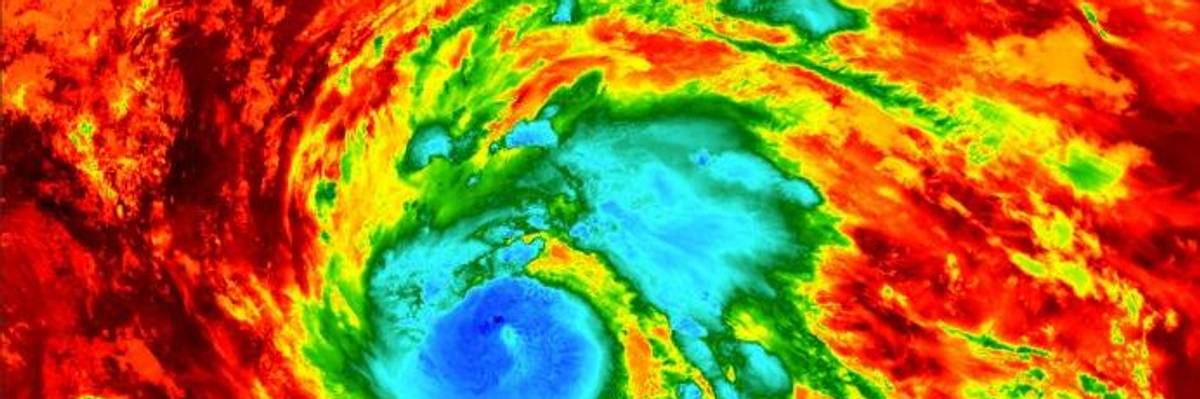
As Hurricane Harvey, a category 4 storm, slammed into the Gulf Coast Friday night, President Donald Trump made multiple controversial announcements. (Photo: European Space Agency)
As residents of Southern Texas and Louisiana fled the life-threatening category 4 hurricane charging toward the Gulf Coast Friday evening--the strongest to hit the U.S. in over a decade--the Trump administration made three major announcements, in what many have deemed "flagrant" attempts to bury controversial news.
"To be clear, this isn't a normal Friday news dump. This is the president using the cover of a major hurricane to announce unpopular moves."
--Tony Romm, reporter
Just after 6pm, President Donald Trump issued a directive for the Secretaries of Defense and Homeland Security to reinstate a ban on transgender individuals enlisting in the U.S. military. Around 8pm, Trump announced that he was pardoning the infamous former sheriff Joe Arpaio, who was recently convicted of racially profiling Latinos in Maricopa County, Arizona. An hour later, news broke that Trump's notorious national security advisor Sebastian Gorka was no longer working for the White House.
Although the Friday night news dump is not a new concept, they rarely accompany a natural disaster--espeically the first major natural disaster to occur during a presidency.
As journalist Amber Phillips notes at the Washington Post, Trump announcing the transgender troops ban and Arpaio pardon just as Hurricane Harvey made landfall in Texas was "a flagrant attempt to hide a series of politically fraught (but base-pleasing) moves."
"Of course, the irony for Trump is the exact opposite is happening," Phillips admits. "In so obviously trying to downplay this news, he's framing it in neon flashing signs."
Despite the White House's apparent attempts to bury these breaking stories, many news outlets were quick to report on them while still tracking the storm--with reporters, pundits and politicians alike acknowledging that the administration's timing seemed both strategic and inappropriate.
In a segment on CNN early Saturday morning, Douglas Brinkley, the network's pesidential historian and a professor of history at Rice University, pointed out that "we don't even have a head of Homeland Security at this juncture," and several posts for "emergency operations for the federal government haven't been filled by the Trump administration."
Brinkley criticized Trump for "doing a news dump when a category 4 storm is slamming into Gulf Texas," noting that many coastal communities could likely be "devastated for years" by the storm damage. "I would think this would be a Friday night not to politicize it, to have a kind of reverence" for those affected by the hurricane, he added, "but Donald Trump seemed to be thinking on a different wavelength."
"At the very least this all could have waited for a week," Brinkley added. "He did it in the middle of an evening when the rest of the country should be watching what's going on in the Gulf of Mexico."
Those sentiments were echoed online, along with reactions to the three headlines.
The transgender troops ban and first presidential pardon caused a wave of intense criticism, even as the hurricane flooded coastal Texas and Louisiana.
Trump's memo bans transgender individuals from enlisting and instructs the Pentagon to stop paying for gender reassignment surgery--as well as to sort out how best to address the thousands of transgender people who currently serve in the military. It follows an initial unexpected announcement the president made on Twitter last month, which also provoked condemnation from military leaders, enlisted transgender troops, LGBTQ advocates, and others.
The president's pardon for Arpaio was hardly a surprise--Trump has hinted for several days that the former sheriff would be "just fine," despite his criminal conviction--but triggered outrage among immigrant rights advocates, legal experts, politicians, journalists, and more.
While the news about Gorka, fired or not, was welcomed by many, it was not without controversy.
Gorka, as the Guardian notes, is "a fringe rightwing figure with questionable foreign policy and security credentials." His departure was somewhat anticipated after his White House ally Steve Bannon recently returned to Breitbart News in the wake of a revealing report that another Trump staffer supposedly called "DEFCON 1-level bad." However, whether Gorka resigned or was forced out remains a contentious debate.
In parts of a resignation letter published The Federalist, Gorka reportedly wrote to the president: "the individuals who most embodied and represented the policies that will 'Make America Great Again,' have been internally countered, systematically removed, or undermined in recent months," expressing particular concern that Trump supposedly gave a foreign policy speech from which all mentions of "Radical Islam or radical Islamic terrorism" were removed.
Gorka--who joins a growing list of ousted Trump staffers--publicly maintains that leaving the administration was his call, but it's been heavily reported that the new White House Chief of Staff Gen. John Kelly wanted him gone, and on Saturday reports surfaced that Gorka may have had trouble gaining security clearance.
Dear Common Dreams reader, It’s been nearly 30 years since I co-founded Common Dreams with my late wife, Lina Newhouser. We had the radical notion that journalism should serve the public good, not corporate profits. It was clear to us from the outset what it would take to build such a project. No paid advertisements. No corporate sponsors. No millionaire publisher telling us what to think or do. Many people said we wouldn't last a year, but we proved those doubters wrong. Together with a tremendous team of journalists and dedicated staff, we built an independent media outlet free from the constraints of profits and corporate control. Our mission has always been simple: To inform. To inspire. To ignite change for the common good. Building Common Dreams was not easy. Our survival was never guaranteed. When you take on the most powerful forces—Wall Street greed, fossil fuel industry destruction, Big Tech lobbyists, and uber-rich oligarchs who have spent billions upon billions rigging the economy and democracy in their favor—the only bulwark you have is supporters who believe in your work. But here’s the urgent message from me today. It's never been this bad out there. And it's never been this hard to keep us going. At the very moment Common Dreams is most needed, the threats we face are intensifying. We need your support now more than ever. We don't accept corporate advertising and never will. We don't have a paywall because we don't think people should be blocked from critical news based on their ability to pay. Everything we do is funded by the donations of readers like you. When everyone does the little they can afford, we are strong. But if that support retreats or dries up, so do we. Will you donate now to make sure Common Dreams not only survives but thrives? —Craig Brown, Co-founder |
As residents of Southern Texas and Louisiana fled the life-threatening category 4 hurricane charging toward the Gulf Coast Friday evening--the strongest to hit the U.S. in over a decade--the Trump administration made three major announcements, in what many have deemed "flagrant" attempts to bury controversial news.
"To be clear, this isn't a normal Friday news dump. This is the president using the cover of a major hurricane to announce unpopular moves."
--Tony Romm, reporter
Just after 6pm, President Donald Trump issued a directive for the Secretaries of Defense and Homeland Security to reinstate a ban on transgender individuals enlisting in the U.S. military. Around 8pm, Trump announced that he was pardoning the infamous former sheriff Joe Arpaio, who was recently convicted of racially profiling Latinos in Maricopa County, Arizona. An hour later, news broke that Trump's notorious national security advisor Sebastian Gorka was no longer working for the White House.
Although the Friday night news dump is not a new concept, they rarely accompany a natural disaster--espeically the first major natural disaster to occur during a presidency.
As journalist Amber Phillips notes at the Washington Post, Trump announcing the transgender troops ban and Arpaio pardon just as Hurricane Harvey made landfall in Texas was "a flagrant attempt to hide a series of politically fraught (but base-pleasing) moves."
"Of course, the irony for Trump is the exact opposite is happening," Phillips admits. "In so obviously trying to downplay this news, he's framing it in neon flashing signs."
Despite the White House's apparent attempts to bury these breaking stories, many news outlets were quick to report on them while still tracking the storm--with reporters, pundits and politicians alike acknowledging that the administration's timing seemed both strategic and inappropriate.
In a segment on CNN early Saturday morning, Douglas Brinkley, the network's pesidential historian and a professor of history at Rice University, pointed out that "we don't even have a head of Homeland Security at this juncture," and several posts for "emergency operations for the federal government haven't been filled by the Trump administration."
Brinkley criticized Trump for "doing a news dump when a category 4 storm is slamming into Gulf Texas," noting that many coastal communities could likely be "devastated for years" by the storm damage. "I would think this would be a Friday night not to politicize it, to have a kind of reverence" for those affected by the hurricane, he added, "but Donald Trump seemed to be thinking on a different wavelength."
"At the very least this all could have waited for a week," Brinkley added. "He did it in the middle of an evening when the rest of the country should be watching what's going on in the Gulf of Mexico."
Those sentiments were echoed online, along with reactions to the three headlines.
The transgender troops ban and first presidential pardon caused a wave of intense criticism, even as the hurricane flooded coastal Texas and Louisiana.
Trump's memo bans transgender individuals from enlisting and instructs the Pentagon to stop paying for gender reassignment surgery--as well as to sort out how best to address the thousands of transgender people who currently serve in the military. It follows an initial unexpected announcement the president made on Twitter last month, which also provoked condemnation from military leaders, enlisted transgender troops, LGBTQ advocates, and others.
The president's pardon for Arpaio was hardly a surprise--Trump has hinted for several days that the former sheriff would be "just fine," despite his criminal conviction--but triggered outrage among immigrant rights advocates, legal experts, politicians, journalists, and more.
While the news about Gorka, fired or not, was welcomed by many, it was not without controversy.
Gorka, as the Guardian notes, is "a fringe rightwing figure with questionable foreign policy and security credentials." His departure was somewhat anticipated after his White House ally Steve Bannon recently returned to Breitbart News in the wake of a revealing report that another Trump staffer supposedly called "DEFCON 1-level bad." However, whether Gorka resigned or was forced out remains a contentious debate.
In parts of a resignation letter published The Federalist, Gorka reportedly wrote to the president: "the individuals who most embodied and represented the policies that will 'Make America Great Again,' have been internally countered, systematically removed, or undermined in recent months," expressing particular concern that Trump supposedly gave a foreign policy speech from which all mentions of "Radical Islam or radical Islamic terrorism" were removed.
Gorka--who joins a growing list of ousted Trump staffers--publicly maintains that leaving the administration was his call, but it's been heavily reported that the new White House Chief of Staff Gen. John Kelly wanted him gone, and on Saturday reports surfaced that Gorka may have had trouble gaining security clearance.
As residents of Southern Texas and Louisiana fled the life-threatening category 4 hurricane charging toward the Gulf Coast Friday evening--the strongest to hit the U.S. in over a decade--the Trump administration made three major announcements, in what many have deemed "flagrant" attempts to bury controversial news.
"To be clear, this isn't a normal Friday news dump. This is the president using the cover of a major hurricane to announce unpopular moves."
--Tony Romm, reporter
Just after 6pm, President Donald Trump issued a directive for the Secretaries of Defense and Homeland Security to reinstate a ban on transgender individuals enlisting in the U.S. military. Around 8pm, Trump announced that he was pardoning the infamous former sheriff Joe Arpaio, who was recently convicted of racially profiling Latinos in Maricopa County, Arizona. An hour later, news broke that Trump's notorious national security advisor Sebastian Gorka was no longer working for the White House.
Although the Friday night news dump is not a new concept, they rarely accompany a natural disaster--espeically the first major natural disaster to occur during a presidency.
As journalist Amber Phillips notes at the Washington Post, Trump announcing the transgender troops ban and Arpaio pardon just as Hurricane Harvey made landfall in Texas was "a flagrant attempt to hide a series of politically fraught (but base-pleasing) moves."
"Of course, the irony for Trump is the exact opposite is happening," Phillips admits. "In so obviously trying to downplay this news, he's framing it in neon flashing signs."
Despite the White House's apparent attempts to bury these breaking stories, many news outlets were quick to report on them while still tracking the storm--with reporters, pundits and politicians alike acknowledging that the administration's timing seemed both strategic and inappropriate.
In a segment on CNN early Saturday morning, Douglas Brinkley, the network's pesidential historian and a professor of history at Rice University, pointed out that "we don't even have a head of Homeland Security at this juncture," and several posts for "emergency operations for the federal government haven't been filled by the Trump administration."
Brinkley criticized Trump for "doing a news dump when a category 4 storm is slamming into Gulf Texas," noting that many coastal communities could likely be "devastated for years" by the storm damage. "I would think this would be a Friday night not to politicize it, to have a kind of reverence" for those affected by the hurricane, he added, "but Donald Trump seemed to be thinking on a different wavelength."
"At the very least this all could have waited for a week," Brinkley added. "He did it in the middle of an evening when the rest of the country should be watching what's going on in the Gulf of Mexico."
Those sentiments were echoed online, along with reactions to the three headlines.
The transgender troops ban and first presidential pardon caused a wave of intense criticism, even as the hurricane flooded coastal Texas and Louisiana.
Trump's memo bans transgender individuals from enlisting and instructs the Pentagon to stop paying for gender reassignment surgery--as well as to sort out how best to address the thousands of transgender people who currently serve in the military. It follows an initial unexpected announcement the president made on Twitter last month, which also provoked condemnation from military leaders, enlisted transgender troops, LGBTQ advocates, and others.
The president's pardon for Arpaio was hardly a surprise--Trump has hinted for several days that the former sheriff would be "just fine," despite his criminal conviction--but triggered outrage among immigrant rights advocates, legal experts, politicians, journalists, and more.
While the news about Gorka, fired or not, was welcomed by many, it was not without controversy.
Gorka, as the Guardian notes, is "a fringe rightwing figure with questionable foreign policy and security credentials." His departure was somewhat anticipated after his White House ally Steve Bannon recently returned to Breitbart News in the wake of a revealing report that another Trump staffer supposedly called "DEFCON 1-level bad." However, whether Gorka resigned or was forced out remains a contentious debate.
In parts of a resignation letter published The Federalist, Gorka reportedly wrote to the president: "the individuals who most embodied and represented the policies that will 'Make America Great Again,' have been internally countered, systematically removed, or undermined in recent months," expressing particular concern that Trump supposedly gave a foreign policy speech from which all mentions of "Radical Islam or radical Islamic terrorism" were removed.
Gorka--who joins a growing list of ousted Trump staffers--publicly maintains that leaving the administration was his call, but it's been heavily reported that the new White House Chief of Staff Gen. John Kelly wanted him gone, and on Saturday reports surfaced that Gorka may have had trouble gaining security clearance.

