SUBSCRIBE TO OUR FREE NEWSLETTER
Daily news & progressive opinion—funded by the people, not the corporations—delivered straight to your inbox.
5
#000000
#FFFFFF
To donate by check, phone, or other method, see our More Ways to Give page.
Daily news & progressive opinion—funded by the people, not the corporations—delivered straight to your inbox.
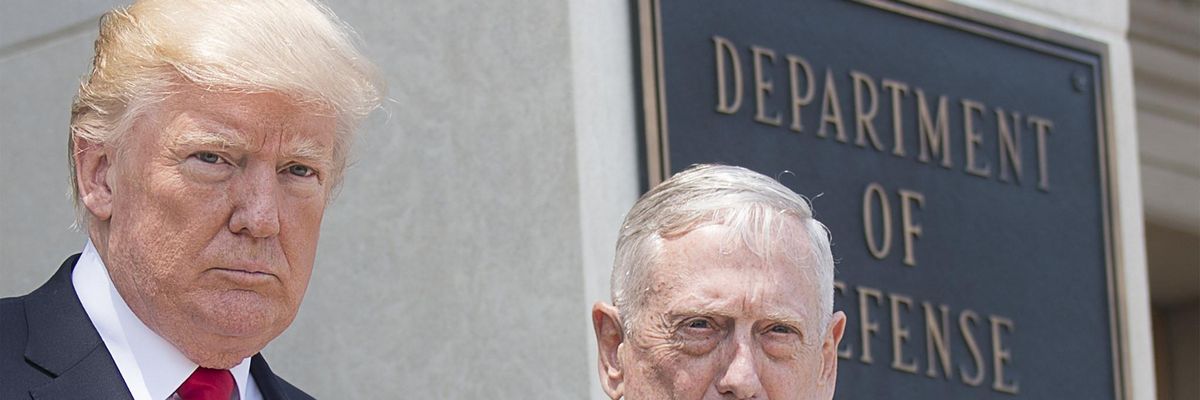
After years of criticizing U.S. involvement in Afghanistan, Trump is expected to announce that he'll deploy more troops there. (Photo: Chairman of the Joint Chiefs of Staff/Flickr/cc)
The president and his advisors have been weighing options regarding how to proceed in the 16-year-old war for months. Military leaders including National Security Advisor H.R. McMaster have pushed for a troop increase. But while war hawks claim that a withdrawal would leave openings for the Taliban and ISIS to win back control of the region, the Taliban in a recent open letter argued that the only thing driving the war is the continued presence of U.S. troops and allied forces. Trump aides including former top adviser Steve Bannon also reportedly met with Erik Prince, founder of the private security firm Blackwater, to discuss the possibility of sending contractors to Afghanistan to privatize the war.
During the Obama administration and the 2016 campaign, Trump frequently criticized the continuation of the conflict in Afghanistan.
Former State Department official Matthew Hoh, who resigned from his position in protest of the Obama administration's announcement that it would increase troop levels in Afghanistan in 2009, wrote Monday that Trump's speech would likely include the same falsehoods that have allowed the two previous administrations to rationalize the continuation of the conflict:
Tonight, the American people will hear again the great lie about the progress the American military once made in Afghanistan after "the Afghan Surge," just as we often hear the lie about how the American military had "won" in Iraq...In Afghanistan there has never even been an attempt at...a political solution and all the Afghan people have seen in the last eight years, every year, has been a worsening of the violence.
Americans will also hear tonight how the U.S. military has done great things for the Afghan people. You would be hard pressed to find many Afghans outside of the incredibly corrupt and illegitimate government, a better definition of a kleptocracy you will not find, that the U.S. keeps in power with its soldiers and $35 billion a year, who would agree with the statements of the American politicians, the American generals, and the pundits, the latter of which are mostly funded, directly or indirectly, by the military companies.
The president's actions in the conflict this year have included an airstrike in northeastern Afghanistan in April, in which the military dropped the "Mother of All Bombs," the United States' most powerful non-nuclear weapon, on suspected ISIS targets, killing less than 100 fighters.
In June, Trump authorized Defense Secretary General James Mattis to send up to 3,900 additional troops into the country, but has thus far supplied the military with no clear sense of what a potential troop surge would accomplish. NATO allies have also declined to send more men and women to the region without clear directives from Trump.
Dear Common Dreams reader, It’s been nearly 30 years since I co-founded Common Dreams with my late wife, Lina Newhouser. We had the radical notion that journalism should serve the public good, not corporate profits. It was clear to us from the outset what it would take to build such a project. No paid advertisements. No corporate sponsors. No millionaire publisher telling us what to think or do. Many people said we wouldn't last a year, but we proved those doubters wrong. Together with a tremendous team of journalists and dedicated staff, we built an independent media outlet free from the constraints of profits and corporate control. Our mission has always been simple: To inform. To inspire. To ignite change for the common good. Building Common Dreams was not easy. Our survival was never guaranteed. When you take on the most powerful forces—Wall Street greed, fossil fuel industry destruction, Big Tech lobbyists, and uber-rich oligarchs who have spent billions upon billions rigging the economy and democracy in their favor—the only bulwark you have is supporters who believe in your work. But here’s the urgent message from me today. It's never been this bad out there. And it's never been this hard to keep us going. At the very moment Common Dreams is most needed, the threats we face are intensifying. We need your support now more than ever. We don't accept corporate advertising and never will. We don't have a paywall because we don't think people should be blocked from critical news based on their ability to pay. Everything we do is funded by the donations of readers like you. When everyone does the little they can afford, we are strong. But if that support retreats or dries up, so do we. Will you donate now to make sure Common Dreams not only survives but thrives? —Craig Brown, Co-founder |
The president and his advisors have been weighing options regarding how to proceed in the 16-year-old war for months. Military leaders including National Security Advisor H.R. McMaster have pushed for a troop increase. But while war hawks claim that a withdrawal would leave openings for the Taliban and ISIS to win back control of the region, the Taliban in a recent open letter argued that the only thing driving the war is the continued presence of U.S. troops and allied forces. Trump aides including former top adviser Steve Bannon also reportedly met with Erik Prince, founder of the private security firm Blackwater, to discuss the possibility of sending contractors to Afghanistan to privatize the war.
During the Obama administration and the 2016 campaign, Trump frequently criticized the continuation of the conflict in Afghanistan.
Former State Department official Matthew Hoh, who resigned from his position in protest of the Obama administration's announcement that it would increase troop levels in Afghanistan in 2009, wrote Monday that Trump's speech would likely include the same falsehoods that have allowed the two previous administrations to rationalize the continuation of the conflict:
Tonight, the American people will hear again the great lie about the progress the American military once made in Afghanistan after "the Afghan Surge," just as we often hear the lie about how the American military had "won" in Iraq...In Afghanistan there has never even been an attempt at...a political solution and all the Afghan people have seen in the last eight years, every year, has been a worsening of the violence.
Americans will also hear tonight how the U.S. military has done great things for the Afghan people. You would be hard pressed to find many Afghans outside of the incredibly corrupt and illegitimate government, a better definition of a kleptocracy you will not find, that the U.S. keeps in power with its soldiers and $35 billion a year, who would agree with the statements of the American politicians, the American generals, and the pundits, the latter of which are mostly funded, directly or indirectly, by the military companies.
The president's actions in the conflict this year have included an airstrike in northeastern Afghanistan in April, in which the military dropped the "Mother of All Bombs," the United States' most powerful non-nuclear weapon, on suspected ISIS targets, killing less than 100 fighters.
In June, Trump authorized Defense Secretary General James Mattis to send up to 3,900 additional troops into the country, but has thus far supplied the military with no clear sense of what a potential troop surge would accomplish. NATO allies have also declined to send more men and women to the region without clear directives from Trump.
The president and his advisors have been weighing options regarding how to proceed in the 16-year-old war for months. Military leaders including National Security Advisor H.R. McMaster have pushed for a troop increase. But while war hawks claim that a withdrawal would leave openings for the Taliban and ISIS to win back control of the region, the Taliban in a recent open letter argued that the only thing driving the war is the continued presence of U.S. troops and allied forces. Trump aides including former top adviser Steve Bannon also reportedly met with Erik Prince, founder of the private security firm Blackwater, to discuss the possibility of sending contractors to Afghanistan to privatize the war.
During the Obama administration and the 2016 campaign, Trump frequently criticized the continuation of the conflict in Afghanistan.
Former State Department official Matthew Hoh, who resigned from his position in protest of the Obama administration's announcement that it would increase troop levels in Afghanistan in 2009, wrote Monday that Trump's speech would likely include the same falsehoods that have allowed the two previous administrations to rationalize the continuation of the conflict:
Tonight, the American people will hear again the great lie about the progress the American military once made in Afghanistan after "the Afghan Surge," just as we often hear the lie about how the American military had "won" in Iraq...In Afghanistan there has never even been an attempt at...a political solution and all the Afghan people have seen in the last eight years, every year, has been a worsening of the violence.
Americans will also hear tonight how the U.S. military has done great things for the Afghan people. You would be hard pressed to find many Afghans outside of the incredibly corrupt and illegitimate government, a better definition of a kleptocracy you will not find, that the U.S. keeps in power with its soldiers and $35 billion a year, who would agree with the statements of the American politicians, the American generals, and the pundits, the latter of which are mostly funded, directly or indirectly, by the military companies.
The president's actions in the conflict this year have included an airstrike in northeastern Afghanistan in April, in which the military dropped the "Mother of All Bombs," the United States' most powerful non-nuclear weapon, on suspected ISIS targets, killing less than 100 fighters.
In June, Trump authorized Defense Secretary General James Mattis to send up to 3,900 additional troops into the country, but has thus far supplied the military with no clear sense of what a potential troop surge would accomplish. NATO allies have also declined to send more men and women to the region without clear directives from Trump.