SUBSCRIBE TO OUR FREE NEWSLETTER
Daily news & progressive opinion—funded by the people, not the corporations—delivered straight to your inbox.
5
#000000
#FFFFFF
To donate by check, phone, or other method, see our More Ways to Give page.

As popular support for single-payer continues to grow and Sen. Bernie Sanders (I-Vt.) prepares to introduce Medicare for All legislation, the Establishment wing of the Democratic Party is reportedly "alarmed" by the shifting dynamics and fearful "of primary election challenges" if they don't support Sanders's proposal.
"It's a litmus test. It's a clarifying issue like none I've ever seen. We're talking about people's lives and health and money."
-- RoseAnn DeMoro, National Nurses United
"Democrats who don't get behind it could find themselves on the wrong side of the most energetic wing of the party," Politico reported Monday.
Political organizers and supporters of Sanders are already speaking out about how lawmakers' responses could impact upcoming elections.
"Any Democrat worth their salt that doesn't unequivocally say Medicare for All is the way to go? To me, there's something wrong with them," Nina Turner, president of Our Revolution--the political group that formed out of Sanders's presidential campaign--told Politico. "We're not going to accept no more hemming and hawing. No more game playing. Make your stand."
"Our view is that within the Democratic Party, this is fast-emerging as a litmus test," Ben Tulchin, the pollster for Sanders's presidential run, told Politico.
RoseAnn DeMoro, executive director of the Sanders-aligned National Nurses United union, agrees. "It's a litmus test," DeMoro told NBC News last month. "It's a clarifying issue like none I've ever seen. We're talking about people's lives and health and money."
Mounting public support of a Medicare for All national healthcare system could sway centrist Democrats, and perhaps even Senate Republicans, who are up for reelection in 2018 or 2020.
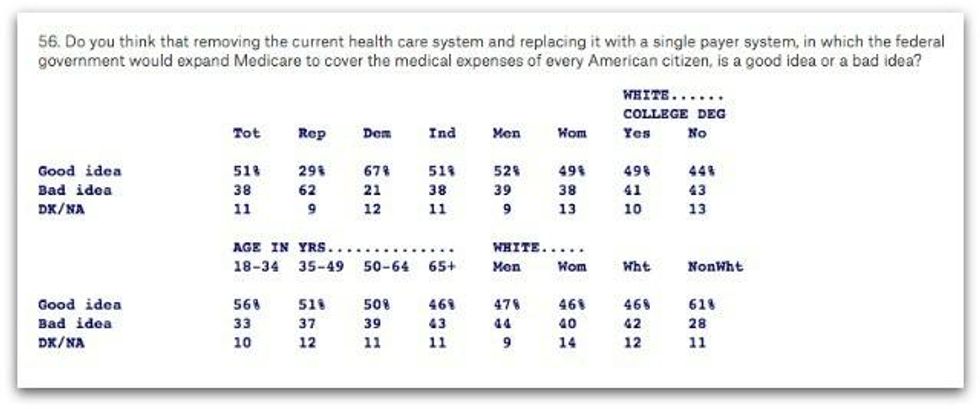
A national poll released by Quinnipiac last week found that a majority of American voters overall, and 67 percent of Democrats, believe that replacing the nation's current healthcare system with a single-payer system--"in which the federal government would expand Medicare to cover the medical expenses of every American citizen"--is a good idea.
Growing support for related legislation in the House also suggests that Democratic senators could be pressured by public opinion to support Sen. Sanders's proposal.
For more than a decade, Rep. John Conyers (D-Mich.) has consistently introduced House single-payer legislation, but his bill introduced earlier this year--"The Expanded And Improved Medicare For All Act" or H.R. 676 (pdf)--has received unprecedented support from House Democrats, with more than 100 of them signing on as co-sponsors.
Rep. Keith Ellison (D-Minn.), deputy chair of the Democratic National Committee, acknowledged how impactful a candidate's position on the Medicare for All issue can be on Congressional races in a May interview with the Huffington Post.
Although Rep. Ellison emphasized that the DNC won't tell candidates which positions to take on any issues, he also said: "I recommend that you win your election, and I think a good way to do it is to support the Conyers bill."
Looking toward the 2020 presidential race, Rep. Conyers told NBC News: "I don't know how many of the candidates will support Medicare for All.... But it's pretty obvious at this point that the winning one will."
Despite the efforts of lawmakers like Sen. Sanders and Rep. Conyers, as well as growing public support of Medicare for All, many establishment Democrats within and beyond Congress remain apprehensive about supporting it.
"In the name of political reality, some liberal pundits, politicians and policy wonks are scolding progressives to give up on Medicare for All," noted Michael Lightly, National Nurses United's director of public policy, in a Common Dreams op-ed on Tuesday.
Citing Paul Krugman's latest New York Times column warning against the push for Medicare for All, Lightly argues that "progressives are badly served" by such "shallow political advice," which "obscures the reality working people actually face, and undermines the fight for our values and program."
The program Lightly envisions aligns with the proposals of Sen. Sanders and Rep. Conyers: improving Medicare, and expanding it to all Americans, which, he writes, would establish a national system to "confront the industry, contain prices and restore the values of caring, compassion and community to our healthcare system."
As popular support for single-payer continues to grow and Sen. Bernie Sanders (I-Vt.) prepares to introduce Medicare for All legislation, the Establishment wing of the Democratic Party is reportedly "alarmed" by the shifting dynamics and fearful "of primary election challenges" if they don't support Sanders's proposal.
"It's a litmus test. It's a clarifying issue like none I've ever seen. We're talking about people's lives and health and money."
-- RoseAnn DeMoro, National Nurses United
"Democrats who don't get behind it could find themselves on the wrong side of the most energetic wing of the party," Politico reported Monday.
Political organizers and supporters of Sanders are already speaking out about how lawmakers' responses could impact upcoming elections.
"Any Democrat worth their salt that doesn't unequivocally say Medicare for All is the way to go? To me, there's something wrong with them," Nina Turner, president of Our Revolution--the political group that formed out of Sanders's presidential campaign--told Politico. "We're not going to accept no more hemming and hawing. No more game playing. Make your stand."
"Our view is that within the Democratic Party, this is fast-emerging as a litmus test," Ben Tulchin, the pollster for Sanders's presidential run, told Politico.
RoseAnn DeMoro, executive director of the Sanders-aligned National Nurses United union, agrees. "It's a litmus test," DeMoro told NBC News last month. "It's a clarifying issue like none I've ever seen. We're talking about people's lives and health and money."
Mounting public support of a Medicare for All national healthcare system could sway centrist Democrats, and perhaps even Senate Republicans, who are up for reelection in 2018 or 2020.
A national poll released by Quinnipiac last week found that a majority of American voters overall, and 67 percent of Democrats, believe that replacing the nation's current healthcare system with a single-payer system--"in which the federal government would expand Medicare to cover the medical expenses of every American citizen"--is a good idea.
Growing support for related legislation in the House also suggests that Democratic senators could be pressured by public opinion to support Sen. Sanders's proposal.
For more than a decade, Rep. John Conyers (D-Mich.) has consistently introduced House single-payer legislation, but his bill introduced earlier this year--"The Expanded And Improved Medicare For All Act" or H.R. 676 (pdf)--has received unprecedented support from House Democrats, with more than 100 of them signing on as co-sponsors.
Rep. Keith Ellison (D-Minn.), deputy chair of the Democratic National Committee, acknowledged how impactful a candidate's position on the Medicare for All issue can be on Congressional races in a May interview with the Huffington Post.
Although Rep. Ellison emphasized that the DNC won't tell candidates which positions to take on any issues, he also said: "I recommend that you win your election, and I think a good way to do it is to support the Conyers bill."
Looking toward the 2020 presidential race, Rep. Conyers told NBC News: "I don't know how many of the candidates will support Medicare for All.... But it's pretty obvious at this point that the winning one will."
Despite the efforts of lawmakers like Sen. Sanders and Rep. Conyers, as well as growing public support of Medicare for All, many establishment Democrats within and beyond Congress remain apprehensive about supporting it.
"In the name of political reality, some liberal pundits, politicians and policy wonks are scolding progressives to give up on Medicare for All," noted Michael Lightly, National Nurses United's director of public policy, in a Common Dreams op-ed on Tuesday.
Citing Paul Krugman's latest New York Times column warning against the push for Medicare for All, Lightly argues that "progressives are badly served" by such "shallow political advice," which "obscures the reality working people actually face, and undermines the fight for our values and program."
The program Lightly envisions aligns with the proposals of Sen. Sanders and Rep. Conyers: improving Medicare, and expanding it to all Americans, which, he writes, would establish a national system to "confront the industry, contain prices and restore the values of caring, compassion and community to our healthcare system."