SUBSCRIBE TO OUR FREE NEWSLETTER
Daily news & progressive opinion—funded by the people, not the corporations—delivered straight to your inbox.
5
#000000
#FFFFFF
To donate by check, phone, or other method, see our More Ways to Give page.
Daily news & progressive opinion—funded by the people, not the corporations—delivered straight to your inbox.
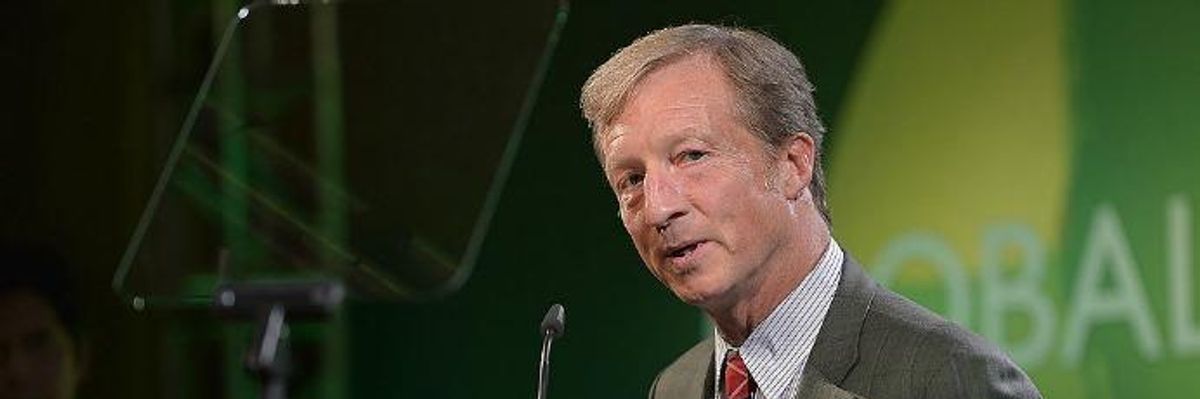
Tom Steyer speaks at Global Green USA's Millennium Awards at Fairmont Miramar Hotel on June 8, 2013 in Santa Monica, California. (Photo by Charley Gallay/Getty Images for Global Green)
As Democrats scramble to form a coherent and inspiring message for the 2018 congressional elections in the face of a historically unpopular president, billionaire Democratic mega-donor Tom Steyer argued in a recent interview that they should look no further than the platform of Sen. Bernie Sanders (I-Vt.).
"There is an absolute, unspoken war between corporate interests and the American people."
--Tom SteyerWhile he acknowledged it is "much too early to be talking about 2020," Steyer nonetheless insisted that Sanders's ambitious ideas for tackling the various crises facing the United States and the world--from climate change to staggering inequality to a dysfunctional healthcare system--offer the Democrats a blueprint for victory.
"When people say Bernie is crazy, no. Bernie is talking about inequality," Steyer said in an interview with Mic. "That is the burning issue in the United States."
Steyer, as Mic's Jake Horowitz notes, is a longtime donor to the Democratic Party, and he spent a whopping $87 million on Democratic candidates and causes in 2016.
Though he endorsed former Secretary of State Hillary Clinton in the 2016 primaries, Steyer told Mic that he has come to view Sanders's progressive platform as the necessary way forward.
"There is an absolute, unspoken war between corporate interests and the American people," he said. "That's the underlying subtext for all of the public discussions within the Democratic party. We're seeing a deliberate attempt to take away [working families'] future by really rich people. Until we address that, I don't think we're dealing with the reality Americans are facing today."
Specifically, Steyer argued that Democrats should rally around Sanders's Medicare for All proposal, which has seen a massive surge of support in recent weeks as the Republican Party attempts to dismantle the Affordable Care Act.
"The idea that we're not going to cover people is over," Steyer said, echoing the argument of progressives who have argued that single-payer is now not only possible, but inevitable.
"The question," Steyer concluded, "is how do we deliver it in the most efficient manner possible."
Steyer also referenced stagnant wages, which Sanders has long emphasized as a central factor in America's ever-worsening inequality crisis. In April, Sanders--who has not ruled out a 2020 presidential run--introduced the Raise the Wage Act, which if passed would hike the federal minimum wage to $15 an hour by 2024 and index it to inflation. The bill has garnered the support of 22 Democrats.
Echoing Sanders, Steyer argued that Democrats should focus not merely on creating jobs but also on ensuring that those jobs pay a livable wage.
"We [only] have 4.3 percent unemployment," he said. "But what we do have is a whole bunch of people who have jobs they can't live on."
"Democrats have to move from resistance to offense. Being not-Trump is not nearly enough."
--Tom Steyer
In the aftermath of the 2016 election, the Democratic Party has faced what many have deemed an identity crisis, and over a quarter of Democrats say their party "just stands against Trump."
Republicans currently have unprecedented control over nearly every level of government, and Democrats are searching for a way to cut into these gains in the 2018 congressional races.
As Common Dreams has reported, a new initiative launched by two tech billionaires--Mark Pincus, the the co-founder of Zynga, and Reid Hoffman, the co-founder of LinkedIn--will pressure the party to move rightward by adopting a stance that is both "pro-social" and "pro-business."
"I'm fearful the Democratic Party is already moving too far to the left," Pincus recently said.
Steyer argues the opposite. Democrats, he says, must embrace "a solidly progressive agenda" if they want to win back the Congress and ultimately the presidency.
"Democrats have to move from resistance to offense," Steyer concluded. "Being not-Trump is not nearly enough. We have to put forward our positive vision for the future. If we can't do that, then I don't understand the point."
Dear Common Dreams reader, It’s been nearly 30 years since I co-founded Common Dreams with my late wife, Lina Newhouser. We had the radical notion that journalism should serve the public good, not corporate profits. It was clear to us from the outset what it would take to build such a project. No paid advertisements. No corporate sponsors. No millionaire publisher telling us what to think or do. Many people said we wouldn't last a year, but we proved those doubters wrong. Together with a tremendous team of journalists and dedicated staff, we built an independent media outlet free from the constraints of profits and corporate control. Our mission has always been simple: To inform. To inspire. To ignite change for the common good. Building Common Dreams was not easy. Our survival was never guaranteed. When you take on the most powerful forces—Wall Street greed, fossil fuel industry destruction, Big Tech lobbyists, and uber-rich oligarchs who have spent billions upon billions rigging the economy and democracy in their favor—the only bulwark you have is supporters who believe in your work. But here’s the urgent message from me today. It's never been this bad out there. And it's never been this hard to keep us going. At the very moment Common Dreams is most needed, the threats we face are intensifying. We need your support now more than ever. We don't accept corporate advertising and never will. We don't have a paywall because we don't think people should be blocked from critical news based on their ability to pay. Everything we do is funded by the donations of readers like you. When everyone does the little they can afford, we are strong. But if that support retreats or dries up, so do we. Will you donate now to make sure Common Dreams not only survives but thrives? —Craig Brown, Co-founder |
As Democrats scramble to form a coherent and inspiring message for the 2018 congressional elections in the face of a historically unpopular president, billionaire Democratic mega-donor Tom Steyer argued in a recent interview that they should look no further than the platform of Sen. Bernie Sanders (I-Vt.).
"There is an absolute, unspoken war between corporate interests and the American people."
--Tom SteyerWhile he acknowledged it is "much too early to be talking about 2020," Steyer nonetheless insisted that Sanders's ambitious ideas for tackling the various crises facing the United States and the world--from climate change to staggering inequality to a dysfunctional healthcare system--offer the Democrats a blueprint for victory.
"When people say Bernie is crazy, no. Bernie is talking about inequality," Steyer said in an interview with Mic. "That is the burning issue in the United States."
Steyer, as Mic's Jake Horowitz notes, is a longtime donor to the Democratic Party, and he spent a whopping $87 million on Democratic candidates and causes in 2016.
Though he endorsed former Secretary of State Hillary Clinton in the 2016 primaries, Steyer told Mic that he has come to view Sanders's progressive platform as the necessary way forward.
"There is an absolute, unspoken war between corporate interests and the American people," he said. "That's the underlying subtext for all of the public discussions within the Democratic party. We're seeing a deliberate attempt to take away [working families'] future by really rich people. Until we address that, I don't think we're dealing with the reality Americans are facing today."
Specifically, Steyer argued that Democrats should rally around Sanders's Medicare for All proposal, which has seen a massive surge of support in recent weeks as the Republican Party attempts to dismantle the Affordable Care Act.
"The idea that we're not going to cover people is over," Steyer said, echoing the argument of progressives who have argued that single-payer is now not only possible, but inevitable.
"The question," Steyer concluded, "is how do we deliver it in the most efficient manner possible."
Steyer also referenced stagnant wages, which Sanders has long emphasized as a central factor in America's ever-worsening inequality crisis. In April, Sanders--who has not ruled out a 2020 presidential run--introduced the Raise the Wage Act, which if passed would hike the federal minimum wage to $15 an hour by 2024 and index it to inflation. The bill has garnered the support of 22 Democrats.
Echoing Sanders, Steyer argued that Democrats should focus not merely on creating jobs but also on ensuring that those jobs pay a livable wage.
"We [only] have 4.3 percent unemployment," he said. "But what we do have is a whole bunch of people who have jobs they can't live on."
"Democrats have to move from resistance to offense. Being not-Trump is not nearly enough."
--Tom Steyer
In the aftermath of the 2016 election, the Democratic Party has faced what many have deemed an identity crisis, and over a quarter of Democrats say their party "just stands against Trump."
Republicans currently have unprecedented control over nearly every level of government, and Democrats are searching for a way to cut into these gains in the 2018 congressional races.
As Common Dreams has reported, a new initiative launched by two tech billionaires--Mark Pincus, the the co-founder of Zynga, and Reid Hoffman, the co-founder of LinkedIn--will pressure the party to move rightward by adopting a stance that is both "pro-social" and "pro-business."
"I'm fearful the Democratic Party is already moving too far to the left," Pincus recently said.
Steyer argues the opposite. Democrats, he says, must embrace "a solidly progressive agenda" if they want to win back the Congress and ultimately the presidency.
"Democrats have to move from resistance to offense," Steyer concluded. "Being not-Trump is not nearly enough. We have to put forward our positive vision for the future. If we can't do that, then I don't understand the point."
As Democrats scramble to form a coherent and inspiring message for the 2018 congressional elections in the face of a historically unpopular president, billionaire Democratic mega-donor Tom Steyer argued in a recent interview that they should look no further than the platform of Sen. Bernie Sanders (I-Vt.).
"There is an absolute, unspoken war between corporate interests and the American people."
--Tom SteyerWhile he acknowledged it is "much too early to be talking about 2020," Steyer nonetheless insisted that Sanders's ambitious ideas for tackling the various crises facing the United States and the world--from climate change to staggering inequality to a dysfunctional healthcare system--offer the Democrats a blueprint for victory.
"When people say Bernie is crazy, no. Bernie is talking about inequality," Steyer said in an interview with Mic. "That is the burning issue in the United States."
Steyer, as Mic's Jake Horowitz notes, is a longtime donor to the Democratic Party, and he spent a whopping $87 million on Democratic candidates and causes in 2016.
Though he endorsed former Secretary of State Hillary Clinton in the 2016 primaries, Steyer told Mic that he has come to view Sanders's progressive platform as the necessary way forward.
"There is an absolute, unspoken war between corporate interests and the American people," he said. "That's the underlying subtext for all of the public discussions within the Democratic party. We're seeing a deliberate attempt to take away [working families'] future by really rich people. Until we address that, I don't think we're dealing with the reality Americans are facing today."
Specifically, Steyer argued that Democrats should rally around Sanders's Medicare for All proposal, which has seen a massive surge of support in recent weeks as the Republican Party attempts to dismantle the Affordable Care Act.
"The idea that we're not going to cover people is over," Steyer said, echoing the argument of progressives who have argued that single-payer is now not only possible, but inevitable.
"The question," Steyer concluded, "is how do we deliver it in the most efficient manner possible."
Steyer also referenced stagnant wages, which Sanders has long emphasized as a central factor in America's ever-worsening inequality crisis. In April, Sanders--who has not ruled out a 2020 presidential run--introduced the Raise the Wage Act, which if passed would hike the federal minimum wage to $15 an hour by 2024 and index it to inflation. The bill has garnered the support of 22 Democrats.
Echoing Sanders, Steyer argued that Democrats should focus not merely on creating jobs but also on ensuring that those jobs pay a livable wage.
"We [only] have 4.3 percent unemployment," he said. "But what we do have is a whole bunch of people who have jobs they can't live on."
"Democrats have to move from resistance to offense. Being not-Trump is not nearly enough."
--Tom Steyer
In the aftermath of the 2016 election, the Democratic Party has faced what many have deemed an identity crisis, and over a quarter of Democrats say their party "just stands against Trump."
Republicans currently have unprecedented control over nearly every level of government, and Democrats are searching for a way to cut into these gains in the 2018 congressional races.
As Common Dreams has reported, a new initiative launched by two tech billionaires--Mark Pincus, the the co-founder of Zynga, and Reid Hoffman, the co-founder of LinkedIn--will pressure the party to move rightward by adopting a stance that is both "pro-social" and "pro-business."
"I'm fearful the Democratic Party is already moving too far to the left," Pincus recently said.
Steyer argues the opposite. Democrats, he says, must embrace "a solidly progressive agenda" if they want to win back the Congress and ultimately the presidency.
"Democrats have to move from resistance to offense," Steyer concluded. "Being not-Trump is not nearly enough. We have to put forward our positive vision for the future. If we can't do that, then I don't understand the point."