
After Profiting from Weapons Sales and Bombing Yemen, U.S. Calls for Ceasefire
U.S. and U.K. call for unconditional ceasefire in Yemen conflict "within hours"
The United States, Britain, and the U.N. peace envoy to Yemen called Sunday for an unconditional ceasefire in Yemen to take place "within hours."
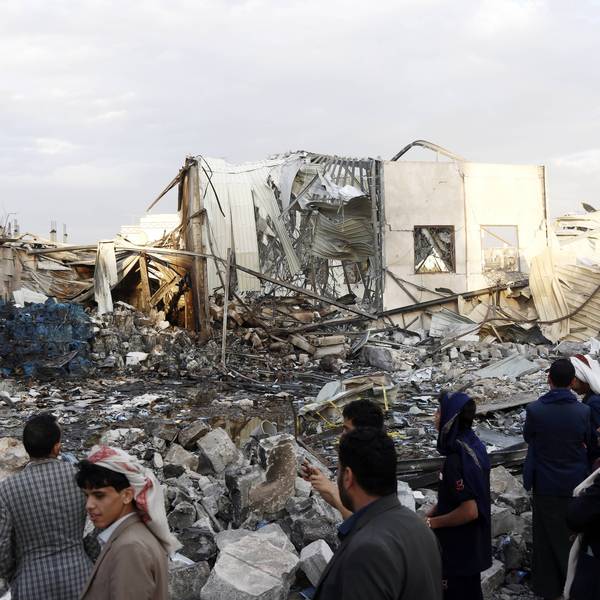
The two nations are trying "to seize on outrage caused by the killing of 140 people in a Saudi airstrike," the Guardian reports.
The newspaper describes the details of the proposed ceasefire:
The US secretary of state, John Kerry, said if Yemen's opposing sides accepted and moved forward on a ceasefire then the UN special envoy, Ismail Ould Cheikh Ahmed, would work through the details and announce when and how it would take effect.
"This is the time to implement a ceasefire unconditionally and then move to the negotiating table," Kerry said after a brief meeting with the British foreign secretary, Boris Johnson, and other officials in London. "We cannot emphasize enough today the urgency of ending the violence in Yemen."
Kerry said he, Johnson and Cheikh Ahmed were calling for the implementation of a ceasefire "as rapidly as possible, meaning Monday, Tuesday." Kerry and Johnson also met the Saudi foreign minister, Adel al-Jubeir.
The brutal Saudi-led bombing campaign against Yemen's Houthi rebels has lasted for over 18 months, and the U.S. continues to sell billions of dollars worth of weapons to Saudi Arabia despite repeated reports that the kingdom has been targeting civilian sites.
The U.S. also joined the war and bombed Yemen itself earlier this week, claiming self-defense.
Johnson's and Kerry's ceasefire call "came after meetings in London with Saudi Foreign Minister Adel al-Jubeir and senior UAE officials," Reuters reports. "Kerry met Iranian Foreign Minister Javad Zarif on Saturday in Switzerland on the sidelines of Syria talks."
Reuters quotes Kerry's statements on the ceasefire at length:
"It is a crisis now of enormous proportions with an increasing economic, increasing humanitarian and health crisis, and obviously the military components are troubling to everybody," Kerry said.
He added that the release of two American prisoners by Yemen's Houthi and the evacuation of Yemeni civilians wounded in a Saudi airstrike were "an important humanitarian gesture by the Saudis to address the humanitarian concern".
Kerry did not appear to mention the United States' most recent $1.15 billion weapons sale to Saudi Arabia, nor address the U.S. airstrikes that struck Yemen Wednesday.
The conflict in Yemen "has killed almost 6,900 people, wounded more than 35,000 and displaced at least three million since March last year, according to the United Nations," AFP notes, adding that civilians "have paid the heaviest price in an increasingly dire humanitarian crisis."
An Urgent Message From Our Co-Founder
Dear Common Dreams reader, It’s been nearly 30 years since I co-founded Common Dreams with my late wife, Lina Newhouser. We had the radical notion that journalism should serve the public good, not corporate profits. It was clear to us from the outset what it would take to build such a project. No paid advertisements. No corporate sponsors. No millionaire publisher telling us what to think or do. Many people said we wouldn't last a year, but we proved those doubters wrong. Together with a tremendous team of journalists and dedicated staff, we built an independent media outlet free from the constraints of profits and corporate control. Our mission has always been simple: To inform. To inspire. To ignite change for the common good. Building Common Dreams was not easy. Our survival was never guaranteed. When you take on the most powerful forces—Wall Street greed, fossil fuel industry destruction, Big Tech lobbyists, and uber-rich oligarchs who have spent billions upon billions rigging the economy and democracy in their favor—the only bulwark you have is supporters who believe in your work. But here’s the urgent message from me today. It's never been this bad out there. And it's never been this hard to keep us going. At the very moment Common Dreams is most needed, the threats we face are intensifying. We need your support now more than ever. We don't accept corporate advertising and never will. We don't have a paywall because we don't think people should be blocked from critical news based on their ability to pay. Everything we do is funded by the donations of readers like you. When everyone does the little they can afford, we are strong. But if that support retreats or dries up, so do we. Will you donate now to make sure Common Dreams not only survives but thrives? —Craig Brown, Co-founder |
The United States, Britain, and the U.N. peace envoy to Yemen called Sunday for an unconditional ceasefire in Yemen to take place "within hours."
The two nations are trying "to seize on outrage caused by the killing of 140 people in a Saudi airstrike," the Guardian reports.
The newspaper describes the details of the proposed ceasefire:
The US secretary of state, John Kerry, said if Yemen's opposing sides accepted and moved forward on a ceasefire then the UN special envoy, Ismail Ould Cheikh Ahmed, would work through the details and announce when and how it would take effect.
"This is the time to implement a ceasefire unconditionally and then move to the negotiating table," Kerry said after a brief meeting with the British foreign secretary, Boris Johnson, and other officials in London. "We cannot emphasize enough today the urgency of ending the violence in Yemen."
Kerry said he, Johnson and Cheikh Ahmed were calling for the implementation of a ceasefire "as rapidly as possible, meaning Monday, Tuesday." Kerry and Johnson also met the Saudi foreign minister, Adel al-Jubeir.
The brutal Saudi-led bombing campaign against Yemen's Houthi rebels has lasted for over 18 months, and the U.S. continues to sell billions of dollars worth of weapons to Saudi Arabia despite repeated reports that the kingdom has been targeting civilian sites.
The U.S. also joined the war and bombed Yemen itself earlier this week, claiming self-defense.
Johnson's and Kerry's ceasefire call "came after meetings in London with Saudi Foreign Minister Adel al-Jubeir and senior UAE officials," Reuters reports. "Kerry met Iranian Foreign Minister Javad Zarif on Saturday in Switzerland on the sidelines of Syria talks."
Reuters quotes Kerry's statements on the ceasefire at length:
"It is a crisis now of enormous proportions with an increasing economic, increasing humanitarian and health crisis, and obviously the military components are troubling to everybody," Kerry said.
He added that the release of two American prisoners by Yemen's Houthi and the evacuation of Yemeni civilians wounded in a Saudi airstrike were "an important humanitarian gesture by the Saudis to address the humanitarian concern".
Kerry did not appear to mention the United States' most recent $1.15 billion weapons sale to Saudi Arabia, nor address the U.S. airstrikes that struck Yemen Wednesday.
The conflict in Yemen "has killed almost 6,900 people, wounded more than 35,000 and displaced at least three million since March last year, according to the United Nations," AFP notes, adding that civilians "have paid the heaviest price in an increasingly dire humanitarian crisis."
The United States, Britain, and the U.N. peace envoy to Yemen called Sunday for an unconditional ceasefire in Yemen to take place "within hours."
The two nations are trying "to seize on outrage caused by the killing of 140 people in a Saudi airstrike," the Guardian reports.
The newspaper describes the details of the proposed ceasefire:
The US secretary of state, John Kerry, said if Yemen's opposing sides accepted and moved forward on a ceasefire then the UN special envoy, Ismail Ould Cheikh Ahmed, would work through the details and announce when and how it would take effect.
"This is the time to implement a ceasefire unconditionally and then move to the negotiating table," Kerry said after a brief meeting with the British foreign secretary, Boris Johnson, and other officials in London. "We cannot emphasize enough today the urgency of ending the violence in Yemen."
Kerry said he, Johnson and Cheikh Ahmed were calling for the implementation of a ceasefire "as rapidly as possible, meaning Monday, Tuesday." Kerry and Johnson also met the Saudi foreign minister, Adel al-Jubeir.
The brutal Saudi-led bombing campaign against Yemen's Houthi rebels has lasted for over 18 months, and the U.S. continues to sell billions of dollars worth of weapons to Saudi Arabia despite repeated reports that the kingdom has been targeting civilian sites.
The U.S. also joined the war and bombed Yemen itself earlier this week, claiming self-defense.
Johnson's and Kerry's ceasefire call "came after meetings in London with Saudi Foreign Minister Adel al-Jubeir and senior UAE officials," Reuters reports. "Kerry met Iranian Foreign Minister Javad Zarif on Saturday in Switzerland on the sidelines of Syria talks."
Reuters quotes Kerry's statements on the ceasefire at length:
"It is a crisis now of enormous proportions with an increasing economic, increasing humanitarian and health crisis, and obviously the military components are troubling to everybody," Kerry said.
He added that the release of two American prisoners by Yemen's Houthi and the evacuation of Yemeni civilians wounded in a Saudi airstrike were "an important humanitarian gesture by the Saudis to address the humanitarian concern".
Kerry did not appear to mention the United States' most recent $1.15 billion weapons sale to Saudi Arabia, nor address the U.S. airstrikes that struck Yemen Wednesday.
The conflict in Yemen "has killed almost 6,900 people, wounded more than 35,000 and displaced at least three million since March last year, according to the United Nations," AFP notes, adding that civilians "have paid the heaviest price in an increasingly dire humanitarian crisis."