
Congress is expected to introduce a so-called 'Fast Track' bill--which would accelerate passage of the corporate-friendly Trans-Pacific Partnership (TPP) and other trade proposals--as soon as next week.
But despite the Obama administration's aggressive push to speed approval of problematic trade pacts, opposition to Trade Promotion Authority and the deals it would advance is mounting.
Earlier this week, Sen. Elizabeth Warren (D-Mass.) penned an op-ed for the Washington Post outlining her criticism of the TPP provision known as 'Investor-State Dispute Settlement' (ISDS), which she claims would "tilt the playing field in the United States further in favor of big multinational corporations."
"This free trade agreement is another step in a global race to the bottom."
--Senator Bernie Sanders
Such provisions "would give protections to international corporations that are not available to United States environmental and labor groups," Warren stated in an interview with Politico published Friday. "Multinational corporations are increasingly realizing this is an opportunity to gut U.S. regulations they don't like."
Warren and other senators took to the chamber floor on Thursday to further voice their concern that passing Fast Track authority, which would cede the nuts and bolts of crafting trade agreements to the executive branch for at least four years, will undermine the U.S. economy.
"The talent and tenacity of American workers hasn't changed--but our leaders' commitment to them has," said Sen. Sherrod Brown (D-Ohio). "And nowhere is that abandonment more clear than the free trade agreements we now approve with little oversight and minimal debate."
Independent Sen. Bernie Sanders, of Vermont, called on Congress to "develop a new set of trade policies, which work for the ordinary American worker and not for large corporations and big campaign donors. We need to create decent-paying jobs in this country for a change and not just in other countries around the world."
He added: "This free trade agreement is another step in a global race to the bottom to boost the profits of large corporations and Wall Street by outsourcing jobs; undercutting worker rights; dismantling labor, environmental, health, food safety and financial laws; and allowing corporations to challenge our laws in international tribunals rather than our own court system."
"The Trans-Pacific Partnership (TPP) talks are stalling while the White House assures its trading partners that this secret trade agreement won't be amended when it comes back to Congress for ratification after the President signs the deal," Maira Sutton explained for EFF.
"That's why the Executive is scrambling to get its allies in Congress to pass Fast Track," she continued. "If they succeed, the U.S. Trade Representative can block remaining opportunities for the examination of the TPP's provisions by lawmakers who could ensure that this secret deal does not contain expansive copyright rules that would lock the U.S. into broken copyright rules that are already in bad need of reform."
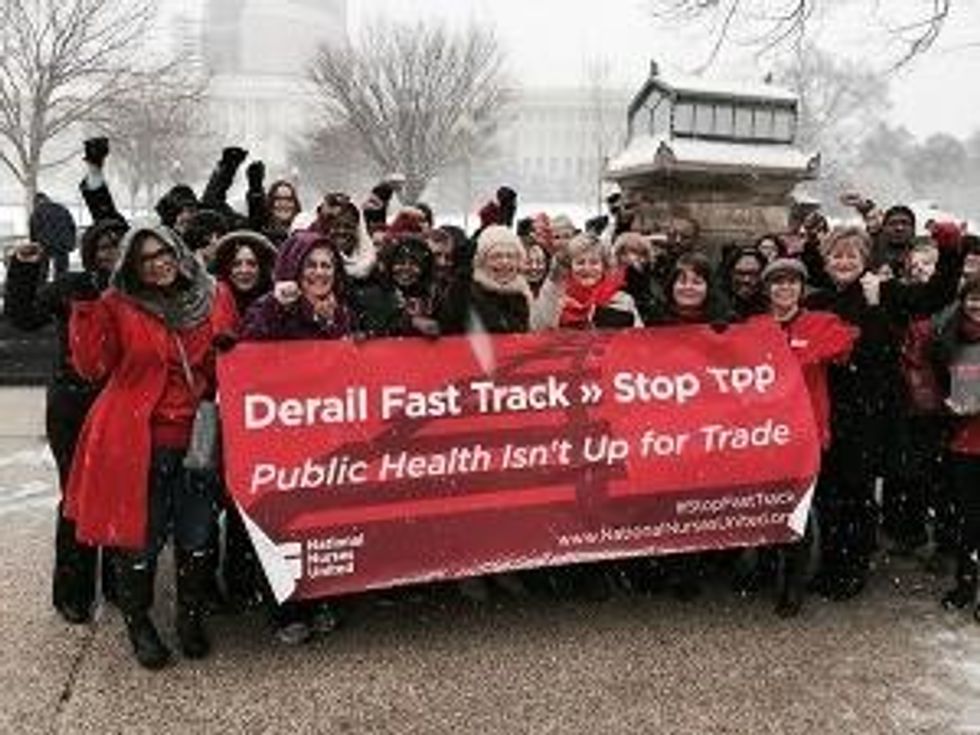
And National Nurses United held its own press conference Thursday "to sound a Code Blue on Fast Track," calling special attention to the TPP's implications for food safety, drug prices, and access to medicine.
"While there are many good reasons to reject Fast Track, the nation's registered nurses are particularly concerned about these trade agreements' threats to public health and safety," said registered nurse Deborah Burger, a member of the NNU's Council of Presidents.
In an op-ed at The Hill on Friday, North Carolina State Conference of the NAACP president Rev. William Barber, who spearheaded the Moral Monday movement, called on Congress to "slow down."
"We have learned that when these trade deals get rushed through, working people get the short end of the stick," he wrote. "The TPP reminds us of the North American and the Central American Free Trade Agreements. Most of the victims of these deals have been poor, minorities, and other members of what used to be called the 'working class'."
"The issue now is to slow down the process of ratification," he added. "The people most affected--southern workers in particular--need to have a chance to challenge the potentially transformative--and damaging--TPP."
Congress is expected to introduce a so-called 'Fast Track' bill--which would accelerate passage of the corporate-friendly Trans-Pacific Partnership (TPP) and other trade proposals--as soon as next week.
But despite the Obama administration's aggressive push to speed approval of problematic trade pacts, opposition to Trade Promotion Authority and the deals it would advance is mounting.
Earlier this week, Sen. Elizabeth Warren (D-Mass.) penned an op-ed for the Washington Post outlining her criticism of the TPP provision known as 'Investor-State Dispute Settlement' (ISDS), which she claims would "tilt the playing field in the United States further in favor of big multinational corporations."
"This free trade agreement is another step in a global race to the bottom."
--Senator Bernie Sanders
Such provisions "would give protections to international corporations that are not available to United States environmental and labor groups," Warren stated in an interview with Politico published Friday. "Multinational corporations are increasingly realizing this is an opportunity to gut U.S. regulations they don't like."
Warren and other senators took to the chamber floor on Thursday to further voice their concern that passing Fast Track authority, which would cede the nuts and bolts of crafting trade agreements to the executive branch for at least four years, will undermine the U.S. economy.
"The talent and tenacity of American workers hasn't changed--but our leaders' commitment to them has," said Sen. Sherrod Brown (D-Ohio). "And nowhere is that abandonment more clear than the free trade agreements we now approve with little oversight and minimal debate."
Independent Sen. Bernie Sanders, of Vermont, called on Congress to "develop a new set of trade policies, which work for the ordinary American worker and not for large corporations and big campaign donors. We need to create decent-paying jobs in this country for a change and not just in other countries around the world."
He added: "This free trade agreement is another step in a global race to the bottom to boost the profits of large corporations and Wall Street by outsourcing jobs; undercutting worker rights; dismantling labor, environmental, health, food safety and financial laws; and allowing corporations to challenge our laws in international tribunals rather than our own court system."
"The Trans-Pacific Partnership (TPP) talks are stalling while the White House assures its trading partners that this secret trade agreement won't be amended when it comes back to Congress for ratification after the President signs the deal," Maira Sutton explained for EFF.
"That's why the Executive is scrambling to get its allies in Congress to pass Fast Track," she continued. "If they succeed, the U.S. Trade Representative can block remaining opportunities for the examination of the TPP's provisions by lawmakers who could ensure that this secret deal does not contain expansive copyright rules that would lock the U.S. into broken copyright rules that are already in bad need of reform."
And National Nurses United held its own press conference Thursday "to sound a Code Blue on Fast Track," calling special attention to the TPP's implications for food safety, drug prices, and access to medicine.
"While there are many good reasons to reject Fast Track, the nation's registered nurses are particularly concerned about these trade agreements' threats to public health and safety," said registered nurse Deborah Burger, a member of the NNU's Council of Presidents.
In an op-ed at The Hill on Friday, North Carolina State Conference of the NAACP president Rev. William Barber, who spearheaded the Moral Monday movement, called on Congress to "slow down."
"We have learned that when these trade deals get rushed through, working people get the short end of the stick," he wrote. "The TPP reminds us of the North American and the Central American Free Trade Agreements. Most of the victims of these deals have been poor, minorities, and other members of what used to be called the 'working class'."
"The issue now is to slow down the process of ratification," he added. "The people most affected--southern workers in particular--need to have a chance to challenge the potentially transformative--and damaging--TPP."
Congress is expected to introduce a so-called 'Fast Track' bill--which would accelerate passage of the corporate-friendly Trans-Pacific Partnership (TPP) and other trade proposals--as soon as next week.
But despite the Obama administration's aggressive push to speed approval of problematic trade pacts, opposition to Trade Promotion Authority and the deals it would advance is mounting.
Earlier this week, Sen. Elizabeth Warren (D-Mass.) penned an op-ed for the Washington Post outlining her criticism of the TPP provision known as 'Investor-State Dispute Settlement' (ISDS), which she claims would "tilt the playing field in the United States further in favor of big multinational corporations."
"This free trade agreement is another step in a global race to the bottom."
--Senator Bernie Sanders
Such provisions "would give protections to international corporations that are not available to United States environmental and labor groups," Warren stated in an interview with Politico published Friday. "Multinational corporations are increasingly realizing this is an opportunity to gut U.S. regulations they don't like."
Warren and other senators took to the chamber floor on Thursday to further voice their concern that passing Fast Track authority, which would cede the nuts and bolts of crafting trade agreements to the executive branch for at least four years, will undermine the U.S. economy.
"The talent and tenacity of American workers hasn't changed--but our leaders' commitment to them has," said Sen. Sherrod Brown (D-Ohio). "And nowhere is that abandonment more clear than the free trade agreements we now approve with little oversight and minimal debate."
Independent Sen. Bernie Sanders, of Vermont, called on Congress to "develop a new set of trade policies, which work for the ordinary American worker and not for large corporations and big campaign donors. We need to create decent-paying jobs in this country for a change and not just in other countries around the world."
He added: "This free trade agreement is another step in a global race to the bottom to boost the profits of large corporations and Wall Street by outsourcing jobs; undercutting worker rights; dismantling labor, environmental, health, food safety and financial laws; and allowing corporations to challenge our laws in international tribunals rather than our own court system."
"The Trans-Pacific Partnership (TPP) talks are stalling while the White House assures its trading partners that this secret trade agreement won't be amended when it comes back to Congress for ratification after the President signs the deal," Maira Sutton explained for EFF.
"That's why the Executive is scrambling to get its allies in Congress to pass Fast Track," she continued. "If they succeed, the U.S. Trade Representative can block remaining opportunities for the examination of the TPP's provisions by lawmakers who could ensure that this secret deal does not contain expansive copyright rules that would lock the U.S. into broken copyright rules that are already in bad need of reform."
And National Nurses United held its own press conference Thursday "to sound a Code Blue on Fast Track," calling special attention to the TPP's implications for food safety, drug prices, and access to medicine.
"While there are many good reasons to reject Fast Track, the nation's registered nurses are particularly concerned about these trade agreements' threats to public health and safety," said registered nurse Deborah Burger, a member of the NNU's Council of Presidents.
In an op-ed at The Hill on Friday, North Carolina State Conference of the NAACP president Rev. William Barber, who spearheaded the Moral Monday movement, called on Congress to "slow down."
"We have learned that when these trade deals get rushed through, working people get the short end of the stick," he wrote. "The TPP reminds us of the North American and the Central American Free Trade Agreements. Most of the victims of these deals have been poor, minorities, and other members of what used to be called the 'working class'."
"The issue now is to slow down the process of ratification," he added. "The people most affected--southern workers in particular--need to have a chance to challenge the potentially transformative--and damaging--TPP."