SUBSCRIBE TO OUR FREE NEWSLETTER
Daily news & progressive opinion—funded by the people, not the corporations—delivered straight to your inbox.
5
#000000
#FFFFFF
To donate by check, phone, or other method, see our More Ways to Give page.
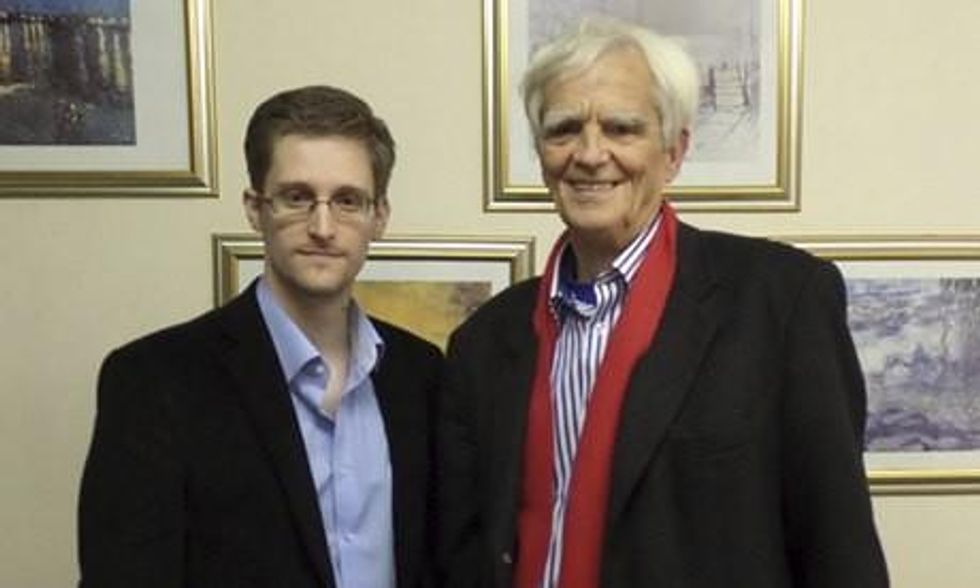
"Though the outcome of my efforts has been demonstrably positive, my government continues to treat dissent as defection, and seeks to criminalize political speech with felony charges that provide no defense. However, speaking the truth is not a crime. I am confident that with the support of the international community, the government of the United States will abandon this harmful behavior." -Edward Snowden
However, in an open letter delivered to the German government on Friday, Snowden--still living under temporary asylum in Russia--indicated he is willing to assist the investigation of alleged spying once the "difficulties" of his personal situation are resolved.
According to the Associated Press, Germany's Interior Minister Hans-Peter Friedrich, said Friday that he "will try and find a way for Edward Snowden to speak to German officials" if the whistleblower is willing and able to "provide details about the NSA's activities" concerning the alleged surveillance. How that might be accomplished remains unclear.
As the Guardian reports:
Action is under way in the Bundestag to commission a parliamentary investigation into US intelligence service spying and a German politician met Snowden in Moscow on Thursday to discuss the matter.
Hans-Christian Strobele, the veteran Green party candidate for Berlin's Kreuzberg district, reported that the US whistleblower was prepared in principle to assist a parliamentary inquiry.
But Strobele warned of the legal complications that would come with Snowden leaving Russia, where he has been granted asylum after leaking documents on mass NSA surveillance. Witnesses to parliamentary enquiries are usually given the financial support and legal protection required for them to travel to Germany.
Snowden provided Strobele with the typed letter, the full content of which follows:
To whom it may concern,
I have been invited to write to you regarding your investigation of mass surveillance.
I am Edward Joseph Snowden, formerly employed through contracts or direct hire as a technical expert for the United States National Security Agency, Central Intelligence Agency, and Defense Intelligence Agency.
In the course of my service to these organizations, I believe I witnessed systemic violations of law by my government that created a moral duty to act. As a result of reporting these concerns, I have face a severe and sustained campaign of persecution that forced me from my family and home. I am currently living in exile under a grant of temporary asylum in the Russian Federation in accordance with international law.
I am heartened by the response to my act of political expression, in both the United States and beyond. Citizens around the world as well as high officials - including in the United States - have judged the revelation of an unaccountable system of pervasive surveillance to be a public service. These spying revelations have resulted in the proposal of many new laws and policies to address formerly concealed abuses of the public trust. The benefits to society of this growing knowledge are becoming increasingly clear at the same time claimed risks are being shown to have been mitigated.
Though the outcome of my efforts has been demonstrably positive, my government continues to treat dissent as defection, and seeks to criminalize political speech with felony charges that provide no defense. However, speaking the truth is not a crime. I am confident that with the support of the international community, the government of the United States will abandon this harmful behavior. I hope that when the difficulties of this humanitarian situation have been resolved, I will be able to cooperate in the responsible finding of fact regarding reports in the media, particularly in regard to the truth and authenticity of documents, as appropriate and in accordance with the law.
I look forward to speaking with you in your country when the situation is resolved, and thank you for your efforts in upholding the international laws that protect us all.
With my best regards,
Edward Snowden
And Reuters reports that even though Snowden may like to speak with German officials or travel to Germany when opportunity allows, he indicated that he "would rather go before the U.S. Congress, or a committee of the U.S. Congress and lay the facts on the table."
For the moment, however, with a standing warrant for his arrest, Snowden is unlikely to return to the U.S. until he is offered assurances that he would face a fair hearing. Given the treatment of other whistleblowers by the Obama administation, defenders of Snowden have said it would be irresponsible and dangerous for him to return.
Norman Solomon, co-founder of the online advocacy group RootsAction, has argued that the U.S. government deserves rebuke for revoking Snowden's passport in the first place.
In an email to Common Dreams, Solomon said events this week have only underscored the importance of restoring Snowden's freedom to travel.
If his passport was reinstated, Snowden could "present vital testimony to parliament in Germany" and elsewhere.
"If any committee chair had the guts to fight for a single day of immunity from capture, he could present vital testimony to Congress in the United States," Solomon said.
"Overall," he continued, "Snowden's freedom to travel and everyone's freedom to communicate without government surveillance are closely related. The same U.S. government committed to trashing his passport is committed to making sure that no one on planet Earth can live beyond the eyes and ears of the NSA."
As of Friday, a RootsAction petition calling for Secretary of State John Kerry to reinstate the Snowden's right to travel had garnered more than 35,000 signatures.
In an op-ed that appeared in Guardian Friday morning, Harvard Law professor Yochai Benkler, who directs the Berkman Center for Internet & Society, called on members of Congress to grant Snowden amnesty for his disclosure of the NSA documents, arguing:
Congress has in its power the ability to bring home the man without whom all the abuses, errors, and oversight workarounds would have continued unchecked. Five years ago, when Congress passed the Fisa Amendments Act, the legislature included in that statute a set of provisions that immunized the telecommunications companies that cooperated with the Bush administration's warrantless wiretapping program from civil suits by citizens whose rights had been violated and from states that wanted to investigate or sanction these companies. That provision was roundly criticized by civil liberties advocates, but it does provide a legislative model for what Congress could now do to protect Snowden from criminal or civil liability arising from his disclosures.
Critics say that Snowden broke the law and should pay the price; they argue that facing the consequences is what civil disobedience requires; that is what we learned from Martin Luther King, they say. But do they really believe that ultra-segregationist Bull Connor's arrests in the civil rights era were justified?
Critics will also say that giving Snowden immunity encourages future leakers and whistleblowers to the detriment of national security. It is, however, highly unlikely that a future whistleblower or leaker will take the chance that their disclosures will so transform public attitudes that they could become the subject of a congressional amnesty. And if a precedent is indeed set, what exactly is wrong with the possibility of amnesty for people who break the law in good conscience to disclose practices that, once exposed, are outlawed or abandoned by Congress, the courts, or the executive itself?
_________________________________________
"Though the outcome of my efforts has been demonstrably positive, my government continues to treat dissent as defection, and seeks to criminalize political speech with felony charges that provide no defense. However, speaking the truth is not a crime. I am confident that with the support of the international community, the government of the United States will abandon this harmful behavior." -Edward Snowden
However, in an open letter delivered to the German government on Friday, Snowden--still living under temporary asylum in Russia--indicated he is willing to assist the investigation of alleged spying once the "difficulties" of his personal situation are resolved.
According to the Associated Press, Germany's Interior Minister Hans-Peter Friedrich, said Friday that he "will try and find a way for Edward Snowden to speak to German officials" if the whistleblower is willing and able to "provide details about the NSA's activities" concerning the alleged surveillance. How that might be accomplished remains unclear.
As the Guardian reports:
Action is under way in the Bundestag to commission a parliamentary investigation into US intelligence service spying and a German politician met Snowden in Moscow on Thursday to discuss the matter.
Hans-Christian Strobele, the veteran Green party candidate for Berlin's Kreuzberg district, reported that the US whistleblower was prepared in principle to assist a parliamentary inquiry.
But Strobele warned of the legal complications that would come with Snowden leaving Russia, where he has been granted asylum after leaking documents on mass NSA surveillance. Witnesses to parliamentary enquiries are usually given the financial support and legal protection required for them to travel to Germany.
Snowden provided Strobele with the typed letter, the full content of which follows:
To whom it may concern,
I have been invited to write to you regarding your investigation of mass surveillance.
I am Edward Joseph Snowden, formerly employed through contracts or direct hire as a technical expert for the United States National Security Agency, Central Intelligence Agency, and Defense Intelligence Agency.
In the course of my service to these organizations, I believe I witnessed systemic violations of law by my government that created a moral duty to act. As a result of reporting these concerns, I have face a severe and sustained campaign of persecution that forced me from my family and home. I am currently living in exile under a grant of temporary asylum in the Russian Federation in accordance with international law.
I am heartened by the response to my act of political expression, in both the United States and beyond. Citizens around the world as well as high officials - including in the United States - have judged the revelation of an unaccountable system of pervasive surveillance to be a public service. These spying revelations have resulted in the proposal of many new laws and policies to address formerly concealed abuses of the public trust. The benefits to society of this growing knowledge are becoming increasingly clear at the same time claimed risks are being shown to have been mitigated.
Though the outcome of my efforts has been demonstrably positive, my government continues to treat dissent as defection, and seeks to criminalize political speech with felony charges that provide no defense. However, speaking the truth is not a crime. I am confident that with the support of the international community, the government of the United States will abandon this harmful behavior. I hope that when the difficulties of this humanitarian situation have been resolved, I will be able to cooperate in the responsible finding of fact regarding reports in the media, particularly in regard to the truth and authenticity of documents, as appropriate and in accordance with the law.
I look forward to speaking with you in your country when the situation is resolved, and thank you for your efforts in upholding the international laws that protect us all.
With my best regards,
Edward Snowden
And Reuters reports that even though Snowden may like to speak with German officials or travel to Germany when opportunity allows, he indicated that he "would rather go before the U.S. Congress, or a committee of the U.S. Congress and lay the facts on the table."
For the moment, however, with a standing warrant for his arrest, Snowden is unlikely to return to the U.S. until he is offered assurances that he would face a fair hearing. Given the treatment of other whistleblowers by the Obama administation, defenders of Snowden have said it would be irresponsible and dangerous for him to return.
Norman Solomon, co-founder of the online advocacy group RootsAction, has argued that the U.S. government deserves rebuke for revoking Snowden's passport in the first place.
In an email to Common Dreams, Solomon said events this week have only underscored the importance of restoring Snowden's freedom to travel.
If his passport was reinstated, Snowden could "present vital testimony to parliament in Germany" and elsewhere.
"If any committee chair had the guts to fight for a single day of immunity from capture, he could present vital testimony to Congress in the United States," Solomon said.
"Overall," he continued, "Snowden's freedom to travel and everyone's freedom to communicate without government surveillance are closely related. The same U.S. government committed to trashing his passport is committed to making sure that no one on planet Earth can live beyond the eyes and ears of the NSA."
As of Friday, a RootsAction petition calling for Secretary of State John Kerry to reinstate the Snowden's right to travel had garnered more than 35,000 signatures.
In an op-ed that appeared in Guardian Friday morning, Harvard Law professor Yochai Benkler, who directs the Berkman Center for Internet & Society, called on members of Congress to grant Snowden amnesty for his disclosure of the NSA documents, arguing:
Congress has in its power the ability to bring home the man without whom all the abuses, errors, and oversight workarounds would have continued unchecked. Five years ago, when Congress passed the Fisa Amendments Act, the legislature included in that statute a set of provisions that immunized the telecommunications companies that cooperated with the Bush administration's warrantless wiretapping program from civil suits by citizens whose rights had been violated and from states that wanted to investigate or sanction these companies. That provision was roundly criticized by civil liberties advocates, but it does provide a legislative model for what Congress could now do to protect Snowden from criminal or civil liability arising from his disclosures.
Critics say that Snowden broke the law and should pay the price; they argue that facing the consequences is what civil disobedience requires; that is what we learned from Martin Luther King, they say. But do they really believe that ultra-segregationist Bull Connor's arrests in the civil rights era were justified?
Critics will also say that giving Snowden immunity encourages future leakers and whistleblowers to the detriment of national security. It is, however, highly unlikely that a future whistleblower or leaker will take the chance that their disclosures will so transform public attitudes that they could become the subject of a congressional amnesty. And if a precedent is indeed set, what exactly is wrong with the possibility of amnesty for people who break the law in good conscience to disclose practices that, once exposed, are outlawed or abandoned by Congress, the courts, or the executive itself?
_________________________________________
"Though the outcome of my efforts has been demonstrably positive, my government continues to treat dissent as defection, and seeks to criminalize political speech with felony charges that provide no defense. However, speaking the truth is not a crime. I am confident that with the support of the international community, the government of the United States will abandon this harmful behavior." -Edward Snowden
However, in an open letter delivered to the German government on Friday, Snowden--still living under temporary asylum in Russia--indicated he is willing to assist the investigation of alleged spying once the "difficulties" of his personal situation are resolved.
According to the Associated Press, Germany's Interior Minister Hans-Peter Friedrich, said Friday that he "will try and find a way for Edward Snowden to speak to German officials" if the whistleblower is willing and able to "provide details about the NSA's activities" concerning the alleged surveillance. How that might be accomplished remains unclear.
As the Guardian reports:
Action is under way in the Bundestag to commission a parliamentary investigation into US intelligence service spying and a German politician met Snowden in Moscow on Thursday to discuss the matter.
Hans-Christian Strobele, the veteran Green party candidate for Berlin's Kreuzberg district, reported that the US whistleblower was prepared in principle to assist a parliamentary inquiry.
But Strobele warned of the legal complications that would come with Snowden leaving Russia, where he has been granted asylum after leaking documents on mass NSA surveillance. Witnesses to parliamentary enquiries are usually given the financial support and legal protection required for them to travel to Germany.
Snowden provided Strobele with the typed letter, the full content of which follows:
To whom it may concern,
I have been invited to write to you regarding your investigation of mass surveillance.
I am Edward Joseph Snowden, formerly employed through contracts or direct hire as a technical expert for the United States National Security Agency, Central Intelligence Agency, and Defense Intelligence Agency.
In the course of my service to these organizations, I believe I witnessed systemic violations of law by my government that created a moral duty to act. As a result of reporting these concerns, I have face a severe and sustained campaign of persecution that forced me from my family and home. I am currently living in exile under a grant of temporary asylum in the Russian Federation in accordance with international law.
I am heartened by the response to my act of political expression, in both the United States and beyond. Citizens around the world as well as high officials - including in the United States - have judged the revelation of an unaccountable system of pervasive surveillance to be a public service. These spying revelations have resulted in the proposal of many new laws and policies to address formerly concealed abuses of the public trust. The benefits to society of this growing knowledge are becoming increasingly clear at the same time claimed risks are being shown to have been mitigated.
Though the outcome of my efforts has been demonstrably positive, my government continues to treat dissent as defection, and seeks to criminalize political speech with felony charges that provide no defense. However, speaking the truth is not a crime. I am confident that with the support of the international community, the government of the United States will abandon this harmful behavior. I hope that when the difficulties of this humanitarian situation have been resolved, I will be able to cooperate in the responsible finding of fact regarding reports in the media, particularly in regard to the truth and authenticity of documents, as appropriate and in accordance with the law.
I look forward to speaking with you in your country when the situation is resolved, and thank you for your efforts in upholding the international laws that protect us all.
With my best regards,
Edward Snowden
And Reuters reports that even though Snowden may like to speak with German officials or travel to Germany when opportunity allows, he indicated that he "would rather go before the U.S. Congress, or a committee of the U.S. Congress and lay the facts on the table."
For the moment, however, with a standing warrant for his arrest, Snowden is unlikely to return to the U.S. until he is offered assurances that he would face a fair hearing. Given the treatment of other whistleblowers by the Obama administation, defenders of Snowden have said it would be irresponsible and dangerous for him to return.
Norman Solomon, co-founder of the online advocacy group RootsAction, has argued that the U.S. government deserves rebuke for revoking Snowden's passport in the first place.
In an email to Common Dreams, Solomon said events this week have only underscored the importance of restoring Snowden's freedom to travel.
If his passport was reinstated, Snowden could "present vital testimony to parliament in Germany" and elsewhere.
"If any committee chair had the guts to fight for a single day of immunity from capture, he could present vital testimony to Congress in the United States," Solomon said.
"Overall," he continued, "Snowden's freedom to travel and everyone's freedom to communicate without government surveillance are closely related. The same U.S. government committed to trashing his passport is committed to making sure that no one on planet Earth can live beyond the eyes and ears of the NSA."
As of Friday, a RootsAction petition calling for Secretary of State John Kerry to reinstate the Snowden's right to travel had garnered more than 35,000 signatures.
In an op-ed that appeared in Guardian Friday morning, Harvard Law professor Yochai Benkler, who directs the Berkman Center for Internet & Society, called on members of Congress to grant Snowden amnesty for his disclosure of the NSA documents, arguing:
Congress has in its power the ability to bring home the man without whom all the abuses, errors, and oversight workarounds would have continued unchecked. Five years ago, when Congress passed the Fisa Amendments Act, the legislature included in that statute a set of provisions that immunized the telecommunications companies that cooperated with the Bush administration's warrantless wiretapping program from civil suits by citizens whose rights had been violated and from states that wanted to investigate or sanction these companies. That provision was roundly criticized by civil liberties advocates, but it does provide a legislative model for what Congress could now do to protect Snowden from criminal or civil liability arising from his disclosures.
Critics say that Snowden broke the law and should pay the price; they argue that facing the consequences is what civil disobedience requires; that is what we learned from Martin Luther King, they say. But do they really believe that ultra-segregationist Bull Connor's arrests in the civil rights era were justified?
Critics will also say that giving Snowden immunity encourages future leakers and whistleblowers to the detriment of national security. It is, however, highly unlikely that a future whistleblower or leaker will take the chance that their disclosures will so transform public attitudes that they could become the subject of a congressional amnesty. And if a precedent is indeed set, what exactly is wrong with the possibility of amnesty for people who break the law in good conscience to disclose practices that, once exposed, are outlawed or abandoned by Congress, the courts, or the executive itself?
_________________________________________