

SUBSCRIBE TO OUR FREE NEWSLETTER
Daily news & progressive opinion—funded by the people, not the corporations—delivered straight to your inbox.
5
#000000
#FFFFFF
To donate by check, phone, or other method, see our More Ways to Give page.
The Chinese government declared in a pre-G20 briefing that it joins Russia--host of the summit--in standing against proposed military strikes. Chinese deputy finance minister Zhu Guangyao declared, "Military action would have a negative impact on the global economy, especially on oil prices - it will cause a hike in the oil price."
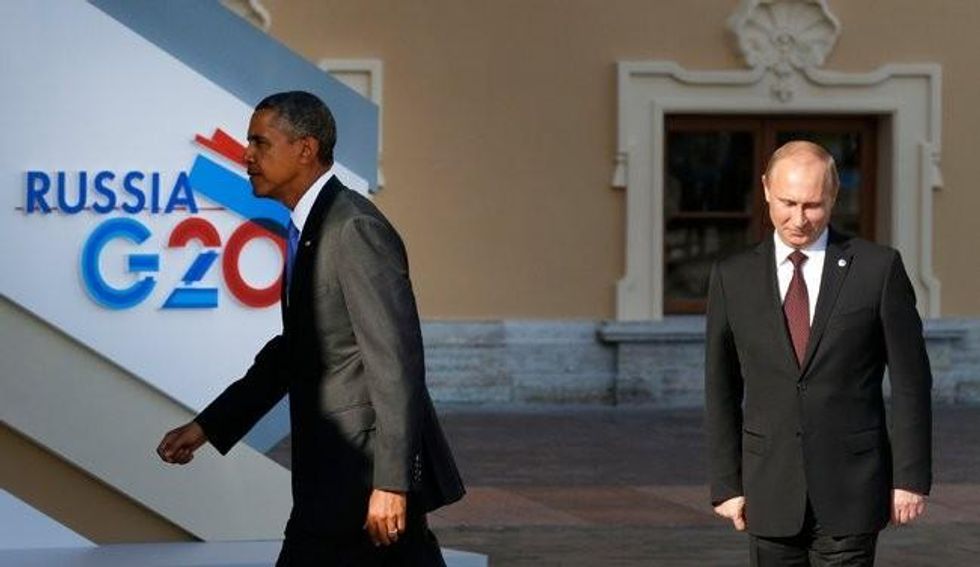
Meanwhile, the rift between Obama and Russian President Vladimir Putin appears to be growing, after Putin escalated language opposing strikes Wednesday, levying charges that U.S. Secretary of State John Kerry "is lying and knows he is lying," and Russian government officials announced a 100-page report they claim shows that the opposition against President Bashar al-Assad carried out chemical weapons attacks earlier this year.
Catholic church head Pope Francis wrote a personal letter to Putin, ahead of the G20 meetings, making a "heartfelt appeal" to world leaders to prevent the "futile pursuit of a military solution."
While France, Turkey and Saudi Arabia stand behind U.S.-led strikes, President Obama otherwise grows increasingly isolated in his sprint towards war, following the British parliament's rejection of military intervention.
Obama has already set to work to sell the intervention to hesitant allies, including a Thursday meeting with Japanese Prime Minister Shinzo Abe, who has so far refrained from sharing publicly his position on military intervention. Obama will meet with President Francois Hollande of France and President Xi Jinping of China in coming days.
Benjamin J. Rhodes, the president's deputy national security adviser, told reporters on Air Force One as they traveled to Russia, "We would not anticipate every member of the G20 agreeing about the way forward in Syria, particularly given the Russian position," the New York Times reports
Meanwhile, an overwhelming majority of people in the U.S. are against military strikes on Syria, according to all major polls, and neither Congress nor the Senate have officially approved attacks.
_____________________
The Chinese government declared in a pre-G20 briefing that it joins Russia--host of the summit--in standing against proposed military strikes. Chinese deputy finance minister Zhu Guangyao declared, "Military action would have a negative impact on the global economy, especially on oil prices - it will cause a hike in the oil price."
Meanwhile, the rift between Obama and Russian President Vladimir Putin appears to be growing, after Putin escalated language opposing strikes Wednesday, levying charges that U.S. Secretary of State John Kerry "is lying and knows he is lying," and Russian government officials announced a 100-page report they claim shows that the opposition against President Bashar al-Assad carried out chemical weapons attacks earlier this year.
Catholic church head Pope Francis wrote a personal letter to Putin, ahead of the G20 meetings, making a "heartfelt appeal" to world leaders to prevent the "futile pursuit of a military solution."
While France, Turkey and Saudi Arabia stand behind U.S.-led strikes, President Obama otherwise grows increasingly isolated in his sprint towards war, following the British parliament's rejection of military intervention.
Obama has already set to work to sell the intervention to hesitant allies, including a Thursday meeting with Japanese Prime Minister Shinzo Abe, who has so far refrained from sharing publicly his position on military intervention. Obama will meet with President Francois Hollande of France and President Xi Jinping of China in coming days.
Benjamin J. Rhodes, the president's deputy national security adviser, told reporters on Air Force One as they traveled to Russia, "We would not anticipate every member of the G20 agreeing about the way forward in Syria, particularly given the Russian position," the New York Times reports
Meanwhile, an overwhelming majority of people in the U.S. are against military strikes on Syria, according to all major polls, and neither Congress nor the Senate have officially approved attacks.
_____________________
The Chinese government declared in a pre-G20 briefing that it joins Russia--host of the summit--in standing against proposed military strikes. Chinese deputy finance minister Zhu Guangyao declared, "Military action would have a negative impact on the global economy, especially on oil prices - it will cause a hike in the oil price."
Meanwhile, the rift between Obama and Russian President Vladimir Putin appears to be growing, after Putin escalated language opposing strikes Wednesday, levying charges that U.S. Secretary of State John Kerry "is lying and knows he is lying," and Russian government officials announced a 100-page report they claim shows that the opposition against President Bashar al-Assad carried out chemical weapons attacks earlier this year.
Catholic church head Pope Francis wrote a personal letter to Putin, ahead of the G20 meetings, making a "heartfelt appeal" to world leaders to prevent the "futile pursuit of a military solution."
While France, Turkey and Saudi Arabia stand behind U.S.-led strikes, President Obama otherwise grows increasingly isolated in his sprint towards war, following the British parliament's rejection of military intervention.
Obama has already set to work to sell the intervention to hesitant allies, including a Thursday meeting with Japanese Prime Minister Shinzo Abe, who has so far refrained from sharing publicly his position on military intervention. Obama will meet with President Francois Hollande of France and President Xi Jinping of China in coming days.
Benjamin J. Rhodes, the president's deputy national security adviser, told reporters on Air Force One as they traveled to Russia, "We would not anticipate every member of the G20 agreeing about the way forward in Syria, particularly given the Russian position," the New York Times reports
Meanwhile, an overwhelming majority of people in the U.S. are against military strikes on Syria, according to all major polls, and neither Congress nor the Senate have officially approved attacks.
_____________________

