

SUBSCRIBE TO OUR FREE NEWSLETTER
Daily news & progressive opinion—funded by the people, not the corporations—delivered straight to your inbox.
5
#000000
#FFFFFF
To donate by check, phone, or other method, see our More Ways to Give page.
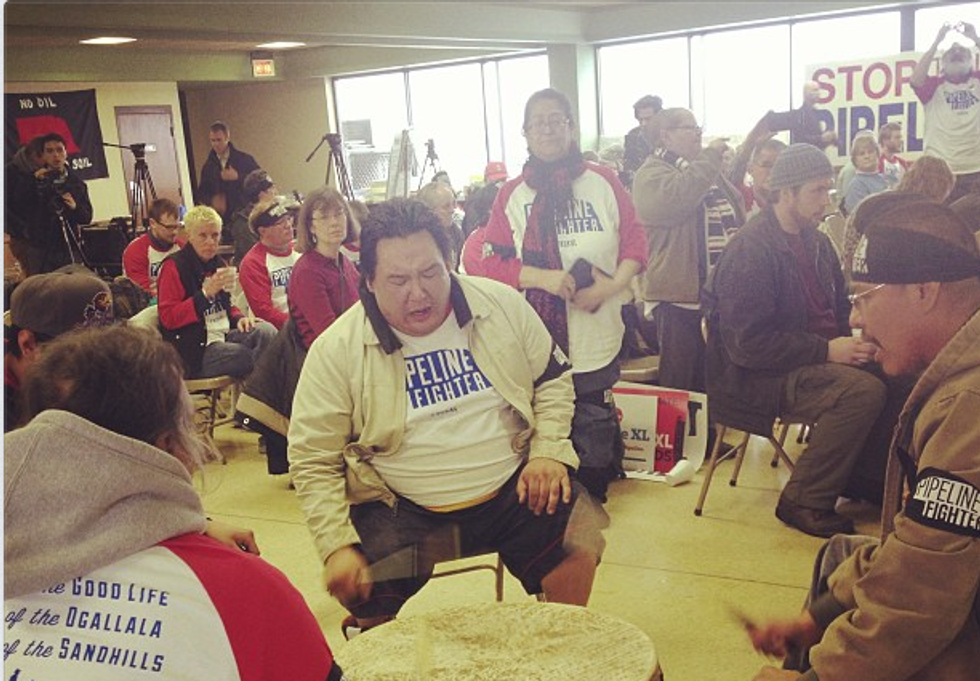
During the hearing, which will be held in the town of Grand Island in the environmentally sensitive Sand Hills region, the State Department will hear testimonies from both sides of the debate in two sessions set for noon-3:30 pm. and 4-8 p.m (CST). The public forum comes as the State Department prepares a recommendation to President Obama on whether to approve the project or not.
In an New York Times op-ed published Wednesday, Nebraskan Mary Pipher--calling the pipeline the "Keystone Extra Leaky"--says that the proposed construction has rallied the otherwise "polite" and "cautious" Nebraskans into a coalition of "newly minted activists."
She writes:
Many of our citizens had seen their parents or grandparents struggle to hold on to family land, and they weren't about to give up their rights without a fight. Our government wasn't helping, so they realized they needed to save themselves. Our citizen engagement arose from feelings of powerlessness. TransCanada had access to our legislators and the governor, but ordinary citizens, doing what we had been taught to do in our civics books, like writing or talking to our legislators, had virtually no impact. We had to create new ways to influence our politicians.
We became a state of ordinary heroes who decided that money couldn't buy everything and that some things were sacred.
The great global skirmishes of this century will be fought over food, energy, water and dirt. Our remote, conservative, flyover state seems like an odd place to make a stand for clean water and fertile land, but we will be at the heart of those battles. We are fighting not only for ourselves but for people all over the world. And we know that everywhere, in their particular places, people are fighting for us. The campaign to stop the Keystone XL is not over. It won't be over until we give up, and we aren't giving up.
Among those who plan to speak against the pipeline are Nebraska rancher Randy Thompson, chair of the "All Risk, No Reward" campaign which launched a series of anti-pipeline ad campaigns ahead of the hearing.
"We do believe that we can stop the pipeline," said Jane Kleeb, director of the local advocacy group Bold Nebraska.
Tweets about "from:janekleeb OR from:boldnebraska OR from:uneditedcamera"
Shannon Graves, of a fourth generation farming family in Bradshaw, Nebraska, is another vocal opponent of the pipeline which she describes as "a great big scar right down the center" of the United States. Graves told the Lincoln Journal Star that when she saw Transcanada planting their stakes near her family property, "it got a little scary." She adds, "You look at Mayflower, Arkansas, and a 22-foot gash in a much smaller pipeline and the damage that did in that cul-de-sac."
The hearing comes ahead of a decision by President Obama and the State Department as to whether or not to authorize the construction of Transcanada's pipeline, which would pump 1.4 million barrels per day of the "dirtiest fuel on the planet" from Alberta, Canada over Nebraska's Ogallala Aquifer on to the Gulf of Mexico.
The public comments follow the February release of a "laughable" and "deeply flawed" draft of an environmental impact statement by the State Department that reasoned that despite the estimated 17 percent more greenhouse gases produced by the extraction and use of tar sands oil, the pipeline would not result in increased emissions because Canada would simply sell the oil someplace else.
Subsequent reports have slammed the draft.
_____________________
During the hearing, which will be held in the town of Grand Island in the environmentally sensitive Sand Hills region, the State Department will hear testimonies from both sides of the debate in two sessions set for noon-3:30 pm. and 4-8 p.m (CST). The public forum comes as the State Department prepares a recommendation to President Obama on whether to approve the project or not.
In an New York Times op-ed published Wednesday, Nebraskan Mary Pipher--calling the pipeline the "Keystone Extra Leaky"--says that the proposed construction has rallied the otherwise "polite" and "cautious" Nebraskans into a coalition of "newly minted activists."
She writes:
Many of our citizens had seen their parents or grandparents struggle to hold on to family land, and they weren't about to give up their rights without a fight. Our government wasn't helping, so they realized they needed to save themselves. Our citizen engagement arose from feelings of powerlessness. TransCanada had access to our legislators and the governor, but ordinary citizens, doing what we had been taught to do in our civics books, like writing or talking to our legislators, had virtually no impact. We had to create new ways to influence our politicians.
We became a state of ordinary heroes who decided that money couldn't buy everything and that some things were sacred.
The great global skirmishes of this century will be fought over food, energy, water and dirt. Our remote, conservative, flyover state seems like an odd place to make a stand for clean water and fertile land, but we will be at the heart of those battles. We are fighting not only for ourselves but for people all over the world. And we know that everywhere, in their particular places, people are fighting for us. The campaign to stop the Keystone XL is not over. It won't be over until we give up, and we aren't giving up.
Among those who plan to speak against the pipeline are Nebraska rancher Randy Thompson, chair of the "All Risk, No Reward" campaign which launched a series of anti-pipeline ad campaigns ahead of the hearing.
"We do believe that we can stop the pipeline," said Jane Kleeb, director of the local advocacy group Bold Nebraska.
Tweets about "from:janekleeb OR from:boldnebraska OR from:uneditedcamera"
Shannon Graves, of a fourth generation farming family in Bradshaw, Nebraska, is another vocal opponent of the pipeline which she describes as "a great big scar right down the center" of the United States. Graves told the Lincoln Journal Star that when she saw Transcanada planting their stakes near her family property, "it got a little scary." She adds, "You look at Mayflower, Arkansas, and a 22-foot gash in a much smaller pipeline and the damage that did in that cul-de-sac."
The hearing comes ahead of a decision by President Obama and the State Department as to whether or not to authorize the construction of Transcanada's pipeline, which would pump 1.4 million barrels per day of the "dirtiest fuel on the planet" from Alberta, Canada over Nebraska's Ogallala Aquifer on to the Gulf of Mexico.
The public comments follow the February release of a "laughable" and "deeply flawed" draft of an environmental impact statement by the State Department that reasoned that despite the estimated 17 percent more greenhouse gases produced by the extraction and use of tar sands oil, the pipeline would not result in increased emissions because Canada would simply sell the oil someplace else.
Subsequent reports have slammed the draft.
_____________________
During the hearing, which will be held in the town of Grand Island in the environmentally sensitive Sand Hills region, the State Department will hear testimonies from both sides of the debate in two sessions set for noon-3:30 pm. and 4-8 p.m (CST). The public forum comes as the State Department prepares a recommendation to President Obama on whether to approve the project or not.
In an New York Times op-ed published Wednesday, Nebraskan Mary Pipher--calling the pipeline the "Keystone Extra Leaky"--says that the proposed construction has rallied the otherwise "polite" and "cautious" Nebraskans into a coalition of "newly minted activists."
She writes:
Many of our citizens had seen their parents or grandparents struggle to hold on to family land, and they weren't about to give up their rights without a fight. Our government wasn't helping, so they realized they needed to save themselves. Our citizen engagement arose from feelings of powerlessness. TransCanada had access to our legislators and the governor, but ordinary citizens, doing what we had been taught to do in our civics books, like writing or talking to our legislators, had virtually no impact. We had to create new ways to influence our politicians.
We became a state of ordinary heroes who decided that money couldn't buy everything and that some things were sacred.
The great global skirmishes of this century will be fought over food, energy, water and dirt. Our remote, conservative, flyover state seems like an odd place to make a stand for clean water and fertile land, but we will be at the heart of those battles. We are fighting not only for ourselves but for people all over the world. And we know that everywhere, in their particular places, people are fighting for us. The campaign to stop the Keystone XL is not over. It won't be over until we give up, and we aren't giving up.
Among those who plan to speak against the pipeline are Nebraska rancher Randy Thompson, chair of the "All Risk, No Reward" campaign which launched a series of anti-pipeline ad campaigns ahead of the hearing.
"We do believe that we can stop the pipeline," said Jane Kleeb, director of the local advocacy group Bold Nebraska.
Tweets about "from:janekleeb OR from:boldnebraska OR from:uneditedcamera"
Shannon Graves, of a fourth generation farming family in Bradshaw, Nebraska, is another vocal opponent of the pipeline which she describes as "a great big scar right down the center" of the United States. Graves told the Lincoln Journal Star that when she saw Transcanada planting their stakes near her family property, "it got a little scary." She adds, "You look at Mayflower, Arkansas, and a 22-foot gash in a much smaller pipeline and the damage that did in that cul-de-sac."
The hearing comes ahead of a decision by President Obama and the State Department as to whether or not to authorize the construction of Transcanada's pipeline, which would pump 1.4 million barrels per day of the "dirtiest fuel on the planet" from Alberta, Canada over Nebraska's Ogallala Aquifer on to the Gulf of Mexico.
The public comments follow the February release of a "laughable" and "deeply flawed" draft of an environmental impact statement by the State Department that reasoned that despite the estimated 17 percent more greenhouse gases produced by the extraction and use of tar sands oil, the pipeline would not result in increased emissions because Canada would simply sell the oil someplace else.
Subsequent reports have slammed the draft.
_____________________

