SUBSCRIBE TO OUR FREE NEWSLETTER
Daily news & progressive opinion—funded by the people, not the corporations—delivered straight to your inbox.
5
#000000
#FFFFFF
To donate by check, phone, or other method, see our More Ways to Give page.
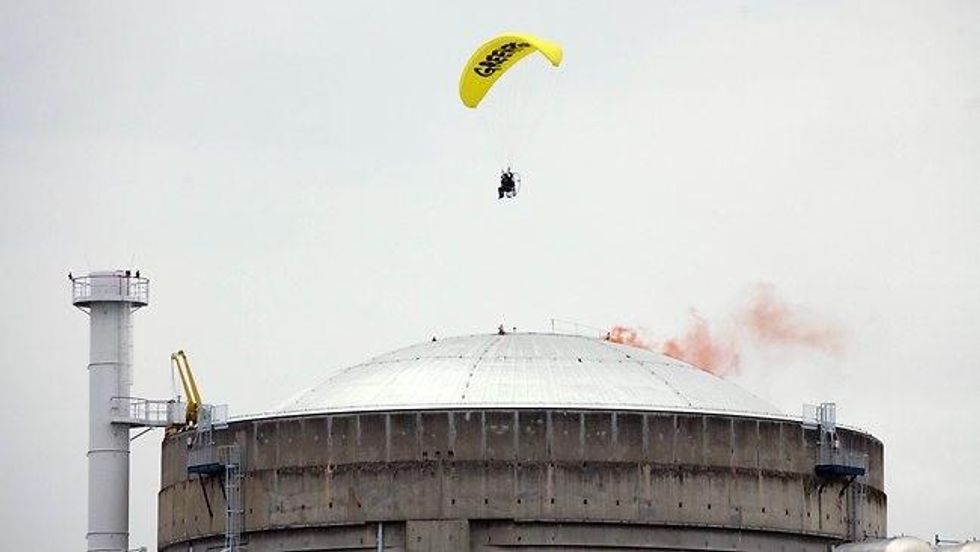
"The purpose of this action is to send a message to the two candidates in the [French] presidential election who are denying the risk of nuclear power," Greenpeace spokeswoman Sophia Majnoni told AFP. "We wanted to illustrate an external danger, like a fall of an airplane" into a nuclear plant, she said.
* * *
Agence France-Presse reports:
"A Greenpeace activist arrived with a motorised paraglider around 7:40 am (0540 GMT). He flew over the plant, threw a smoke bomb and landed inside, where he was detained," police near the Bugey plant in southeastern France told AFP.
The environmental activist group said the action was aimed at the two men vying for the French presidency in a run-off vote Sunday -- President Nicolas Sarkozy and his Socialist rival and opinion poll frontrunner Francois Hollande.
* * *
Reuters reports:
EDF confirmed that an engine-powered paraglider had landed within its Bugey nuclear site in southeastern France but said that it had remained outside the reactor building. The pilot was caught by the police in charge of protecting the site.
"At no moment was the safety of the installations at risk," EDF said in a statement.
France's dependence on nuclear energy has been much debated before the election campaign. France is more dependent on nuclear energy than any other country, relying on it to produce 75 percent of its electricity.
"This overflight shows the vulnerability of the French nuclear site to an air attack. While Germany took account of a plane crash in its safety tests, France still refuses to analyze this risk for our reactors," Sophia Majnoni d'Intignano, in charge of nuclear questions at Greenpeace, said in a statement.
In December, Greenpeace had carried out a similar action when activists entered the Nogent-sur-Seine plant near Paris, climbing onto one of the domes that houses a reactor, while other activists entered other nuclear installations.
Socialist presidential candidate Francois Hollande, who said he would shut France's oldest nuclear plant if elected, said he awaited further information before commenting.
Hollande softened his stance on nuclear after a pre-electoral pact by the Socialists and the Green party included shutting 24 nuclear reactors by 2025. Hollande said he would only pick what he viewed as priority issues in this deal.
After the Fukushima disaster in March 2011, France along with other European countries, decided to carry out safety tests on its 58 nuclear reactors to test their capacity to resist flooding, earthquakes, power outages, failure of the cooling systems and operational management of accidents.
But those did not include terrorist attacks, or the possibility of a plane crash.
# # #
"The purpose of this action is to send a message to the two candidates in the [French] presidential election who are denying the risk of nuclear power," Greenpeace spokeswoman Sophia Majnoni told AFP. "We wanted to illustrate an external danger, like a fall of an airplane" into a nuclear plant, she said.
* * *
Agence France-Presse reports:
"A Greenpeace activist arrived with a motorised paraglider around 7:40 am (0540 GMT). He flew over the plant, threw a smoke bomb and landed inside, where he was detained," police near the Bugey plant in southeastern France told AFP.
The environmental activist group said the action was aimed at the two men vying for the French presidency in a run-off vote Sunday -- President Nicolas Sarkozy and his Socialist rival and opinion poll frontrunner Francois Hollande.
* * *
Reuters reports:
EDF confirmed that an engine-powered paraglider had landed within its Bugey nuclear site in southeastern France but said that it had remained outside the reactor building. The pilot was caught by the police in charge of protecting the site.
"At no moment was the safety of the installations at risk," EDF said in a statement.
France's dependence on nuclear energy has been much debated before the election campaign. France is more dependent on nuclear energy than any other country, relying on it to produce 75 percent of its electricity.
"This overflight shows the vulnerability of the French nuclear site to an air attack. While Germany took account of a plane crash in its safety tests, France still refuses to analyze this risk for our reactors," Sophia Majnoni d'Intignano, in charge of nuclear questions at Greenpeace, said in a statement.
In December, Greenpeace had carried out a similar action when activists entered the Nogent-sur-Seine plant near Paris, climbing onto one of the domes that houses a reactor, while other activists entered other nuclear installations.
Socialist presidential candidate Francois Hollande, who said he would shut France's oldest nuclear plant if elected, said he awaited further information before commenting.
Hollande softened his stance on nuclear after a pre-electoral pact by the Socialists and the Green party included shutting 24 nuclear reactors by 2025. Hollande said he would only pick what he viewed as priority issues in this deal.
After the Fukushima disaster in March 2011, France along with other European countries, decided to carry out safety tests on its 58 nuclear reactors to test their capacity to resist flooding, earthquakes, power outages, failure of the cooling systems and operational management of accidents.
But those did not include terrorist attacks, or the possibility of a plane crash.
# # #
"The purpose of this action is to send a message to the two candidates in the [French] presidential election who are denying the risk of nuclear power," Greenpeace spokeswoman Sophia Majnoni told AFP. "We wanted to illustrate an external danger, like a fall of an airplane" into a nuclear plant, she said.
* * *
Agence France-Presse reports:
"A Greenpeace activist arrived with a motorised paraglider around 7:40 am (0540 GMT). He flew over the plant, threw a smoke bomb and landed inside, where he was detained," police near the Bugey plant in southeastern France told AFP.
The environmental activist group said the action was aimed at the two men vying for the French presidency in a run-off vote Sunday -- President Nicolas Sarkozy and his Socialist rival and opinion poll frontrunner Francois Hollande.
* * *
Reuters reports:
EDF confirmed that an engine-powered paraglider had landed within its Bugey nuclear site in southeastern France but said that it had remained outside the reactor building. The pilot was caught by the police in charge of protecting the site.
"At no moment was the safety of the installations at risk," EDF said in a statement.
France's dependence on nuclear energy has been much debated before the election campaign. France is more dependent on nuclear energy than any other country, relying on it to produce 75 percent of its electricity.
"This overflight shows the vulnerability of the French nuclear site to an air attack. While Germany took account of a plane crash in its safety tests, France still refuses to analyze this risk for our reactors," Sophia Majnoni d'Intignano, in charge of nuclear questions at Greenpeace, said in a statement.
In December, Greenpeace had carried out a similar action when activists entered the Nogent-sur-Seine plant near Paris, climbing onto one of the domes that houses a reactor, while other activists entered other nuclear installations.
Socialist presidential candidate Francois Hollande, who said he would shut France's oldest nuclear plant if elected, said he awaited further information before commenting.
Hollande softened his stance on nuclear after a pre-electoral pact by the Socialists and the Green party included shutting 24 nuclear reactors by 2025. Hollande said he would only pick what he viewed as priority issues in this deal.
After the Fukushima disaster in March 2011, France along with other European countries, decided to carry out safety tests on its 58 nuclear reactors to test their capacity to resist flooding, earthquakes, power outages, failure of the cooling systems and operational management of accidents.
But those did not include terrorist attacks, or the possibility of a plane crash.
# # #