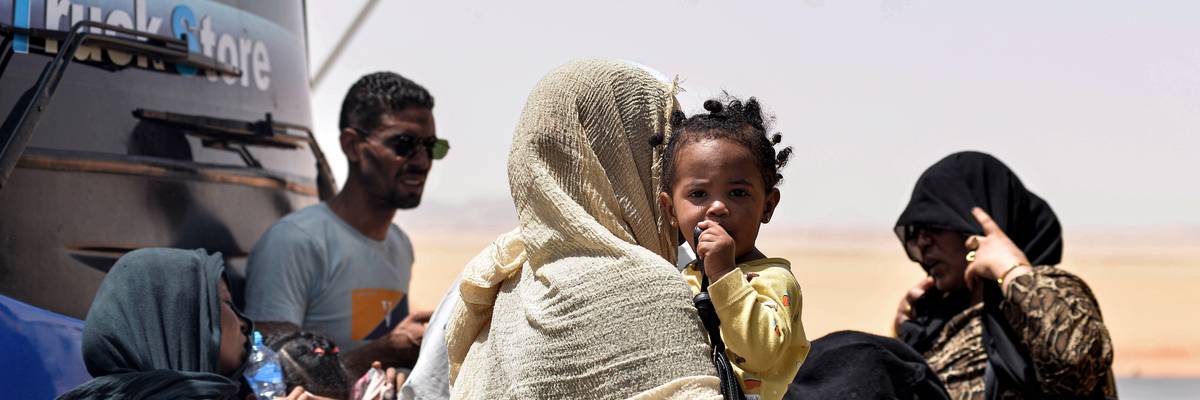
Sudanese refugees enter Egypt through the Argeen border crossing to escape the conflict in their home country on April 27, 2023.
110 Million Now Forcibly Displaced as War, Climate Crisis Wreak Global Havoc
"The 46 least developed countries account for less than 1.3% of global gross domestic product, yet they hosted more than 20% of all refugees," a new report by the United Nations shows.
The United Nations refugee agency on Wednesday released its annual report on forcible displacement across the globe, revealing that the refugee population has hit a new record of 110 million people who have been driven from their homes due largely to violent conflicts and climate-related disasters—with the numbers showing the crisis is rapidly intensifying with each passing year.
At the end of 2022, more than 108 million people were living as refugees—up nearly 20 million from the previous year, according to the report, Global Trends in Forced Displacement 2022.
The recently erupted conflict in Sudan has pushed millions more people out of their homes this year, bringing the mid-year total to 110 million.
More than 32.5 million people have also been displaced by disasters, including those caused by the climate crisis, and 21% of those refugees have left their homes in the world's least developed countries and small island nations.
Dominique Hyde, director of external relations for the U.N. High Commissioner for Refugees (UNHCR), said the agency's report marks "a world record that no one wants to celebrate."
The majority of people—58%—who have been forcibly pushed out of their homes have gone elsewhere in their own countries. More than 35 million people have fled their home countries to find refuge from conflicts, persecution, and the effects of planetary heating, including drought and flooding.
The war in Ukraine has caused the fastest growth in refugee numbers since World War II and was the main driver of displacement in 2022, with 5.7 million people having fled the country by the end of last year.
Violence in Ethiopia, the Democratic Republic of the Congo, and Myanmar have also displaced more than one million people each, as vulnerable residents fled to safety within their own countries.
In Somalia, an extreme drought that began in January 2021 has now displaced one million people. The drought has been linked to the climate crisis and the food shortage it's caused has been exacerbated by the war between Russia and Ukraine, which collectively used to provide Somalia with 90% of its wheat.
"This one-million milestone serves as a massive alarm bell," said Mohamed Abdi, the Norwegian Refugee Council's (NRC) director in Somalia. "Starvation is now haunting the entire country."
More than three-quarters of refugees are hosted in low- and middle-income countries.
"The 46 least developed countries account for less than 1.3% of global gross domestic product, yet they hosted more than 20% of all refugees," said the UNHCR.
Iran is currently hosting 3.4 million refugees, including many from Afghanistan. Colombia and Peru have also welcomed millions of Venezuelan refugees, while countries including the United States have enacted policies in recent months making it more difficult for people fleeing persecution and conflict to find refuge there.
"We see increasingly a reluctance on the part of states to fully adhere to the principles of the [1951 refugee] convention, even states that have signed it," Filippo Grandi, the high commissioner for refugees at the U.N., told Reuters.
The record-breaking number of international refugees shows that policymakers "are far too quick to rush to conflict, and way too slow to find solutions," said Grandi in a statement.
"The consequence is devastation, displacement, and anguish for each of the millions of people forcibly uprooted from their homes," he added.
The agency noted that the refugee crisis has exploded in the past decade after roughly 20 years of relatively stable numbers that hovered around 40 million people worldwide prior to the conflict in Syria that began in 2011. Now, more than one in every 74 people is displaced.
Hyde noted in a column at Reuters that there are solutions that would help mitigate the refugee crisis, both by allowing people to stay safely in their homes and ensuring they are given support in host countries.
"When refugees are included in national systems and given opportunities to study and work, they move out of a state of dependency to one of self-reliance, contributing to local economies to the benefit of themselves and their hosts," wrote Hyde. "If host countries were given proper support on job creation, educational provision, technology, climate change mitigation, healthcare, and more, both the displaced and local communities would benefit."
"We have also seen refugees and IDPs [internally displaced people] return home when the conditions are right," she added. "During 2022, at least 5.7 million IDPs returned home, while 339,300 refugees were also able to go back to their country of origin. But this can only happen if lasting peace is achieved."
We are at a crossroads
This country and this world are at a monumental crossroads. In a few short weeks, US voters will have an opportunity to beat back the forces of fascism and confront the billionaires who are rigging the economy, our media system, and our democracy, making it increasingly impossible for ordinary people to get by. We’re not just talking about the election. We’re talking about what must be done once these fascist elements are vanquished from power. We need a bolder set of solutions than what either major party has so far been willing to offer and a working-class movement ready to fight like hell for it. Trump didn't emerge from nowhere. The conditions that fueled MAGA authoritarianism were created by decades of radical neoliberal economic policies and a corrupt political system dominated by corporate interests. They slashed taxes on the super-rich, promising that the benefits would trickle down. They said giveaways to the corporate titans would make life more affordable for the rest of us. It was all bullshit. And when a bitter, betrayed populace searches for someone to blame, right-wing demagogues have little trouble finding scapegoats. People know when they're being lied to, but you won't hear any of this from the corporate media. Only independent journalism—powered and funded by people who believe in building a better world—can deliver truly trustworthy daily news. Our Fall Campaign is underway, and we need your help. To power our newsroom through the rest of the year, we need to raise $125,000 by midnight on October 31. So if you share our vision, please contribute whatever you can to sustain our work. |
The United Nations refugee agency on Wednesday released its annual report on forcible displacement across the globe, revealing that the refugee population has hit a new record of 110 million people who have been driven from their homes due largely to violent conflicts and climate-related disasters—with the numbers showing the crisis is rapidly intensifying with each passing year.
At the end of 2022, more than 108 million people were living as refugees—up nearly 20 million from the previous year, according to the report, Global Trends in Forced Displacement 2022.
The recently erupted conflict in Sudan has pushed millions more people out of their homes this year, bringing the mid-year total to 110 million.
More than 32.5 million people have also been displaced by disasters, including those caused by the climate crisis, and 21% of those refugees have left their homes in the world's least developed countries and small island nations.
Dominique Hyde, director of external relations for the U.N. High Commissioner for Refugees (UNHCR), said the agency's report marks "a world record that no one wants to celebrate."
The majority of people—58%—who have been forcibly pushed out of their homes have gone elsewhere in their own countries. More than 35 million people have fled their home countries to find refuge from conflicts, persecution, and the effects of planetary heating, including drought and flooding.
The war in Ukraine has caused the fastest growth in refugee numbers since World War II and was the main driver of displacement in 2022, with 5.7 million people having fled the country by the end of last year.
Violence in Ethiopia, the Democratic Republic of the Congo, and Myanmar have also displaced more than one million people each, as vulnerable residents fled to safety within their own countries.
In Somalia, an extreme drought that began in January 2021 has now displaced one million people. The drought has been linked to the climate crisis and the food shortage it's caused has been exacerbated by the war between Russia and Ukraine, which collectively used to provide Somalia with 90% of its wheat.
"This one-million milestone serves as a massive alarm bell," said Mohamed Abdi, the Norwegian Refugee Council's (NRC) director in Somalia. "Starvation is now haunting the entire country."
More than three-quarters of refugees are hosted in low- and middle-income countries.
"The 46 least developed countries account for less than 1.3% of global gross domestic product, yet they hosted more than 20% of all refugees," said the UNHCR.
Iran is currently hosting 3.4 million refugees, including many from Afghanistan. Colombia and Peru have also welcomed millions of Venezuelan refugees, while countries including the United States have enacted policies in recent months making it more difficult for people fleeing persecution and conflict to find refuge there.
"We see increasingly a reluctance on the part of states to fully adhere to the principles of the [1951 refugee] convention, even states that have signed it," Filippo Grandi, the high commissioner for refugees at the U.N., told Reuters.
The record-breaking number of international refugees shows that policymakers "are far too quick to rush to conflict, and way too slow to find solutions," said Grandi in a statement.
"The consequence is devastation, displacement, and anguish for each of the millions of people forcibly uprooted from their homes," he added.
The agency noted that the refugee crisis has exploded in the past decade after roughly 20 years of relatively stable numbers that hovered around 40 million people worldwide prior to the conflict in Syria that began in 2011. Now, more than one in every 74 people is displaced.
Hyde noted in a column at Reuters that there are solutions that would help mitigate the refugee crisis, both by allowing people to stay safely in their homes and ensuring they are given support in host countries.
"When refugees are included in national systems and given opportunities to study and work, they move out of a state of dependency to one of self-reliance, contributing to local economies to the benefit of themselves and their hosts," wrote Hyde. "If host countries were given proper support on job creation, educational provision, technology, climate change mitigation, healthcare, and more, both the displaced and local communities would benefit."
"We have also seen refugees and IDPs [internally displaced people] return home when the conditions are right," she added. "During 2022, at least 5.7 million IDPs returned home, while 339,300 refugees were also able to go back to their country of origin. But this can only happen if lasting peace is achieved."
- Opinion | Hot Wars: The Coming Climate Conflicts | Common Dreams ›
- Opinion | Leave No One Behind: We Need a Rights-Based Approach to Climate Displacement | Common Dreams ›
- Record 76 Million Internally Displaced in 2023, Largely Due to Violence | Common Dreams ›
The United Nations refugee agency on Wednesday released its annual report on forcible displacement across the globe, revealing that the refugee population has hit a new record of 110 million people who have been driven from their homes due largely to violent conflicts and climate-related disasters—with the numbers showing the crisis is rapidly intensifying with each passing year.
At the end of 2022, more than 108 million people were living as refugees—up nearly 20 million from the previous year, according to the report, Global Trends in Forced Displacement 2022.
The recently erupted conflict in Sudan has pushed millions more people out of their homes this year, bringing the mid-year total to 110 million.
More than 32.5 million people have also been displaced by disasters, including those caused by the climate crisis, and 21% of those refugees have left their homes in the world's least developed countries and small island nations.
Dominique Hyde, director of external relations for the U.N. High Commissioner for Refugees (UNHCR), said the agency's report marks "a world record that no one wants to celebrate."
The majority of people—58%—who have been forcibly pushed out of their homes have gone elsewhere in their own countries. More than 35 million people have fled their home countries to find refuge from conflicts, persecution, and the effects of planetary heating, including drought and flooding.
The war in Ukraine has caused the fastest growth in refugee numbers since World War II and was the main driver of displacement in 2022, with 5.7 million people having fled the country by the end of last year.
Violence in Ethiopia, the Democratic Republic of the Congo, and Myanmar have also displaced more than one million people each, as vulnerable residents fled to safety within their own countries.
In Somalia, an extreme drought that began in January 2021 has now displaced one million people. The drought has been linked to the climate crisis and the food shortage it's caused has been exacerbated by the war between Russia and Ukraine, which collectively used to provide Somalia with 90% of its wheat.
"This one-million milestone serves as a massive alarm bell," said Mohamed Abdi, the Norwegian Refugee Council's (NRC) director in Somalia. "Starvation is now haunting the entire country."
More than three-quarters of refugees are hosted in low- and middle-income countries.
"The 46 least developed countries account for less than 1.3% of global gross domestic product, yet they hosted more than 20% of all refugees," said the UNHCR.
Iran is currently hosting 3.4 million refugees, including many from Afghanistan. Colombia and Peru have also welcomed millions of Venezuelan refugees, while countries including the United States have enacted policies in recent months making it more difficult for people fleeing persecution and conflict to find refuge there.
"We see increasingly a reluctance on the part of states to fully adhere to the principles of the [1951 refugee] convention, even states that have signed it," Filippo Grandi, the high commissioner for refugees at the U.N., told Reuters.
The record-breaking number of international refugees shows that policymakers "are far too quick to rush to conflict, and way too slow to find solutions," said Grandi in a statement.
"The consequence is devastation, displacement, and anguish for each of the millions of people forcibly uprooted from their homes," he added.
The agency noted that the refugee crisis has exploded in the past decade after roughly 20 years of relatively stable numbers that hovered around 40 million people worldwide prior to the conflict in Syria that began in 2011. Now, more than one in every 74 people is displaced.
Hyde noted in a column at Reuters that there are solutions that would help mitigate the refugee crisis, both by allowing people to stay safely in their homes and ensuring they are given support in host countries.
"When refugees are included in national systems and given opportunities to study and work, they move out of a state of dependency to one of self-reliance, contributing to local economies to the benefit of themselves and their hosts," wrote Hyde. "If host countries were given proper support on job creation, educational provision, technology, climate change mitigation, healthcare, and more, both the displaced and local communities would benefit."
"We have also seen refugees and IDPs [internally displaced people] return home when the conditions are right," she added. "During 2022, at least 5.7 million IDPs returned home, while 339,300 refugees were also able to go back to their country of origin. But this can only happen if lasting peace is achieved."
- Opinion | Hot Wars: The Coming Climate Conflicts | Common Dreams ›
- Opinion | Leave No One Behind: We Need a Rights-Based Approach to Climate Displacement | Common Dreams ›
- Record 76 Million Internally Displaced in 2023, Largely Due to Violence | Common Dreams ›