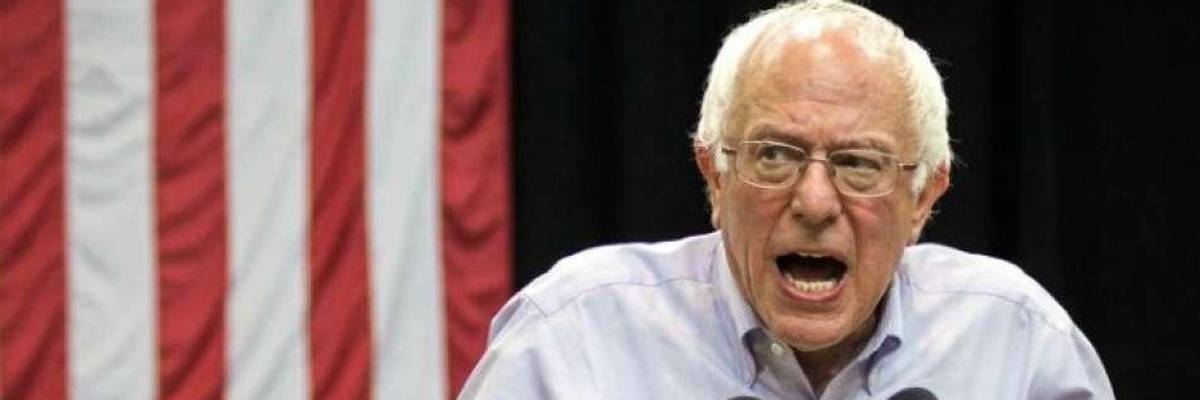
Withholding support for Sen. Bernie Sanders's Medicare for All plan could spell disaster for members of a Democratic Party that's looking to regain several Congressional seats in the 2018 election. (Photo: Nick Solari/flickr/cc)
Why Bernie Sanders' Single-Payer Push Is Great Policy and Even Better Politics
A few important things to be clear about.
Bernie Sanders unveiled his latest version of a Medicare-for-all plan on Wednesday, to a highly unusual level of media attention and support within the Democratic Party. A third of the party's Senate caucus have come out as co-sponsors -- although, unsurprisingly, neither Chuck Schumer nor Nancy Pelosi are backing it yet -- and it looks likely that more will sign on soon.
The plan is extremely generous -- indeed, much more so than many peer countries. But that only makes it great policy and better politics.
So first, the details: The plan would be phased in over a period of four years. In the first year, traditional Medicare would be expanded to cover dental, vision, and hearing aids, as well as people over 55 or under 18, while others would be able to buy in if they wish. In the second year, the age qualification would be lowered to 45, in the third year to 35, and then in the fourth year, everyone remaining would be included.
This upgraded version of Medicare would also be a lot more generous in terms of access. There would be no cost-sharing, except for prescription drugs. It is, as Paul Waldman argues, probably best understood as an opening bid -- a symbolic maximal demand rather than the usual pre-compromised Democratic fare.
Sanders later released a sketch of a financing plan, which lays out several options to reduce costs and raise revenue, though it does not decide which is best. A more detailed discussion will inevitably have to be part of any Medicare-for-all bill. But there are some important things to be clear about. When talking about expanded public health programs, writers and analysts tend to mention "costs" in a way that can be rather misleading. Many skeptics cite Vermont, for example, which balked at the tax increases necessary to pay for a single-payer plan in the state.
Imagine a developing country that is just getting wealthy and organized enough to think about setting up a universal health-care system. There, costs would be a very important question, because a lower-income country can easily run into economic constraints. Therefore, one would have to carefully balance the generosity of the program against the country's ability to mobilize real resources -- doctors, nurses, drugs, and so forth.
The United States, by contrast, is very rich, and already dedicates way more than enough resources to set up the world's most generous health-care system, and a lot more besides. We spend $3.2 trillion per year -- literally twice as much as the OECD average as a share of the economy. We pay enough in health-care taxes alone -- that is, the government revenue that goes to Medicare, Medicaid, the VA, and a few other things -- to cover a Canada-style Medicare-for-all system for the whole U.S., and then that much again in private money. In other words, if we could simply copy-paste Canada's universal health-care system into America, taxes would actually go down.
All that means is that America doesn't have to worry much about costs; it has to worry about allocating existing spending properly. We already have a gigantic pool of resources dedicated to health care -- about half private and half public. We just have to adjust that spending so it can support a single-payer system.
Read the full article at The Week.
Urgent. It's never been this bad.
Dear Common Dreams reader, It’s been nearly 30 years since I co-founded Common Dreams with my late wife, Lina Newhouser. We had the radical notion that journalism should serve the public good, not corporate profits. It was clear to us from the outset what it would take to build such a project. No paid advertisements. No corporate sponsors. No millionaire publisher telling us what to think or do. Many people said we wouldn't last a year, but we proved those doubters wrong. Together with a tremendous team of journalists and dedicated staff, we built an independent media outlet free from the constraints of profits and corporate control. Our mission from the outset was simple. To inform. To inspire. To ignite change for the common good. Building Common Dreams was not easy. Our survival was never guaranteed. When you take on the most powerful forces—Wall Street greed, fossil fuel industry destruction, Big Tech lobbyists, and uber-rich oligarchs who have spent billions upon billions rigging the economy and democracy in their favor—the only bulwark you have is supporters who believe in your work. But here’s the urgent message from me today. It’s never been this bad out there. And it’s never been this hard to keep us going. At the very moment Common Dreams is most needed and doing some of its best and most important work, the threats we face are intensifying. Right now, with just three days to go in our Spring Campaign, we're falling short of our make-or-break goal. When everyone does the little they can afford, we are strong. But if that support retreats or dries up, so do we. Can you make a gift right now to make sure Common Dreams not only survives but thrives? There is no backup plan or rainy day fund. There is only you. —Craig Brown, Co-founder |
Bernie Sanders unveiled his latest version of a Medicare-for-all plan on Wednesday, to a highly unusual level of media attention and support within the Democratic Party. A third of the party's Senate caucus have come out as co-sponsors -- although, unsurprisingly, neither Chuck Schumer nor Nancy Pelosi are backing it yet -- and it looks likely that more will sign on soon.
The plan is extremely generous -- indeed, much more so than many peer countries. But that only makes it great policy and better politics.
So first, the details: The plan would be phased in over a period of four years. In the first year, traditional Medicare would be expanded to cover dental, vision, and hearing aids, as well as people over 55 or under 18, while others would be able to buy in if they wish. In the second year, the age qualification would be lowered to 45, in the third year to 35, and then in the fourth year, everyone remaining would be included.
This upgraded version of Medicare would also be a lot more generous in terms of access. There would be no cost-sharing, except for prescription drugs. It is, as Paul Waldman argues, probably best understood as an opening bid -- a symbolic maximal demand rather than the usual pre-compromised Democratic fare.
Sanders later released a sketch of a financing plan, which lays out several options to reduce costs and raise revenue, though it does not decide which is best. A more detailed discussion will inevitably have to be part of any Medicare-for-all bill. But there are some important things to be clear about. When talking about expanded public health programs, writers and analysts tend to mention "costs" in a way that can be rather misleading. Many skeptics cite Vermont, for example, which balked at the tax increases necessary to pay for a single-payer plan in the state.
Imagine a developing country that is just getting wealthy and organized enough to think about setting up a universal health-care system. There, costs would be a very important question, because a lower-income country can easily run into economic constraints. Therefore, one would have to carefully balance the generosity of the program against the country's ability to mobilize real resources -- doctors, nurses, drugs, and so forth.
The United States, by contrast, is very rich, and already dedicates way more than enough resources to set up the world's most generous health-care system, and a lot more besides. We spend $3.2 trillion per year -- literally twice as much as the OECD average as a share of the economy. We pay enough in health-care taxes alone -- that is, the government revenue that goes to Medicare, Medicaid, the VA, and a few other things -- to cover a Canada-style Medicare-for-all system for the whole U.S., and then that much again in private money. In other words, if we could simply copy-paste Canada's universal health-care system into America, taxes would actually go down.
All that means is that America doesn't have to worry much about costs; it has to worry about allocating existing spending properly. We already have a gigantic pool of resources dedicated to health care -- about half private and half public. We just have to adjust that spending so it can support a single-payer system.
Read the full article at The Week.
Bernie Sanders unveiled his latest version of a Medicare-for-all plan on Wednesday, to a highly unusual level of media attention and support within the Democratic Party. A third of the party's Senate caucus have come out as co-sponsors -- although, unsurprisingly, neither Chuck Schumer nor Nancy Pelosi are backing it yet -- and it looks likely that more will sign on soon.
The plan is extremely generous -- indeed, much more so than many peer countries. But that only makes it great policy and better politics.
So first, the details: The plan would be phased in over a period of four years. In the first year, traditional Medicare would be expanded to cover dental, vision, and hearing aids, as well as people over 55 or under 18, while others would be able to buy in if they wish. In the second year, the age qualification would be lowered to 45, in the third year to 35, and then in the fourth year, everyone remaining would be included.
This upgraded version of Medicare would also be a lot more generous in terms of access. There would be no cost-sharing, except for prescription drugs. It is, as Paul Waldman argues, probably best understood as an opening bid -- a symbolic maximal demand rather than the usual pre-compromised Democratic fare.
Sanders later released a sketch of a financing plan, which lays out several options to reduce costs and raise revenue, though it does not decide which is best. A more detailed discussion will inevitably have to be part of any Medicare-for-all bill. But there are some important things to be clear about. When talking about expanded public health programs, writers and analysts tend to mention "costs" in a way that can be rather misleading. Many skeptics cite Vermont, for example, which balked at the tax increases necessary to pay for a single-payer plan in the state.
Imagine a developing country that is just getting wealthy and organized enough to think about setting up a universal health-care system. There, costs would be a very important question, because a lower-income country can easily run into economic constraints. Therefore, one would have to carefully balance the generosity of the program against the country's ability to mobilize real resources -- doctors, nurses, drugs, and so forth.
The United States, by contrast, is very rich, and already dedicates way more than enough resources to set up the world's most generous health-care system, and a lot more besides. We spend $3.2 trillion per year -- literally twice as much as the OECD average as a share of the economy. We pay enough in health-care taxes alone -- that is, the government revenue that goes to Medicare, Medicaid, the VA, and a few other things -- to cover a Canada-style Medicare-for-all system for the whole U.S., and then that much again in private money. In other words, if we could simply copy-paste Canada's universal health-care system into America, taxes would actually go down.
All that means is that America doesn't have to worry much about costs; it has to worry about allocating existing spending properly. We already have a gigantic pool of resources dedicated to health care -- about half private and half public. We just have to adjust that spending so it can support a single-payer system.
Read the full article at The Week.