

SUBSCRIBE TO OUR FREE NEWSLETTER
Daily news & progressive opinion—funded by the people, not the corporations—delivered straight to your inbox.
5
#000000
#FFFFFF
To donate by check, phone, or other method, see our More Ways to Give page.
Daily news & progressive opinion—funded by the people, not the corporations—delivered straight to your inbox.

"'Drill, baby drill' doesn't help people with housing needs," said one economic justice advocate. "We need living wages and investment in affordable housing."
Given a chance on Wednesday to speak directly to a voter about how his policies would materially help working families to afford housing and other essentials, Republican presidential candidate Donald Trump instead repeated some of his favorite evidence-free attack lines—leaving the voter mainly with promises to "drill, baby, drill" and to get China "to behave properly."
Featured in a "Fox & Friends" segment on Fox News in which the former president called in, the vote explained at the Sturgis Motorcycle Rally in South Dakota that he has regularly been helping five of his eight children financially, as they are "struggling" to afford necessities.
"How are you going to make the economy—not just the food and electricity—but bring down the rent prices, the housing prices, so that these kids can survive without their parents' help?" said the voter.
The former president didn't address the voter directly, instead telling a Fox correspondent that he likely had the support of "at least 99, perhaps 100%" of the people at the motorcycle event, before launching into a meandering reply to the question.
"We're going to drill, baby, drill, we're gonna bring down the cost of energy," he said. "Energy's what caused the worst inflation, I think, in the history of our country. Food prices are up 50%, sometimes more. You look at bacon. Bacon has quadrupled. You can't order bacon, you can't order anything. We're living horribly."
In the last year of Trump's presidency, a pound of bacon cost $5.83; the price is now $6.77 and has gone down over the last two years.
Trump's next claim, that "we have the worst inflation we've probably ever had in our country," was also baseless, with inflation down to 3% in June, following a surge in 2022 that resulted from the coronavirus pandemic.
After telling the voter that he would ensure China and other countries were "treating us good"—and saying nothing about introducing programs to bring down rent prices, the subject of the man's question, the former president said the voter had been "in great shape" during his presidency and exaggerated the current price of gasoline, which has also trended downward since 2021.
"Answering with 'drill baby drill' to a concerned supporter asking about rising rent prices is about as asinine as it gets," said Derek Marshall, an organizer and progressive congressional candidate in California's 3rd District. "Americans deserve better!"
Jonathan Wilson-Hatrgrove, assistant director of the Yale Center for Public Theology & Public Policy, said Trump's response illustrated how the former president and his allies "exploit the pain of white poverty, but they have no coherent answer when asked what they will do to fix it."
Wilson-Hartgrove contrasted Trump's rambling reply with a similar question that was asked of then-presidential candidate Kamala Harris in 2020 at the Poor People's Campaign Presidential Forum.
A young white woman from Washington State asked @KamalaHarris the same question when she ran in 2020. Every voter needs to hear the contrast b/w these two visions of the economy. pic.twitter.com/Ws9OIYdn3P
— Jonathan Wilson-Hartgrove (@wilsonhartgrove) August 8, 2024
"I am proposing what I call the Rent Relief Act, so for renters who are paying more than 30% of their income in rent plus utilities, they will receive a tax credit, so that they can be able to get through the month paying rent," said Harris at the time. "I also connect it to the issue of what we need to do around equal pay, I connect it to the issue of what we need to do to raise the minimum wage."
Voters, said Wilson-Hartgrove, should "hear the contrast between these two visions of the economy."
On Tuesday in Atlanta, Harris, now the Democratic presidential nominee following President Joe Biden's decision to step aside in the 2024 race, told a crowd of supporters that she plans to "take on corporate landlords and cap unfair rent increases."
The Biden administration has also proposed limiting rent increases to 5% nationwide for landlords who own more than 50 units, covering over 20 million units across the country, and exempting yet-to-be-built units in order to encourage the construction of new housing.
Trump's response to the frustrated voter's question about housing costs, said Rev. Dr. William J. Barber II, co-chair of the Poor People's Campaign, was to lie "about the economy he inherited from the Obama/Biden administration, then ran into the ground before his response to Covid made things even worse."
"'Drill, baby drill' doesn't help people with housing needs," said Barber. "We need living wages and investment in affordable housing."
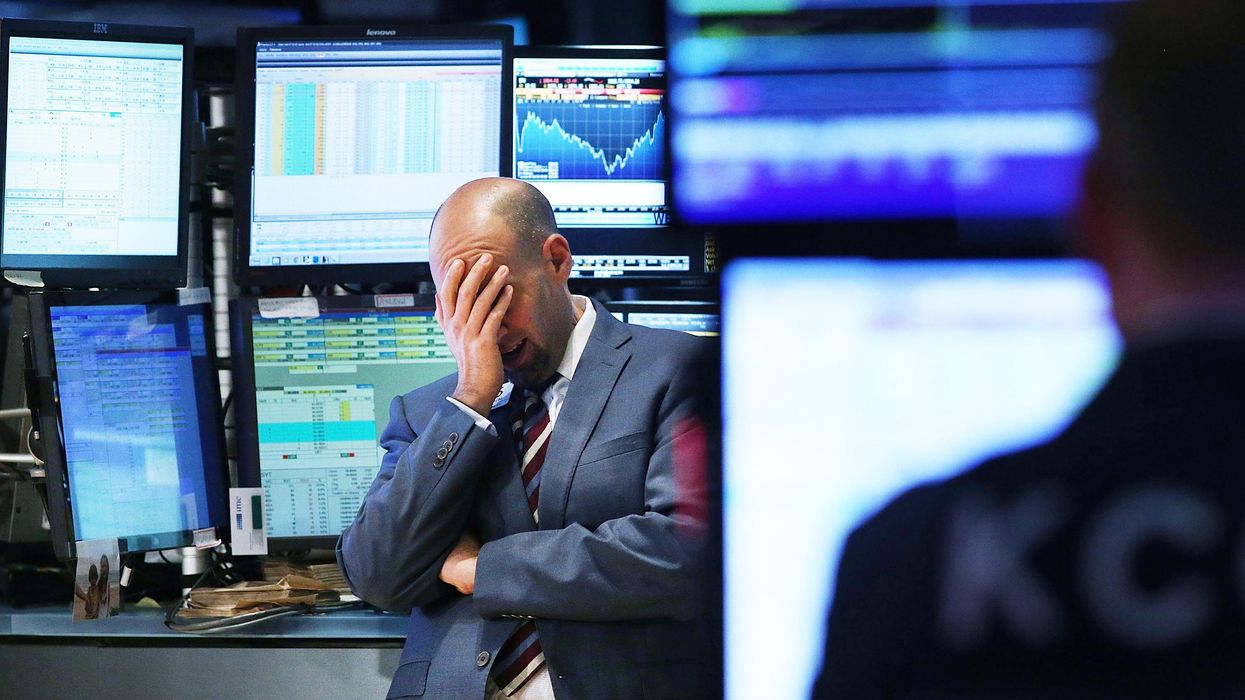
Current laws allow the big international banks to run the largest derivatives casino that the world has ever seen.
This is a sequel to a Jan. 15 article titled “Casino Capitalism and the Derivatives Market: Time for Another ‘Lehman Moment’?”, discussing the threat of a 2024 “black swan” event that could pop the derivatives bubble. That bubble is now over 10 times the gross domestic product of the world and is so interconnected and fragile that an unanticipated crisis could trigger the collapse not just of the bubble but of the economy. To avoid that result, in the event of the bankruptcy of a major financial institution, derivative claimants are put first in line to grab the assets—not just the deposits of customers but their stocks and bonds. This is made possible by the Uniform Commercial Code, under which all assets held by brokers, banks, and “central clearing parties” have been “dematerialized” into fungible pools and are held in “street name.”
This article will consider several proposed alternatives for diffusing what Warren Buffett called a time bomb waiting to go off. That sort of bomb just detonated in the Chinese stock market, contributing to its fall; and the result could be much worse in the U.S., where the stock market plays a much larger role in the economy.
A January 30 article on Bloomberg News notes that “Chinese stocks’ brutal start to the year is being at least partly blamed on the impact of a relatively new financial derivative known as a snowball. The products are tied to indexes, and a key feature is that when the gauges fall below built-in levels, brokerages will sell their related futures positions.”
Further details are in a January 23 article titled “‘Snowball’ Derivatives Feed China’s Stock Market Avalanche.” It states, “China’s plunging stock market is leading to losses on billions of dollars worth of derivatives linked to the country’s equity indexes, fueling further selling as retail investors offload their positions… Snowball products are similar to the index-linked products sold in the 2008 financial crisis, with investors betting that U.S. equities would not fall more than 25% or 30%,” which they did.
Chinese shares rose on February 6, as officials took measures to prop up the ailing market, including imposing new “zero tolerance” curbs for malicious short selling.
The Chinese stock market is much younger and smaller than that in the U.S., with a much smaller role in the economy. Thus China’s economy remains relatively protected from disruptive ups and downs in the stock market. Not so in the U.S., where speculating in the derivatives casino brought down international insurer AIG and investment bank Lehman Brothers in 2008, triggering the global financial crisis of 2008-09. AIG had to be bailed out by the taxpayers to prevent collapse of the too-big-to-fail derivative banks, and Lehman Brothers went through a messy bankruptcy that took years to resolve.
In a December 2010 article on Seeking Alpha titled “Derivatives: The Big Banks’ Quadrillion-Dollar Financial Casino,” attorney Michael Snyder wrote, “Derivatives were at the heart of the financial crisis of 2007 and 2008, and whenever the next financial crisis happens, derivatives will undoubtedly play a huge role once again… Today, the world financial system has been turned into a giant casino where bets are made on just about anything you can possibly imagine, and the major Wall Street banks make a ton of money from it. The system… is totally dominated by the big international banks.”
In a 2009 Cornell Law Faculty publication titled “How Deregulating Derivatives Led to Disaster, and Why Re-Regulating Them Can Prevent Another,” Prof. Lynn Stout proposed stabilizing the market by returning to 20th-century derivative rules. She noted that derivatives are basically wagers or bets, and that before 2000, the U.S. and U.K. regulated derivatives primarily by a common‐law rule known as the “rule against difference contracts.” She explained:
The rule against difference contracts did not stop you from wagering on anything you liked: sporting contests, wheat prices, interest rates. But if you wanted to go to a court to have your wager enforced, you had to demonstrate to a judge’s satisfaction that at least one of the parties to the wager had a real economic interest in the underlying and was using the derivative contract to hedge against a risk to that interest… Using derivatives this way is truly hedging, and it serves a useful social purpose by reducing risk.
…Under the rule against difference contracts and its sister doctrine in insurance law (the requirement of “insurable interest”), derivative contracts that couldn’t be proved to hedge an economic interest in the underlying were deemed nothing more than legally unenforceable wagers.
…Hedge funds, for example, should really call themselves “speculation funds,” as it is quite clear they are using derivatives to try to reap profits at the other traders’ expense.
The rule against difference contracts died in 2000, when the U.S. embraced wholesale deregulation with the passage of the Commodity Futures Modernization Act (CFMA):
The CFMA not only declared financial derivatives exempt from CFTC or SEC oversight, it also declared all financial derivatives legally enforceable. The CFMA thus eliminated, in one fell swoop, a legal constraint on derivatives speculation that dated back not just decades, but centuries. It was this change in the law—not some flash of genius on Wall Street—that created today’s $600 trillion financial derivatives market.
Not only are speculative derivatives now legally enforceable, but under the Bankruptcy Act of 2005, derivative securities enjoy special protections. Most creditors are “stayed” from enforcing their rights while a firm is in bankruptcy, but many derivative contracts are exempt from these stays. Similarly, under the Dodd Frank Act of 2010, derivative claimants have “superpriority” in the bankruptcy of a financial institution. They are privileged to claim collateral immediately without judicial review, before bankruptcy proceedings even begin. Depositors become “unsecured creditors” who can recover their funds only after derivative, repo, and other secured claims, assuming there is anything left to recover, which in the event of a major derivative crisis would be unlikely.
That’s true not only of the deposits in a bankrupt bank but of stocks, bonds, and money market funds held by a broke or dealer that goes bankrupt. Under the Bankruptcy Act of 2005 and Sections 8 and 9 of the Uniform Commercial Code (UCC), “safe harbor” is provided to entities described in court documents as “the protected class.” The customers who purchased the assets have only a “security entitlement,” a weak contractual claim to a pro rata share of a residual pool of fungible assets all held in the name of Cede & Co., the proxy of the Depository Trust and Clearing Corp. (DTCC). As Wall Street financial analyst John Rubino put it in a January 27 podcast:
What we used to think of as a bank bail-in where they take your deposit in order to support a failing bank, that is now spread across the entire financial economy where whatever you have in an account anywhere can just disappear, because they’re going to transfer ownership of it to these big dominant entities out there in the financial system that need those assets in order to keep from blowing up.
Derivative speculators are considered “secured” because they post a portion of what they could wind up owing as “margin,” but why that partial security is superior to the 100% security posted by the depositor or purchaser is not explained. The “protected class” is granted “safe harbor” only because their bets are so risky that to let them fail could crash the economy. But why let them bet at all?
The fix of the G20 leaders following the global financial crisis, however, was to force banks to clear over-the-counter derivatives through central counterparties (CCPs), which stand between buyer and seller and protect either party if the other blows up. By March 2020, 60% of credit default swaps and 80% of interest rate swaps were centrally cleared. The problem, as noted in a December 2023 publication by the Bank for International Settlements, is that these measures taken to protect the system can actually amplify risk.
CCPs tend to ask for more collateral than banks did in the pre-crisis world; and when a CCP hikes its initial margin requirement to cover the risk of default, this applies to everyone in the market, meaning cash calls are synchronized. As explained in a May 2022 Reuters article:
It’s logical that CCPs ask for more collateral during a panic: That’s when defaults are most likely. The problem is that margin calls seem to have made things worse. In March 2020, for example, a so-called “dash for cash” saw investors liquidate even prime money-market funds and U.S. Treasury securities.
… [R]ampant margin calls have intensified a financial panic twice in as many years, with central banks effectively bailing out markets in 2020. That’s better than in 2008, when taxpayers had to step in. But the problem of margin calls remains unsolved.
… Central counterparty (CCP) clearing houses should consider asking clients for more collateral during good times to reduce the risk of destabilizing margin calls during a financial panic, a Bank of England official said on May 19.
Yet all this, as Michael Snyder observes, is to allow the big international banks to run the largest derivatives casino that the world has ever seen. Why not just shut down the casino? Prof. Stout’s suggested solution is for Congress to return to the pre-2000 rule under which speculative derivative bets were not enforceable in court. That would include reversing the “superpriority” privileges in the Bankruptcy Act of 2005 and the Dodd-Frank Act. But it won’t be a quick fix, as Wall Street and our divided Congress can be expected to put up a protracted fight.
In a 2015 law review article titled “Failure of the Clearinghouse: Dodd-Frank’s Fatal Flaw?,” Prof. Stephen Lubben points to a more ominous risk from pushing all derivatives onto exchanges; and that concern is shared by former hedge fund manager David Rogers Webb in his 2024 book The Great Taking. The exchanges are supposed to be safer than private over-the-counter trades because the exchange steps in as market maker, accepting the risk for both sides of the trade. But in a general economic depression, the exchanges themselves could go bankrupt. No provision for that is made in the Dodd-Frank Act, which purports to decree “no more bailouts.” Still, reasons Prof. Lubben, the government would undoubtedly step in to save the market from collapse.
His proposed solution is for Congress to make legislative provision for nationalizing any bankrupt exchange, brokerage, or Central Clearing Counterparty before it fails. This is something to which our gridlocked Congress might agree, since under current circumstances it would not involve any major changes, wealth confiscation, or new tax burdens; and it could protect their own fortunes from confiscation if the DTCC were to go bankrupt.
Another alternative that not only could work but could fix Congress’s budget problems at the same time is to impose a 0.1% tax on all financial transactions. See Scott Smith, A Tale of Two Economies: A New Financial Operating System, showing that U.S. financial transactions (the financialized economy) are over $7.6 quadrillion, more than 350 times the U.S. national income (the productive economy). See my earlier article summarizing all that here. On a financial transaction tax curbing speculation in derivatives, see also here, here, and here.
There are other possible solutions to customer title concerns. There is no longer a need for the archaic practice of holding all securitized assets in the street name of Cede & Co. The digitization of stocks and bonds was a reasonable and efficient step in the 1970s, but today digital cryptography has gotten so sophisticated that “smart contracts” can be attached by blockchain-like distributed ledger technology (DLT) to digital assets, tracking participants, dates, terms, and other contractual details. The states of Delaware and Wyoming have explored maintaining corporate lists of stockholders on a state-run blockchain; but predictably, the measures were opposed. The practice of holding assets in street name has proven very lucrative for the DTCC’s member brokers and banks, as it facilitates short selling and the “rehypothecation” of collateral.
In October 2023, the DTCC reported that it has been exploring adopting DLT; but the goal seems only to be speedier and safer trades. No mention was made of returning registered title to the purchasers of the traded assets, which could be done with distributed ledger technology.
The most readily achievable solution is probably that in a South Dakota bill filed on January 29. The bill is detailed in a February 2 article titled “You Could Lose Your Retirement Savings in the Next Financial Crash Unless Others Follow This State’s Lead,” which observes:
…[I]f your broker… were to go bankrupt, the broker’s secured creditors (the people to whom the broker owes money) would be empowered to take the investments that you paid for in order to settle outstanding debts….
To avoid a catastrophe in the future, a nationwide movement is desperately needed to alter the existing Uniform Commercial Code. Of course, that won’t be easy to accomplish, especially because bank lobbyists and other powerful financial interests will almost certainly fight kicking and screaming to stop policymakers from taking away their advantage over consumers.
The good news is, this “great taking” can be stopped at the state level. Americans don’t need to count on a divided Congress to get the job done. Because the UCC is state law, state lawmakers can take concrete steps to restore the property rights of their constituents and protect them in the event of a financial crisis.
On Monday, South Dakota legislators introduced a bill that would do just that. The legislation would ensure that individual investors have priority over securities held by brokerage firms and other intermediaries.
It would also alter jurisdictional provisions so that cases are determined in the state of the individual investor, rather than the state of the broker, custodian, or clearing corporation. This would ensure that individual investors are able to rely on the laws of their local state.
Hopefully, other states will follow South Dakota’s lead. Tennessee, for one, is reported to have such a bill in the works.
"Cause of death: citizen activism informed by science."
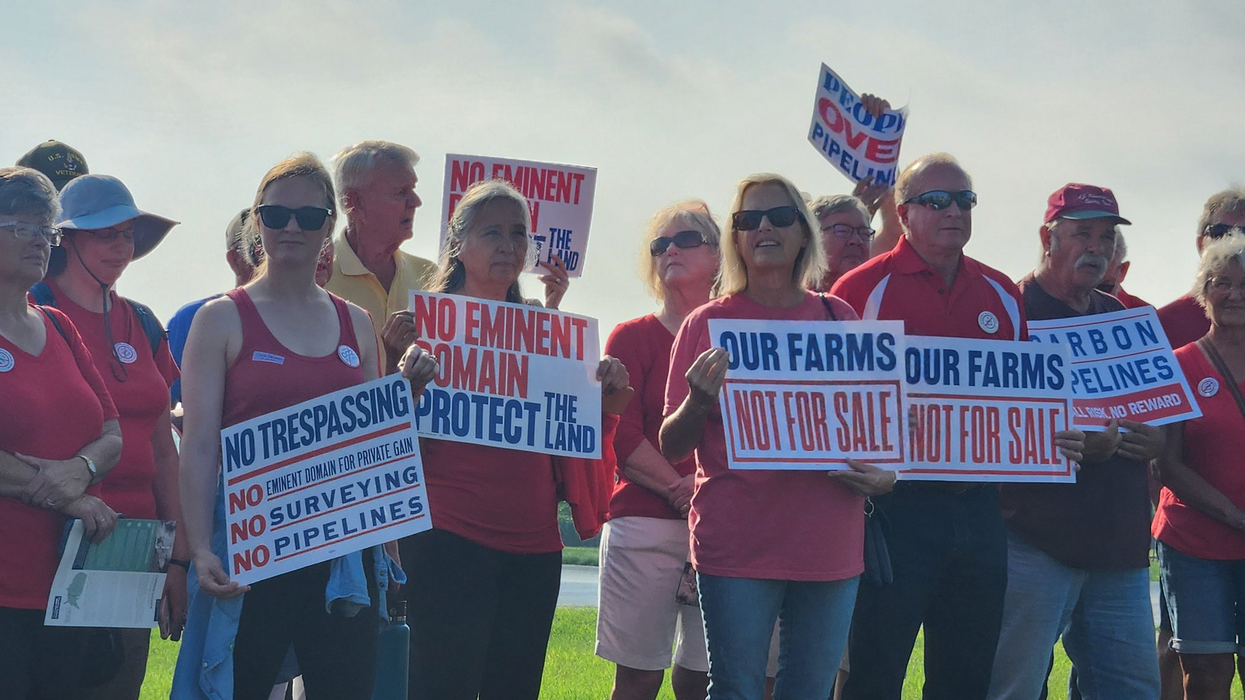
Climate action advocates and scientists joined residents of five Midwestern states in applauding Friday after a Nebraska firm canceled plans to build a carbon pipeline, following outcry from the public and opponents of "dangerous, wasteful" carbon capture schemes.
Navigator CO2 Ventures said it was abandoning plans to build the $3.5 billion, 1,300-mile Heartland Greenway pipeline project—whose backers included investment firm BlackRock and Valero Energy—after South Dakota regulators denied a permit.
The company cited "the unpredictable nature of the regulatory and government processes involved," but advocates in the five states that would have been affected credited grassroots campaigning, including by residents who spoke out against the company's plan to potentially use eminent domain to gain access to land.
"As soon as Iowans learned about CO2 pipelines we knew these were not pipelines we wanted in our communities," said Susan and Jerry Stoefen, members of Iowa Citizens for Community Improvement. "Iowans organized to be heard: 'No CO2 Pipelines, No Eminent Domain!' Now is the time for Iowans to find reals solutions to reducing CO2 emissions that don't degrade our land, water, and air."
One Iowa resident summed up the victory as, "A bunch of elderly farmers without internet just took down BlackRock."
Along with Iowa and Nebraska, the pipeline would have cut through parts of South Dakota, Minnesota, and Illinois, where Navigator CO2 planned to store liquefied carbon deep underground after capturing it and transporting it from 18 ethanol plants owned by Poet, the world's largest ethanol producer, and Iowa Fertilizer Company.
The company is one of three firms that have planned to build carbon capture pipelines in the Midwest, promoting what climate advocates and scientists have decried as an energy-intensive, unproven false solution that diverts focus away from efforts to slash fossil fuel emissions and transition to renewable energy.
Summit Carbon Solutions and Wolf Carbon Solutions also have pipeline proposals, but Summit announced Thursday it was delaying construction of its $5.5 billion project by two years until 2026, citing permit denials similar to Navigator's.
U.S. President Joe Biden has made carbon capture a focus of his climate plans, announcing an investment of up to $1.2 billion for two major direct-air carbon capture facilities in Texas and Louisiana earlier this year.
"While the federal government keeps trying to waste billions of dollars to promote these massive carbon pipelines, grassroots organizing is winning the fight to stop these egregious handouts to corporate polluters," said Emily Wurth, managing director of organizing for Food & Water Watch. "These carbon pipelines will not reduce emissions—they are dangerous, wasteful schemes to prolong and expand polluting industries. Instead of throwing away money supporting polluters, the government should invest in proven clean energy solutions, not carbon capture pipe dreams."
In addition to warning that carbon capture is a false solution to the climate crisis, critics warned that a rupture of a pipeline carrying highly pressurized CO2—an asphyxiant—could pose a major public health threat to nearby communities, as one accident did in the town of Sartartia, Mississippi in 2021.
Both Summit and Navigator initially warned residents living in areas that would be affected by the pipelines that they could resort to eminent domain—a legal process by which companies can gain access to land when a landowner refuses to grant it—and Summit has already pursued dozens of eminent domain orders for its proposed pipeline.
Although Navigator has not yet pursued the actions, the company's vice president of government and public affairs, Elizabeth Burns-Thompson, said at a public debate in August that it couldn't guarantee eminent domain wouldn't be used to complete Heartland Greenway.
Biologist Sandra Steingraber, a vocal critic of carbon capture schemes, celebrated the demise of the proposed pipeline, whose "cause of death," she said, was "citizen activism informed by science."
"Piping pressurized supercritical CO2 all over creation," said Steingraber, "endangers people, destroys farmland, [and] does nothing meaningful for the climate."
Earlier this month, Reps. Ilhan Omar (D-Minn.) and Jesús "Chuy" García (D-Ill.) led a call for Biden to place a moratorium on federal permitting for CO2 pipelines, citing public health concerns.

"We're not the subjugated and disenfranchised people that we were," said one Ponca elder who took part in the 1973 revolt. "Wounded Knee was an important beginning of that."
As many Native Americans on Monday marked the 50th anniversary of the militant occupation of Wounded Knee, South Dakota, participants in the 1973 uprising and other activists linked the deadly revolt to modern-day Indigenous resistance, from Standing Rock to the #LandBack movement.
On February 27, 1973 around 300 Oglala Lakota and members of the American Indian Movement (AIM), seething from centuries of injustices ranging from genocide to leniency for whites who committed crimes against Indians, occupied the hamlet of Wounded Knee on the Pine Ridge Reservation for more than two months. The uprising occurred during a period of increased Native American militancy and the rise of AIM, which first drew international attention in 1969 with the 19-month occupation of Alcatraz Island in San Francisco Bay.
"The Native people of this land after Wounded Knee, they had like a surge of new pride in being Native people," Dwain Camp, an 85-year-old Ponca elder who took part in the 1973 revolt, told The Associated Press.
"Anything that goes on, anything we do, even today with the #LandBack issue, all of that is just a continuation."
Camp said the occupation drove previously "unimaginable" changes, including the Indian Self-Determination and Education Assistance Act, the Indian Child Welfare Act, the American Indian Religious Freedom Act, and the Indian Gaming Regulatory Act.
"After we left Wounded Knee, it became paramount that protecting Mother Earth was our foremost issue," he explained. "Since that period of time, we've learned that we've got to teach our kids our true history."
Camp said the spirit of Wounded Knee lives on in Indigenous resistance today.
"We're not the subjugated and disenfranchised people that we were," he said. "Wounded Knee was an important beginning of that. And because we're a resilient people, it's something we take a lot of pride in."
Some of the participants in the 1973 uprising had been raised by grandparents who remembered or even survived the 1890 massacre of more than 200 Lakota Lakota men, women, and children by U.S. troops at Wounded Knee.
"That's how close we are to our history," Madonna Thunder Hawk, an 83-year-old elder in the Oohenumpa band of the Cheyenne River Sioux Tribe who was a frontline participant in the 1973 occupation, told Indian Country Today. "So anything that goes on, anything we do, even today with the #LandBack issue, all of that is just a continuation. It's nothing new."
Nick Tilsen, an Oglala Lakota who played a prominent role in the 2016-17 protests against the Dakota Access Pipeline at Standing Rock, North Dakota and who founded the NDN Collective, told Indian Country Today that "for me, it's important to acknowledge the generation before us—to acknowledge their risk."
"It's important for us to honor them," said Tilsen, whose parents met at the Wounded Knee occupation. "It's important for us to thank them."
Akim Reinhardt, an associate professor of history at Townson State University in Baltimore, told Indian Country Today that the AIM protests "helped establish a sense of the permanence of Red Power in much the way that Black Power had for African-Americans, a permanent legacy."
"It was the cultural legacy that racism isn't okay and people don't need to be quiet and accept it anymore," he added. "That it's okay to be proud of who you are."
Indian Country Today reports:
The occupation began on the night of Feb. 27, 1973, when a group of warriors led by Oklahoma AIM leader Carter Camp, Ponca, moved into the small town of Wounded Knee. They took over the trading post and established a base of operations along with AIM leaders Russell Means, Oglala Lakota; Dennis Banks, Ojibwe; and Clyde Bellecourt, White Earth Nation.
Within days, hundreds of activists had joined them for what became a 71-day standoff with the U.S. government and other law enforcement.
Black activist Ray Robinson, who had been working with the Oglala Sioux Civil Rights Organization, went missing during the standoff. In 2014, the FBI confirmed that Robinson died at Wounded Knee, but his body was never recovered.
AIM remains active today. Its members have participated in the fights against the Dakota Access, Keystone XL, and Line 3 pipelines, as well as in the effort to free Leonard Peltier, a former AIM leader who has been imprisoned for over 45 years after a dubious conviction for murdering two FBI agents during a separate 1975 shootout on the Pine Ridge Reservation.
Kevin McKiernan, then a rookie reporter for NPR who was smuggled into Wounded Knee after the Nixon administration banned journalists from covering the standoff, said in an interview with NPR that the #LandBack movement—spearheaded in the U.S. by NDN Collective—is a leading example of the occupation's legacy.
"And I think that there is a collective or a movement like that on every reservation with every tribe," McKiernan said. "They're going to get back, to buy back, to get donated—just do it by inches."
"That's what's going on in every inch of Indian country today," he added.

One critic said Republican Gov. Kristi Noem is "stopping at nothing until every woman in South Dakota is forced to carry an unwanted pregnancy to term."
South Dakota's Republican governor and attorney general on Tuesday issued a threatening letter directed at the state's pharmacists in response to a recent move by the Biden administration to ease restrictions on dispensing abortion pills amid the GOP's nationwide assault on reproductive freedom.
Gov. Kristi Noem and AG Marty Jackley's letter begins by noting that after Dobbs v. Jackson Women's Health Organization, the U.S. Supreme Court ruling that reversed Roe v. Wade last year, abortion became illegal in South Dakota except to save the life of the pregnant person. It's one of 14 states where abortions are now largely unavailable.
The letter states that "in South Dakota, any person who administers, prescribes, or procures for any pregnant female any medicine or drug with the intent to induce an abortion is guilty of a felony."
In a policy change long advocated by medical experts and rights campaigners, the Food and Drug Administration (FDA) earlier this month formalized a regulatory change to allow retail pharmacies in the U.S. to dispense mifepristone, one of two drugs often taken in tandem for a medication abortion.
Referencing that development, the letter says that "under South Dakota law, pharmacies, including chain drug stores, are prohibited from procuring and dispensing abortion-inducing drugs with the intent to induce an abortion, and are subject to felony prosecution under South Dakota law, despite the recent FDA ruling."
As The Associated Press reported Tuesday:
The [FDA's] change could expand access at online pharmacies. People can get a prescription via telehealth consultation with a health professional and then receive the pills through the mail, where permitted by law.
Still, in states like South Dakota, the rule change's impact has been blunted by laws limiting abortion broadly and the pills specifically. Legal experts foresee years of court battles over access to the pills as abortion rights proponents bring test cases to challenge state restrictions.
Amanda Bacon, the director of the South Dakota Pharmacists Association, said in an email that she was not aware of any South Dakota pharmacies with plans to participate in the federal program to dispense abortion pills.
The pro-choice Guttmacher Institute, which tracks policies across the country, labels all six states that border South Dakota as restrictive of abortion access to various degrees—and South Dakota is among the dozen "most restrictive" states in the nation.
Since the Dobbs decision, states with pro-choice policies—especially those like Illinois, which is surrounded by states with abortion restrictions—have seen an influx of "healthcare refugees."
While the FDA's recent move was widely seen as a step toward alleviating some of the strain on clinics trying to serve a growing number of patients fleeing states with forced-birth policies, an ongoing legal battle over the agency's initial approval of mifepristone in 2000 could jeopardize access to the drug nationwide.
Anti-choice physicians last month asked Judge Matthew Kacsmaryk—appointed by former President Donald Trump to the U.S. District Court for the Northern District of Texas—to throw out the FDA's 2000 decision. The judge, who was previously the deputy general counsel at a conservative Christian legal advocacy group, could issue a ruling as soon as February 10.
If the Christian alliance that launched the attack on the FDA approval "wins in federal district court, the Biden administration would appeal to the 5th Circuit in New Orleans, a conservative court with 12 of its 16 active judges appointed by Republicans," CNBC pointed out Tuesday. "From there, the case could end up at the Supreme Court."

South Dakotans on Tuesday resoundingly defeated a Republican-authored constitutional amendment that would have raised the threshold for passage of most ballot initiatives from a simple majority to 60%, an effort motivated by GOP lawmakers' desire to head off a Medicaid expansion vote set for November.
Voters rejected the proposal, known as Amendment C, by a margin of 67.4% to 32.6%, dealing a decisive blow to state-level Republicans' latest attempt to weaken the ballot initiative process.
"Amendment C is a political ploy that would empower special interests, lobbyists, and politicians at the expense of South Dakota voters."
"The people of South Dakota have preserved their right to use direct democracy," said Kelly Hall, executive director of the Fairness Project, a national group that worked to defeat the South Dakota amendment. "This victory will benefit tens of thousands of South Dakotans who will choose to use the ballot measure process to increase access to healthcare for their families and neighbors, raise wages, and more policies that improve lives."
"We look forward to what's next in South Dakota: an aggressive campaign to expand Medicaid in the state," Hall added.
If passed, Amendment C would have required a 60% supermajority to approve any voter-initiated referendum that would "increase taxes or fees or that would require the state to appropriate $10 million or more in the first five fiscal years." The proposal was endorsed by South Dakota's Republican Gov. Kristi Noem and the powerful Koch network, which spent big on pro-Amendment C ads and mailers.
"Amendment C is a political ploy that would empower special interests, lobbyists, and politicians at the expense of South Dakota voters," South Dakotans for Fair Elections said ahead of Tuesday's vote. "If you care about secure and fair elections, vote no on C."
Republican sponsors and supporters of the amendment readily admitted that their expedited campaign to get Amendment C on the primary election ballot was fueled at least in part by opposition to the Medicaid referendum, which would make South Dakota the seventh state since 2017 to approve an expansion of the healthcare program through the voter initiative process.
Only Idaho's 2018 Medicaid expansion initiative received more than 60% of the vote, an indication that Amendment C would likely have spelled doom for the South Dakota referendum.
As Daniel Nichanian of Bolts noted late Tuesday, "GOP lawmakers in South Dakota were not able to increase the threshold of passage for initiatives on their own, without consulting voters, since the change would have affected the state constitution."
"And South Dakotans' refusal to go along with this stands out as reaffirming the state's historical legacy," Nichanian observed. "South Dakota was the first in the nation to adopt a process for citizens to initiate ballot measures. In 1898, voters approved a constitutional amendment to that effect that was pushed by local populist leaders--a legacy that voters reaffirmed on Tuesday."

Two weeks after South Dakota Gov. Kristi Noem signed a law banning transgender students from joining sports teams that match their gender identity, the Republican came under fire Thursday for her apparent ignorance of difficulties faced by many LGBTQ+ people.
During a press briefing, reporter Kyle Ireland asked Noem: "There's a statistic circling around right now that 90% of South Dakota's LGBTQ community is diagnosed with either anxiety or depression. Why do you think that is?"
The governor responded: "I don't know. That makes me sad and we should figure it out."
The National Center for Lesbian Rights (NCLR) shared a video of the exchange on Twitter and noted that discriminatory policies like the one Noem approved earlier this month "can be directly correlated to anxiety, depression, and even suicidal ideation" in LGBTQ+ youth.
The NCLR also highlighted that similar measures are being considered and enacted in several other states, and reiterated that such policies "will have LONG-TERM and SERIOUS ramifications for the mental health and well-being" of the young people targeted.
Congresswoman Marie Newman (D-Ill.)--who has a trans daughter--also responded to Noem's comments on Twitter.
"Really? Last year was the deadliest on record for transgender Americans. You just passed a discriminatory bill that attacks trans kids who just want be themselves and play sports," Newman said. "Want to figure out why LGBTQ+ youth are more prone to depression? It's because of people like you."
After Noem--who is widely considered a leading candidate for the GOP's 2024 presidential primary race--signed the anti-trans measure, Cathryn Oakley of Human Rights Campaign (HRC) said her "eagerness to pass a bill attacking transgender kids reveals that her national political aspirations override any sense of responsibility she has to fulfill her oath to protect South Dakotans."
"Gov. Noem and South Dakota legislators need to stop playing games with vulnerable children," added HRC's legislative director and senior counsel. "Transgender children are children. They deserve the ability to play with their friends. This legislation isn't solving an actual problem that South Dakota was facing: It is discrimination, plain and simple. Shame on Gov. Noem."
Related Content

Last year, according to HRC, legislators introduced more than 250 anti-LGBTQ+ measures in 31 states and enacted 17 laws in 10 states. As Common Dreams reported last week, Republican lawmakers continue to pursue such policies, despite warnings about the impact.
Polling published in August 2020 by Morning Consult and the Trevor Project found that LGBTQ+ youth "are significantly more likely than straight/cis youth to exhibit symptoms of depression, anxiety, and/or both."
Of the 600 LGBTQ+ people ages 13-24 who were surveyed, 55% reported symptoms of anxiety, 53% reported symptoms of depression, and 43% reported symptoms of both in the two weeks preceding the survey. The figures were even higher for trans and nonbinary youth, at 69%, 66%, and 61%, respectively.
Amit Paley, CEO and executive director of the Trevor Project, said at the time that "we've known that LGBTQ youth have faced unique challenges because of the countless heartbreaking stories we've heard on our 24/7 phone lifeline, text, and chat crisis services; but these findings illuminate the existence of alarming mental health disparities that must be addressed through public policy."
The National Suicide Prevention Lifeline is 1-800-273-TALK (8255) and Lifeline Chat is available at SuicidePreventionLifeline.org. The Trevor Project's crisis counselors can be reached at 1-866-488-7386, by texting "START" to 678-678, or through chat at TheTrevorProject.org. Both offer 24/7, free, and confidential support.
This post has been updated with comment from Rep. Marie Newman (D-Ill.).
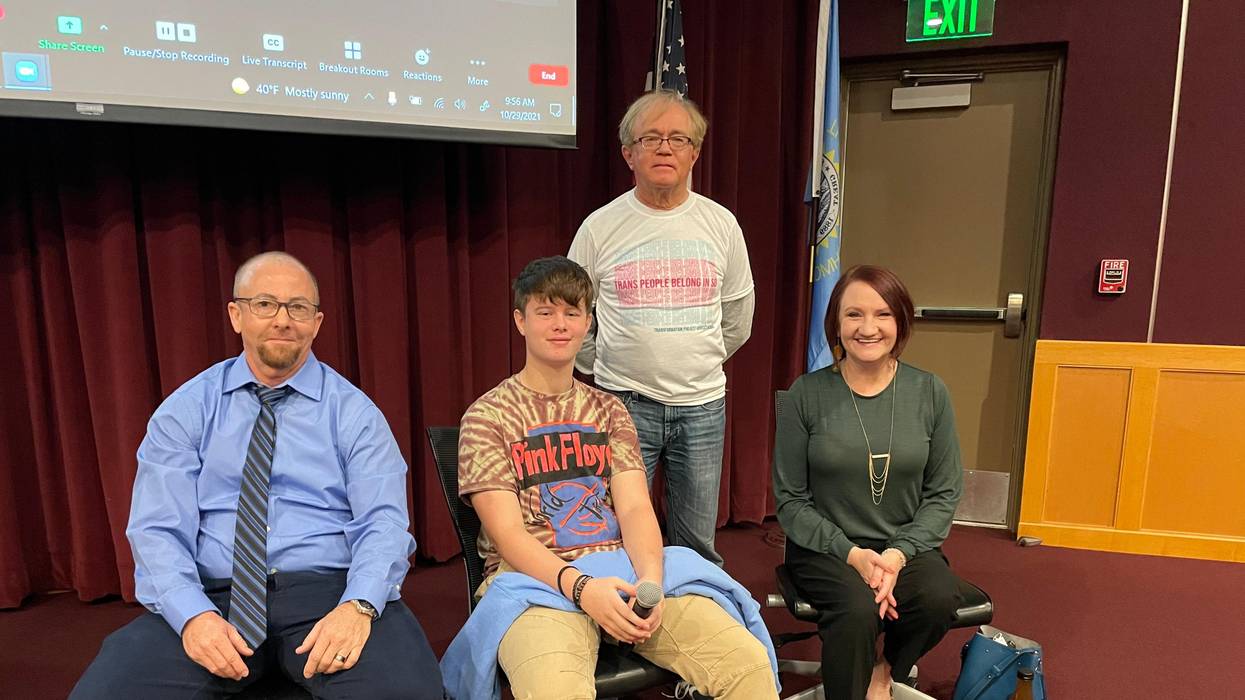
LGBTQ+ rights advocates on Thursday condemned a new South Dakota law banning transgender students from playing on sports teams matching their gender identity.
"This legislation isn't solving an actual problem that South Dakota was facing: It is discrimination, plain and simple. Shame on Gov. Noem."
The Sioux Falls Argus Leader reports Gov. Kristi Noem, a Republican with 2024 presidential aspirations, cited "fairness" as she signed S.B. 46, which mandates that scholastic sports teams from the kindergarten through collegiate levels be segregated by sex assigned at birth.
Mark Miller, Noem's chief of staff and lead counsel, last month likened transgender athletes' participation on school sports teams that match their gender identity to "terrorism."
"You see it elsewhere and don't want it to get to South Dakota," he said.
The ACLU tweeted Thursday that "this cruel and dangerous bill is part of a coordinated attack on trans youth moving nationwide."
S.B. 46, which is the first bill of its kind to be signed into law this year, is set to take effect on July 1, although implementation could be delayed by legal challenges.
A second anti-trans measure, H.B. 1005, which would bar transgender students from using restrooms that correspond with their gender identity, was passed Tuesday by the South Dakota House and was sent to the state Senate for consideration.
Kris Wilka, a 14-year-old transgender boy who plays football for Harrisburg North Middle School in Sioux Falls, will be banned from his team if the new law takes effect.
"Sports is my life," Wilka told NBC News. "My world revolves around football, and I don't know if I would be able to function without it."
Human Rights Campaign state legislative director and senior counsel Cathryn Oakley said in a statement that "instead of focusing on the real issues affecting the people of South Dakota, Gov. Noem and anti-LGBTQ+ state legislators continue their relentless, baseless, and patently discriminatory attacks against transgender kids."
"They show no shame," she continued. "The governor's eagerness to pass a bill attacking transgender kids reveals that her national political aspirations override any sense of responsibility she has to fulfill her oath to protect South Dakotans."
"Gov. Noem and South Dakota legislators need to stop playing games with vulnerable children," Oakley added. "Transgender children are children. They deserve the ability to play with their friends. This legislation isn't solving an actual problem that South Dakota was facing: It is discrimination, plain and simple. Shame on Gov. Noem."
According to the Human Rights Campaign, more than 250 pieces of anti-LGBTQ+ legislation were introduced in 31 U.S. states last year, with 17 new laws enacted in 10 states.
Hoera Kingi is an Oglala Lakota and Ngati Kahungunu transgender two-spirit woman. The non-binary two-spirit identity has been acknowledged and revered by Indigenous peoples for centuries before white invaders conquered what is now South Dakota.
Testifying against S.B. 46 last month, the former high school cheerleader said that not being able to compete on sports teams "would've been devastating to me."
"It would've stopped me from meeting my favorite people and [making] my most cherished memories," she added.

In an effort to protect South Dakota's ballot measure process from a Republican-led assault, state residents on Tuesday filed a lawsuit against a proposed amendment they argue is a "classic example of logrolling" that violates the state constitution and imperils direct democracy.
At issue is Amendment C, a legislatively referred constitutional amendment that would require a three-fifths supermajority to approve ballot measures--whether introduced through citizen initiative or by state lawmakers--that increase taxes or appropriate $10 million or more in the first five fiscal years of implementation.
"This proposed amendment is exhibit A in the effort to undermine the ballot measures process by legislatures all over the country," Kelly Hall, executive director of the Fairness Project, which started the Ballot Measure Rescue Campaign to defend direct democracy in the U.S., said in a statement Tuesday. "Special interests and extremist politicians understand that if voters can bypass legislatures intent on blocking worker-friendly change, they lose."
"In South Dakota and elsewhere," Hall added, "they're trying to change the rules in the middle of the game by raising thresholds for changing policy at the ballot box, to give themselves the power to simply ignore the will of the people."
Skye Perryman, president and CEO of Democracy Forward, said in a statement that his advocacy group is "proud to support these efforts by voters to stand up and protect South Dakota's long history of direct democracy, and uphold the will of the people."
"Constitutional Amendment C," said Perryman, "is the latest example of the orchestrated and ongoing attack from bad actors across the country on our democratic institutions."
The South Dakota Legislature's move to impose a 60% threshold is anti-democratic on its face, say opponents, especially given the state's decades-long history of enabling voters to make change directly at the ballot box through majority rule.
In addition to restricting the ability of citizens to initiate change, plaintiffs David Owen of Sioux Falls and Jim Holbeck of Renner argue that Amendment C shouldn't be allowed to appear on the ballot because it forces voters to decide on more than one change at the same time--an attempt at vote aggregation and a violation of the state constitution's single subject and separate vote requirements.
According to the suit, Amendment C contains two different subjects--a "taxation supermajority requirement" and a "spending supermajority requirement"--and therefore undermines voters' constitutional right to consider each issue separately. Some voters, for example, may support a 60% win threshold for ballot measures to raise taxes, but oppose a 60% win threshold for ballot measures to appropriate money.
Given that not all new appropriations require increasing taxes, the two topics are not necessarily linked, argue the plaintiffs, and it is illegal to force voters to either support or oppose both provisions simultaneously.
South Dakotans have "a long, proud, bipartisan history of making their voices heard through our initiative process," Owen and Holbeck said in a joint statement. "Since our state's founding, voters have passed and amended laws by majority rule, guided by the idea of voting on one issue at a time."
"Unfortunately, Amendment C silences our voice and fundamentally undermines the one issue, one vote principle of our ballot measure process," they continued. "It forces us to vote on the two distinct subjects contained in this single measure at the same time. We have a constitutional right to vote on them separately."
"In 2018, the people of South Dakota reiterated our approval of the single subject principle by explicitly adding it to our constitution," added Owen and Holbeck. "Overwhelmingly, South Dakotans said they did not want to be forced to vote for multiple policies in one measure, but that's exactly what Amendment C does. We hope the courts will agree."
Their lawsuit follows the South Dakota Supreme Court's recent decision on Amendment A. That measure to legalize hemp and recreational marijuana use was approved by voters in 2020 but nullified a year later when the high court upheld a lower court's ruling that the amendment's inclusion of multiple subjects ran afoul of the state constitution.
Owen and Holbeck, who are seeking immediate relief in the form of a permanent injunction barring Amendment C from being placed on the June primary ballot, have asked judges to apply the same logic in this case.

Footage of public school teachers in Sioux Falls, South Dakota scrambling on an ice rink to gather one-dollar bills for school supplies went viral over the weekend, with labor leaders and economic justice advocates pointing at the video as the latest evidence that schools are drastically underfunded and corporations and the wealthy must pay their fair share in taxes.
Onlookers cheered Saturday night as the teachers participated in the first-ever "Dash for Cash" at a hockey game. Five thousand dollars in one-dollar bills were laid out on a mat on the ice and the educators were given five minutes to stuff the cash into their shirts so they could use the money to buy school supplies and pay for classroom upgrades.
The money was donated by a local mortgage company, CU Mortgage Direct, according to The Guardian.
Human rights attorney Qasim Rashid called the competition "dystopian," "disgusting," and "dehumanizing."
"Tax billionaires already," he tweeted.
"South Dakota treats international money launderers better than teachers."
South Dakota is one of the lowest-ranked states in terms of education spending. According to census data, the state spends more per student than only 13 other states.
Teachers in the state also ranked last-in-the-nation for compensation in 2016 and in 2021, according to the Argus Leader, a newspaper based in Sioux Falls. The chronic low funding for public education sparked a teacher walkout in the city in early 2020. South Dakota teachers are paid an average of $48,984 per year.
A 2018 survey by the U.S. Department of Education showed that teachers in the state spend an average of $350 of their own money to pay for classroom supplies.
"My mother was a public school teacher in South Dakota. She also worked as a waitress and housekeeper to make ends meet," said organizer Nick Estes in response to the Dash for Cash. "This video shows how South Dakota teachers are humiliated just to fund their classrooms today. Imagine the U.S. military having to do this for their money."
While teachers in South Dakota are left scrambling for money to pay for school supplies, as Common Dreams reported last week, the state has become a haven for ultra-rich people looking to hide their assets and avoid taxes. More than 80 out of 106 trusts in the U.S. are located in South Dakota, granting secrecy and protection to the wealthy and powerful.
"South Dakota treats international money launderers better than teachers," tweeted Jason Linkins, deputy editor at The New Republic.
The state is also ending 2021 with an $86 million budget surplus, noted Kooper Caraway, president of the South Dakota Federation of Labor.
Last week, Republican Gov. Kristi Noem proposed a 6% increase in education funding for next year, but South Dakota Education Association Loren Paul warned the increase is not enough to fix chronic problems with underfunding.
"Our problem is the years where we don't even meet inflation, and we've had several of those," Paul told local outlet KELO last week.