

SUBSCRIBE TO OUR FREE NEWSLETTER
Daily news & progressive opinion—funded by the people, not the corporations—delivered straight to your inbox.
5
#000000
#FFFFFF
To donate by check, phone, or other method, see our More Ways to Give page.
Daily news & progressive opinion—funded by the people, not the corporations—delivered straight to your inbox.
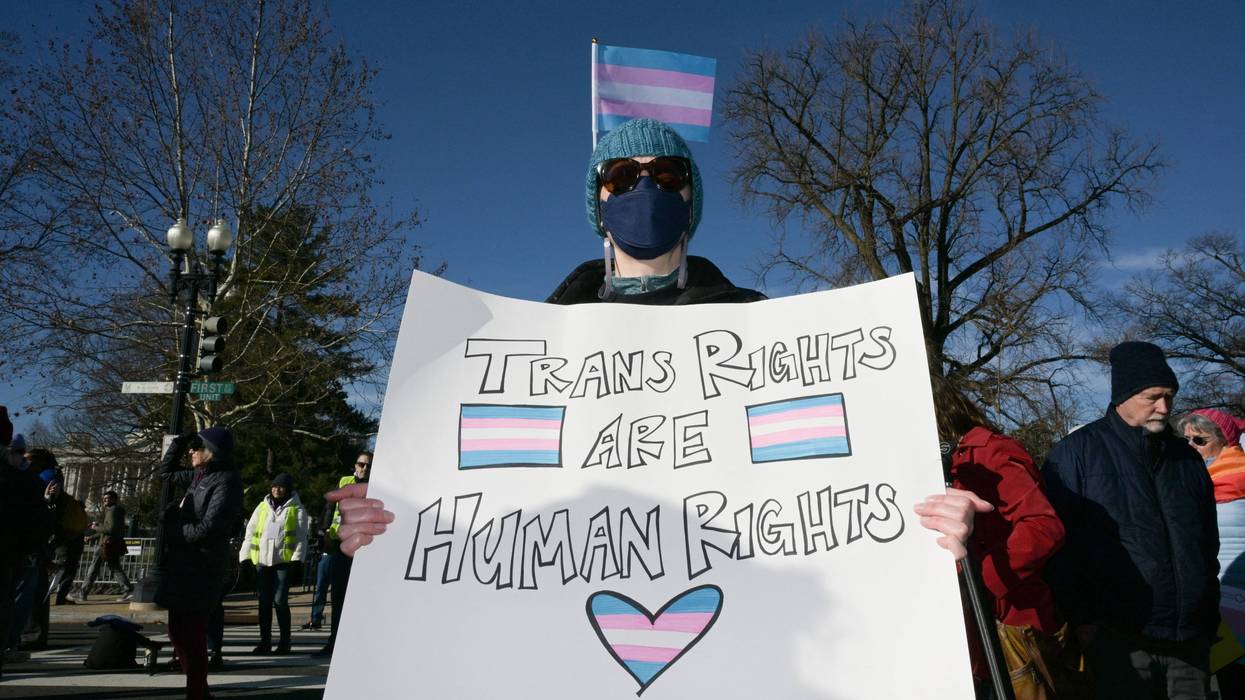
"SB 244 is a transparent attempt to deny transgender people autonomy over their own identities and push them out of public life altogether.”
Accusing Kansas Republican lawmakers of violating the state's Constitution and waging "a direct attack on the dignity and humanity of transgender Kansans" by passing a law that invalidates their driver's licenses, the ACLU on Friday filed a lawsuit on behalf of two transgender residents and called on a state judge to block the statute.
The organization took legal action a day after SB 244 went into effect, rendering the birth certificates and driver's licenses of about 1,700 Kansans invalid because they have been changed to reflect the gender identity of the people they were issued to, rather than their sex assigned at birth.
Transgender Kansans across the state received letters this week from the Kansas Department of Revenue instructing them to "surrender [their] current credential" and exchange it for one that matches their sex assigned at birth.
“Your current credential will be invalid immediately,’’ warns the letter, adding that driving without a valid license could result in penalties.
SB 244 also prohibits transgender Kansans from updating the gender marker on state-issued birth certificates and driver's licenses in the future, prohibits transgender people from using public restrooms that match their identity on government property, and allows anyone who suspects a transgender person is in violation of the law to sue the individual for damages of up to $1,000.
The bathroom provisions were added to SB 244 without a hearing or any public comment.
The state's Democratic governor, Laura Kelly, vetoed the legislation, but Republican legislators overrode her veto.
"A confident republic does not need to erase people to prove a point. It can hold together across deep differences without turning paperwork into a weapon."
Harper Seldin, a senior staff attorney for the ACLU's LGBTQ and HIV Rights Project, called the law "a cruel and craven threat to public safety all in the name of fostering fear, division, and paranoia."
“The invalidation of state-issued IDs threatens to out transgender people against their will every time they apply for a job, rent an apartment, or interact with police," said Seldin. "Taken as a whole, SB 244 is a transparent attempt to deny transgender people autonomy over their own identities and push them out of public life altogether.”
States including Texas, Florida, and Tennessee have laws requiring the gender marker on a person's driver's license to match their sex assigned at birth, but Kansas is the first state to invalidate the licenses of people who have changed the gender markers.
The law was passed as President Donald Trump and Republican lawmakers denounce what they view as radical "gender ideology," including science-backed findings that a person's gender can be fluid and that gender-affirming healthcare can reduce depression and suicidal ideation.
In 2025, the ACLU tracked more than 600 anti-LGBTQ laws and proposals in states. At least 74 were passed into law.
In the lawsuit filed in the District Court of Douglas County, two anonymous plaintiffs identified as Daniel Doe and Matthew Moe argue that SB 244 violates the Kansas Constitution's guarantees of personal autonomy, privacy, equality under the law, due process, and freedom of speech.
They argue that the law is discriminatory and violates equal protection laws because other Kansans are free to change their name or choose whether or not to list other aspects of their identity, such disclosing veteran status or a disability, on their licenses.
One critic calledlled SB 244 "humiliation with a state seal."
"This does not make anyone safer on the road. It just forces people to carry documents that lie about who they are, and then punishes them when those lies put them at risk at traffic stops, pharmacies, airports," the social media user said. "A confident republic does not need to erase people to prove a point. It can hold together across deep differences without turning paperwork into a weapon."
Heather St. Clair, a lawyer with Ballard Spahr, a law firm helping to represent the plaintiffs, said the law amounts to "state-sanctioned attack on transgender people aimed at silencing, dehumanizing, and alienating Kansans whose gender identity does not conform to the state Legislature’s preferences."
Ballard Spahr, she said, "is dedicated to protecting the constitutional rights jeopardized by this new law.”
The plaintiffs are seeking a temporary restraining order and a temporary injunction to block the law from entering into force while the case is being decided.
The advocacy group Southern Equality applauded the legal challenge.
"We are grateful to the ACLU for filing a lawsuit against this heinous law in defense of trans Kansans," said Southern Equality. "We join in solidarity with trans people everywhere: You belong in public spaces, and we will not stand by while your rights are stripped away."

"In our democracy, the press is a watchdog against abuse," said Marion County Record publisher Eric Meyer. "If the watchdog itself is the target of abuse, and all it does is roll over, democracy suffers.”
A Kansas county has agreed to pay $3 million over 2023 police raids of a local newspaper and multiple homes—one of which belonged to its elderly publisher, whose death shortly followed—sparking nationwide alarm over increasing attacks on the free press.
Marion County agreed to pay the seven-figure settlement and issue a formal apology to the publishers of the Marion County Record admitting that wrongdoing had occurred during the August 11, 2023 raids on the paper's newsroom and two homes.
The apology states that the Marion County Sheriff's Office "wishes to express its sincere regrets to Eric and Joan Meyer and Ruth and Ronald Herbel for its participation in the drafting and execution of the Marion Police Department’s search warrants on their homes and the Marion County Record. This likely would not have happened if established law had been reviewed and applied prior to the execution of the warrant."
Bernie Rhodes, an attorney for the Record, told the paper, "This is a first step—but a big step—in making sure that Joan Meyer’s death served a purpose, in making sure that the next crazed cop who thinks they can raid a newsroom understands the consequences are measured in millions of dollars."
Rhodes was referring to the 98-year-old Record co-owner, who was reportedly in good health for her age, but collapsed and died at her home in the immediate aftermath of the raid by Marion police and country sheriff's deputies.
"This is a first step—but a big step—in making sure that Joan Meyer’s death served a purpose."
Eric Meyer, Joan Meyer's son and the current publisher of the Record, said: “The admission of wrongdoing is the most important part. In our democracy, the press is a watchdog against abuse. If the watchdog itself is the target of abuse, and all it does is roll over, democracy suffers.”
According to the Record, awards include:
Record business manager Cheri Bentz—who suffered aggravation of health conditions following one of the raids—previously settled with the county for $50,000.
Katherine Jacobsen, the US, Canada, and Caribbean program coordinator at the Committee to Protect Journalists, hailed the settlement as "an important win for press freedom amid a growing trend of hostility toward those who hold power to account."
"Journalists must be able to work freely and without fear of having their homes raided and equipment seized due to the overreach of authorities," she added.
The raids—during which police seized the Record‘s electronic equipment, work product, and documentary materials—were conducted with search warrants related to an alleged identity theft investigation.
However, critics—who have called the warrants falsified and invalid—noted that the raids came as the Record investigated sexual misconduct allegations against then-Marion Police Chief Police Gideon Cody. The raids, they say, were motivated by Cody's desire to silence the paper's unfavorable reporting about him.
State District Judge Ryan Rosauer ruled last month that Cody likely committed a felony crime when he instructed a witness with whom he allegedly had an improper romantic relationship to delete text messages they exchanged before, during, and after the raids.
While Cody will not be tried in connection with Meyer's death or the 2023 raids, Rosauer ordered him to stand trial over the deleted texts.
Meyer at the time expressed dismay that Cody wasn't being tried for his mother's death or the raids. He also worried that Cody was being made a scapegoat, as other people and law enforcement agencies were involved in the incident.
Following the announcement of the settlement, Meyer said that "this never has been about money, the key issue always has been that no one is above the law."
"No one can trample on the First and Fourth Amendments for personal or political purposes and get away with it," he continued. "When my mother warned officers that the stress they were putting her under might lead to her death, she called what they were doing Hitler tactics."
"What keeps our democracy from descending as Germany did before World War II is the courage she demonstrated—and we’ve tried to continue—in fighting back," Meyer added.
"This never has been about money, the key issue always has been that no one is above the law."
Five consolidated federal civil rights lawsuits have been filed in the US District Court for the District of Kansas, alleging wrongful death, unlawful searches, retaliation for protected speech, and other claims tied to the raids.
“It’s a shame additional criminal charges aren’t possible,” Meyer said, “but the federal civil cases will do everything they can to discourage future abuses of power.”
Although unable to savor the Record's victory, Joan Meyer presciently told the officers raiding her home, "Boy, are you going to be in trouble."
“She was so right," said Rhodes.

"This is what potentially winning right-wing legal cases read like these days," said one progressive activist. "Dark stuff."
Opinion polls have repeatedly made clear that U.S. voters are turned off by the Republican Party's fixation on banning abortion care and controlling Americans' reproductive choices—but that didn't stop three GOP officials from writing in a court filing this month that they want to restrict abortion pill access because it would reduce teen pregnancy rates in their state.
"In my expert legal opinion, this is deeply gross and weird," wrote attorney and writer Madiba K. Dennie on Monday at Balls & Strikes, a news outlet focused on the judiciary.
Dennie was referring to a legal filing by Republican Attorneys General Andrew Bailey of Missouri, Kris Kobach of Kansas, and Raúl Labrador of Idaho in a case regarding mifepristone, one of two pills commonly used in medication abortions—which account for more than half of abortions in the United States.
As S.P. Rogers wrote at the newsletter Repro-Truth, attorneys general filed an amended complaint earlier this month in an effort to revive Alliance for Hippocratic Medicine v. Food and Drug Administration (FDA), a case in which the plaintiffs argued in favor of severely restricting mifepristone access nationwide.
The three states had joined the case earlier this year, before the U.S. Supreme Court rejected the case based on the plaintiffs' lack of standing.
Because the high court didn't outright dismiss the case, the three attorneys general were able to file a complaint on October 11 seeking to prohibit mifepristone use for anyone under the age of 18 and overturn eased restrictions for the drug.
Bailey, Kobach, and Labrador argued that mifepristone access would could cause "injuries" to their states because it is "depressing expected birth rates for teenaged mothers."
"A loss of potential population causes further injuries as well: The [states'] subsequent 'diminishment of political representation' and 'loss of federal funds,' such as potentially 'losing a seat in Congress or qualifying for less federal funding if their populations are' reduced or their increase diminished," reads the court filing.
In other words, wrote Rogers, in the view of the Republican state officials, "teenage girls, which the states refer to as 'teenaged mothers,' exist for the purposes of churning out new citizens for the states."
"Idaho, Kansas, and Missouri are claiming to have a legitimate, sovereign state interest in forced birth—in teenage girls and women as breeders. It's an argument that positions everyone capable of birthing as brood mares—a scenario in which the state does not exist for the people, but the people for the state—and augurs a future claim for the prohibition of contraception," added Rogers.
Republicans including GOP presidential nominee Donald Trump have signaled their desire to roll back the right to contraception.
At Balls & Strikes, Dennie wrote that the GOP officials made clear that they believe "uteri are state slush funds, and girls owe the state reproduction once they are capable of it."
"A personal dislike of somebody else taking medicine is not a legitimate grievance," wrote Dennie. "So the states are trying to show that they are entitled to the population growth and accompanying funds that pregnant minors would produce, and the FDA is getting in the way of that."
While the argument is "shocking in its brazenness," added Dennie, it shouldn't come as a surprise in a country where the Republican Party has shown no sign of backing down from its goal of banning abortion, even as news reports mount about children who have been forced to give birth and pregnant patients who have died or become gravely ill because healthcare providers have refused to treat them for fear of prosecution.
The legal complaint, said Dennie, "is a natural outgrowth of the conservative legal movement's efforts to subordinate women."

"This is an immense victory for the health, safety, and dignity of people in Kansas and the entire Midwestern region, where millions have been cut off from abortion access," said one advocate.
Reproductive rights defenders on Friday cheered a pair of Kansas Supreme Court decisions reaffirming the right to abortion and striking down various restrictions—rulings expected to impact people beyond the Midwestern state, given how many patients must now travel for care.
"The state devoted much of its brief to inviting us to reverse our earlier ruling in this case that the Kansas Constitution protects a right to abortion. We decline the invitation," Justice Eric Rosen wrote in the decision against Senate Bill 95, which outlawed a common abortion procedure for second-trimester pregnancies called dilation and evacuation (D&E).
Rosen was referring to the court's 2019 ruling that "Section 1 of the Kansas Constitution Bill of Rights affords protection of the right of personal autonomy," which "allows a woman to make her own decisions regarding her body, health, family formation, and family life—decisions that can include whether to continue a pregnancy."
The justice wrote Friday that "S.B. 95 does not further patient safety, it compromises patient safety," noting that "as the district court found and the state did not contest, S.B. 95 eliminates a safe and common medical procedure and leaves patients subject to procedures that are rarely used, are untested, and are sometimes more dangerous or impossible."
The court's other new ruling was about what critics call targeted restrictions on abortion providers (TRAP) policies. Both decisions were 5-1—with Justice Stegall Caleb dissenting and Justice K.J. Wall not participating—and followed Kansas voters rejecting a proposed anti-choice amendment to the state constitution in August 2022.
"Now the Kansas Supreme Court has decisively reaffirmed that the state constitution protects abortion as a fundamental right."
"Kansas voters made it loud and clear in 2022: The right to abortion must be protected. Now the Kansas Supreme Court has decisively reaffirmed that the state constitution protects abortion as a fundamental right," said Nancy Northup, president and CEO of the Center for Reproductive Rights, which was involved with both cases.
"This is an immense victory for the health, safety, and dignity of people in Kansas and the entire Midwestern region, where millions have been cut off from abortion access," Northup added. "We will continue our fight to ensure Kansans can access the essential healthcare they need in their home state."
The anti-choice ballot measure's failure two years ago came shortly after the U.S. Supreme Court's right-wing supermajority reversed Roe v. Wade with Dobbs v. Jackson Women's Health Organization—which bolstered GOP efforts to further restrict reproductive rights at the state level, forcing patients to more frequently travel for abortion care.
Kansas allows abortion care up until 22 weeks of pregnancy and has seen an influx of healthcare refugees from states that have imposed bans. The Guttmacher Institute said last month that "in Kansas, clinic numbers increased by 50% (from four to six) between 2020 and 2023, and the number of abortions rose by 152% (an increase of 12,440)."
Despite the fresh wins in court, the broader battle for reproductive freedom continues in Kansas. As KMUW reported Friday:
Several new abortion laws took effect in Kansas earlier this week, but one of them—a law requiring doctors to ask patients getting abortions their reason for doing so—is being challenged in court. A Johnson County judge said Monday that doctors could add the law to a larger lawsuit they brought against a handful of older state abortion restrictions, including a 24-hour waiting period. The judge agreed to temporarily block the older laws while the case proceeds.
The Kansas Department of Health and Environment told providers it will "not, for now" enforce the abortion reasons law, providers said Monday. The health department has not responded to requests seeking to confirm that.
The Center for Reproductive Rights noted Friday that it "is currently representing abortion providers in another ongoing challenge to several onerous restrictions including a law forcing providers to falsely tell their patients that a medication abortion can be 'reversed,' an unproven claim not based on medicine or science."

As context, the median household income in Kansas is just shy of $70,000, meaning that Mr. Koch’s windfall would be the equivalent of more than 12 years’ worth of income for the typical Kansas household.
Last week, both houses of the Kansas legislature approved a significant tax cut centered around replacing the state’s graduated rate income tax structure with a flat tax instead. The bulk of this would flow to upper-income families, mostly through lowering the state’s top income tax rate from 5.7 to 5.25 percent. This tax cut would be especially lucrative for the state’s wealthiest individual, billionaire Charles Koch. We estimate that Mr. Koch could expect to receive a tax cut in the neighborhood of $875,000 per year. As context, the median household income in Kansas is just shy of $70,000, meaning that Mr. Koch’s windfall would be the equivalent of more than 12 years’ worth of income for the typical Kansas household.
It bears noting that an $875,000 annual tax cut is more than 7,500 times larger than the $116 average tax cut that the middle 20 percent of earners could expect to receive under this legislation.
The figure below combines data from the ITEP Tax Microsimulation Model with an off-model analysis performed using data on Mr. Koch’s finances that were reported by Pro Publica and Forbes. According to the ITEP Model, the top 1 percent of earners in Kansas would see far larger tax cuts under this legislation than anyone among the bottom 99 percent of families. The $6,608 average tax cut going to top earners is 57 times larger than the average cut for middle-income earners and 114 times larger than the average cut for the state’s lowest-income residents. But some members of the top 1 percent, almost certainly including Mr. Koch, would receive tax cuts far larger than $6,608.

The ITEP Model analyzes tax impacts across the income scale for all state and local tax types. But the model’s ability to estimate effects at the extreme reaches of the economic scale, particularly at the state level, is limited by IRS restrictions on reporting of top earners’ incomes and deductions. Typically, the highest income group for which we report tax data is the top 1 percent of earners. Supplementing our model data with additional data on the nation’s wealthiest families allows us to offer a fuller picture of tax impacts than the model alone can provide.
Without access to Mr. Koch’s Kansas tax filings, it is not possible to compute his precise tax cut with certainty. But a reasonable estimate can be arrived at using federal tax return data reported by ProPublica.
That reporting indicated that Mr. Koch enjoyed an average federal adjusted gross income of $213 million dollars per year across the six-year period spanning 2013 to 2018, and average federal taxable income of approximately $141 million per year. Adjusting those figures to account for differences in state and federal definitions of taxable income, and growing them in line with recent increases in Mr. Koch’s wealth as reported by Forbes, leads us to conclude that his state taxable income is likely in the vicinity of $194 million today. For somebody with an income at that level, the tax bracket and exemption changes contained in the legislation that recently passed the Kansas legislature would provide a tax cut of roughly $875,000 per year.
Choosing to cut taxes for high-income families in Kansas will inevitably require the state to do less of something else instead, be it fewer teacher pay raises, less frequent infrastructure maintenance, or any number of other reductions in public services.
Mr. Koch could also expect to receive additional sales and property tax cuts under the bill, but those would amount to little more than a rounding error relative to the far larger windfall he would receive from the top income tax rate reduction.
It bears noting that an $875,000 annual tax cut is more than 7,500 times larger than the $116 average tax cut that the middle 20 percent of earners could expect to receive under this legislation. Similar, it is more than 15,000 times larger than the $58 average tax cut that the state’s lowest earners could expect to receive.
Across the country, state revenue and budget outlooks are rapidly becoming less rosy than they have been during the last few years. As surpluses dwindle and some states begin to face shortfalls, the tradeoffs associated with deep tax cutting will become harder to ignore. Choosing to cut taxes for high-income families in Kansas will inevitably require the state to do less of something else instead, be it fewer teacher pay raises, less frequent infrastructure maintenance, or any number of other reductions in public services. Lawmakers should imagine what Kansas could do for its residents with $875,000 a year, and then ask a simple question: is that money better spent on helping our communities thrive, or lining the pockets of a single billionaire?

"The Record should sue not only to deter future searches of its newsroom, but to protect journalists and news outlets around the country from future illegal raids," said one press freedom advocate.
The local prosecutor behind last week's police raid on a Kansas newspaper and its co-owners' home—which has been widely decried by media outlets and press freedom advocates—agreed on Wednesday to withdraw the related search warrant and return seized items including computers and cellphones to the Marion County Record.
"On Monday, August 14, 2023, I reviewed in detail the warrant applications made Friday, August 11, 2023 to search various locations in Marion County including the office of the Marion County Record," said Marion County Attorney Joel Ensey in a statement. "The affidavits, which I am asking the court to release, established probable cause to believe that an employee of the newspaper may have committed the crime of K.S.A. 21-5839, Unlawful Acts Concerning Computers."
"Upon further review however, I have come to the conclusion that insufficient evidence exists to establish a legally sufficient nexus between this alleged crime and the places searched and the items seized," he continued. "As a result, I have submitted a proposed order asking the court to release the evidence seized. I have asked local law enforcement to return the material seized to the owners of the property."
Ensey noted that "this matter will remain under review" until the Kansas Bureau of Investigation, which is now responsible for the probe, may submit findings to his office for a charging decision. The KBI Wednesday said that "this investigation remains open" and "will proceed independently, and without review or examination of any of the evidence seized on Friday."
KSHB 41 reported that the Record's lawyer, Bernie Rhodes, "says all items that were seized as part of the raid have been released back to the attorney representing the newspaper," and "a forensics expert is on standby to examine the items that were seized."
Rhodes told The Washington Post that the withdrawal of the warrant was "a promising first step" but "it doesn't do anything to undo the past and regrettably, it doesn't bring back Joan Meyer," who lived with her son, Eric Meyer, the Record's co-owner and publisher.
According to the targeted newspaper, "Stressed beyond her limits and overwhelmed by hours of shock and grief after illegal police raids on her home and the Marion County Record newspaper office Friday, 98-year-old newspaper co-owner Joan Meyer, otherwise in good health for her age, collapsed Saturday afternoon and died at her home."
Echoing Rhodes, PEN America's Shannon Jankowski said in a statement Wednesday that "the withdrawal of a search warrant against the Marion County Record and the return of seized devices after a raid by law enforcement is a first step toward accountability in this unconscionable breach of press freedom."
"While withdrawing the search warrant is the correct step, Marion County tragically cannot undo the death of the newspaper's 98-year-old co-owner Joan Meyer, who collapsed and died after police rifled through papers and seized materials from her home," she stressed. "Nor can law enforcement reverse the damage that has resulted to the newspaper staff, its confidential sources, and the chill on press freedom writ large from the raid. PEN America continues to stand in solidarity with the Record and urges that those responsible for the raid be held to account for violating the newspaper's rights."
Leaders at the Freedom of the Press Foundation similarly called for accountability on Wednesday, with deputy director of advocacy Caitlin Vogus saying that "the Record and the public deserve to know why the Marion police decided to conduct this raid and whether they gave even a moment's thought to the First Amendment or other legal restrictions before they decided to search a newsroom."
"Government officials who think they can raid a newsroom should be on notice that there are consequences for searches that violate the law," Vogus continued, noting that the newspaper has threatened a lawsuit. "The Record should sue not only to deter future searches of its newsroom, but to protect journalists and news outlets around the country from future illegal raids."
In this case, Freedom of the Press Foundation director of advocacy Seth Stern argued, "authorities deserve zero credit for coming to their senses only after an intense backlash from the local and national media and an aggressive letter from the Record's lawyer."
"These kinds of frivolous abuses of the legal system to attack the press are intended not to win but to intimidate journalists," he said. "Usually, after accomplishing that goal, authorities are able to drop charges quietly to avoid embarrassing themselves in court. It's good that this time the process is playing out publicly, thanks to the media attention this case rightfully received."
Despite several obstacles created by local law enforcement seizing electronics and reporting materials, the Record published on Wednesday—with a front-page headline that declared, "SEIZED... but not silenced."
"Phyllis Zorn, a staff reporter, said she had heard of the term 'all-nighter,' but she didn't know it to be real before," the Kansas Reflector reported, noting that newspaper staff finished the pages of Wednesday's edition just after 5:00 am and Eric Meyer made it home at 7:30 am.
The publisher told the Reflector that "if we hadn't been able to figure out how to get computers together, Phyllis and I and everybody else would be handwriting notes out on Post-It notes and putting them on doors around the town, because we were going to publish one way or another."
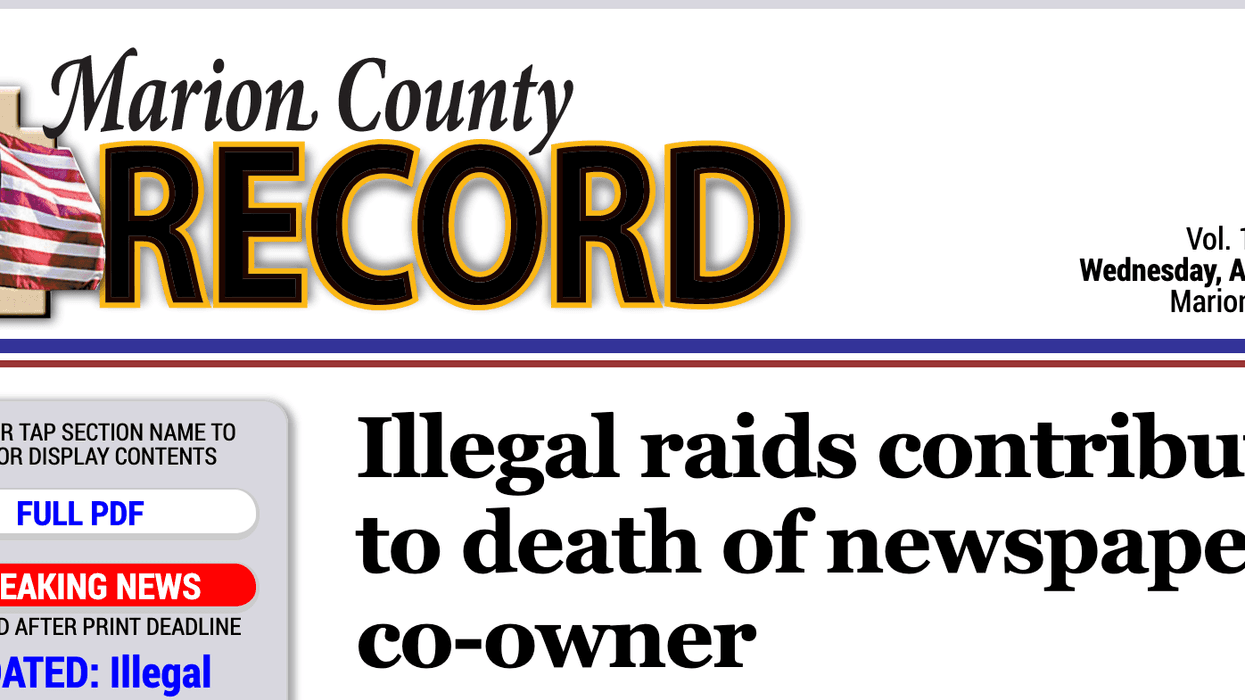
One columnist said that "it is not hyperbole to say that this attack on the people's right to know appears to have killed" 98-year-old Joan Meyer.
Advocacy groups and reporters across the United States have sounded the alarm throughout the weekend about a legally dubious police raid on Friday targeting the Marion County Record office and the publisher's Kansas home in an alleged identity theft investigation—events that the newspaper said contributed to the death of the elderly co-owner.
"Stressed beyond her limits and overwhelmed by hours of shock and grief after illegal police raids on her home and the Marion County Record newspaper office Friday, 98-year-old newspaper co-owner Joan Meyer, otherwise in good health for her age, collapsed Saturday afternoon and died at her home," the outlet reported.
Joan Meyer lived with her son, Eric Meyer, the Record's co-owner and publisher. According to the newspaper:
She had not been able to eat after police showed up at the door of her home Friday with a search warrant in hand. Neither was she able to sleep Friday night.
She tearfully watched during the raid as police not only carted away her computer and a router used by an Alexa smart speaker but also dug through her son Eric's personal bank and investments statements to photograph them. Electronic cords were left in a jumbled pile on her floor.
Joan Meyer's ability to stream TV shows at her home and to get help through her Alexa smart speakers were taken away with the electronics.
Joan Meyer "died in the line of duty," Kansas City Star columnist Melinda Henneberger wrote Sunday. "It is not hyperbole to say that this attack on the people's right to know appears to have killed her."
Henneberger highlighted that Joan Meyer had responded to the raid by referencing German dictator Adolf Hitler, telling The Wichita Eagle that "these are Hitler tactics and something has to be done."
Eric Meyer told the Kansas Reflector that the city of Marion's five police officers and two sheriff's deputies forced took "everything we have" in a "chilling" raid motivated by a confidential source leaking to the paper evidence that Kari Newell—a local restaurateur who was trying to obtain a liquor license—had been convicted of drunken driving but continued using a vehicle without a driver's license.
"Basically," he said, "all the law enforcement officers on duty in Marion County, Kansas, descended on our offices today and seized our server and computers and personal cellphones of staff members all because of a story we didn't publish."
The Reflector explained Friday that the search warrant appears to violate a federal law intended to protect journalists and the Marion County District Court Magistrate Judge Laura Viar, who signed it, did not respond to a request for comment.
As the newspaper noted Saturday:
The Marion Police Department, in a statement posted Saturday on the department's Facebook page, acknowledged that the federal Privacy Protection Act protects journalists from searches. However, the department argued, the law doesn't apply when journalists are suspected of criminal activity.
[...]
Newell declined to answer questions for this story but pointed to a statement she issued Saturday on her personal Facebook page. She said someone had used a piece of mail addressed to her from the Kansas Department of Revenue to obtain her driver's license number and date of birth. That information was then used to find her driver's license history through KDOR's website.
The Record itself confirmed that the paper, whose staff was forced to stay outside for hours during a heat advisory, "is expected to file a federal suit against the city of Marion and those involved in the search, which legal experts contacted were unanimous in saying violated multiple state and federal laws, including the U.S. Constitution, and multiple court rulings."
"Our first priority is to be able to publish next week," said Eric Meyer, "but we also want to make sure no other news organization is ever exposed to the Gestapo tactics we witnessed today. We will be seeking the maximum sanctions possible under law."
Across the state and beyond, journalists and advocates have been quick to weigh in—including former students of Eric Meyer, who was a journalism professor at the University of Illinois Urbana-Champaign for over two decades:
"Based on the reporting so far, the police raid of the Marion County Record on Friday appears to have violated federal law, the First Amendment, and basic human decency. Everyone involved should be ashamed of themselves," Freedom of the Press Foundation director of advocacy Seth Stern said in a statement Saturday.
"This looks like the latest example of American law enforcement officers treating the press in a manner previously associated with authoritarian regimes," he added. "The anti-press rhetoric that's become so pervasive in this country has become more than just talk and is creating a dangerous environment for journalists trying to do their jobs."
Noting Eric Meyer's warning that the raid is "going to have a chilling effect on us even tackling issues" and "on people giving us information,” Kansas Reflector opinion editor Clay Wirestone wrote Saturday that "no matter how the story shakes out—if officials return all the seized computers and cellphones this afternoon—a message has been sent. That message conflicts with the tenets of an open society. It conflicts with free expression. It shuts down the ability of democracy's defenders to do their jobs, informing and educating the public."
Kansas Press Association executive director Emily Bradbury said that "an attack on a newspaper office through an illegal search is not just an infringement on the rights of journalists but an assault on the very foundation of democracy and the public's right to know. This cannot be allowed to stand."
PEN America's journalism and disinformation program director, Shannon Jankowski, similarly said that "such egregious attempts to interfere with news reporting cannot go unchecked in a democracy. Law enforcement can, and should, be held accountable for any violations of the Record's legal rights."
The president of the National Press Club and its Journalism Institute, Eileen O'Reilly and Gil Klein, also demanded accountability, saying that "we are shocked and outraged by this brazen violation of press freedom by authorities in Marion County, Kansas."
"A law enforcement raid of a newspaper office is deeply upsetting anywhere in the world. It is especially concerning in the United States, where we have strong and well-established legal protections guaranteeing the freedom of the press," they continued. "We demand local authorities return the reporting equipment to the Marion County Record immediately, and we expect a full investigation by appropriate state and federal authorities into why this search warrant was requested, authorized, and executed."
Committee to Protect Journalists president Jodie Ginsberg echoed calls for investigations into the members of law enforcement and the judiciary behind the "deeply disturbing" raid.
"Local news providers are essential in holding power to account—and they must be able to report freely, without fear of authorities' overreach," Ginsberg said. "This kind of action by police—which we sadly see with growing frequency worldwide—has a chilling effect on journalism and on democracy more broadly."

"Management's retaliatory threats are despicable, but union nurses won't give up on our fight for our patients."
The largest nurses union in the United States said Tuesday that the nonprofit hospital chain Ascension had "failed to intimidate" thousands of its members as 2,000 registered nurses in Texas and Kansas went forward with a historic one-day strike to demand safe staffing levels in their contracts—a matter, they said, of putting patients over profits.
Registered nurses represented by National Nurses United (NNU) staged the strike despite a threat from Ascencion, the second-largest Catholic nonprofit healthcare network in the U.S., to impose a three-day lockout on anyone who took part in the work stoppage.
The strike is being held at Ascension via Christi St. Joseph Hospital and Ascension via Christi St. Francis Hospital, both in Wichita, Kansas, and Ascension Seton Medical Center in Austin.
The strike is reportedly the largest ever held by the union in Texas and the first in Kansas.
"Management's retaliatory threats are despicable, but union nurses won't give up on our fight for our patients," said Kris Fuentes, a nurse at Ascension Seton Medical Center. "Ascension's dangerous staffing practices disrupt our ability to provide quality care and put our patients at risk every day. This is a clear sign Ascension would rather use its vast resources to delay improvement than to invest in the care our patients and our communities deserve with appropriate staffing."
NNU said that despite Ascension's vast financial resources, it has for years maintained what nurses say are dangerously low staffing levels, with roughly six patients assigned to each nurse in a shift, according to The Austin Chronicle.
In California, hospitals are legally required to assign no more than five general patients or two critical care patients to a single nurse.
"Nurses at Seton say chemotherapy patients don't have a dedicated chemotherapy nurse, so nurses must leave their patients to administer treatment," reported the Chronicle last week. "There's been an increase in falls as patients try to get to the bathroom by themselves when nurses can't come fast enough."
Lindsay Spinney, who works in Seton's neonatal intensive care unit, told the outlet that she is frequently tasked with caring for three or four medically fragile babies at a time.
"Everybody that's taken care of a baby knows how challenging one can be," Spinney said. "These tiny people can't tolerate mistakes. It's a safety issue. The community should be concerned that the hospital is willing to do that, rather than help us get to a good solution that's safe for everyone."
While forcing patients and nurses to cope with understaffing, Ascension has amassed $19.5 billion in cash reserves. The chain also has "an investment arm that manages $41 billion and a private equity operation worth $1 billion," said NNU.
STAT News reported in 2021 that Ascension's foray into private equity was "unprecedented and strikingly unusual" for a healthcare company that claims to be a nonprofit, while a New York Times investigation found that the chain has allowed high provider-to-patient ratios "in an effort to improve profitability."
Sen. Bernie Sanders (I-Vt.) on Tuesday expressed strong support for the nurses and said Ascension's treatment of its healthcare professionals is indicative of "the greed in our corporate healthcare system."
On the picket line, nurses carried signs reading, "Called heroes, treated like zeroes," and "Staff shortages cost lives."
"Nurses are patient advocates at the bedside and, when we need to be, on the strike line," said Carol Samsel, an intensive care unit nurse at St. Joseph Hospital. "Union nurses are ready to stand united against these conditions, which are driving away both veteran nurses, whom we need to ensure the highest standards of care, and new graduates, who are necessary for the sustainability of our profession."

"This is an attempt to blatantly disregard the will of the people."
Kansas voters left little room for interpretation when a sizable majority voted in August to reject a ballot measure that would have paved the way for a statewide abortion ban—but that isn't stopping Republicans from attempting to force residents to continue unwanted pregnancies by imposing city-by-city bans.
State Sen. Chase Blasi on Thursday introduced Senate Bill 65, which would authorize cities and counties "to enact local laws more stringent than state law regarding regulation of abortion" and would repeal the state law which prohibits "political subdivisions" from enacting bans.
The proposal's language makes clear that cities and counties would not be permitted to protect abortion rights if a state ban were to be imposed in the future—only to pass bans if abortion care remains legal in Kansas.
"The irony of this bill is too much," Anamarie Rebori Simmons, a spokesperson for Planned Parenthood Great Plains Votes, told The New Republic on Friday. "The party that tried to remove fundamental protections from the state constitution didn't get the outcome they wanted when Kansans overwhelmingly supported abortion access. This is an attempt to blatantly disregard the will of the people."
Blasi proposed the legislation five months after 59% of Kansas voters rejected a ballot measure which would have removed the right to abortion care from the state constitution. In 2019, the Kansas Supreme Court ruled that under the constitution, pregnant people have a "right to personal autonomy" and that Kansans could legally obtain abortion care even if Roe v. Wade was overturned as it was last year.
The rejection of the ballot measure in August was seen as a major victory for abortion rights advocates and a clear illustration of the fact that Americans in both red and blue states "want to make their own decisions about abortion," as Nancy Northrup, president and CEO of the Center for Reproductive Rights, said at the time.
Since then, voters in Michigan, California, Kentucky, Montana, and Vermont have been asked whether they support or oppose restricting reproductive rights, and in all the states they have voted in favor of abortion access.
Washington Post reporter Caroline Kitchener noted that proposals like Blasi's "could become part of the playbook for combating the success of ballot initiatives that protect the right to abortion."
In Kansas, Rebori Simmons told The New Republic, "Abortion rights won in a landslide, including in the home county of the bill’s sponsor."
"Politicians serve as the voice of the people in the legislature," she said, "and Republican lawmakers should know better than to silence those they represent."

Cleanup and assessment efforts continued Monday after a Canadian fossil fuel company's pipeline spilled nearly an Olympic-sized swimming pool's worth of crude tar sands oil into a northern Kansas creek that feeds a watershed providing drinking water for hundreds of thousands of people.
"The only safe way to transport tar sands oil is not to do it at all."
In what's being called the largest U.S. onshore crude oil leak in nearly a decade and the largest by far in the accident-prone Keystone Pipeline system's history, approximately 14,000 barrels, or 600,000 gallons, of crude tar sands oil spewed from the Keystone 1 pipeline onto surrounding land and into Mill Creek just north of Washington, Kansas at around 8:00 pm on Wednesday.
Mill Creek flows into the Little Blue River, which in turn drains into the Big Blue River, which then runs into the Tuttle Creek Reservoir before draining into the Kansas River.
Aerial footage published by Nebraska Public Media over the weekend showed the extent of the damage:
"Over 61,000 square miles of watershed in Kansas, southern Nebraska, and eastern Colorado drain to the Kansas River, the drinking water source for over 800,000 Kansans and a vital natural resource," the local environmental group Friends of the Kaw said in a statement Friday.
"This area includes the creek, rivers, and reservoir potentially impacted by this Keystone pipeline spill. While Washington County is seemingly far away from the Kansas River, disasters like this one illustrate how connected the people and places in our watershed truly are," the group added.
Calgary, Alberta-based TC Energy said Sunday that the company has "contained" the spill and "continues to progress in our response" to the accident. The firm also said it is working with federal, state, and tribal agencies in response to the spill.
"We appreciate the patience and collaboration of the surrounding community and partner agencies for their support in responding to this incident," the company added. "We recognize this is concerning to the community and commit that we will continue our response until we have fully remediated the site."
While part of the same system, the Keystone 1 pipeline--which carries an estimated 720,000 barrels of Canadian tar sands oil per day--is a separate conduit from the proposed Keystone XL extension that was defeated by Indigenous, green, and progressive activism and rejected by the Obama and Biden administrations.
The Keystone system carries tar sands oil--what the National Congress of American Indians calls "the world's dirtiest and most environmentally destructive form of oil"--from Alberta, Canada to refineries in Illinois and the Texas Gulf Coast. The pipelines are staunchly opposed by Indigenous and environmental activists, many of whom have been arrested and some of whom have been criminally charged.
Keystone XL opponents warned of the danger of leaks prior to and during its construction, which was halted last year. According to the anti-pipeline group Bold Nebraska, there have been 22 Keystone spills since 2010.
"As we wait to hear how much tar sands and toxic chemicals like benzene have polluted our water from TC Energy's Keystone 1 pipeline, it is critical to note our state and counties need better laws on the books for pipelines," Bold Nebraska founder Jane Kleeb said in a statement.
"Thankfully, landowners and tribal nations came together to stop the larger Keystone XL pipeline from cutting through sensitive areas of the Ogallala Aquifer and the Niobrara River," Kleeb added. "Now is the time to get stronger laws on the books to protect our state's assets--the land, the water, and the people."
Friends of the Kaw implored, "For the sake of the people and wildlife in Washington County and those living downstream who could be impacted, we urge TC Energy to clean up the entire spill and to take action on any later impacts that may occur as a result of their actions."