

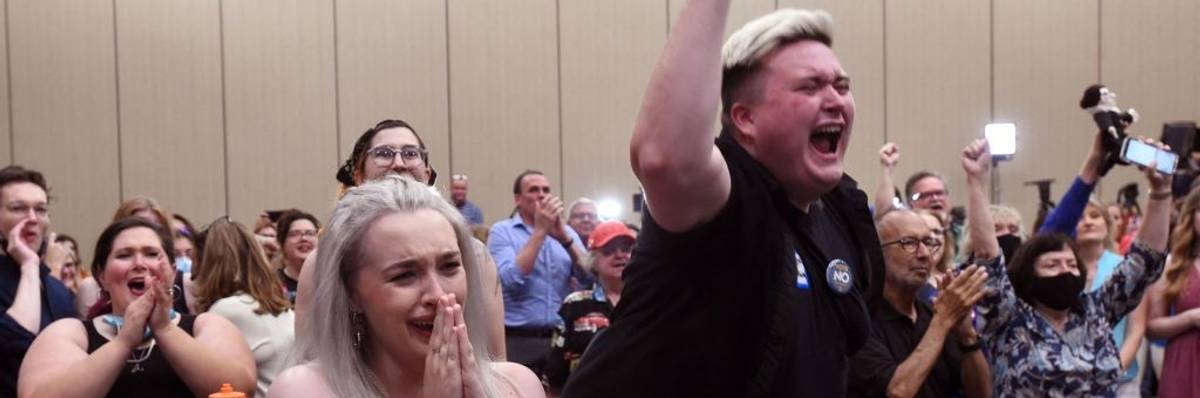
Abortion rights supporters react to the failure of an anti-choice state constitutional amendment in Overland Park, Kansas on August 2, 2022.
Kansas Supreme Court Affirms Abortion Rights, Strikes Down Restrictions
"This is an immense victory for the health, safety, and dignity of people in Kansas and the entire Midwestern region, where millions have been cut off from abortion access," said one advocate.
Reproductive rights defenders on Friday cheered a pair of Kansas Supreme Court decisions reaffirming the right to abortion and striking down various restrictions—rulings expected to impact people beyond the Midwestern state, given how many patients must now travel for care.
"The state devoted much of its brief to inviting us to reverse our earlier ruling in this case that the Kansas Constitution protects a right to abortion. We decline the invitation," Justice Eric Rosen wrote in the decision against Senate Bill 95, which outlawed a common abortion procedure for second-trimester pregnancies called dilation and evacuation (D&E).
Rosen was referring to the court's 2019 ruling that "Section 1 of the Kansas Constitution Bill of Rights affords protection of the right of personal autonomy," which "allows a woman to make her own decisions regarding her body, health, family formation, and family life—decisions that can include whether to continue a pregnancy."
The justice wrote Friday that "S.B. 95 does not further patient safety, it compromises patient safety," noting that "as the district court found and the state did not contest, S.B. 95 eliminates a safe and common medical procedure and leaves patients subject to procedures that are rarely used, are untested, and are sometimes more dangerous or impossible."
The court's other new ruling was about what critics call targeted restrictions on abortion providers (TRAP) policies. Both decisions were 5-1—with Justice Stegall Caleb dissenting and Justice K.J. Wall not participating—and followed Kansas voters rejecting a proposed anti-choice amendment to the state constitution in August 2022.
"Now the Kansas Supreme Court has decisively reaffirmed that the state constitution protects abortion as a fundamental right."
"Kansas voters made it loud and clear in 2022: The right to abortion must be protected. Now the Kansas Supreme Court has decisively reaffirmed that the state constitution protects abortion as a fundamental right," said Nancy Northup, president and CEO of the Center for Reproductive Rights, which was involved with both cases.
"This is an immense victory for the health, safety, and dignity of people in Kansas and the entire Midwestern region, where millions have been cut off from abortion access," Northup added. "We will continue our fight to ensure Kansans can access the essential healthcare they need in their home state."
The anti-choice ballot measure's failure two years ago came shortly after the U.S. Supreme Court's right-wing supermajority reversed Roe v. Wade with Dobbs v. Jackson Women's Health Organization—which bolstered GOP efforts to further restrict reproductive rights at the state level, forcing patients to more frequently travel for abortion care.
Kansas allows abortion care up until 22 weeks of pregnancy and has seen an influx of healthcare refugees from states that have imposed bans. The Guttmacher Institute said last month that "in Kansas, clinic numbers increased by 50% (from four to six) between 2020 and 2023, and the number of abortions rose by 152% (an increase of 12,440)."
Despite the fresh wins in court, the broader battle for reproductive freedom continues in Kansas. As KMUW reported Friday:
Several new abortion laws took effect in Kansas earlier this week, but one of them—a law requiring doctors to ask patients getting abortions their reason for doing so—is being challenged in court. A Johnson County judge said Monday that doctors could add the law to a larger lawsuit they brought against a handful of older state abortion restrictions, including a 24-hour waiting period. The judge agreed to temporarily block the older laws while the case proceeds.
The Kansas Department of Health and Environment told providers it will "not, for now" enforce the abortion reasons law, providers said Monday. The health department has not responded to requests seeking to confirm that.
The Center for Reproductive Rights noted Friday that it "is currently representing abortion providers in another ongoing challenge to several onerous restrictions including a law forcing providers to falsely tell their patients that a medication abortion can be 'reversed,' an unproven claim not based on medicine or science."
We are at a crossroads
This country and this world are at a monumental crossroads. In a few short weeks, US voters will have an opportunity to beat back the forces of fascism and confront the billionaires who are rigging the economy, our media system, and our democracy, making it increasingly impossible for ordinary people to get by. We’re not just talking about the election. We’re talking about what must be done once these fascist elements are vanquished from power. We need a bolder set of solutions than what either major party has so far been willing to offer and a working-class movement ready to fight like hell for it. Trump didn't emerge from nowhere. The conditions that fueled MAGA authoritarianism were created by decades of radical neoliberal economic policies and a corrupt political system dominated by corporate interests. They slashed taxes on the super-rich, promising that the benefits would trickle down. They said giveaways to the corporate titans would make life more affordable for the rest of us. It was all bullshit. And when a bitter, betrayed populace searches for someone to blame, right-wing demagogues have little trouble finding scapegoats. People know when they're being lied to, but you won't hear any of this from the corporate media. Only independent journalism—powered and funded by people who believe in building a better world—can deliver truly trustworthy daily news. Our Fall Campaign is underway, and we need your help. To power our newsroom through the rest of the year, we need to raise $125,000 by midnight on October 31. So if you share our vision, please contribute whatever you can to sustain our work. |
Reproductive rights defenders on Friday cheered a pair of Kansas Supreme Court decisions reaffirming the right to abortion and striking down various restrictions—rulings expected to impact people beyond the Midwestern state, given how many patients must now travel for care.
"The state devoted much of its brief to inviting us to reverse our earlier ruling in this case that the Kansas Constitution protects a right to abortion. We decline the invitation," Justice Eric Rosen wrote in the decision against Senate Bill 95, which outlawed a common abortion procedure for second-trimester pregnancies called dilation and evacuation (D&E).
Rosen was referring to the court's 2019 ruling that "Section 1 of the Kansas Constitution Bill of Rights affords protection of the right of personal autonomy," which "allows a woman to make her own decisions regarding her body, health, family formation, and family life—decisions that can include whether to continue a pregnancy."
The justice wrote Friday that "S.B. 95 does not further patient safety, it compromises patient safety," noting that "as the district court found and the state did not contest, S.B. 95 eliminates a safe and common medical procedure and leaves patients subject to procedures that are rarely used, are untested, and are sometimes more dangerous or impossible."
The court's other new ruling was about what critics call targeted restrictions on abortion providers (TRAP) policies. Both decisions were 5-1—with Justice Stegall Caleb dissenting and Justice K.J. Wall not participating—and followed Kansas voters rejecting a proposed anti-choice amendment to the state constitution in August 2022.
"Now the Kansas Supreme Court has decisively reaffirmed that the state constitution protects abortion as a fundamental right."
"Kansas voters made it loud and clear in 2022: The right to abortion must be protected. Now the Kansas Supreme Court has decisively reaffirmed that the state constitution protects abortion as a fundamental right," said Nancy Northup, president and CEO of the Center for Reproductive Rights, which was involved with both cases.
"This is an immense victory for the health, safety, and dignity of people in Kansas and the entire Midwestern region, where millions have been cut off from abortion access," Northup added. "We will continue our fight to ensure Kansans can access the essential healthcare they need in their home state."
The anti-choice ballot measure's failure two years ago came shortly after the U.S. Supreme Court's right-wing supermajority reversed Roe v. Wade with Dobbs v. Jackson Women's Health Organization—which bolstered GOP efforts to further restrict reproductive rights at the state level, forcing patients to more frequently travel for abortion care.
Kansas allows abortion care up until 22 weeks of pregnancy and has seen an influx of healthcare refugees from states that have imposed bans. The Guttmacher Institute said last month that "in Kansas, clinic numbers increased by 50% (from four to six) between 2020 and 2023, and the number of abortions rose by 152% (an increase of 12,440)."
Despite the fresh wins in court, the broader battle for reproductive freedom continues in Kansas. As KMUW reported Friday:
Several new abortion laws took effect in Kansas earlier this week, but one of them—a law requiring doctors to ask patients getting abortions their reason for doing so—is being challenged in court. A Johnson County judge said Monday that doctors could add the law to a larger lawsuit they brought against a handful of older state abortion restrictions, including a 24-hour waiting period. The judge agreed to temporarily block the older laws while the case proceeds.
The Kansas Department of Health and Environment told providers it will "not, for now" enforce the abortion reasons law, providers said Monday. The health department has not responded to requests seeking to confirm that.
The Center for Reproductive Rights noted Friday that it "is currently representing abortion providers in another ongoing challenge to several onerous restrictions including a law forcing providers to falsely tell their patients that a medication abortion can be 'reversed,' an unproven claim not based on medicine or science."
- Defend Direct Democracy to Save Abortion Access ›
- Post-Dobbs Bans Leave 14 States With No Abortion Clinics ›
- Opinion | Libraries: the Frontline in the Fight for Abortion Access—and Against Misinformation | Common Dreams ›
- Opinion | After an Abortion Provider’s Murder, Clinics Became Safer; Let’s Not Undo That Progress | Common Dreams ›
Reproductive rights defenders on Friday cheered a pair of Kansas Supreme Court decisions reaffirming the right to abortion and striking down various restrictions—rulings expected to impact people beyond the Midwestern state, given how many patients must now travel for care.
"The state devoted much of its brief to inviting us to reverse our earlier ruling in this case that the Kansas Constitution protects a right to abortion. We decline the invitation," Justice Eric Rosen wrote in the decision against Senate Bill 95, which outlawed a common abortion procedure for second-trimester pregnancies called dilation and evacuation (D&E).
Rosen was referring to the court's 2019 ruling that "Section 1 of the Kansas Constitution Bill of Rights affords protection of the right of personal autonomy," which "allows a woman to make her own decisions regarding her body, health, family formation, and family life—decisions that can include whether to continue a pregnancy."
The justice wrote Friday that "S.B. 95 does not further patient safety, it compromises patient safety," noting that "as the district court found and the state did not contest, S.B. 95 eliminates a safe and common medical procedure and leaves patients subject to procedures that are rarely used, are untested, and are sometimes more dangerous or impossible."
The court's other new ruling was about what critics call targeted restrictions on abortion providers (TRAP) policies. Both decisions were 5-1—with Justice Stegall Caleb dissenting and Justice K.J. Wall not participating—and followed Kansas voters rejecting a proposed anti-choice amendment to the state constitution in August 2022.
"Now the Kansas Supreme Court has decisively reaffirmed that the state constitution protects abortion as a fundamental right."
"Kansas voters made it loud and clear in 2022: The right to abortion must be protected. Now the Kansas Supreme Court has decisively reaffirmed that the state constitution protects abortion as a fundamental right," said Nancy Northup, president and CEO of the Center for Reproductive Rights, which was involved with both cases.
"This is an immense victory for the health, safety, and dignity of people in Kansas and the entire Midwestern region, where millions have been cut off from abortion access," Northup added. "We will continue our fight to ensure Kansans can access the essential healthcare they need in their home state."
The anti-choice ballot measure's failure two years ago came shortly after the U.S. Supreme Court's right-wing supermajority reversed Roe v. Wade with Dobbs v. Jackson Women's Health Organization—which bolstered GOP efforts to further restrict reproductive rights at the state level, forcing patients to more frequently travel for abortion care.
Kansas allows abortion care up until 22 weeks of pregnancy and has seen an influx of healthcare refugees from states that have imposed bans. The Guttmacher Institute said last month that "in Kansas, clinic numbers increased by 50% (from four to six) between 2020 and 2023, and the number of abortions rose by 152% (an increase of 12,440)."
Despite the fresh wins in court, the broader battle for reproductive freedom continues in Kansas. As KMUW reported Friday:
Several new abortion laws took effect in Kansas earlier this week, but one of them—a law requiring doctors to ask patients getting abortions their reason for doing so—is being challenged in court. A Johnson County judge said Monday that doctors could add the law to a larger lawsuit they brought against a handful of older state abortion restrictions, including a 24-hour waiting period. The judge agreed to temporarily block the older laws while the case proceeds.
The Kansas Department of Health and Environment told providers it will "not, for now" enforce the abortion reasons law, providers said Monday. The health department has not responded to requests seeking to confirm that.
The Center for Reproductive Rights noted Friday that it "is currently representing abortion providers in another ongoing challenge to several onerous restrictions including a law forcing providers to falsely tell their patients that a medication abortion can be 'reversed,' an unproven claim not based on medicine or science."
- Defend Direct Democracy to Save Abortion Access ›
- Post-Dobbs Bans Leave 14 States With No Abortion Clinics ›
- Opinion | Libraries: the Frontline in the Fight for Abortion Access—and Against Misinformation | Common Dreams ›
- Opinion | After an Abortion Provider’s Murder, Clinics Became Safer; Let’s Not Undo That Progress | Common Dreams ›