

SUBSCRIBE TO OUR FREE NEWSLETTER
Daily news & progressive opinion—funded by the people, not the corporations—delivered straight to your inbox.
5
#000000
#FFFFFF
To donate by check, phone, or other method, see our More Ways to Give page.

Daily news & progressive opinion—funded by the people, not the corporations—delivered straight to your inbox.
Some Indiana Republicans vocally objected to the president's pressure campaign, with one saying Hoosiers "don’t like to be bullied in any fashion."
Republican Indiana Lt. Gov. Micah Beckwith posted and subsequently deleted a claim that President Donald Trump had threatened to cut off funding to his state unless its legislators approved a mid-decade gerrymander that would have changed the composition of its congressional map to further favor the GOP.
Just over four hours after the Republican-led Indiana state Senate on Thursday voted down the Trump-backed gerrymander—which would have changed the projected balance of Indiana’s current congressional makeup from seven Republicans and two Democrats to a 9-0 map in favor of the GOP—Beckwith took to X to warn that the Hoosier State would soon be feeling the president's wrath.
"The Trump admin was VERY clear about this," he wrote, referring to threats to take away federal funding for Indiana. "They told many lawmakers, cabinet members, and the [governor] and I that this would happen. The Indiana Senate made it clear to the Trump admin today that they do not want to be partners with the [White House]. The WH made it clear to them that they'd oblige."
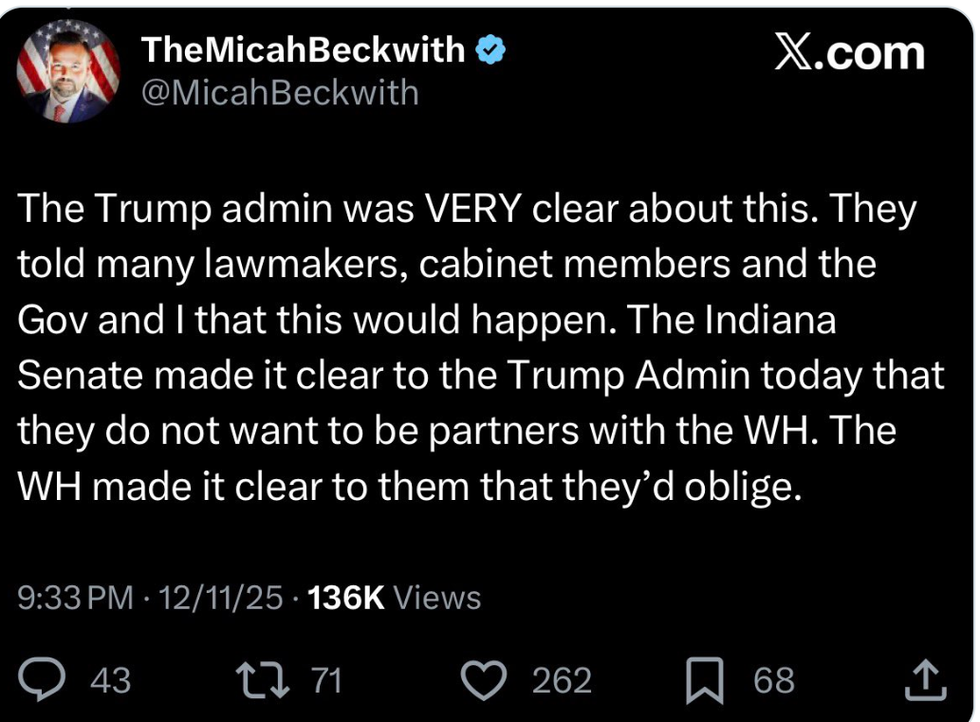
Although Beckwith deleted his post, he also confirmed to Politico reporter Adam Wren that the White House said that Indiana could lose out on funding for projects if the state did not approve the map, although Beckwith insisted that this was not a "threat" but merely "an honest conversation about who the White House does want to partner with."
Earlier on Thursday, the X account for right-wing advocacy group Heritage Action, a sister organization of the Heritage Foundation think tank, claimed that Trump had threatened to decimate Indiana's state finances unless the state Senate approved his proposed gerrymander.
"President Trump has made it clear to Indiana leaders: if the Indiana Senate fails to pass the map, all federal funding will be stripped from the state," Heritage Action wrote. "Roads will not be paved. Guard bases will close. Major projects will stop. These are the stakes and every NO vote will be to blame."
Trump has not yet publicly threatened to cut off Indiana's federal funds, and it's not clear that the administration actually plans to punish the state for defying the president.
According to a Thursday report from CNN, the Trump White House pressure campaign against Republican Indiana state senators backfired because many legislators resented being subjected to angry threats from Trump supporters, including some incidents in which lawmakers were swatted at their homes.
Republican Indiana state Sen. Jean Leising told CNN that the all-out pressure campaign waged by the president ended up pushing more people into opposing his agenda.
"You wouldn’t change minds by being mean," Leising said. "And the efforts were mean-spirited from the get-go. If you were wanting to change votes, you would probably try to explain why we should be doing this, in a positive way. That never happened, so, you know, I think they get what they get."
Fellow Republican Indiana state Sen. Sue Glick echoed Leinsing's assessment, and said that blunt-force threats against legislators were doomed to failure.
"Hoosiers are a hardy lot, and they don’t like to be threatened," Glick said. "They don’t like to be intimidated. They don’t like to be bullied in any fashion. And I think a lot of them responded with, ‘That isn’t going to work.' And it didn’t."
Indiana’s rejection of the proposed gerrymander this week was a major blow to Trump’s unprecedented mid-decade redistricting crusade, which began in Texas and subsequently spread to Missouri and North Carolina.
The vote came after an emotional debate in which some Republican lawmakers detailed threats and harassment they'd received for opposing the president's redistricting scheme.
President Donald Trump's push to get Indiana Republicans to redraw their congressional map ahead of the 2026 midterm elections went down in overwhelming defeat in the Indiana state Senate on Thursday.
As reported by Punchbowl News' Jake Sherman, the proposal to support a mid-decade gerrymander in Indiana was rejected by a vote of 19 in favor to 31 opposed, with 21 Republican state senators crossing the aisle to vote with all 10 Democrats to torpedo the measure, which would have changed the projected balance of Indiana's current congressional makeup from seven Republicans and two Democrats to a 9-0 map in favor of the GOP.
The Senate vote came after the state House's approval of the bill and an emotional debate in which some Indiana Republicans opposed to the president's plan detailed violent threats they'd received from his supporters.
According to a report published in the Atlantic on Thursday, Republican Indiana state Sen. Greg Walker (41) this week detailed having heavily armed police come to his home as the result of a false emergency call, a practice commonly known as swatting.
Walker said that he refused to be intimated by such tactics, and added that "I fear for all states if we allow threats and intimidation to become the norm."
Indiana's rejection of the effort is a major blow to Trump’s unprecedented mid-decade redistricting crusade, which began in Texas and subsequently spread to Missouri and North Carolina.
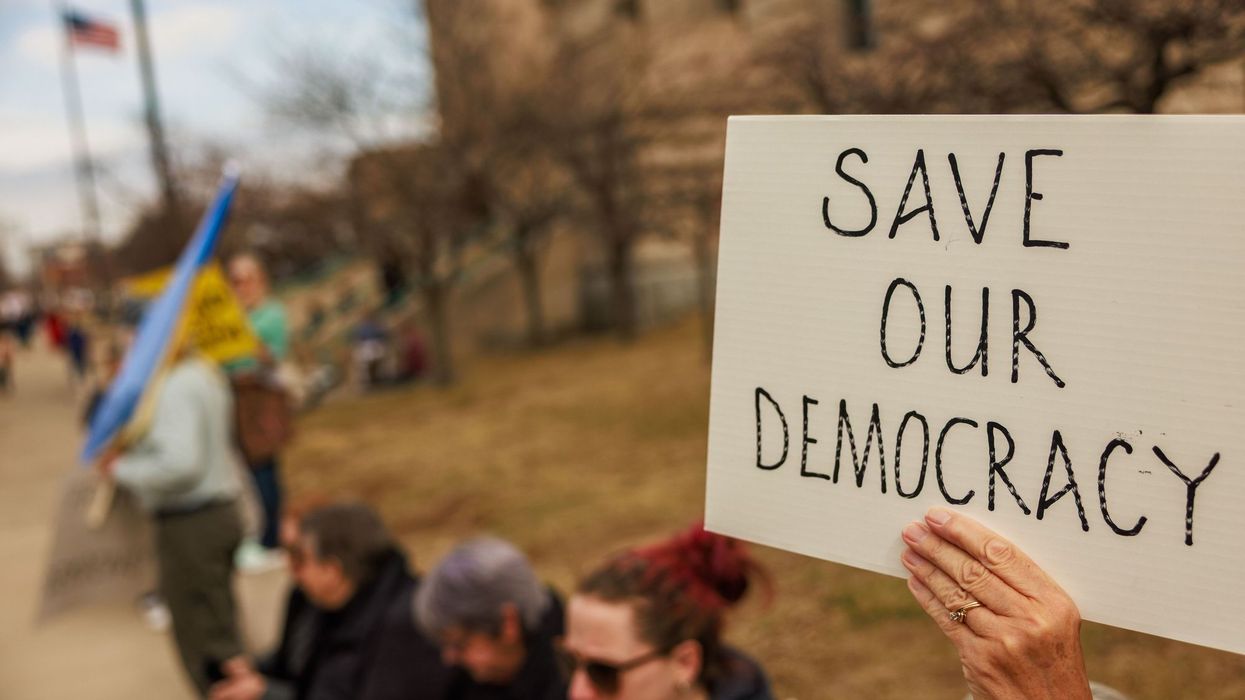
Christina Harvey, executive director for Stand Up America, said that the Indiana state Senate's rejection of the Trump plan was an "important victory for democracy."
"For weeks, Indiana residents have been pleading with their state leaders to stop mid-decade redistricting and the Senate listened," Harvey said. “Despite threats to themselves and their families, a majority of Indiana senators were steadfast in rejecting this gerrymandered map."
John Bisognano, president of the National Democratic Redistricting Committee, praised the Republicans who rejected the president's scheme despite enduring threats and harassment.
"Threats of violence are never acceptable, and no lawmakers should face violent threats for simply standing up for their constituents," Bisognano said. "Republicans in other states who are facing a similar choice—whether to listen to their constituents or follow orders from Washington—should follow Indiana’s lead in rejecting this charade and finally put an end to the national gerrymandering crisis."
Democratic State Sen. Fady Qaddoura, who immediately filed legislation to ban mid-decade redistricting, called the new map an illegal "racial gerrymander."
After months of escalating attacks against Indiana's Republican lawmakers by President Donald Trump, the state House GOP has revealed a new map for the 2026 midterms designed to hand every US House seat in the state to Republicans.
Republicans won 58% of the vote across Indiana's US House elections in 2024, granting them an already overrepresentative seven of the state's nine congressional seats. The new map, published Monday, would eliminate the remaining two seats in the state held by Democrats.
As Bolts magazine editor and founder Daniel Nichanian explained on social media, under the new map, "Indianapolis would be cracked into GOP seats, and Gary would be drowned in red." In other words, the new map would transparently dilute the power of Indiana's two largest concentrations of nonwhite voters.
The redrawing of Indiana's map comes amid a wider push spearheaded by Trump for Republican states to pursue unprecedented mid-decade gerrymandering in hopes of clinging to a governing trifecta against what is expected to be a wave year for Democrats in 2026.
A similar effort has been undertaken in Texas to potentially add five more seats to the GOP ranks, which is currently under appeal at the US Supreme Court. Trump has likewise pressured Republican lawmakers in Missouri, Utah, and North Carolina to draw maps that would net the GOP even more seats. This power grab has been met with redistricting efforts by some blue states, most notably California, which passed a new map last month, likely adding five more seats to the Democratic column.
Indiana's new map could be put to a vote in the state House as soon as December 8, where it would then be kicked up to the Senate. That is where Trump has run into some resistance, and he hasn't taken it well.
In mid-November, a group of 19 Republican state senators joined a united Democratic caucus to vote down the new map—one of the no votes, state Sen. Kyle Walker (R-33), said he'd "spent the past several months listening closely to [his] constituents on mid-decade redistricting" and found "93% opposed."
After the map was voted down, Trump lit into some of the holdouts in a rant on Truth Social. He said he was "disappointed" in the senators who voted against the map, adding that "any Republican that votes against this important redistricting, potentially having an impact on America itself, should be PRIMARIED," before calling to "get them out of office ASAP" if they failed.
Trump identified two specific lawmakers—Senate Pro Tem Rod Bray (R-37) and Sen. Greg Goode (R-38)—as the "RINO Senators" most responsible for the vote failing.
Within hours of the post, Goode was targeted by a "swatting" attack, in which an anonymous person placed a fraudulent emergency report in hopes of provoking a SWAT team or other large law enforcement response at the target's residence.
Four other Republicans, all of whom had voiced opposition to the map, were also swatted. Another received a bomb threat at his business. And on Monday, another opponent of the map, Sen. Jean Leising (R-42), said she'd received a pipe bomb threat over the weekend, which she blamed on "DC political pundits” in favor of redistricting.
As NBC News reported Monday, at least 10 Indiana Republican lawmakers have received violent threats since Trump's rant—most of whom have been opponents of redistricting.
Indiana Gov. Mike Braun (R) also received threats after catching heat in Trump's rant. But he joined Trump's attacks on the Republican caucus, specifically Bray, who he said "was forced to partner with DEMOCRATS to block an effort by the growing number of America First Senators who wanted to have a vote on passing fair maps.”
Fearful of the wrath of Trump and Braun, Indiana's House reconvened last week. And after saying that the Senate would not reconvene in December, Bray said it would do so on December 8 to "make a final decision… on any redistricting proposal sent from the House.”
Within an hour of Monday's announcement of the GOP map, Democrats, led by state Sen. Fady Qaddoura (D-30), said they planned to introduce legislation to ban mid-decade gerrymandering.
"Voters should choose their leaders, not the other way around," said Qaddoura, who added that the map was "racially gerrymandered."
If the map does pass the Senate, this may present an obstacle. Texas' map is under review by the US Supreme Court after a GOP-majority lower court ruled that the legislature had redrawn districts "based on their racial makeup,” which is illegal under Section 2 of the Voting Rights Act.
But its passage in the state Senate is far from certain. Despite continued pressure from the White House, Politico reports that Bray remains opposed. Meanwhile, Walker has accused the White House of violating the Hatch Act when it invited him to meet with Trump to discuss redistricting.
Trump also lost another ally this weekend in Sen. Mike Bohacek (R-8), who announced that he'd be voting no on redistricting after Trump referred to Minnesota Gov. Tim Walz (D) as "retarded" in an unhinged Thanksgiving Day social media rant.
"I have been an unapologetic advocate for people with intellectual disabilities since the birth of my second daughter," Bohacek said, noting that his daughter has Down syndrome. "This is not the first time our president has used these insulting and derogatory references, and his choices of words have consequences. I will be voting NO on redistricting, perhaps he can use the next 10 months to convince voters that his policies and behavior deserve a congressional majority."
The GOP map remains largely unpopular among Hoosiers. The most recent survey, conducted by the Virginia-based firm Bellwether Research, found that among its sample of 800 voters, "51% didn’t want redistricting now—with 45% 'strongly' opposed. About 39% supported the prospect, but just 23% 'strongly' backed it," as Indiana Public Media reported.
As the map was introduced on Monday, hundreds of Hoosiers gathered inside the State Capitol to voice their disapproval.
"At a time when Hoosiers are facing high costs for childcare, groceries, utilities, housing, and health care, the last thing needed is politicians manipulating maps instead of solving real issues," Qaddoura said. "Hoosiers deserve fair elections, stable districts, and a government that reflects them."