SUBSCRIBE TO OUR FREE NEWSLETTER
Daily news & progressive opinion—funded by the people, not the corporations—delivered straight to your inbox.
5
#000000
#FFFFFF
To donate by check, phone, or other method, see our More Ways to Give page.
Daily news & progressive opinion—funded by the people, not the corporations—delivered straight to your inbox.
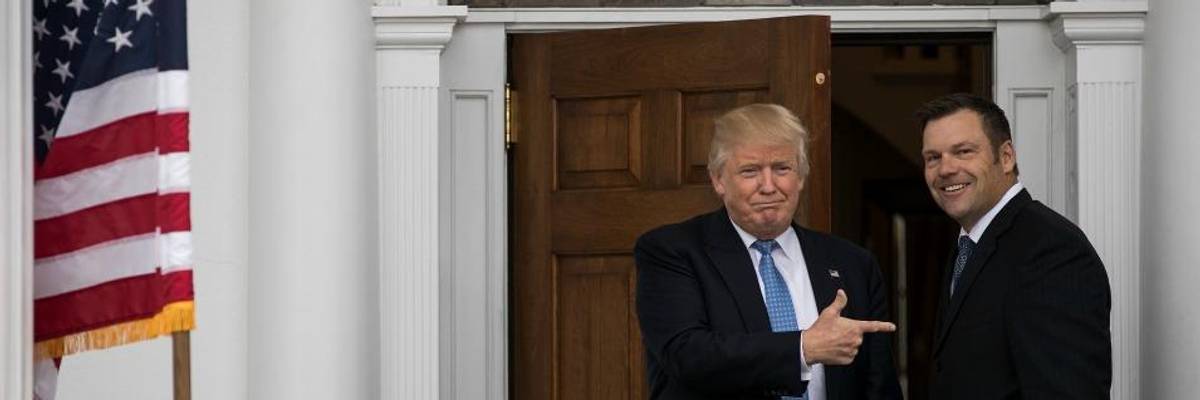
Kansas Secretary of State Kris Kobach was selected by President Donald Trump to head his so-called Election Integrity Commission last year, a panel which was disbanded after failing to find any evidence that the 2016 popular vote results had been compromised by illegal voting. (Photo by Drew Angerer/Getty Images)
Once tasked with overseeing the integrity of the United States' electoral system after spending much of his political career creating obstacles for Americans who want to vote, Kansas Secretary of State Kris Kobach launched his latest attack on elections on Wednesday when he refused to recuse himself from a recount effort in a race he himself ran in.
Kobach was one of seven Republicans to run in the state's primary for governor on Tuesday. As of Wednesday morning, Kobach led incumbent Republican Gov. Jeff Colyer by just 191 votes after technical difficulties in one county, signaling that a recount could be called.
At the state level, the Secretary of State's office oversees all elections and recounts. Kobach argued as the close results came in Tuesday night that because officials in Kansas's 105 counties would coordinate each county's vote tallying effort, it was not necessary for him to recuse himself from overseeing the overall recount.
"The secretary of state's office merely serves as a coordinating entity overseeing it all but not actually counting the votes," the former Kansas GOP chairman said.
Kobach's refusal drew ire from election experts and other critics.
"It would be good practice even if not required by state law for an election official to recuse from any recount or legal proceedings surrounding his or her own election efforts," Rick Hasen, an election law expert at the University of California, Irvine School of Law, told the Kansas City Star. "A longstanding English and American tradition is that 'no man should be a judge of his own case.' That should apply here."
The election comes eight months after the President's Election Integrity Commission, which President Donald Trump appointed Kobach to run last year, disbanded after facing multiple legal challenges and failing to prove Trump's theory that he lost the popular vote in 2016 due to votes being cast illegally.
As the vice chair of the commission--which embraced blatant racism byrequesting Texas officials flag the voter records of residents with Hispanic surnames--Kobach continued a long pattern of using his political power to attack voting rights.
Kobach has championed the Interstate Crosscheck System, a program that compares states' voter rolls and flags voters with the same name and date of birth in different states, recommending voter purges to states. Earlier this year, a federal judge tossed out a law Kobach had proposed requiring Kansans to prove they were U.S. citizens before voting.
Dear Common Dreams reader, It’s been nearly 30 years since I co-founded Common Dreams with my late wife, Lina Newhouser. We had the radical notion that journalism should serve the public good, not corporate profits. It was clear to us from the outset what it would take to build such a project. No paid advertisements. No corporate sponsors. No millionaire publisher telling us what to think or do. Many people said we wouldn't last a year, but we proved those doubters wrong. Together with a tremendous team of journalists and dedicated staff, we built an independent media outlet free from the constraints of profits and corporate control. Our mission has always been simple: To inform. To inspire. To ignite change for the common good. Building Common Dreams was not easy. Our survival was never guaranteed. When you take on the most powerful forces—Wall Street greed, fossil fuel industry destruction, Big Tech lobbyists, and uber-rich oligarchs who have spent billions upon billions rigging the economy and democracy in their favor—the only bulwark you have is supporters who believe in your work. But here’s the urgent message from me today. It's never been this bad out there. And it's never been this hard to keep us going. At the very moment Common Dreams is most needed, the threats we face are intensifying. We need your support now more than ever. We don't accept corporate advertising and never will. We don't have a paywall because we don't think people should be blocked from critical news based on their ability to pay. Everything we do is funded by the donations of readers like you. When everyone does the little they can afford, we are strong. But if that support retreats or dries up, so do we. Will you donate now to make sure Common Dreams not only survives but thrives? —Craig Brown, Co-founder |
Once tasked with overseeing the integrity of the United States' electoral system after spending much of his political career creating obstacles for Americans who want to vote, Kansas Secretary of State Kris Kobach launched his latest attack on elections on Wednesday when he refused to recuse himself from a recount effort in a race he himself ran in.
Kobach was one of seven Republicans to run in the state's primary for governor on Tuesday. As of Wednesday morning, Kobach led incumbent Republican Gov. Jeff Colyer by just 191 votes after technical difficulties in one county, signaling that a recount could be called.
At the state level, the Secretary of State's office oversees all elections and recounts. Kobach argued as the close results came in Tuesday night that because officials in Kansas's 105 counties would coordinate each county's vote tallying effort, it was not necessary for him to recuse himself from overseeing the overall recount.
"The secretary of state's office merely serves as a coordinating entity overseeing it all but not actually counting the votes," the former Kansas GOP chairman said.
Kobach's refusal drew ire from election experts and other critics.
"It would be good practice even if not required by state law for an election official to recuse from any recount or legal proceedings surrounding his or her own election efforts," Rick Hasen, an election law expert at the University of California, Irvine School of Law, told the Kansas City Star. "A longstanding English and American tradition is that 'no man should be a judge of his own case.' That should apply here."
The election comes eight months after the President's Election Integrity Commission, which President Donald Trump appointed Kobach to run last year, disbanded after facing multiple legal challenges and failing to prove Trump's theory that he lost the popular vote in 2016 due to votes being cast illegally.
As the vice chair of the commission--which embraced blatant racism byrequesting Texas officials flag the voter records of residents with Hispanic surnames--Kobach continued a long pattern of using his political power to attack voting rights.
Kobach has championed the Interstate Crosscheck System, a program that compares states' voter rolls and flags voters with the same name and date of birth in different states, recommending voter purges to states. Earlier this year, a federal judge tossed out a law Kobach had proposed requiring Kansans to prove they were U.S. citizens before voting.
Once tasked with overseeing the integrity of the United States' electoral system after spending much of his political career creating obstacles for Americans who want to vote, Kansas Secretary of State Kris Kobach launched his latest attack on elections on Wednesday when he refused to recuse himself from a recount effort in a race he himself ran in.
Kobach was one of seven Republicans to run in the state's primary for governor on Tuesday. As of Wednesday morning, Kobach led incumbent Republican Gov. Jeff Colyer by just 191 votes after technical difficulties in one county, signaling that a recount could be called.
At the state level, the Secretary of State's office oversees all elections and recounts. Kobach argued as the close results came in Tuesday night that because officials in Kansas's 105 counties would coordinate each county's vote tallying effort, it was not necessary for him to recuse himself from overseeing the overall recount.
"The secretary of state's office merely serves as a coordinating entity overseeing it all but not actually counting the votes," the former Kansas GOP chairman said.
Kobach's refusal drew ire from election experts and other critics.
"It would be good practice even if not required by state law for an election official to recuse from any recount or legal proceedings surrounding his or her own election efforts," Rick Hasen, an election law expert at the University of California, Irvine School of Law, told the Kansas City Star. "A longstanding English and American tradition is that 'no man should be a judge of his own case.' That should apply here."
The election comes eight months after the President's Election Integrity Commission, which President Donald Trump appointed Kobach to run last year, disbanded after facing multiple legal challenges and failing to prove Trump's theory that he lost the popular vote in 2016 due to votes being cast illegally.
As the vice chair of the commission--which embraced blatant racism byrequesting Texas officials flag the voter records of residents with Hispanic surnames--Kobach continued a long pattern of using his political power to attack voting rights.
Kobach has championed the Interstate Crosscheck System, a program that compares states' voter rolls and flags voters with the same name and date of birth in different states, recommending voter purges to states. Earlier this year, a federal judge tossed out a law Kobach had proposed requiring Kansans to prove they were U.S. citizens before voting.