

SUBSCRIBE TO OUR FREE NEWSLETTER
Daily news & progressive opinion—funded by the people, not the corporations—delivered straight to your inbox.
5
#000000
#FFFFFF
To donate by check, phone, or other method, see our More Ways to Give page.
Daily news & progressive opinion—funded by the people, not the corporations—delivered straight to your inbox.
On the heels of the
release of The Cornucopia Institute's study exposing the import-dependent
organic soy industry, a report by the United States Department of Agriculture substantiates
Cornucopia's findings. Using different research methods, the two reports
reach similar conclusions: organic manufacturers and farmers are facing escalating
competition from large conventional food manufacturers entering the organic
market, and companies are increasingly looking to China and other countries to import
organic foods and ingredients.
"Two
of the major findings of the USDA report--conventional food corporations
taking over successful independent organic companies, and increasing dependence
on imports--are not unrelated," suggests Charlotte Vallaeys, Farm
and Food Policy Analyst at The Cornucopia Institute and primary author of the
organization's study Behind the
Bean: The Heroes and Charlatans of the Organic Soy Industry.
The USDA report, Emerging
Issues in the U.S. Organic Industry, was released
earlier this month.
"When
agribusiness corporations enter the organic market, like Dean Foods when it
bought the Silk soymilk brand from a pioneering independent company, they
sometimes look abroad for cheaper imports or abandon organics altogether,
rather than maintain their commitment to supporting domestic organic farmers,"
Vallaeys adds. "The handlers mentioned in the USDA report that now
complain of shortages of domestically grown organic crops are therefore by no
means innocent victims of forces beyond their control, but rather helped create
these shortages by opting for cheaper organic imports instead of supporting
domestic farmers with sustainable prices."
According
to the USDA's report U.S.
organic soybean production started declining several years ago despite steeply
increasing demand for organic feed grains and consumer products such as soymilk.
"As the number of organic soybean producers has increased worldwide, U.S.
producers have faced increased competition for the domestic market," concludes
Catherine Greene, USDA economist and lead author of the USDA report.
Cornucopia
contends that the purported shortage of organic soybeans in the United States is not a legitimate excuse for
companies to import cheap crops from China or abandon organic ingredient
sourcing altogether. "Our research reveals that there are many highly
committed organic companies that are offering products made with American-grown
soybeans," says Vallaeys. Examples are Eden Foods, which continues its long-standing
relationships with domestic farmers who grow organic soybeans, and new market
players like Vermont Soy that are actively engaged in recruiting existing local
organic farmers to grow soybeans.
On
the opposite end of the spectrum are companies like Dean Foods, a leading
agribusiness involved mainly in dairy, which markets Silk soymilk. When Dean
Foods first acquired the Silk brand, American farmers were eager to ramp up
domestic production of organic soybeans for their soymilk. According to
Cornucopia's report, Dean Foods quickly dashed their hopes, telling multiple midwestern
farmers and farmer cooperatives that they had to match the rock-bottom prices of
Chinese organic soybeans--a price they simply could not meet. So Dean
Foods bought Chinese soybeans for years, building its commanding industry
market share, before substantially decreasing its support of organic
agriculture altogether. Today, few Silk products are certified organic and
some are even processed with toxic chemicals and labeled "natural."
"What
comes first, the organic chicken or the organic egg?" asks Mark Kastel, Senior Farm Policy Analyst at The
Cornucopia Institute. "Companies like Dean Foods complain that there aren't
enough organic soybeans grown in the U.S., yet they took an active role
in creating this shortage by refusing to work with American farmers when they
had the chance."
Merle
Kramer, a marketer for the Midwestern Organic Farmers Cooperative, based in
Michigan, laments: "Dean Foods had the opportunity to push organic and
sustainable agriculture to incredible heights of production by working with
North American farmers and traders to get more land in organic production, but
what they did was pit cheap foreign soybeans against the U.S. organic farmer,
taking away any attraction for conventional farmers to make the move into
sustainable agriculture."
The
USDA report concludes, "Despite the potential for organic agriculture to
improve the environmental performance of U.S. agriculture, the national
standard is having only a modest impact on environmental externalities caused
by conventional production methods because the organic adoption rate is so
low." In other words, our country could be reducing pesticide
contamination of surface- and groundwater, soil erosion, loss of wildlife, and
other negative impacts on the environment, but greed appears to have stunted
the growth of domestic organic agriculture.
As
a by-product of its research, Cornucopia also creates scorecards that rate
organic dairy and soy foods brands based on their production practices and
ethical values. Consumers who buy organic, in part because they want their
purchases to benefit domestic farmers and the American environment, may not realize
that leading brands are importing from countries with dubious food safety and
organic integrity, or environmental issues, like China, Brazil, and India.
"The
Cornucopia Institute's goal is to help consumers differentiate between
the brands that are truly committed to organic values, from those that aren't,"
says Kastel. "We encourage consumers to use the scorecards when voting in
the marketplace, and to support the companies that buy American-grown organic
soybeans."
The Cornucopia Institute, a Wisconsin-based nonprofit farm policy research group, is dedicated to the fight for economic justice for the family-scale farming community. Their Organic Integrity Project acts as a corporate and governmental watchdog assuring that no compromises to the credibility of organic farming methods and the food it produces are made in the pursuit of profit.
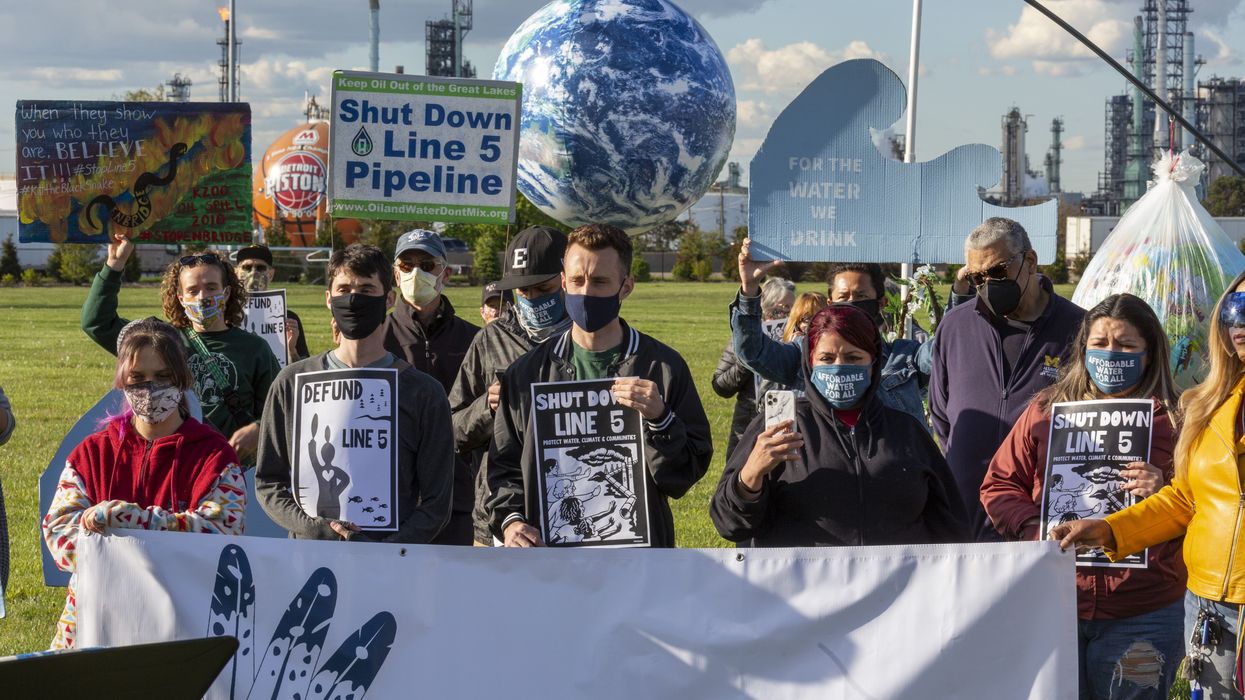
State regulators said the permits for a tunnel under the Straits of Mackinac would have "significant impacts" on wildlife and sacred Indigenous burial grounds, but issued them nonetheless.
Anti-fossil fuel campaigners on Wednesday emphasized that Michigan state regulators had issued key permits for the Enbridge Line 5 tunnel in the Straits of Mackinac on the same day that "wildfire smoke from climate change blotted out the Mackinac Bridge from view" and as the US and other countries faced extreme heatwaves.
Despite the mounting evidence that—as energy and climate experts have long warned—continued fossil fuel extraction is heating the planet and causing dangerous extreme weather, Michigan's Department of Environment, Great Lakes, and Energy handed down a permit Wednesday to allow the Canadian company Enbridge to construct a tunnel that EGLE officials acknowledged will likely have "significant impacts" on threatened or endangered species and Indigenous burial ground in the Straits.
“The magnitude of impacts to recognized historic and cultural values of this proposed project exceeds that of any other that EGLE has reviewed,” said EGLE in its statement on the permits.
Enbridge has sought to build a tunnel around its Line 5 pipeline in the Straits for years, following a massive oil spill from its Line 6B pipeline in the Kalamazoo River. Line 5 has been struck by ships' anchors numerous times, heightening concerns.
EGLE said in its explanation that the oil spill risk was found to be "unacceptable" and that the need for the tunnel outweighed its risks.
But opponents who have argued that Line 5 should be permanently shut down, including the Bay Mills Indian Community, condemned the agency for "rewarding" Enbridge with new permits even after its fossil fuel infrastructure has caused hazardous oil spills.
“Enbridge has spilled oil, committed safety violations, trespassed on lands, shattered ecosystems, pierced aquifers, violated our laws, and repeatedly shown contempt for tribal sovereignty," said Whitney Gravelle, president of the Bay Mills Indian Community. "They have left devastation in their wake, and now they’re being rewarded with responsibility over one of the most precious and sacred resources in our state. The Great Lakes are not safe in their hands. This decision is a deep betrayal of our Great Lake State, and we will confront it immediately, fiercely, and without hesitation.”
The state Department of Natural Resources also issued a permit following EGLE's decision, granting permission for the tunnel despite its potential impact on rare plants and animal habitats.
According to Michigan Bridge, about 1.53 acres of wetlands in Mackinac County would be impacted by the tunnel project, as well as 0.17 acres of Lake Michigan bottomlands in Emmet County, where Enbridge is expected to build a water intake structure.
The environmental legal organization Earthjustice, which has helped represent the Bay Mills Indian Community in its legal challenges against Enbridge, said that with the permits, the company will "transform the Straits of Mackinac into an industrial construction zone for at least six years, destroying views, displacing wildlife, and interrupting tourism dollars."
“Our environmental laws, the looming climate crisis, and simple common sense tells us that an oil pipeline doesn’t belong in the Great Lakes,” said Earthjustice managing attorney Debbie Chizewer. “Today’s decision is a setback, but we’re not giving up. A future without oil in the Great Lakes is still possible.”
EGLE is also expected to rule by September 30 on an Enbridge request to discharge millions of gallons of treated wastewater per day into Lake Michigan while it is constructing the tunnel, and the Michigan Supreme Court is considering a lawsuit brought by four Tribal Nations, including Bay Mills, alleging that the Michigan Public Service Commission improperly issued a key tunnel permit in 2023.
The state is also fighting Enbridge over Democratic Gov. Gretchen Whitmer's 2020 order to shut down Line 5 over oil spill concerns. She had campaigned in 2018 on a promise to shut down the pipeline. A federal judge ruled last year that the state had no authority to terminate the use of the pipeline, and the state appealed that ruling.
Advocates expressed anger on Wednesday at Whitmer as her government issued the permits.
“It’s incredibly disappointing that a governor who ran on a commitment to the climate and protecting the Great Lakes has now decided to instead endorse a Canadian industrial tunnel project that still threatens the Great Lakes and will contribute fossil fuels to the climate,” David Holtz, coalition coordinator for the anti-Line 5 group Oil & Water Don’t Mix, told Bridge Michigan.
David Gover, managing attorney for the Native American Rights Fund, said that "the Straits of Mackinac are not a piece of Enbridge oil infrastructure; they are the heart of creation for Anishinaabe people and a vital source of life for all who depend on the Great Lakes."
“We will pursue every legal avenue," Gover said, "to defend treaty rights, protect drinking water, and preserve tribal lifeways from another Enbridge disaster.”

Drop Site reported that Iran warned Vice President JD Vance that "the pair were more interested in exploiting insider knowledge of the negotiations to profit in financial markets than they were in reaching a deal."
Iranian officials reportedly warned US Vice President JD Vance late last month that two officials leading the Trump administration's diplomatic efforts in the Middle East—special envoys Steve Witkoff and Jared Kushner—were trying to profit from their proximity to critical negotiations rather than working to secure a lasting peace agreement.
According to Drop Site, which cited an unnamed Iranian official, "Iran conveyed to Vance that the pair were more interested in exploiting insider knowledge of the negotiations to profit in financial markets than they were in reaching a deal." The Iranian side also "expressed concern about repeated leaks from Kushner to Israeli Prime Minister Benjamin Netanyahu."
Iranians estimated that people with inside information have raked in $9 billion in profits stemming from financial market moves related to the US-Israeli war on Iran, which sparked significant volatility in energy and equity prices.
On several occasions during the war, massive trading volumes have closely preceded major conflict-related announcements by US President Donald Trump. (Kushner is Trump's son-in-law, and Witkoff is a close personal friend of the president.)
Mohammad Bagher Ghalibaf, speaker of the Iranian Parliament and the country's top negotiator, accused the Trump administration in March of peddling "fake news" to "manipulate the financial and oil markets and escape the quagmire in which the US and Israel are trapped."
According to Drop Site, Iranians "conveyed through intermediaries" that $4.5 billion of profits allegedly accumulated through market manipulation should be "allocated to the Iranian side."
“The exchanged texts will ultimately become part of the historical record," said the unnamed Iranian official.
The Trump administration denied that Vance received messages from the Iranian side related to Kushner and Witkoff, and accused Drop Site journalists of being "so filled with hate for America and devoid of respect for themselves that they have become full-throated propagandists for the Iranian regime."
Concerns that Kushner and Witkoff's personal and familial financial interests could influence their approach to diplomatic talks are hardly new.
"The public has no reason to trust Jared Kushner’s integrity as a government official to put their interests above his financial benefit," Donald Sherman, president of Citizens for Responsibility and Ethics in Washington, said after Trump formally named Kushner a special peace envoy in February.
Less than a month later, The New York Times reported that Kushner was trying to raise at least $5 billion in funding for his private equity firm, Affinity Partners, from Middle East governments. Saudi Arabia's Public Investment Fund is the largest investor in Affinity.
Witkoff, a real estate investor, has also faced scrutiny for potentially massive conflicts of interest.
Rep. Greg Stanton (D-Ariz.) noted during a House hearing last month that Witkoff "co-founded the cryptocurrency venture firm World Liberty Financial, alongside President Trump and President Trump’s children."
Stanton continued:
Days before Trump’s second inauguration, a firm controlled by a member of the royal family of the United Arab Emirates, Sheikh Tahnoon, bought a 49% stake in the company. That was a $500 million investment. $31 million of that went straight to the Witkoff family.
Witkoff was still a financial stakeholder in World Liberty as he was simultaneously leading high-level US government negotiations in his role as special envoy. One of those negotiations was over the export of America’s most advanced AI chips to the UAE, negotiations personally attended by Sheikh Tahnoon.
Drop Site's reporting came as the Trump administration on Wednesday expanded its aerial assault on Iran, hitting targets in the northern part of the country as the prospect of a negotiated resolution appeared increasingly remote. Recent US strikes have killed more than 30 people and wounded hundreds of others, according to Iranian officials.
Iran said it retaliated with strikes on US military installations in the region, including in Kuwait and Bahrain.

"This should be a blaring wake-up call for Democratic leaders," said one campaigner. "The political tide is clearly turning against unconditional US military support for Israel."
Nearly half of all Democrats in the House of Representatives voted Wednesday to cut off US military aid to Israel, a move that underscored a dramatic shift away from the US support the Mideast ally has enjoyed for nearly 60 years.
While House lawmakers ultimately rejected Rep. Thomas Massie's (R-Ky.) amendment to a national security spending bill that would have eliminated the $3.3 billion in annual foreign military financing provided to Israel’s military, the details of the vote were viewed as an encouraging sign by defenders of Palestine and the rule of law.
Massie and 103 Democrats voted for the measure, while 215 Republicans and 98 Democrats rejected it. The overall tally was 104 for, 314 against, and 10 "present" votes, with 9 absences.
"I cannot vote for aid to a country that committed genocide and has used tax dollars to detain Americans like me," Rep. Ro Khanna (D-Calif.) said ahead of the vote, referring to an incident in which heavily armed residents of an Israeli settler colony stopped and surrounded him last week in the illegally occupied West Bank of Palestine.
Speaking to reporters after the vote, Congressional Progressive Caucus Chair Greg Casar (D-Texas)—who had urged colleagues to support Massie's amendment—noted, "It used to be that just a small number of House Democrats would vote against sending taxpayer dollars to weapons for the Israeli military."
"Today, over 100 House Democrats voted for a measure to block billions of dollars in weapons to [Israeli Prime Minister Benjamin] Netanyahu," he continued. "That is enormous progress. That is a victory for our movement, for security, peace, and justice for all people."
The vote, Casar said, "sasends a strong message to Netanyahu that the days are over of an unaccountable blank check to his wars and his war crimes, at least from the Democratic Party."
"So this is an important moment because nothing will be the same on this issue ever again, I think, after this vote," he added.
CPC Chair @RepCasar, Deputy Chair @Ilhan Omar and @USProgressives on the historic vote by a majority of House Democrats to block $3 billion in weapons to Israel pic.twitter.com/T58q6J5LHZ
— Keane Bhatt (@KeaneBhatt) July 15, 2026
Speaking after Casar, Rep. Ilhan Omar (D-Minn.) said that she was "surprised" by many of her colleagues' votes in favor of the amendment, "and I am proud of them."
"I am proud that they have finally decided to lead with their morals, that they finally dared to stand up, and that we are all finally listening to our constituents, who have been asking us to do the right thing for many years," she added.
The high vote count in favor of Massie's amendment came after a "dear colleague" letter from House Minority Leader Hakeem Jeffries' (D-NY) expressing his opposition to the measure.
Palestine and human rights defenders hailed Wednesday's vote.
“Today’s vote reflects a seismic shift in US politics. What was once unquestioning bipartisan consensus to fund Israel’s atrocities against Palestinians is now breaking apart," Jewish Voice for Peace Action political director Beth Miller said in a statement. "While it is shameful that the House failed to pass this amendment, it is also now clear that it is impossible for Congress to ignore our voices."
"The overwhelming majority of Democratic voters are demanding that we halt US military funding to Israel, and every Democrat who ignored these calls should fear for their seat,” Miller added.
Margaret DeReus, executive director of policy projects at the Institute for Middle East Understanding (IMEU), said Wednesday's vote "reflects the popular will of Americans, and the overwhelming majority of Democratic voters who do not want to see another penny of our tax dollars fund Israel’s genocidal military."
"No more weapons to Israel is a principled demand, a legal obligation, and now a political necessity for any Democrat in office," DeReus added. "Democratic lawmakers who continue to stand with [the American Israel Public Affairs Committee's] fringe agenda of funding to Israel, and against their voters on the moral issue of our time, are inviting a primary challenge.
The United Nations' International Court of Justice is currently weighing a genocide case against Israel filed by South Africa and formally supported by nearly 20 nations. A UN panel of experts concluded last year that Israel is committing genocide in Gaza.
Meanwhile, the International Criminal Court has issued arrest warrants for Netanyahu and Yoav Gallant, his former defense minister, for alleged crimes against humanity and war crimes in Gaza, where more than 250,000 Palestinians have been killed or wounded, most of them civilians, since the Hamas-led attack of October 7, 2023, including over 9,000 people who are missing and presumed dead and buried beneath rubble.
In addition to the $3.3 billion in annual military aid the US gives Israel under a 2016 memorandum of understanding signed by then-President Barack Obama, the Biden and Trump administrations have provided billions of dollars in additional armed aid to Israel since it began waging its US-backed war on Gaza.
All told, the US has provided approximately $174 billion in direct bilateral assistance and missile defense funding—over $300 billion when adjusted for inflation—since the modern Israeli state's atrocity-laden founding in 1948. This makes Israel the largest overall beneficiary of US foreign aid since World War II.
US aid dramatically increased after the 1967 Israeli occupation of the West Bank, East Jerusalem, and Gaza, and the attack that same year by Israeli forces on the USS Liberty, which killed or wounded more than 200 Navy sailors in what numerous senior US officials believed was a deliberate attack. Last month, Massie introduced a resolution honoring the 34 Americans killed and 174 wounded in the Liberty attack.
Demand Progress senior policy adviser Cavan Kharrazian said in a statement that "congressional Democrats are finally starting to catch up to the American people, who no longer want to give Israel a blank check."
"This should be a blaring wake-up call for Democratic leaders," Kharrazian added. "The political tide is clearly turning against unconditional US military support for Israel. Leadership can no longer dismiss this position as marginal or politically untenable. Members should listen to their constituents, stop shielding Israel’s government from accountability, and support future efforts to end the flow of US weapons and military financing."