SUBSCRIBE TO OUR FREE NEWSLETTER
Daily news & progressive opinion—funded by the people, not the corporations—delivered straight to your inbox.
5
#000000
#FFFFFF
To donate by check, phone, or other method, see our More Ways to Give page.
Daily news & progressive opinion—funded by the people, not the corporations—delivered straight to your inbox.
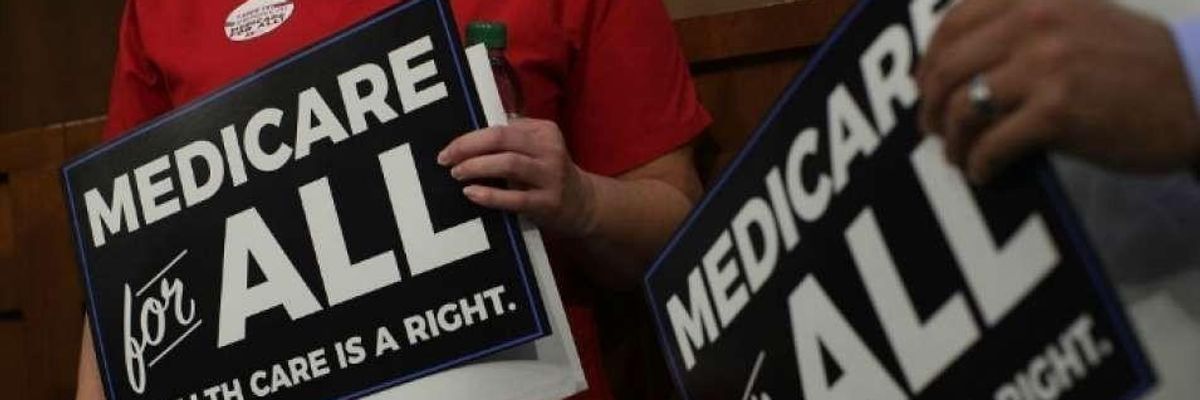
A new analysis estimates that 3.5 million workers lost their health insurance in the last two weeks because of their insurance being tied to employment. (Photo: Alex Wong/Getty Images)
A new analysis estimates that 3.5 million U.S. workers may have lost their job-tied health insurance in just the last two weeks.
"The COVID-19 pandemic lays bare the cruelty of tying health insurance coverage to employment," wrote Ben Zipperer, an economist at the Economic Policy Institute (EPI), on Twitter Thursday.
The analysis from Zipperer and EPI director of research Josh Bivens came the same day data from the U.S. Department of Labor revealed that 6.6 million Americans filed jobless claims last week--more than double the previous record of 3.28 million claims filed the week before--as the economic fallout of the coronavirus pandemic continues to batter workers.
The analysis also provides fresh evidence for Medicare for All advocates' longstanding argument that the current healthcare system, in which roughly half of Americans rely on their employer for healthcare coverage, must be abandoned in favor of a system that guarantees coverage to everyone regardless of employment.
"It is especially terrifying for workers to lose their health insurance as a result of, and during, an ongoing pandemic," wrote Zipperer and Bivens.
While the 3.5 million estimated figure of newly-uninsured people is bleak, the number may be even higher, the analysis finds:
Using new UI claims by industry from the state of Washington--the epicenter of the coronavirus outbreak in the United States--we are able to provide a very rough estimate of the number of workers at high risk of losing health insurance they had through their own employer due to coronavirus-related layoffs (or furloughs or hours reductions). We can't say exactly how many people will lose insurance coverage altogether for several reasons. For example, some workers who lose EPHI due to layoffs or hours reductions that trigger UI claims may be able to obtain coverage through health care exchanges set up by the Affordable Care Act (ACA) or through Medicaid. Some of this group may also be able to obtain continuing coverage through COBRA, paying out of pocket the full cost of their EPHI coverage. Some workers may be able to obtain coverage through other family members, or if only experiencing a temporary furlough or hours reduction, their employers might continue to pay for coverage. On the other hand, our calculations might understate the loss of health insurance coverage because they do not account for family members who are no longer covered because of the policyholder's layoff. And because not all layoffs result in UI claims, we will underestimate the actual magnitude of job losses.
" Unemployment insurance claims for the last two weeks are mind-blowing," EPI policy director Heidi Shierholz wrote in a Twitter thread Thursday in which she called the number of newly-uninsured "the cherry-from-hell on top."
The pandemic has also helped highlight the differences in healthcare proposals put forth by Democratic presidential candidates Sen. Bernie Sanders and former Vice President Joe Biden.
Biden has reaffirmed his opposition to Medicare for All, even as new polling shows record high for such a system.
Sanders, who's made Medicare for All a central component of his campaign, has said the need the current pandemic only serves to underscore his policy proposal.
In a Thursday tweet, Sanders said, "We need Medicare for All so that your health insurance is not tied to your job."
Dear Common Dreams reader, It’s been nearly 30 years since I co-founded Common Dreams with my late wife, Lina Newhouser. We had the radical notion that journalism should serve the public good, not corporate profits. It was clear to us from the outset what it would take to build such a project. No paid advertisements. No corporate sponsors. No millionaire publisher telling us what to think or do. Many people said we wouldn't last a year, but we proved those doubters wrong. Together with a tremendous team of journalists and dedicated staff, we built an independent media outlet free from the constraints of profits and corporate control. Our mission has always been simple: To inform. To inspire. To ignite change for the common good. Building Common Dreams was not easy. Our survival was never guaranteed. When you take on the most powerful forces—Wall Street greed, fossil fuel industry destruction, Big Tech lobbyists, and uber-rich oligarchs who have spent billions upon billions rigging the economy and democracy in their favor—the only bulwark you have is supporters who believe in your work. But here’s the urgent message from me today. It's never been this bad out there. And it's never been this hard to keep us going. At the very moment Common Dreams is most needed, the threats we face are intensifying. We need your support now more than ever. We don't accept corporate advertising and never will. We don't have a paywall because we don't think people should be blocked from critical news based on their ability to pay. Everything we do is funded by the donations of readers like you. When everyone does the little they can afford, we are strong. But if that support retreats or dries up, so do we. Will you donate now to make sure Common Dreams not only survives but thrives? —Craig Brown, Co-founder |
A new analysis estimates that 3.5 million U.S. workers may have lost their job-tied health insurance in just the last two weeks.
"The COVID-19 pandemic lays bare the cruelty of tying health insurance coverage to employment," wrote Ben Zipperer, an economist at the Economic Policy Institute (EPI), on Twitter Thursday.
The analysis from Zipperer and EPI director of research Josh Bivens came the same day data from the U.S. Department of Labor revealed that 6.6 million Americans filed jobless claims last week--more than double the previous record of 3.28 million claims filed the week before--as the economic fallout of the coronavirus pandemic continues to batter workers.
The analysis also provides fresh evidence for Medicare for All advocates' longstanding argument that the current healthcare system, in which roughly half of Americans rely on their employer for healthcare coverage, must be abandoned in favor of a system that guarantees coverage to everyone regardless of employment.
"It is especially terrifying for workers to lose their health insurance as a result of, and during, an ongoing pandemic," wrote Zipperer and Bivens.
While the 3.5 million estimated figure of newly-uninsured people is bleak, the number may be even higher, the analysis finds:
Using new UI claims by industry from the state of Washington--the epicenter of the coronavirus outbreak in the United States--we are able to provide a very rough estimate of the number of workers at high risk of losing health insurance they had through their own employer due to coronavirus-related layoffs (or furloughs or hours reductions). We can't say exactly how many people will lose insurance coverage altogether for several reasons. For example, some workers who lose EPHI due to layoffs or hours reductions that trigger UI claims may be able to obtain coverage through health care exchanges set up by the Affordable Care Act (ACA) or through Medicaid. Some of this group may also be able to obtain continuing coverage through COBRA, paying out of pocket the full cost of their EPHI coverage. Some workers may be able to obtain coverage through other family members, or if only experiencing a temporary furlough or hours reduction, their employers might continue to pay for coverage. On the other hand, our calculations might understate the loss of health insurance coverage because they do not account for family members who are no longer covered because of the policyholder's layoff. And because not all layoffs result in UI claims, we will underestimate the actual magnitude of job losses.
" Unemployment insurance claims for the last two weeks are mind-blowing," EPI policy director Heidi Shierholz wrote in a Twitter thread Thursday in which she called the number of newly-uninsured "the cherry-from-hell on top."
The pandemic has also helped highlight the differences in healthcare proposals put forth by Democratic presidential candidates Sen. Bernie Sanders and former Vice President Joe Biden.
Biden has reaffirmed his opposition to Medicare for All, even as new polling shows record high for such a system.
Sanders, who's made Medicare for All a central component of his campaign, has said the need the current pandemic only serves to underscore his policy proposal.
In a Thursday tweet, Sanders said, "We need Medicare for All so that your health insurance is not tied to your job."
A new analysis estimates that 3.5 million U.S. workers may have lost their job-tied health insurance in just the last two weeks.
"The COVID-19 pandemic lays bare the cruelty of tying health insurance coverage to employment," wrote Ben Zipperer, an economist at the Economic Policy Institute (EPI), on Twitter Thursday.
The analysis from Zipperer and EPI director of research Josh Bivens came the same day data from the U.S. Department of Labor revealed that 6.6 million Americans filed jobless claims last week--more than double the previous record of 3.28 million claims filed the week before--as the economic fallout of the coronavirus pandemic continues to batter workers.
The analysis also provides fresh evidence for Medicare for All advocates' longstanding argument that the current healthcare system, in which roughly half of Americans rely on their employer for healthcare coverage, must be abandoned in favor of a system that guarantees coverage to everyone regardless of employment.
"It is especially terrifying for workers to lose their health insurance as a result of, and during, an ongoing pandemic," wrote Zipperer and Bivens.
While the 3.5 million estimated figure of newly-uninsured people is bleak, the number may be even higher, the analysis finds:
Using new UI claims by industry from the state of Washington--the epicenter of the coronavirus outbreak in the United States--we are able to provide a very rough estimate of the number of workers at high risk of losing health insurance they had through their own employer due to coronavirus-related layoffs (or furloughs or hours reductions). We can't say exactly how many people will lose insurance coverage altogether for several reasons. For example, some workers who lose EPHI due to layoffs or hours reductions that trigger UI claims may be able to obtain coverage through health care exchanges set up by the Affordable Care Act (ACA) or through Medicaid. Some of this group may also be able to obtain continuing coverage through COBRA, paying out of pocket the full cost of their EPHI coverage. Some workers may be able to obtain coverage through other family members, or if only experiencing a temporary furlough or hours reduction, their employers might continue to pay for coverage. On the other hand, our calculations might understate the loss of health insurance coverage because they do not account for family members who are no longer covered because of the policyholder's layoff. And because not all layoffs result in UI claims, we will underestimate the actual magnitude of job losses.
" Unemployment insurance claims for the last two weeks are mind-blowing," EPI policy director Heidi Shierholz wrote in a Twitter thread Thursday in which she called the number of newly-uninsured "the cherry-from-hell on top."
The pandemic has also helped highlight the differences in healthcare proposals put forth by Democratic presidential candidates Sen. Bernie Sanders and former Vice President Joe Biden.
Biden has reaffirmed his opposition to Medicare for All, even as new polling shows record high for such a system.
Sanders, who's made Medicare for All a central component of his campaign, has said the need the current pandemic only serves to underscore his policy proposal.
In a Thursday tweet, Sanders said, "We need Medicare for All so that your health insurance is not tied to your job."