
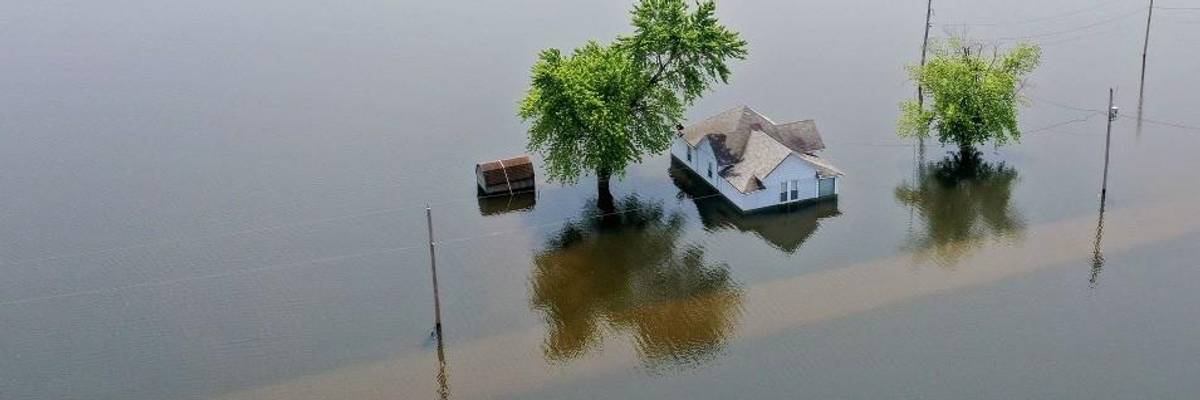
Floodwater from the Mississippi River rises around a home on June 1, 2019 in West Alton, Missouri. (Photo: Scott Olson/Getty Images)
Planet Just Had Costliest Decade for Global Natural Disasters: Insurance Industry Report
The Mississippi Basin floods were among the disasters with a massive price tag.
The planet just closed out the costliest decade ever for natural disasters, insurance broker Aon said Wednesday.
The economic losses from 2010-2019, according to Aon's Weather, Climate & Catastrophe Insight: 2019 Annual Report (pdf), hit nearly $3 trillion. That's up from 1.8 trillion recorded between 2000 and 2009.
"Perhaps the biggest takeaway from the last decade of natural disasters," said Steve Bowen, director and meteorologist at Aon's Impact Forecasting team, "was the emergence of previously considered 'secondary' perils--such as wildfire, flood, and drought--becoming much more costly and impactful."
"Scientific research indicates that climate change will continue to affect all types of weather phenomena and subsequently impact increasingly urbanized areas," he added.
The Asia-Pacific area took the biggest economic hit from disasters. It had 44 percent of the decade's economic losses at about $1 .3 trillion. Convective storms and hurricanes helped put the United States in second place, with the country suffering $906 billion. The report adds:
When comparing losses of the 2000s versus the 2010s, the most considerable uptick occurred in the Americas; notably the Caribbean. The region registered a 192 percent increase in economic costs from natural perils in the 2010s compared to the 2000s. This was largely driven by the historic Atlantic hurricane season of 2017 and Hurricane Dorian in 2019.
Focusing on just 2019, over 400 natural disasters struck globally, said Aon, with costs hitting $232 billion.
Over 10,000 people also lost their lives to natural disasters, the report notes.
"Five of the top 10 costliest disasters of 2019 were flood-related," the publication adds. Those include the summer Monsoon floods in China, which cost $15 billion and took the lives of 300 people, and the Mississippi Basin Floods that resulted in $10 billion in losses.
Among the other highlights from 2019, as noted by Aon:
- Cyclone Idai in Mozambique caused the most substantial humanitarian crisis, killing 1,303 people and destroying more than 300,000 homes with $2 billion economic losses.
- Intense multi-year drought and record-setting spring and summer heat led to conditions able to ignite destructive bushfires in Australia. Some 18.2 million hectares (46 million acres) burned and more than 2,500 homes were destroyed, likely to result in insured losses topping $1 billion.
Aon's report comes a week after scientists confirmed 2019 was the second-warmest year on record and ended the warmest decade on record.
The publication also comes as climate activists direct their demands for urgent action to address the climate ecological crises to the global elite gathered in Davos, Switzerland for the World Economic Forum's summit.
Swedish teen Greta Thunberg added her voice to that chorus, tell summit-goers: "Let's be clear: we don't need a low carbon economy; we don't need to lower emissions. Our emissions have to stop if we are to have a chance to stay below the 1.5 degree target."
"Our house is still on fire," she said. "Your inaction is fueling the flames by the hour. We are still telling you to panic, and to act as if you loved your children above all else."
We are at a crossroads
This country and this world are at a monumental crossroads. US voters have an opportunity to beat back the forces of fascism and confront the billionaires who are rigging the economy, our media system, and our democracy, making it increasingly impossible for ordinary people to get by. We’re not just talking about the election. We’re talking about what must be done once these fascist elements are vanquished from power. We need a bolder set of solutions than what either major party has so far been willing to offer and a working-class movement ready to fight like hell for it. Trump didn't emerge from nowhere. The conditions that fueled MAGA authoritarianism were created by decades of radical neoliberal economic policies and a corrupt political system dominated by corporate interests. They slashed taxes on the super-rich, promising that the benefits would trickle down. They said giveaways to the corporate titans would make life more affordable for the rest of us. It was all bullshit. And when a bitter, betrayed populace searches for someone to blame, right-wing demagogues have little trouble finding scapegoats. People know when they're being lied to, but you won't hear any of this from the corporate media. Only independent journalism—powered and funded by people who believe in building a better world—can deliver truly trustworthy daily news. Our Fall Campaign is underway, and we need your help. To power our newsroom through the rest of the year, we need to raise $125,000 by midnight on October 31. So if you share our vision, please contribute whatever you can to sustain our work. |
The planet just closed out the costliest decade ever for natural disasters, insurance broker Aon said Wednesday.
The economic losses from 2010-2019, according to Aon's Weather, Climate & Catastrophe Insight: 2019 Annual Report (pdf), hit nearly $3 trillion. That's up from 1.8 trillion recorded between 2000 and 2009.
"Perhaps the biggest takeaway from the last decade of natural disasters," said Steve Bowen, director and meteorologist at Aon's Impact Forecasting team, "was the emergence of previously considered 'secondary' perils--such as wildfire, flood, and drought--becoming much more costly and impactful."
"Scientific research indicates that climate change will continue to affect all types of weather phenomena and subsequently impact increasingly urbanized areas," he added.
The Asia-Pacific area took the biggest economic hit from disasters. It had 44 percent of the decade's economic losses at about $1 .3 trillion. Convective storms and hurricanes helped put the United States in second place, with the country suffering $906 billion. The report adds:
When comparing losses of the 2000s versus the 2010s, the most considerable uptick occurred in the Americas; notably the Caribbean. The region registered a 192 percent increase in economic costs from natural perils in the 2010s compared to the 2000s. This was largely driven by the historic Atlantic hurricane season of 2017 and Hurricane Dorian in 2019.
Focusing on just 2019, over 400 natural disasters struck globally, said Aon, with costs hitting $232 billion.
Over 10,000 people also lost their lives to natural disasters, the report notes.
"Five of the top 10 costliest disasters of 2019 were flood-related," the publication adds. Those include the summer Monsoon floods in China, which cost $15 billion and took the lives of 300 people, and the Mississippi Basin Floods that resulted in $10 billion in losses.
Among the other highlights from 2019, as noted by Aon:
- Cyclone Idai in Mozambique caused the most substantial humanitarian crisis, killing 1,303 people and destroying more than 300,000 homes with $2 billion economic losses.
- Intense multi-year drought and record-setting spring and summer heat led to conditions able to ignite destructive bushfires in Australia. Some 18.2 million hectares (46 million acres) burned and more than 2,500 homes were destroyed, likely to result in insured losses topping $1 billion.
Aon's report comes a week after scientists confirmed 2019 was the second-warmest year on record and ended the warmest decade on record.
The publication also comes as climate activists direct their demands for urgent action to address the climate ecological crises to the global elite gathered in Davos, Switzerland for the World Economic Forum's summit.
Swedish teen Greta Thunberg added her voice to that chorus, tell summit-goers: "Let's be clear: we don't need a low carbon economy; we don't need to lower emissions. Our emissions have to stop if we are to have a chance to stay below the 1.5 degree target."
"Our house is still on fire," she said. "Your inaction is fueling the flames by the hour. We are still telling you to panic, and to act as if you loved your children above all else."