SUBSCRIBE TO OUR FREE NEWSLETTER
Daily news & progressive opinion—funded by the people, not the corporations—delivered straight to your inbox.
5
#000000
#FFFFFF
To donate by check, phone, or other method, see our More Ways to Give page.
Daily news & progressive opinion—funded by the people, not the corporations—delivered straight to your inbox.
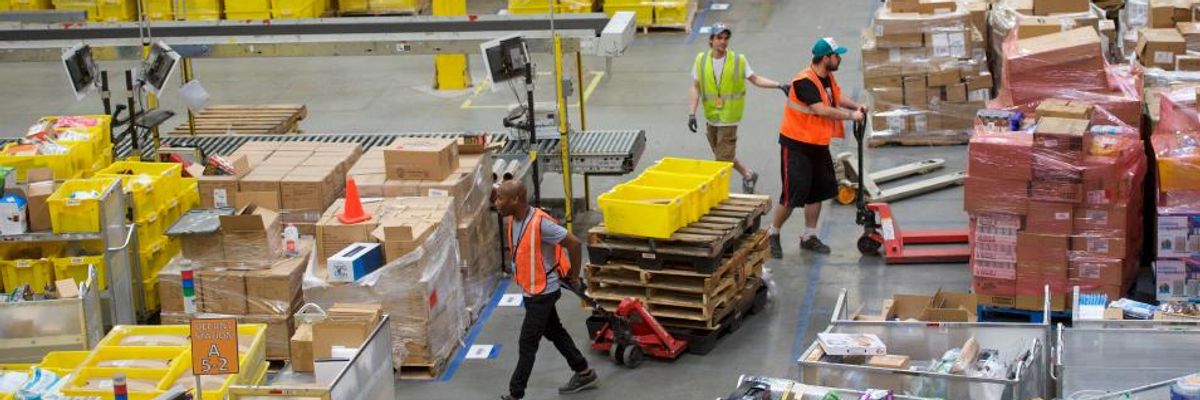
A robot set off a can of bear spray at an Amazon facility in Robbinsville, New Jersey on Wednesday. (Photo: Mark Makela/Getty Images)
At least one person was in critical condition and 24 were hospitalized after a robot accidentally punctured a 9oz. aerosol can of bear repellent at an Amazon warehouse in Robbinsville Township, New Jersey on Wednesday, causing dozens of employees to experience trouble breathing.
"This is another outrageous example of the company putting profits over the health and safety of their workers, and we cannot stand for this."
--Stuart Appelbaum, union leader
All told, 54 Amazon employees received medical attention because of the incident, according to multiple reports, which follow global strikes and demands from workers, advocates, and even lawmakers such as Sen. Bernie Sanders (I-Vt.) for the company--which is run by the richest man in the world, Jeff Bezos--to improve workplace conditions, including warehouse safety.
"Amazon's automated robots put humans in life-threatening danger," declared Stuart Appelbaum, president of the Retail, Wholesale and Department Store Union.
"This is another outrageous example of the company putting profits over the health and safety of their workers, and we cannot stand for this," he added, emphasizing that as one of the world's biggest companies, Amazon "cannot continue to be let off the hook for putting hard working people's lives at risk."
The National Council for Occupational Safety and Health, a worker advocacy group, called for reforms to ensure employee safety.
"The company keeps saying that safety of workers is their 'top priority," Marcy Goldstein Gelb, the group's co-executive director, told the Asbury Park Press. "The tens of millions of consumers who will spend money at Amazon this holiday season have a right to ask: 'If that's true, why do people keep getting hurt, injured and killed at Amazon facilities?'"
Rachael Lighty, a spokeswoman for Amazon, claimed in a statement to the Washington Post that "the safety of our employees is our top priority." Another statement to NJ.com said that "all of the impacted employees have been or are expected to be released from hospital within the next 24 hours," including the person initially listed as in critical condition.
Robbinsville spokesman John Nalbone explained to the Post that the can of bear spray released in the facility contained capsaicin, derived from the chile pepper plant capsicum. Such derivatives, according to the National Park Service (pdf), "are an extreme irritant of the skin, eyes, nose, throat, and lungs of bears, humans, and other mammals."
Dear Common Dreams reader, It’s been nearly 30 years since I co-founded Common Dreams with my late wife, Lina Newhouser. We had the radical notion that journalism should serve the public good, not corporate profits. It was clear to us from the outset what it would take to build such a project. No paid advertisements. No corporate sponsors. No millionaire publisher telling us what to think or do. Many people said we wouldn't last a year, but we proved those doubters wrong. Together with a tremendous team of journalists and dedicated staff, we built an independent media outlet free from the constraints of profits and corporate control. Our mission has always been simple: To inform. To inspire. To ignite change for the common good. Building Common Dreams was not easy. Our survival was never guaranteed. When you take on the most powerful forces—Wall Street greed, fossil fuel industry destruction, Big Tech lobbyists, and uber-rich oligarchs who have spent billions upon billions rigging the economy and democracy in their favor—the only bulwark you have is supporters who believe in your work. But here’s the urgent message from me today. It's never been this bad out there. And it's never been this hard to keep us going. At the very moment Common Dreams is most needed, the threats we face are intensifying. We need your support now more than ever. We don't accept corporate advertising and never will. We don't have a paywall because we don't think people should be blocked from critical news based on their ability to pay. Everything we do is funded by the donations of readers like you. When everyone does the little they can afford, we are strong. But if that support retreats or dries up, so do we. Will you donate now to make sure Common Dreams not only survives but thrives? —Craig Brown, Co-founder |
At least one person was in critical condition and 24 were hospitalized after a robot accidentally punctured a 9oz. aerosol can of bear repellent at an Amazon warehouse in Robbinsville Township, New Jersey on Wednesday, causing dozens of employees to experience trouble breathing.
"This is another outrageous example of the company putting profits over the health and safety of their workers, and we cannot stand for this."
--Stuart Appelbaum, union leader
All told, 54 Amazon employees received medical attention because of the incident, according to multiple reports, which follow global strikes and demands from workers, advocates, and even lawmakers such as Sen. Bernie Sanders (I-Vt.) for the company--which is run by the richest man in the world, Jeff Bezos--to improve workplace conditions, including warehouse safety.
"Amazon's automated robots put humans in life-threatening danger," declared Stuart Appelbaum, president of the Retail, Wholesale and Department Store Union.
"This is another outrageous example of the company putting profits over the health and safety of their workers, and we cannot stand for this," he added, emphasizing that as one of the world's biggest companies, Amazon "cannot continue to be let off the hook for putting hard working people's lives at risk."
The National Council for Occupational Safety and Health, a worker advocacy group, called for reforms to ensure employee safety.
"The company keeps saying that safety of workers is their 'top priority," Marcy Goldstein Gelb, the group's co-executive director, told the Asbury Park Press. "The tens of millions of consumers who will spend money at Amazon this holiday season have a right to ask: 'If that's true, why do people keep getting hurt, injured and killed at Amazon facilities?'"
Rachael Lighty, a spokeswoman for Amazon, claimed in a statement to the Washington Post that "the safety of our employees is our top priority." Another statement to NJ.com said that "all of the impacted employees have been or are expected to be released from hospital within the next 24 hours," including the person initially listed as in critical condition.
Robbinsville spokesman John Nalbone explained to the Post that the can of bear spray released in the facility contained capsaicin, derived from the chile pepper plant capsicum. Such derivatives, according to the National Park Service (pdf), "are an extreme irritant of the skin, eyes, nose, throat, and lungs of bears, humans, and other mammals."
At least one person was in critical condition and 24 were hospitalized after a robot accidentally punctured a 9oz. aerosol can of bear repellent at an Amazon warehouse in Robbinsville Township, New Jersey on Wednesday, causing dozens of employees to experience trouble breathing.
"This is another outrageous example of the company putting profits over the health and safety of their workers, and we cannot stand for this."
--Stuart Appelbaum, union leader
All told, 54 Amazon employees received medical attention because of the incident, according to multiple reports, which follow global strikes and demands from workers, advocates, and even lawmakers such as Sen. Bernie Sanders (I-Vt.) for the company--which is run by the richest man in the world, Jeff Bezos--to improve workplace conditions, including warehouse safety.
"Amazon's automated robots put humans in life-threatening danger," declared Stuart Appelbaum, president of the Retail, Wholesale and Department Store Union.
"This is another outrageous example of the company putting profits over the health and safety of their workers, and we cannot stand for this," he added, emphasizing that as one of the world's biggest companies, Amazon "cannot continue to be let off the hook for putting hard working people's lives at risk."
The National Council for Occupational Safety and Health, a worker advocacy group, called for reforms to ensure employee safety.
"The company keeps saying that safety of workers is their 'top priority," Marcy Goldstein Gelb, the group's co-executive director, told the Asbury Park Press. "The tens of millions of consumers who will spend money at Amazon this holiday season have a right to ask: 'If that's true, why do people keep getting hurt, injured and killed at Amazon facilities?'"
Rachael Lighty, a spokeswoman for Amazon, claimed in a statement to the Washington Post that "the safety of our employees is our top priority." Another statement to NJ.com said that "all of the impacted employees have been or are expected to be released from hospital within the next 24 hours," including the person initially listed as in critical condition.
Robbinsville spokesman John Nalbone explained to the Post that the can of bear spray released in the facility contained capsaicin, derived from the chile pepper plant capsicum. Such derivatives, according to the National Park Service (pdf), "are an extreme irritant of the skin, eyes, nose, throat, and lungs of bears, humans, and other mammals."