SUBSCRIBE TO OUR FREE NEWSLETTER
Daily news & progressive opinion—funded by the people, not the corporations—delivered straight to your inbox.
5
#000000
#FFFFFF
To donate by check, phone, or other method, see our More Ways to Give page.
Daily news & progressive opinion—funded by the people, not the corporations—delivered straight to your inbox.
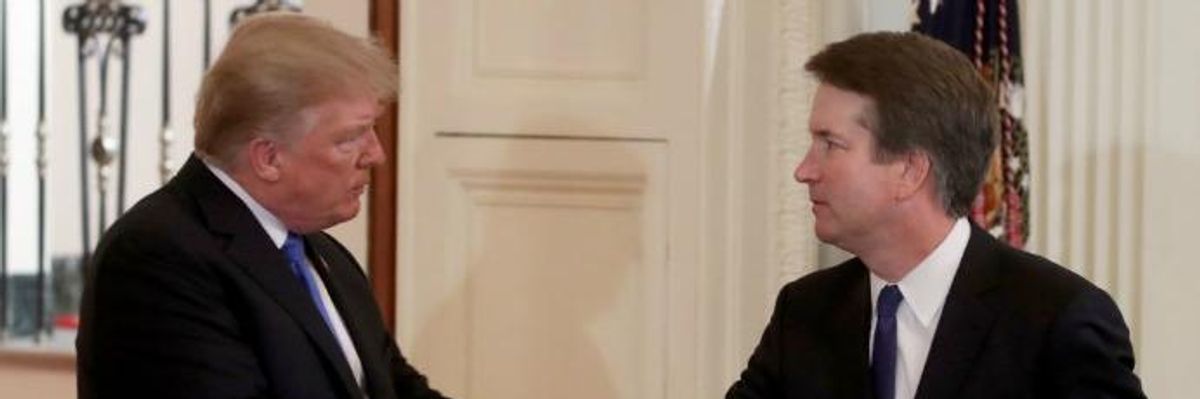
President Donald Trump introduces U.S. Circuit Judge Brett M. Kavanaugh as his nominee to the United States Supreme Court during an event in the East Room of the White House July 9, 2018 in Washington, D.C. (Photo: Mark Wilson/Getty Images)
In addition to the mountain of much-discussed reasons the American public should be alarmed by President Donald Trump's Supreme Court pick Brett Kavanaugh--from his anti-abortion views to his past opinions favoring the interests of big polluters--advocacy groups are warning that the 53-year-old judge's established record of hostility to net neutrality and support for mass surveillance shows that his confirmation would spell "disaster for internet freedom."
"Trump's SCOTUS pick Brett Kavanaugh is an enemy of net neutrality and has sided with big cable companies in the lower courts," noted Demand Progress on Twitter following Trump's official selection of Kavanaugh Monday night, citing his previous argument that net neutrality rules violate the free speech of internet service providers.
In an analysis of Kavanaugh's past opinions late Monday--which include his assertion that net neutrality rules are "unlawful and must be vacated"--Slate's April Glaser notes how the record of Trump's pick for the court reveals a judge who is vastly more "sympathetic to the handful of companies that control the internet...than to the hundreds of millions of Americans who use it."
"Judge Brett Kavanaugh is notorious for his hostility to international law and infamously ruled in favor of the NSA's expansive and illegal dragnet surveillance program."
--Jamil Dakwar, ACLU
While the net neutrality protections established in 2015 were officially rolled back by FCC chair and former Verizon lawyer Ajit Pai last month, this telecom-backed move is facing a slew of legal challenges from advocacy groups and state attorneys general that could ultimately make it to the nation's highest court.
"If any of those cases do make it to the Supreme Court, Kavanaugh probably feels that net neutrality isn't something the federal government should take strides to preserve," Glaser writes.
While Kavanaugh's past rulings as a federal appeals court judge demonstrate his concern for the rights of giant corporations, they also lay bare his apparent contempt for the privacy rights of Americans.
As Politico reported ahead of his nomination, Kavanaugh "has a history of embracing warrantless surveillance and rejecting Fourth Amendment challenges to it."
In a concurring opinion in 2015, Kavanaugh argued that the National Security Agency's warrentless metadata collection program--which was exposed by whistleblower Edward Snowden in 2013--is "consistent with the Fourth Amendment" and insisted that "critical national security need outweighs the impact on privacy occasioned by this program."
Glaser of Slate argued that, if confirmed by the Senate, Kavanaugh will "cement a conservative majority that is likely to agree that the government should be allowed to make broad requests to access the data that companies collect on us without a warrant."
"Many of the major problems we have on the internet today--dragnet corporate and government surveillance, a handful of powerful companies that are allowed to control how we use the internet--could be deepened by a Supreme Court justice who could well be there for decades," Glaser concluded.
Dear Common Dreams reader, It’s been nearly 30 years since I co-founded Common Dreams with my late wife, Lina Newhouser. We had the radical notion that journalism should serve the public good, not corporate profits. It was clear to us from the outset what it would take to build such a project. No paid advertisements. No corporate sponsors. No millionaire publisher telling us what to think or do. Many people said we wouldn't last a year, but we proved those doubters wrong. Together with a tremendous team of journalists and dedicated staff, we built an independent media outlet free from the constraints of profits and corporate control. Our mission has always been simple: To inform. To inspire. To ignite change for the common good. Building Common Dreams was not easy. Our survival was never guaranteed. When you take on the most powerful forces—Wall Street greed, fossil fuel industry destruction, Big Tech lobbyists, and uber-rich oligarchs who have spent billions upon billions rigging the economy and democracy in their favor—the only bulwark you have is supporters who believe in your work. But here’s the urgent message from me today. It's never been this bad out there. And it's never been this hard to keep us going. At the very moment Common Dreams is most needed, the threats we face are intensifying. We need your support now more than ever. We don't accept corporate advertising and never will. We don't have a paywall because we don't think people should be blocked from critical news based on their ability to pay. Everything we do is funded by the donations of readers like you. When everyone does the little they can afford, we are strong. But if that support retreats or dries up, so do we. Will you donate now to make sure Common Dreams not only survives but thrives? —Craig Brown, Co-founder |
In addition to the mountain of much-discussed reasons the American public should be alarmed by President Donald Trump's Supreme Court pick Brett Kavanaugh--from his anti-abortion views to his past opinions favoring the interests of big polluters--advocacy groups are warning that the 53-year-old judge's established record of hostility to net neutrality and support for mass surveillance shows that his confirmation would spell "disaster for internet freedom."
"Trump's SCOTUS pick Brett Kavanaugh is an enemy of net neutrality and has sided with big cable companies in the lower courts," noted Demand Progress on Twitter following Trump's official selection of Kavanaugh Monday night, citing his previous argument that net neutrality rules violate the free speech of internet service providers.
In an analysis of Kavanaugh's past opinions late Monday--which include his assertion that net neutrality rules are "unlawful and must be vacated"--Slate's April Glaser notes how the record of Trump's pick for the court reveals a judge who is vastly more "sympathetic to the handful of companies that control the internet...than to the hundreds of millions of Americans who use it."
"Judge Brett Kavanaugh is notorious for his hostility to international law and infamously ruled in favor of the NSA's expansive and illegal dragnet surveillance program."
--Jamil Dakwar, ACLU
While the net neutrality protections established in 2015 were officially rolled back by FCC chair and former Verizon lawyer Ajit Pai last month, this telecom-backed move is facing a slew of legal challenges from advocacy groups and state attorneys general that could ultimately make it to the nation's highest court.
"If any of those cases do make it to the Supreme Court, Kavanaugh probably feels that net neutrality isn't something the federal government should take strides to preserve," Glaser writes.
While Kavanaugh's past rulings as a federal appeals court judge demonstrate his concern for the rights of giant corporations, they also lay bare his apparent contempt for the privacy rights of Americans.
As Politico reported ahead of his nomination, Kavanaugh "has a history of embracing warrantless surveillance and rejecting Fourth Amendment challenges to it."
In a concurring opinion in 2015, Kavanaugh argued that the National Security Agency's warrentless metadata collection program--which was exposed by whistleblower Edward Snowden in 2013--is "consistent with the Fourth Amendment" and insisted that "critical national security need outweighs the impact on privacy occasioned by this program."
Glaser of Slate argued that, if confirmed by the Senate, Kavanaugh will "cement a conservative majority that is likely to agree that the government should be allowed to make broad requests to access the data that companies collect on us without a warrant."
"Many of the major problems we have on the internet today--dragnet corporate and government surveillance, a handful of powerful companies that are allowed to control how we use the internet--could be deepened by a Supreme Court justice who could well be there for decades," Glaser concluded.
In addition to the mountain of much-discussed reasons the American public should be alarmed by President Donald Trump's Supreme Court pick Brett Kavanaugh--from his anti-abortion views to his past opinions favoring the interests of big polluters--advocacy groups are warning that the 53-year-old judge's established record of hostility to net neutrality and support for mass surveillance shows that his confirmation would spell "disaster for internet freedom."
"Trump's SCOTUS pick Brett Kavanaugh is an enemy of net neutrality and has sided with big cable companies in the lower courts," noted Demand Progress on Twitter following Trump's official selection of Kavanaugh Monday night, citing his previous argument that net neutrality rules violate the free speech of internet service providers.
In an analysis of Kavanaugh's past opinions late Monday--which include his assertion that net neutrality rules are "unlawful and must be vacated"--Slate's April Glaser notes how the record of Trump's pick for the court reveals a judge who is vastly more "sympathetic to the handful of companies that control the internet...than to the hundreds of millions of Americans who use it."
"Judge Brett Kavanaugh is notorious for his hostility to international law and infamously ruled in favor of the NSA's expansive and illegal dragnet surveillance program."
--Jamil Dakwar, ACLU
While the net neutrality protections established in 2015 were officially rolled back by FCC chair and former Verizon lawyer Ajit Pai last month, this telecom-backed move is facing a slew of legal challenges from advocacy groups and state attorneys general that could ultimately make it to the nation's highest court.
"If any of those cases do make it to the Supreme Court, Kavanaugh probably feels that net neutrality isn't something the federal government should take strides to preserve," Glaser writes.
While Kavanaugh's past rulings as a federal appeals court judge demonstrate his concern for the rights of giant corporations, they also lay bare his apparent contempt for the privacy rights of Americans.
As Politico reported ahead of his nomination, Kavanaugh "has a history of embracing warrantless surveillance and rejecting Fourth Amendment challenges to it."
In a concurring opinion in 2015, Kavanaugh argued that the National Security Agency's warrentless metadata collection program--which was exposed by whistleblower Edward Snowden in 2013--is "consistent with the Fourth Amendment" and insisted that "critical national security need outweighs the impact on privacy occasioned by this program."
Glaser of Slate argued that, if confirmed by the Senate, Kavanaugh will "cement a conservative majority that is likely to agree that the government should be allowed to make broad requests to access the data that companies collect on us without a warrant."
"Many of the major problems we have on the internet today--dragnet corporate and government surveillance, a handful of powerful companies that are allowed to control how we use the internet--could be deepened by a Supreme Court justice who could well be there for decades," Glaser concluded.