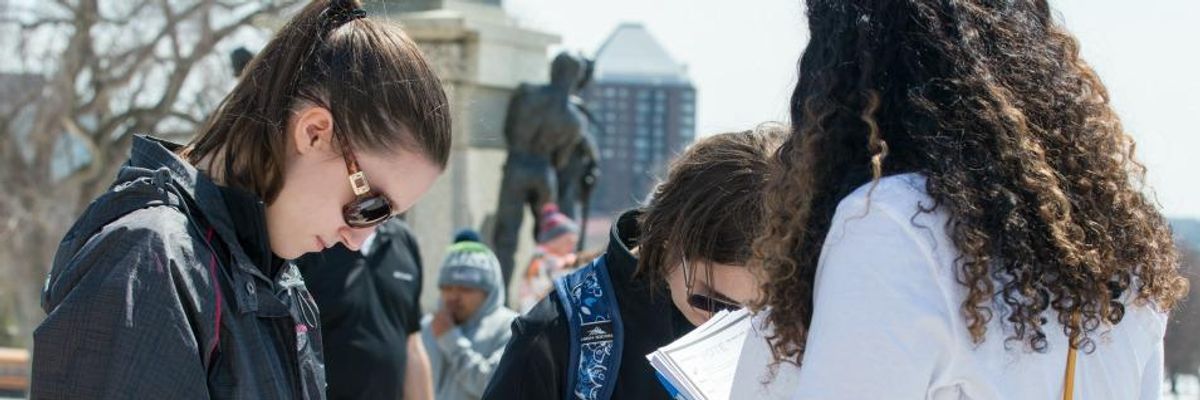
High school students in St. Paul, Minn. filling out voter registration forms at a National Student Walkout event in April. (Photo: Fibonacci Blue/Flickr/cc)
Young Voters Likely to Continue Post-Parkland Mobilization in Voting Booth, Registration Records Show
Young people represented a significantly large share of newly-registered voters in several key states in the weeks following the Parkland shooting
According to voter registration records in states that will be closely watched in the November midterm elections, young Americans are planning to exercise their right to vote in greater numbers than usual.
"We know that young people don't vote as often as they should," Aleigha Cavalier of billionaire Democratic donor Tom Steyer's voter mobilization group, NextGen America, told the New York Times. "This year we are seeing energy because they have a feeling of voting for or voting against, whether it's Donald Trump or issues that they care about, and on issues like gun safety, because we are seeing things happen in real time, like Parkland, that weren't happening before."
Following the February 14 shooting at Marjory Stoneman Douglas High School in Parkland, Fla., records of young people who signed up to vote in March and April rose significantly in states including Florida, North Carolina, and Pennsylvania.
The surge took place as survivors of the shooting were organizing a nationwide movement to demand sensible gun control reforms that have failed to pass in Congress in recent years despite widespread public support--and threatening to vote lawmakers out of office if they accept money from the powerful pro-gun lobbying group, the National Rifle Association (NRA).
In Florida, voters under the age of 26 made up nearly 30 percent of new registrants in March and April, up from less than 20 percent in the first two months of the year. About 40 percent of new voters in North Carolina were under 25 in the weeks following the Parkland shooting, and in Pennsylvania more than half of those who registered were young voters.
According to the Times, in Florida, a third of the new registrants signed up as Democrats, 21 percent as Republicans, and 46 percent as unaffiliated or with another party.
Florida will be closely watched in November as Republican Gov. Rick Scott challenges Democratic Sen. Bill Nelson, while Sen. Bob Casey (D-Penn.) is running for re-election.
"What I have seen is what I am calling a once in a generation attitudinal shift about the efficacy of participating in the political process," John Della Volpe, director of the Harvard Kennedy School's Institute of Politics, told the Times. "I am optimistic that the increasing interest we have tracked in politics will likely lead to increased participation in the midterms."
Following the Parkland shooting, students were joined by Broward County, Fla. Sheriff Scott Israel, who memorably said at a vigil for the 17 people killed, "If you're an elected official, and you want to keep things the way they are--if you want to keep gun laws as they are now--you will not get re-elected in Broward County."
On Sunday, Houston Police Chief Art Acevedo issued a similar statement on CBS News' "Face the Nation," calling on Americans to vote out politicians who offer only "thoughts and prayers" after shootings like the ones in Parkland and Santa, Fe, Texas, where 10 people were killed at a high school on Friday.
"We need to start using the ballot box and ballot initiatives, to take the matters out of the hands of people that are doing nothing, that are elected, into the hands of the people--to see that the will of the people in this country is actually carried out," he said.
We are at a crossroads
This country and this world are at a monumental crossroads. In a few short weeks, US voters will have an opportunity to beat back the forces of fascism and confront the billionaires who are rigging the economy, our media system, and our democracy, making it increasingly impossible for ordinary people to get by. We’re not just talking about the election. We’re talking about what must be done once these fascist elements are vanquished from power. We need a bolder set of solutions than what either major party has so far been willing to offer and a working-class movement ready to fight like hell for it. Trump didn't emerge from nowhere. The conditions that fueled MAGA authoritarianism were created by decades of radical neoliberal economic policies and a corrupt political system dominated by corporate interests. They slashed taxes on the super-rich, promising that the benefits would trickle down. They said giveaways to the corporate titans would make life more affordable for the rest of us. It was all bullshit. And when a bitter, betrayed populace searches for someone to blame, right-wing demagogues have little trouble finding scapegoats. People know when they're being lied to, but you won't hear any of this from the corporate media. Only independent journalism—powered and funded by people who believe in building a better world—can deliver truly trustworthy daily news. Our Fall Campaign is underway, and we need your help. To power our newsroom through the rest of the year, we need to raise $125,000 by midnight on October 31. So if you share our vision, please contribute whatever you can to sustain our work. |
According to voter registration records in states that will be closely watched in the November midterm elections, young Americans are planning to exercise their right to vote in greater numbers than usual.
"We know that young people don't vote as often as they should," Aleigha Cavalier of billionaire Democratic donor Tom Steyer's voter mobilization group, NextGen America, told the New York Times. "This year we are seeing energy because they have a feeling of voting for or voting against, whether it's Donald Trump or issues that they care about, and on issues like gun safety, because we are seeing things happen in real time, like Parkland, that weren't happening before."
Following the February 14 shooting at Marjory Stoneman Douglas High School in Parkland, Fla., records of young people who signed up to vote in March and April rose significantly in states including Florida, North Carolina, and Pennsylvania.
The surge took place as survivors of the shooting were organizing a nationwide movement to demand sensible gun control reforms that have failed to pass in Congress in recent years despite widespread public support--and threatening to vote lawmakers out of office if they accept money from the powerful pro-gun lobbying group, the National Rifle Association (NRA).
In Florida, voters under the age of 26 made up nearly 30 percent of new registrants in March and April, up from less than 20 percent in the first two months of the year. About 40 percent of new voters in North Carolina were under 25 in the weeks following the Parkland shooting, and in Pennsylvania more than half of those who registered were young voters.
According to the Times, in Florida, a third of the new registrants signed up as Democrats, 21 percent as Republicans, and 46 percent as unaffiliated or with another party.
Florida will be closely watched in November as Republican Gov. Rick Scott challenges Democratic Sen. Bill Nelson, while Sen. Bob Casey (D-Penn.) is running for re-election.
"What I have seen is what I am calling a once in a generation attitudinal shift about the efficacy of participating in the political process," John Della Volpe, director of the Harvard Kennedy School's Institute of Politics, told the Times. "I am optimistic that the increasing interest we have tracked in politics will likely lead to increased participation in the midterms."
Following the Parkland shooting, students were joined by Broward County, Fla. Sheriff Scott Israel, who memorably said at a vigil for the 17 people killed, "If you're an elected official, and you want to keep things the way they are--if you want to keep gun laws as they are now--you will not get re-elected in Broward County."
On Sunday, Houston Police Chief Art Acevedo issued a similar statement on CBS News' "Face the Nation," calling on Americans to vote out politicians who offer only "thoughts and prayers" after shootings like the ones in Parkland and Santa, Fe, Texas, where 10 people were killed at a high school on Friday.
"We need to start using the ballot box and ballot initiatives, to take the matters out of the hands of people that are doing nothing, that are elected, into the hands of the people--to see that the will of the people in this country is actually carried out," he said.
According to voter registration records in states that will be closely watched in the November midterm elections, young Americans are planning to exercise their right to vote in greater numbers than usual.
"We know that young people don't vote as often as they should," Aleigha Cavalier of billionaire Democratic donor Tom Steyer's voter mobilization group, NextGen America, told the New York Times. "This year we are seeing energy because they have a feeling of voting for or voting against, whether it's Donald Trump or issues that they care about, and on issues like gun safety, because we are seeing things happen in real time, like Parkland, that weren't happening before."
Following the February 14 shooting at Marjory Stoneman Douglas High School in Parkland, Fla., records of young people who signed up to vote in March and April rose significantly in states including Florida, North Carolina, and Pennsylvania.
The surge took place as survivors of the shooting were organizing a nationwide movement to demand sensible gun control reforms that have failed to pass in Congress in recent years despite widespread public support--and threatening to vote lawmakers out of office if they accept money from the powerful pro-gun lobbying group, the National Rifle Association (NRA).
In Florida, voters under the age of 26 made up nearly 30 percent of new registrants in March and April, up from less than 20 percent in the first two months of the year. About 40 percent of new voters in North Carolina were under 25 in the weeks following the Parkland shooting, and in Pennsylvania more than half of those who registered were young voters.
According to the Times, in Florida, a third of the new registrants signed up as Democrats, 21 percent as Republicans, and 46 percent as unaffiliated or with another party.
Florida will be closely watched in November as Republican Gov. Rick Scott challenges Democratic Sen. Bill Nelson, while Sen. Bob Casey (D-Penn.) is running for re-election.
"What I have seen is what I am calling a once in a generation attitudinal shift about the efficacy of participating in the political process," John Della Volpe, director of the Harvard Kennedy School's Institute of Politics, told the Times. "I am optimistic that the increasing interest we have tracked in politics will likely lead to increased participation in the midterms."
Following the Parkland shooting, students were joined by Broward County, Fla. Sheriff Scott Israel, who memorably said at a vigil for the 17 people killed, "If you're an elected official, and you want to keep things the way they are--if you want to keep gun laws as they are now--you will not get re-elected in Broward County."
On Sunday, Houston Police Chief Art Acevedo issued a similar statement on CBS News' "Face the Nation," calling on Americans to vote out politicians who offer only "thoughts and prayers" after shootings like the ones in Parkland and Santa, Fe, Texas, where 10 people were killed at a high school on Friday.
"We need to start using the ballot box and ballot initiatives, to take the matters out of the hands of people that are doing nothing, that are elected, into the hands of the people--to see that the will of the people in this country is actually carried out," he said.