SUBSCRIBE TO OUR FREE NEWSLETTER
Daily news & progressive opinion—funded by the people, not the corporations—delivered straight to your inbox.
5
#000000
#FFFFFF
To donate by check, phone, or other method, see our More Ways to Give page.
Daily news & progressive opinion—funded by the people, not the corporations—delivered straight to your inbox.
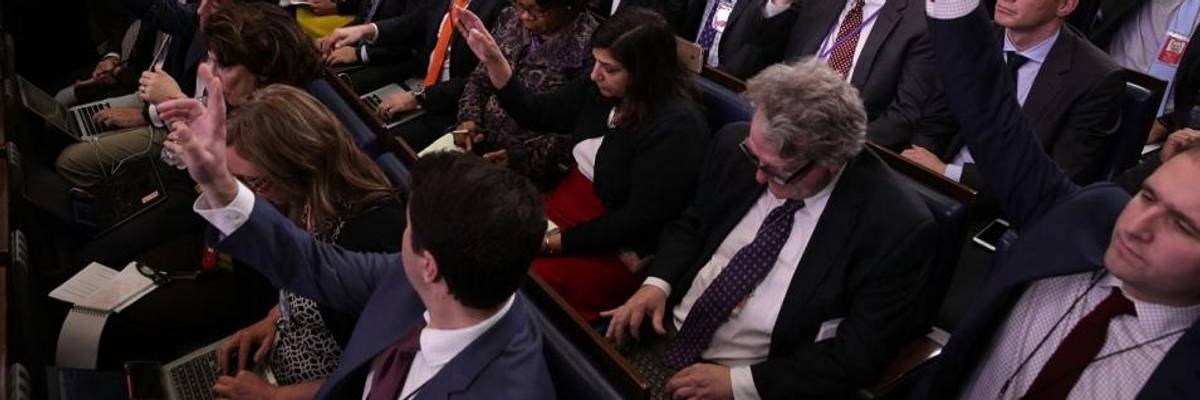
Members of the media raise their hands to ask questions during a daily briefing by White House press secretary Sean Spicer in the James Brady Press Briefing Room on Jan. 23, 2017 in Washington, DC. (Photo: Alex Wong/Getty Images)
While U.S. press freedom continues to decline, "media-bashing enthusiast" President Donald Trump reiterated his hostility toward journalists who critically cover his administration on Wednesday, provoking a new wave of warnings from reporters and and supporters of the First Amendment.
Trump suggested that all "negative" reports should be classified as "fake" and the journalists who produce those reports should have their "credentials" revoked. He tweeted:
"These authoritarian impulses of yours are anti-American," responded former White House ethics director Walter Shaub, one of many free press defenders who swiftly denounced the president's message.
"The president just called all negative coverage fake, and is apparently threatening to revoke credentials unless the press starts writing fan fiction. I always thought of authoritarianism as a slick and stealthy evil, but our democracy appears to be going down via temper tantrum," remarked journalist Lauren Duca.
Responding to Trump's proposal to revoke press credentials over critical coverage, New York Magazine's Olivia Nuzzi pointed out that "his campaign did this to many reporters, including me. It made it more logistically challenging to cover him, but the banned press still covered him."
"He's probably just suggesting this to make everybody upset because he's bored and agitated and chaos thrills him," Nuzzi added, "but it's possible he sees a direct link between a press ban and a successful election."
Blacklisting reporters is just one of the many tactics that Trump and his team have used to "control the media," as Robert Reich outlined shortly after the 2016 presidential election. The Trump campaign's strategy also included berating the media, attempting to turn the public against the media, and threatening libel lawsuits.
"Taking away press credentials because we don't like what they say is wrong," declared Democratic FCC Commissioner Jessica Rosenworcel on Twitter, urging all Americans "to stand up for the First Amendment."
"Thank goodness we have the First Amendment. We need it now more than ever," concluded former federal prosecutor Renato Mariotti.
While offering no praise for the president or his threats, some suggested that revoking credentials could actually improve the critical coverage of Trump's administration.
Jason Linkins, a senior editor at ThinkProgress, tweeted:
Radio show host and Huffington Post editor-at-large Mark Signorile said:
The historically cosy relationship between Washington reporters and politicians has long been criticized by media analysts and people within the industry but garnered notable attention in the wake of the White House Correspondents' Dinner (WHCD) late last month.
While some praised comedian Michelle Wolf for "heap[ing] irreverent contempt on D.C. power centers" during her WHCD routine, a contingent of Capitol Hill reporters and cable news commentators--as well as the White House Correspondents' Association (WHCA)--condemned her sharp takes on the current administration and press corps, elevating a decades-old debate about how journalists in Washington should do their jobs.
Some critics of Trump's Wednesday morning tweet referenced the WHCD controversy:
Hours after the president's tweet, WHCA president Margaret Talev issued a statement that said in part, "a president preventing a free and independent press from covering the workings of our republic would be an unconscionable assault on the First Amendment."
ThinkProgress's Ian Millhiser responded:
Dear Common Dreams reader, It’s been nearly 30 years since I co-founded Common Dreams with my late wife, Lina Newhouser. We had the radical notion that journalism should serve the public good, not corporate profits. It was clear to us from the outset what it would take to build such a project. No paid advertisements. No corporate sponsors. No millionaire publisher telling us what to think or do. Many people said we wouldn't last a year, but we proved those doubters wrong. Together with a tremendous team of journalists and dedicated staff, we built an independent media outlet free from the constraints of profits and corporate control. Our mission has always been simple: To inform. To inspire. To ignite change for the common good. Building Common Dreams was not easy. Our survival was never guaranteed. When you take on the most powerful forces—Wall Street greed, fossil fuel industry destruction, Big Tech lobbyists, and uber-rich oligarchs who have spent billions upon billions rigging the economy and democracy in their favor—the only bulwark you have is supporters who believe in your work. But here’s the urgent message from me today. It's never been this bad out there. And it's never been this hard to keep us going. At the very moment Common Dreams is most needed, the threats we face are intensifying. We need your support now more than ever. We don't accept corporate advertising and never will. We don't have a paywall because we don't think people should be blocked from critical news based on their ability to pay. Everything we do is funded by the donations of readers like you. When everyone does the little they can afford, we are strong. But if that support retreats or dries up, so do we. Will you donate now to make sure Common Dreams not only survives but thrives? —Craig Brown, Co-founder |
While U.S. press freedom continues to decline, "media-bashing enthusiast" President Donald Trump reiterated his hostility toward journalists who critically cover his administration on Wednesday, provoking a new wave of warnings from reporters and and supporters of the First Amendment.
Trump suggested that all "negative" reports should be classified as "fake" and the journalists who produce those reports should have their "credentials" revoked. He tweeted:
"These authoritarian impulses of yours are anti-American," responded former White House ethics director Walter Shaub, one of many free press defenders who swiftly denounced the president's message.
"The president just called all negative coverage fake, and is apparently threatening to revoke credentials unless the press starts writing fan fiction. I always thought of authoritarianism as a slick and stealthy evil, but our democracy appears to be going down via temper tantrum," remarked journalist Lauren Duca.
Responding to Trump's proposal to revoke press credentials over critical coverage, New York Magazine's Olivia Nuzzi pointed out that "his campaign did this to many reporters, including me. It made it more logistically challenging to cover him, but the banned press still covered him."
"He's probably just suggesting this to make everybody upset because he's bored and agitated and chaos thrills him," Nuzzi added, "but it's possible he sees a direct link between a press ban and a successful election."
Blacklisting reporters is just one of the many tactics that Trump and his team have used to "control the media," as Robert Reich outlined shortly after the 2016 presidential election. The Trump campaign's strategy also included berating the media, attempting to turn the public against the media, and threatening libel lawsuits.
"Taking away press credentials because we don't like what they say is wrong," declared Democratic FCC Commissioner Jessica Rosenworcel on Twitter, urging all Americans "to stand up for the First Amendment."
"Thank goodness we have the First Amendment. We need it now more than ever," concluded former federal prosecutor Renato Mariotti.
While offering no praise for the president or his threats, some suggested that revoking credentials could actually improve the critical coverage of Trump's administration.
Jason Linkins, a senior editor at ThinkProgress, tweeted:
Radio show host and Huffington Post editor-at-large Mark Signorile said:
The historically cosy relationship between Washington reporters and politicians has long been criticized by media analysts and people within the industry but garnered notable attention in the wake of the White House Correspondents' Dinner (WHCD) late last month.
While some praised comedian Michelle Wolf for "heap[ing] irreverent contempt on D.C. power centers" during her WHCD routine, a contingent of Capitol Hill reporters and cable news commentators--as well as the White House Correspondents' Association (WHCA)--condemned her sharp takes on the current administration and press corps, elevating a decades-old debate about how journalists in Washington should do their jobs.
Some critics of Trump's Wednesday morning tweet referenced the WHCD controversy:
Hours after the president's tweet, WHCA president Margaret Talev issued a statement that said in part, "a president preventing a free and independent press from covering the workings of our republic would be an unconscionable assault on the First Amendment."
ThinkProgress's Ian Millhiser responded:
While U.S. press freedom continues to decline, "media-bashing enthusiast" President Donald Trump reiterated his hostility toward journalists who critically cover his administration on Wednesday, provoking a new wave of warnings from reporters and and supporters of the First Amendment.
Trump suggested that all "negative" reports should be classified as "fake" and the journalists who produce those reports should have their "credentials" revoked. He tweeted:
"These authoritarian impulses of yours are anti-American," responded former White House ethics director Walter Shaub, one of many free press defenders who swiftly denounced the president's message.
"The president just called all negative coverage fake, and is apparently threatening to revoke credentials unless the press starts writing fan fiction. I always thought of authoritarianism as a slick and stealthy evil, but our democracy appears to be going down via temper tantrum," remarked journalist Lauren Duca.
Responding to Trump's proposal to revoke press credentials over critical coverage, New York Magazine's Olivia Nuzzi pointed out that "his campaign did this to many reporters, including me. It made it more logistically challenging to cover him, but the banned press still covered him."
"He's probably just suggesting this to make everybody upset because he's bored and agitated and chaos thrills him," Nuzzi added, "but it's possible he sees a direct link between a press ban and a successful election."
Blacklisting reporters is just one of the many tactics that Trump and his team have used to "control the media," as Robert Reich outlined shortly after the 2016 presidential election. The Trump campaign's strategy also included berating the media, attempting to turn the public against the media, and threatening libel lawsuits.
"Taking away press credentials because we don't like what they say is wrong," declared Democratic FCC Commissioner Jessica Rosenworcel on Twitter, urging all Americans "to stand up for the First Amendment."
"Thank goodness we have the First Amendment. We need it now more than ever," concluded former federal prosecutor Renato Mariotti.
While offering no praise for the president or his threats, some suggested that revoking credentials could actually improve the critical coverage of Trump's administration.
Jason Linkins, a senior editor at ThinkProgress, tweeted:
Radio show host and Huffington Post editor-at-large Mark Signorile said:
The historically cosy relationship between Washington reporters and politicians has long been criticized by media analysts and people within the industry but garnered notable attention in the wake of the White House Correspondents' Dinner (WHCD) late last month.
While some praised comedian Michelle Wolf for "heap[ing] irreverent contempt on D.C. power centers" during her WHCD routine, a contingent of Capitol Hill reporters and cable news commentators--as well as the White House Correspondents' Association (WHCA)--condemned her sharp takes on the current administration and press corps, elevating a decades-old debate about how journalists in Washington should do their jobs.
Some critics of Trump's Wednesday morning tweet referenced the WHCD controversy:
Hours after the president's tweet, WHCA president Margaret Talev issued a statement that said in part, "a president preventing a free and independent press from covering the workings of our republic would be an unconscionable assault on the First Amendment."
ThinkProgress's Ian Millhiser responded: