SUBSCRIBE TO OUR FREE NEWSLETTER
Daily news & progressive opinion—funded by the people, not the corporations—delivered straight to your inbox.
5
#000000
#FFFFFF
To donate by check, phone, or other method, see our More Ways to Give page.
Daily news & progressive opinion—funded by the people, not the corporations—delivered straight to your inbox.
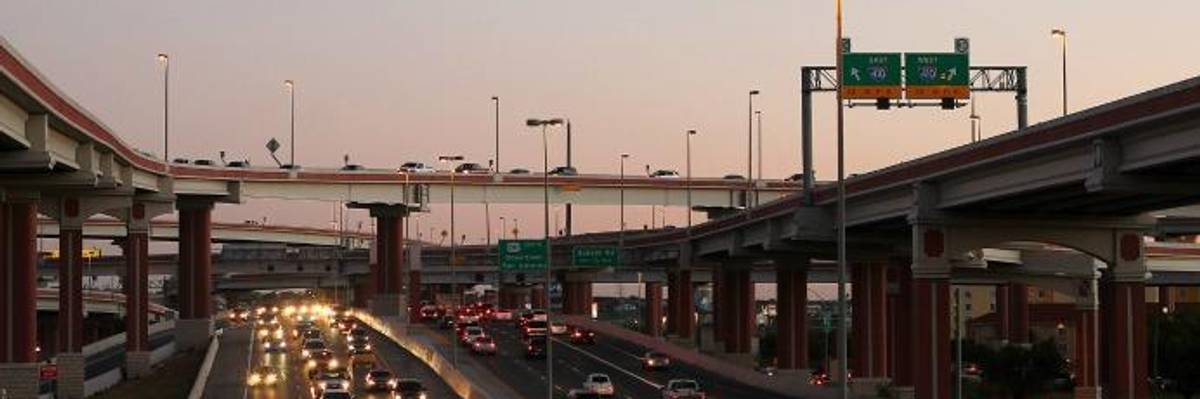
"There is no reason to give automakers a cheap way out of compliance with the standards," says NRDC's Irene Gutierrez. (Photo: formulanone/flickr/cc)
A federal court on Monday stopped another of the Trump administration's attacks on clean air--its indefinite delay of stricter penalties for automakers producing vehicle fleets that don't meet fuel efficiency standards.
"Today's court order is a big win for New Yorkers' and all Americans' health and environment," declared New York Attorney General Eric Schneiderman.
The ruling (pdf) by the U.S. Court of Appeals for the Second Circuit means the higher fine--going from $5.50 per tenth of a mile per gallon to $14 per tenth of a mile per gallon of fuel a vehicle guzzles beyond the standards--stays in place.
Leading environmental groups as well as a Schneiderman-led a coalition of attorneys general (pdf) had filed suit to stop the Trump administration's planned delay of the Obama-era rule. A weak fine, they argued, serves as no incentive for automakers to improve technology that can slash carbon dioxide emissions.
"Americans will breathe easier because the court undid the Trump administration's bizarre attempt to encourage toxic tailpipe pollution," said Vera Pardee, senior counsel at the Center for Biological Diversity. "Cheap fines incentivize automakers to produce gas-guzzlers that fuel climate change and spew harmful pollutants. Reinstating proper penalties will help protect our kids' lungs and our planet's future."
According to NRDC's Irene Gutierrez, the ruling's "a victory for consumers, our economic security, public health and the planet." She explains:
There is no reason to give automakers a cheap way out of compliance with the standards. The benefits of automakers meeting those targets are HUGE. The fuel economy standards for model years 2012 to 2025 will reduce oil consumption by 3.1 million barrels of oil per day in 2030. This in turn reduces climate-harming greenhouse gas emissions, avoiding production of 570 million metric tons of carbon dioxide--the equivalent of taking 85 million cars off the roads, or 140 coal-fired power plants offline.
In addition, she says,
The decision adds to the list of failed efforts by the Trump administration to illegally roll back environmental protections including efforts to scrap methane emissions rules and rules regarding royalty payments on oil and gas leases. We'll likely see more of these decisions over the next few years, as courts hold agencies to follow the procedures required by law.
Given such failures, added Schneiderman, "As we've proven again and again, when the Trump administration puts special interests before public health and our environment, we'll take them to court--and we will win."
Dear Common Dreams reader, It’s been nearly 30 years since I co-founded Common Dreams with my late wife, Lina Newhouser. We had the radical notion that journalism should serve the public good, not corporate profits. It was clear to us from the outset what it would take to build such a project. No paid advertisements. No corporate sponsors. No millionaire publisher telling us what to think or do. Many people said we wouldn't last a year, but we proved those doubters wrong. Together with a tremendous team of journalists and dedicated staff, we built an independent media outlet free from the constraints of profits and corporate control. Our mission has always been simple: To inform. To inspire. To ignite change for the common good. Building Common Dreams was not easy. Our survival was never guaranteed. When you take on the most powerful forces—Wall Street greed, fossil fuel industry destruction, Big Tech lobbyists, and uber-rich oligarchs who have spent billions upon billions rigging the economy and democracy in their favor—the only bulwark you have is supporters who believe in your work. But here’s the urgent message from me today. It's never been this bad out there. And it's never been this hard to keep us going. At the very moment Common Dreams is most needed, the threats we face are intensifying. We need your support now more than ever. We don't accept corporate advertising and never will. We don't have a paywall because we don't think people should be blocked from critical news based on their ability to pay. Everything we do is funded by the donations of readers like you. When everyone does the little they can afford, we are strong. But if that support retreats or dries up, so do we. Will you donate now to make sure Common Dreams not only survives but thrives? —Craig Brown, Co-founder |
A federal court on Monday stopped another of the Trump administration's attacks on clean air--its indefinite delay of stricter penalties for automakers producing vehicle fleets that don't meet fuel efficiency standards.
"Today's court order is a big win for New Yorkers' and all Americans' health and environment," declared New York Attorney General Eric Schneiderman.
The ruling (pdf) by the U.S. Court of Appeals for the Second Circuit means the higher fine--going from $5.50 per tenth of a mile per gallon to $14 per tenth of a mile per gallon of fuel a vehicle guzzles beyond the standards--stays in place.
Leading environmental groups as well as a Schneiderman-led a coalition of attorneys general (pdf) had filed suit to stop the Trump administration's planned delay of the Obama-era rule. A weak fine, they argued, serves as no incentive for automakers to improve technology that can slash carbon dioxide emissions.
"Americans will breathe easier because the court undid the Trump administration's bizarre attempt to encourage toxic tailpipe pollution," said Vera Pardee, senior counsel at the Center for Biological Diversity. "Cheap fines incentivize automakers to produce gas-guzzlers that fuel climate change and spew harmful pollutants. Reinstating proper penalties will help protect our kids' lungs and our planet's future."
According to NRDC's Irene Gutierrez, the ruling's "a victory for consumers, our economic security, public health and the planet." She explains:
There is no reason to give automakers a cheap way out of compliance with the standards. The benefits of automakers meeting those targets are HUGE. The fuel economy standards for model years 2012 to 2025 will reduce oil consumption by 3.1 million barrels of oil per day in 2030. This in turn reduces climate-harming greenhouse gas emissions, avoiding production of 570 million metric tons of carbon dioxide--the equivalent of taking 85 million cars off the roads, or 140 coal-fired power plants offline.
In addition, she says,
The decision adds to the list of failed efforts by the Trump administration to illegally roll back environmental protections including efforts to scrap methane emissions rules and rules regarding royalty payments on oil and gas leases. We'll likely see more of these decisions over the next few years, as courts hold agencies to follow the procedures required by law.
Given such failures, added Schneiderman, "As we've proven again and again, when the Trump administration puts special interests before public health and our environment, we'll take them to court--and we will win."
A federal court on Monday stopped another of the Trump administration's attacks on clean air--its indefinite delay of stricter penalties for automakers producing vehicle fleets that don't meet fuel efficiency standards.
"Today's court order is a big win for New Yorkers' and all Americans' health and environment," declared New York Attorney General Eric Schneiderman.
The ruling (pdf) by the U.S. Court of Appeals for the Second Circuit means the higher fine--going from $5.50 per tenth of a mile per gallon to $14 per tenth of a mile per gallon of fuel a vehicle guzzles beyond the standards--stays in place.
Leading environmental groups as well as a Schneiderman-led a coalition of attorneys general (pdf) had filed suit to stop the Trump administration's planned delay of the Obama-era rule. A weak fine, they argued, serves as no incentive for automakers to improve technology that can slash carbon dioxide emissions.
"Americans will breathe easier because the court undid the Trump administration's bizarre attempt to encourage toxic tailpipe pollution," said Vera Pardee, senior counsel at the Center for Biological Diversity. "Cheap fines incentivize automakers to produce gas-guzzlers that fuel climate change and spew harmful pollutants. Reinstating proper penalties will help protect our kids' lungs and our planet's future."
According to NRDC's Irene Gutierrez, the ruling's "a victory for consumers, our economic security, public health and the planet." She explains:
There is no reason to give automakers a cheap way out of compliance with the standards. The benefits of automakers meeting those targets are HUGE. The fuel economy standards for model years 2012 to 2025 will reduce oil consumption by 3.1 million barrels of oil per day in 2030. This in turn reduces climate-harming greenhouse gas emissions, avoiding production of 570 million metric tons of carbon dioxide--the equivalent of taking 85 million cars off the roads, or 140 coal-fired power plants offline.
In addition, she says,
The decision adds to the list of failed efforts by the Trump administration to illegally roll back environmental protections including efforts to scrap methane emissions rules and rules regarding royalty payments on oil and gas leases. We'll likely see more of these decisions over the next few years, as courts hold agencies to follow the procedures required by law.
Given such failures, added Schneiderman, "As we've proven again and again, when the Trump administration puts special interests before public health and our environment, we'll take them to court--and we will win."