SUBSCRIBE TO OUR FREE NEWSLETTER
Daily news & progressive opinion—funded by the people, not the corporations—delivered straight to your inbox.
5
#000000
#FFFFFF
To donate by check, phone, or other method, see our More Ways to Give page.
Daily news & progressive opinion—funded by the people, not the corporations—delivered straight to your inbox.
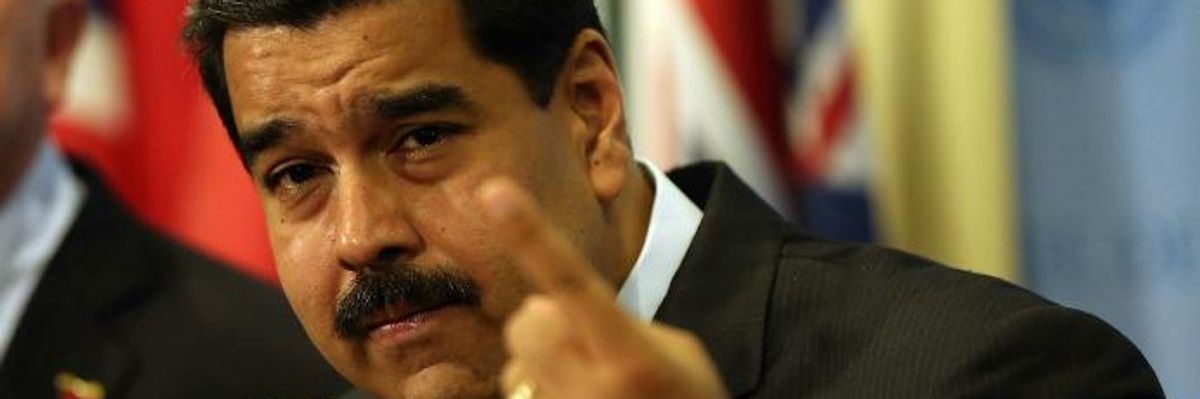
Venezuelan President Nicolas Maduro speaks to the media following a meeting with UN chief Ban Ki-moon at the United Nations (UN) headquarters in New York on July 28, 2015 in New York City. (Photo: Spencer Platt/Getty Images)
In response to comments from President Donald Trump that he wouldn't "rule out" a "military option" against Venezuela--currently embroiled in domestic political conflict as neoliberal forces challenge the socialist-led government of President Nicholas Maduro--the nation's top officials characterized Trump's remarks as "madness" coming from the "imperial" and "extremist elite that rules the United States."
In remarks to reporters made from his estate in Bedminster, New Jersey on Friday Trump said, "We have many options for Venezuela, including a possible military option, if necessary." Trump bragged that the U.S. has "troops all over the world," but said that Venezuela was "not very far away."
Later, it emerged that Trump--who has hosted or greeted with smiles human rights offenders like Israeli Prime Minister Bibi Netanyahu, Turkish President Recep Tayyip Erdogan, and Egyptian President Abdel Fattah al-Sissi--had refused to take a call from Maduro.
In response, Venezuela's Defense Minister Vladimir Padrino denounced the behavior and comments of the U.S. president.
"It is an act of madness. It is an act of supreme extremism. There is an extremist elite that rules the United States," he said in televised remarks.
Separately, the nation's Communication Minister Ernesto Villegas called Trump's threat of military action "an unprecedented threat to national sovereignty." In a tweet, Villegas announced he had summoned the nation's diplomats for a meeting on Saturday and promised to release a later "communique addressing the imperial threat to Venezuela" represented by the U.S. government.
No stranger to U.S. meddling in its internal affairs, Venezuela was the victim of a coup in 2002 that had the explicit backing and support of U.S. officials and neoconservative allies.
Offering perpsective on the ongoing crisis in Venezuela, Mark Weisbrot, economist and co-director of the Center for Economic and Policy Research, appeared on BBC earlier this week amidst increasingly violent street protests and in the wake of new threats from right-wing forces calling for--and actually attempting--a militant rebellion against Maduro's existing democratically-elected government. In his comments, Weisbrot calls it deeply problematic that the Trump administration has openly called for "regime change" in Venezuela, especially given the historic and destructive role of U.S. imperialism in Latin America.
Watch:
Dear Common Dreams reader, It’s been nearly 30 years since I co-founded Common Dreams with my late wife, Lina Newhouser. We had the radical notion that journalism should serve the public good, not corporate profits. It was clear to us from the outset what it would take to build such a project. No paid advertisements. No corporate sponsors. No millionaire publisher telling us what to think or do. Many people said we wouldn't last a year, but we proved those doubters wrong. Together with a tremendous team of journalists and dedicated staff, we built an independent media outlet free from the constraints of profits and corporate control. Our mission has always been simple: To inform. To inspire. To ignite change for the common good. Building Common Dreams was not easy. Our survival was never guaranteed. When you take on the most powerful forces—Wall Street greed, fossil fuel industry destruction, Big Tech lobbyists, and uber-rich oligarchs who have spent billions upon billions rigging the economy and democracy in their favor—the only bulwark you have is supporters who believe in your work. But here’s the urgent message from me today. It's never been this bad out there. And it's never been this hard to keep us going. At the very moment Common Dreams is most needed, the threats we face are intensifying. We need your support now more than ever. We don't accept corporate advertising and never will. We don't have a paywall because we don't think people should be blocked from critical news based on their ability to pay. Everything we do is funded by the donations of readers like you. When everyone does the little they can afford, we are strong. But if that support retreats or dries up, so do we. Will you donate now to make sure Common Dreams not only survives but thrives? —Craig Brown, Co-founder |
In response to comments from President Donald Trump that he wouldn't "rule out" a "military option" against Venezuela--currently embroiled in domestic political conflict as neoliberal forces challenge the socialist-led government of President Nicholas Maduro--the nation's top officials characterized Trump's remarks as "madness" coming from the "imperial" and "extremist elite that rules the United States."
In remarks to reporters made from his estate in Bedminster, New Jersey on Friday Trump said, "We have many options for Venezuela, including a possible military option, if necessary." Trump bragged that the U.S. has "troops all over the world," but said that Venezuela was "not very far away."
Later, it emerged that Trump--who has hosted or greeted with smiles human rights offenders like Israeli Prime Minister Bibi Netanyahu, Turkish President Recep Tayyip Erdogan, and Egyptian President Abdel Fattah al-Sissi--had refused to take a call from Maduro.
In response, Venezuela's Defense Minister Vladimir Padrino denounced the behavior and comments of the U.S. president.
"It is an act of madness. It is an act of supreme extremism. There is an extremist elite that rules the United States," he said in televised remarks.
Separately, the nation's Communication Minister Ernesto Villegas called Trump's threat of military action "an unprecedented threat to national sovereignty." In a tweet, Villegas announced he had summoned the nation's diplomats for a meeting on Saturday and promised to release a later "communique addressing the imperial threat to Venezuela" represented by the U.S. government.
No stranger to U.S. meddling in its internal affairs, Venezuela was the victim of a coup in 2002 that had the explicit backing and support of U.S. officials and neoconservative allies.
Offering perpsective on the ongoing crisis in Venezuela, Mark Weisbrot, economist and co-director of the Center for Economic and Policy Research, appeared on BBC earlier this week amidst increasingly violent street protests and in the wake of new threats from right-wing forces calling for--and actually attempting--a militant rebellion against Maduro's existing democratically-elected government. In his comments, Weisbrot calls it deeply problematic that the Trump administration has openly called for "regime change" in Venezuela, especially given the historic and destructive role of U.S. imperialism in Latin America.
Watch:
In response to comments from President Donald Trump that he wouldn't "rule out" a "military option" against Venezuela--currently embroiled in domestic political conflict as neoliberal forces challenge the socialist-led government of President Nicholas Maduro--the nation's top officials characterized Trump's remarks as "madness" coming from the "imperial" and "extremist elite that rules the United States."
In remarks to reporters made from his estate in Bedminster, New Jersey on Friday Trump said, "We have many options for Venezuela, including a possible military option, if necessary." Trump bragged that the U.S. has "troops all over the world," but said that Venezuela was "not very far away."
Later, it emerged that Trump--who has hosted or greeted with smiles human rights offenders like Israeli Prime Minister Bibi Netanyahu, Turkish President Recep Tayyip Erdogan, and Egyptian President Abdel Fattah al-Sissi--had refused to take a call from Maduro.
In response, Venezuela's Defense Minister Vladimir Padrino denounced the behavior and comments of the U.S. president.
"It is an act of madness. It is an act of supreme extremism. There is an extremist elite that rules the United States," he said in televised remarks.
Separately, the nation's Communication Minister Ernesto Villegas called Trump's threat of military action "an unprecedented threat to national sovereignty." In a tweet, Villegas announced he had summoned the nation's diplomats for a meeting on Saturday and promised to release a later "communique addressing the imperial threat to Venezuela" represented by the U.S. government.
No stranger to U.S. meddling in its internal affairs, Venezuela was the victim of a coup in 2002 that had the explicit backing and support of U.S. officials and neoconservative allies.
Offering perpsective on the ongoing crisis in Venezuela, Mark Weisbrot, economist and co-director of the Center for Economic and Policy Research, appeared on BBC earlier this week amidst increasingly violent street protests and in the wake of new threats from right-wing forces calling for--and actually attempting--a militant rebellion against Maduro's existing democratically-elected government. In his comments, Weisbrot calls it deeply problematic that the Trump administration has openly called for "regime change" in Venezuela, especially given the historic and destructive role of U.S. imperialism in Latin America.
Watch: