

SUBSCRIBE TO OUR FREE NEWSLETTER
Daily news & progressive opinion—funded by the people, not the corporations—delivered straight to your inbox.
5
#000000
#FFFFFF
To donate by check, phone, or other method, see our More Ways to Give page.
Daily news & progressive opinion—funded by the people, not the corporations—delivered straight to your inbox.
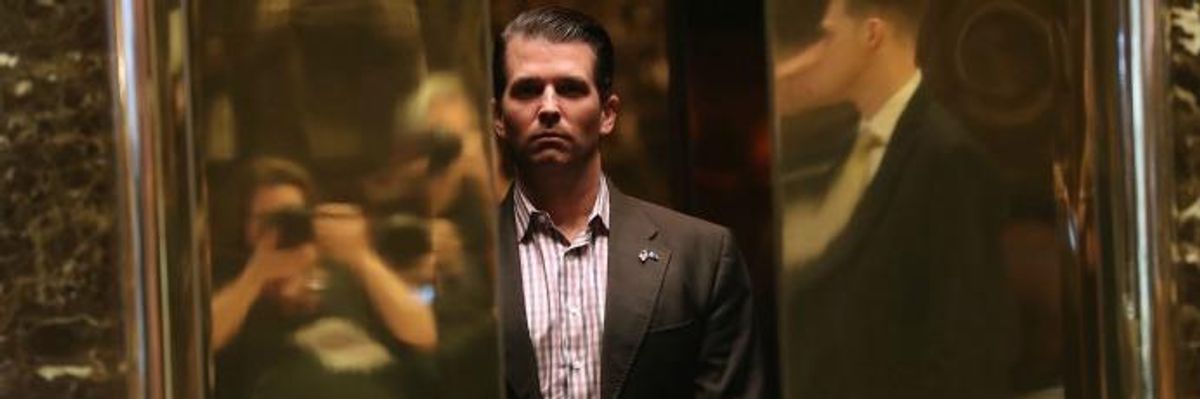
Donald Trump Jr. arrives at Trump Tower in New York City. The president's son is under fire for meeting with a Kremlin-connected lawyer during the campaign. (Photo: John Moore/Getty Images)
Following the latest explosive details about Donald Trump Jr.'s meeting with a Kremlin-connected lawyer during last year's campaign, in which he hoped to receive damaging information about Hillary Clinton, legal experts are saying the encounter could be proof that "collusion"--or even "treason"--took place.
Trump Jr. confirmed the New York Times' initial reports that he attended the meeting with Natalia Veselnitskaya (infamous for challenging the Magnitsky Act, which blacklists suspected Russian human rights abusers) at Trump Tower, along with then-campaign chairman Paul J. Manafort, and Jared Kushner, the president's son-in-law.
However, Trump Jr. and Manafort have since lawyered up, with the Times reporting Monday that Jr. "was informed in an email" that Veselnitskaya's promised dirt on Clinton "was part of a Russian government effort to aid his father's candidacy."
In the wake of the Monday's report, the government ethics watchdogs at CREW said it would be "hard to overstate how huge this is."
MSNBC's chief legal correspondent, Ari Melber, laid out the legal implications on Twitter:
Washington Post columnist Eugene Robinson called the latest revelations a "legal game-changer" because it shows top members of the Trump campaign--in this case the president's own son--willing to accept information believed to be coming from a foreign government.
"Despite what Trump apologists may say, it is not normal practice for a campaign to welcome information undermining an opponent, regardless of the source," explained Robinson. "In 2000, the Al Gore campaign was anonymously sent briefing books and a video that George W. Bush had used to prepare for an upcoming debate. Gore campaign officials immediately turned the material over to the FBI--which opened a criminal investigation."
Trump Jr.'s lawyer claims the reports are "much ado about nothing," but former assistant Watergate special prosecutor Jill Wine-Banks disagrees.
"It is collusion with a foreign adversary if they were working together to get the information from the Russian government," she said Monday night on MSNBC. "And that's what this looks like, it looks like clear proof of collusion."
But even before Monday's revelations, there was talk of treason among legal experts.
"This was an effort to get opposition research on an opponent in an American political campaign from the Russians, who were known to be engaged in spying inside the United States," said Richard Painter, an ethics lawyer under former President George W. Bush, on Sunday. "We do not get our opposition research from spies, we do not collaborate with Russian spies, unless we want to be accused of treason."
"This is unacceptable," he added. "This borders on treason, if it is not itself treason."
Dear Common Dreams reader, It’s been nearly 30 years since I co-founded Common Dreams with my late wife, Lina Newhouser. We had the radical notion that journalism should serve the public good, not corporate profits. It was clear to us from the outset what it would take to build such a project. No paid advertisements. No corporate sponsors. No millionaire publisher telling us what to think or do. Many people said we wouldn't last a year, but we proved those doubters wrong. Together with a tremendous team of journalists and dedicated staff, we built an independent media outlet free from the constraints of profits and corporate control. Our mission has always been simple: To inform. To inspire. To ignite change for the common good. Building Common Dreams was not easy. Our survival was never guaranteed. When you take on the most powerful forces—Wall Street greed, fossil fuel industry destruction, Big Tech lobbyists, and uber-rich oligarchs who have spent billions upon billions rigging the economy and democracy in their favor—the only bulwark you have is supporters who believe in your work. But here’s the urgent message from me today. It's never been this bad out there. And it's never been this hard to keep us going. At the very moment Common Dreams is most needed, the threats we face are intensifying. We need your support now more than ever. We don't accept corporate advertising and never will. We don't have a paywall because we don't think people should be blocked from critical news based on their ability to pay. Everything we do is funded by the donations of readers like you. When everyone does the little they can afford, we are strong. But if that support retreats or dries up, so do we. Will you donate now to make sure Common Dreams not only survives but thrives? —Craig Brown, Co-founder |
Following the latest explosive details about Donald Trump Jr.'s meeting with a Kremlin-connected lawyer during last year's campaign, in which he hoped to receive damaging information about Hillary Clinton, legal experts are saying the encounter could be proof that "collusion"--or even "treason"--took place.
Trump Jr. confirmed the New York Times' initial reports that he attended the meeting with Natalia Veselnitskaya (infamous for challenging the Magnitsky Act, which blacklists suspected Russian human rights abusers) at Trump Tower, along with then-campaign chairman Paul J. Manafort, and Jared Kushner, the president's son-in-law.
However, Trump Jr. and Manafort have since lawyered up, with the Times reporting Monday that Jr. "was informed in an email" that Veselnitskaya's promised dirt on Clinton "was part of a Russian government effort to aid his father's candidacy."
In the wake of the Monday's report, the government ethics watchdogs at CREW said it would be "hard to overstate how huge this is."
MSNBC's chief legal correspondent, Ari Melber, laid out the legal implications on Twitter:
Washington Post columnist Eugene Robinson called the latest revelations a "legal game-changer" because it shows top members of the Trump campaign--in this case the president's own son--willing to accept information believed to be coming from a foreign government.
"Despite what Trump apologists may say, it is not normal practice for a campaign to welcome information undermining an opponent, regardless of the source," explained Robinson. "In 2000, the Al Gore campaign was anonymously sent briefing books and a video that George W. Bush had used to prepare for an upcoming debate. Gore campaign officials immediately turned the material over to the FBI--which opened a criminal investigation."
Trump Jr.'s lawyer claims the reports are "much ado about nothing," but former assistant Watergate special prosecutor Jill Wine-Banks disagrees.
"It is collusion with a foreign adversary if they were working together to get the information from the Russian government," she said Monday night on MSNBC. "And that's what this looks like, it looks like clear proof of collusion."
But even before Monday's revelations, there was talk of treason among legal experts.
"This was an effort to get opposition research on an opponent in an American political campaign from the Russians, who were known to be engaged in spying inside the United States," said Richard Painter, an ethics lawyer under former President George W. Bush, on Sunday. "We do not get our opposition research from spies, we do not collaborate with Russian spies, unless we want to be accused of treason."
"This is unacceptable," he added. "This borders on treason, if it is not itself treason."
Following the latest explosive details about Donald Trump Jr.'s meeting with a Kremlin-connected lawyer during last year's campaign, in which he hoped to receive damaging information about Hillary Clinton, legal experts are saying the encounter could be proof that "collusion"--or even "treason"--took place.
Trump Jr. confirmed the New York Times' initial reports that he attended the meeting with Natalia Veselnitskaya (infamous for challenging the Magnitsky Act, which blacklists suspected Russian human rights abusers) at Trump Tower, along with then-campaign chairman Paul J. Manafort, and Jared Kushner, the president's son-in-law.
However, Trump Jr. and Manafort have since lawyered up, with the Times reporting Monday that Jr. "was informed in an email" that Veselnitskaya's promised dirt on Clinton "was part of a Russian government effort to aid his father's candidacy."
In the wake of the Monday's report, the government ethics watchdogs at CREW said it would be "hard to overstate how huge this is."
MSNBC's chief legal correspondent, Ari Melber, laid out the legal implications on Twitter:
Washington Post columnist Eugene Robinson called the latest revelations a "legal game-changer" because it shows top members of the Trump campaign--in this case the president's own son--willing to accept information believed to be coming from a foreign government.
"Despite what Trump apologists may say, it is not normal practice for a campaign to welcome information undermining an opponent, regardless of the source," explained Robinson. "In 2000, the Al Gore campaign was anonymously sent briefing books and a video that George W. Bush had used to prepare for an upcoming debate. Gore campaign officials immediately turned the material over to the FBI--which opened a criminal investigation."
Trump Jr.'s lawyer claims the reports are "much ado about nothing," but former assistant Watergate special prosecutor Jill Wine-Banks disagrees.
"It is collusion with a foreign adversary if they were working together to get the information from the Russian government," she said Monday night on MSNBC. "And that's what this looks like, it looks like clear proof of collusion."
But even before Monday's revelations, there was talk of treason among legal experts.
"This was an effort to get opposition research on an opponent in an American political campaign from the Russians, who were known to be engaged in spying inside the United States," said Richard Painter, an ethics lawyer under former President George W. Bush, on Sunday. "We do not get our opposition research from spies, we do not collaborate with Russian spies, unless we want to be accused of treason."
"This is unacceptable," he added. "This borders on treason, if it is not itself treason."

