SUBSCRIBE TO OUR FREE NEWSLETTER
Daily news & progressive opinion—funded by the people, not the corporations—delivered straight to your inbox.
5
#000000
#FFFFFF
To donate by check, phone, or other method, see our More Ways to Give page.
Daily news & progressive opinion—funded by the people, not the corporations—delivered straight to your inbox.
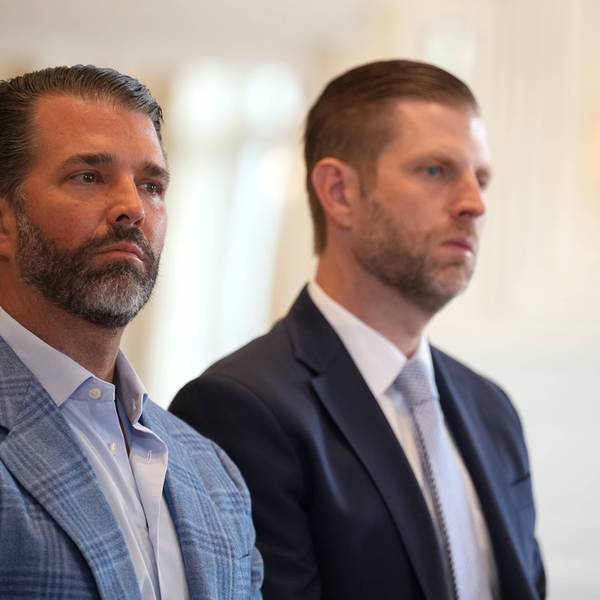
Uproar and revived criticisms of standing "conflict of interest" concerns surfaced Saturday after it was revealed that a business trip that President Donald Trump's second-eldest son, Eric Trump, recently made to Uruguay cost U.S. taxpayers nearly a hundred thousand dollars in hotel costs and administrative fees.
As the Washington Post, which broke the story, reported:
It was a high-profile jaunt out of the country for Eric, the fresh-faced executive of the Trump Organization who, like his father, pledged to keep the company separate from the presidency. Eric mingled with real estate brokers, dined at an open-air beachfront eatery and spoke to hundreds at an "ultra exclusive" Trump Tower Punta del Este evening party celebrating his visit.
The Uruguayan trip shows how the government is unavoidably entangled with the Trump company as a result of the president's refusal to divest his ownership stake. In this case, government agencies are forced to pay to support business operations that ultimately help to enrich the president himself. Though the Trumps have pledged a division of business and government, they will nevertheless depend on the publicly funded protection granted to the first family as they travel the globe promoting their brand.
What's not out of the ordinary is that close family members of the president are provided with Secret Service protection--that is an established tradition and protocol. But what has sparked the serious concern is how taxpayers are being forced to subsidize the business expenditures by the president's wealthy family members--especially Eric and his brother Donald Trump Jr.--who have been temporarily put in charge of the Trump Organization while their father serves as president.
"There is a public benefit to providing Secret Service protection," Kathleen Clark, an expert on government ethics and law professor at Washington University in St. Louis, told the Post. "But what was the public benefit from State Department personnel participating in this private business trip to the coastal town? It raises the specter of the use of public resources for private gain." Clark said the whole affair "is an example of the blurring of the line between the personal interest in the family business"--from which Trump has refused to fully divest, and the U.S. government he is now running.
"This whole story is mind-blowing," declared author and activist Naomi Klein in a tweet. She explained:
Biggest scandal is the whole business model: Eric sells the Trump brand for $$ + that brand's value is up *because* Trump is president. https://t.co/SNHDhh04mr
-- Naomi Klein (@NaomiAKlein) February 3, 2017
Dean Baker, an economist and the co-director of the Center for Economic and Policy Research (CEPR), put it this way:
Norm Eisen, a former Obama ethics adviser who is part of a lawsuit accusing Trump of violating a constitutional provision barring presidents from taking payments from foreign governments, told the Post the conflict are obvious. "Having refused to sever his own personal financial interests," said Eisen, "[the president] is now sending his emissaries, his sons, out to line his own pockets, and he's subsidizing that activity with taxpayer dollars."
Dear Common Dreams reader, It’s been nearly 30 years since I co-founded Common Dreams with my late wife, Lina Newhouser. We had the radical notion that journalism should serve the public good, not corporate profits. It was clear to us from the outset what it would take to build such a project. No paid advertisements. No corporate sponsors. No millionaire publisher telling us what to think or do. Many people said we wouldn't last a year, but we proved those doubters wrong. Together with a tremendous team of journalists and dedicated staff, we built an independent media outlet free from the constraints of profits and corporate control. Our mission has always been simple: To inform. To inspire. To ignite change for the common good. Building Common Dreams was not easy. Our survival was never guaranteed. When you take on the most powerful forces—Wall Street greed, fossil fuel industry destruction, Big Tech lobbyists, and uber-rich oligarchs who have spent billions upon billions rigging the economy and democracy in their favor—the only bulwark you have is supporters who believe in your work. But here’s the urgent message from me today. It's never been this bad out there. And it's never been this hard to keep us going. At the very moment Common Dreams is most needed, the threats we face are intensifying. We need your support now more than ever. We don't accept corporate advertising and never will. We don't have a paywall because we don't think people should be blocked from critical news based on their ability to pay. Everything we do is funded by the donations of readers like you. When everyone does the little they can afford, we are strong. But if that support retreats or dries up, so do we. Will you donate now to make sure Common Dreams not only survives but thrives? —Craig Brown, Co-founder |
Uproar and revived criticisms of standing "conflict of interest" concerns surfaced Saturday after it was revealed that a business trip that President Donald Trump's second-eldest son, Eric Trump, recently made to Uruguay cost U.S. taxpayers nearly a hundred thousand dollars in hotel costs and administrative fees.
As the Washington Post, which broke the story, reported:
It was a high-profile jaunt out of the country for Eric, the fresh-faced executive of the Trump Organization who, like his father, pledged to keep the company separate from the presidency. Eric mingled with real estate brokers, dined at an open-air beachfront eatery and spoke to hundreds at an "ultra exclusive" Trump Tower Punta del Este evening party celebrating his visit.
The Uruguayan trip shows how the government is unavoidably entangled with the Trump company as a result of the president's refusal to divest his ownership stake. In this case, government agencies are forced to pay to support business operations that ultimately help to enrich the president himself. Though the Trumps have pledged a division of business and government, they will nevertheless depend on the publicly funded protection granted to the first family as they travel the globe promoting their brand.
What's not out of the ordinary is that close family members of the president are provided with Secret Service protection--that is an established tradition and protocol. But what has sparked the serious concern is how taxpayers are being forced to subsidize the business expenditures by the president's wealthy family members--especially Eric and his brother Donald Trump Jr.--who have been temporarily put in charge of the Trump Organization while their father serves as president.
"There is a public benefit to providing Secret Service protection," Kathleen Clark, an expert on government ethics and law professor at Washington University in St. Louis, told the Post. "But what was the public benefit from State Department personnel participating in this private business trip to the coastal town? It raises the specter of the use of public resources for private gain." Clark said the whole affair "is an example of the blurring of the line between the personal interest in the family business"--from which Trump has refused to fully divest, and the U.S. government he is now running.
"This whole story is mind-blowing," declared author and activist Naomi Klein in a tweet. She explained:
Biggest scandal is the whole business model: Eric sells the Trump brand for $$ + that brand's value is up *because* Trump is president. https://t.co/SNHDhh04mr
-- Naomi Klein (@NaomiAKlein) February 3, 2017
Dean Baker, an economist and the co-director of the Center for Economic and Policy Research (CEPR), put it this way:
Norm Eisen, a former Obama ethics adviser who is part of a lawsuit accusing Trump of violating a constitutional provision barring presidents from taking payments from foreign governments, told the Post the conflict are obvious. "Having refused to sever his own personal financial interests," said Eisen, "[the president] is now sending his emissaries, his sons, out to line his own pockets, and he's subsidizing that activity with taxpayer dollars."
Uproar and revived criticisms of standing "conflict of interest" concerns surfaced Saturday after it was revealed that a business trip that President Donald Trump's second-eldest son, Eric Trump, recently made to Uruguay cost U.S. taxpayers nearly a hundred thousand dollars in hotel costs and administrative fees.
As the Washington Post, which broke the story, reported:
It was a high-profile jaunt out of the country for Eric, the fresh-faced executive of the Trump Organization who, like his father, pledged to keep the company separate from the presidency. Eric mingled with real estate brokers, dined at an open-air beachfront eatery and spoke to hundreds at an "ultra exclusive" Trump Tower Punta del Este evening party celebrating his visit.
The Uruguayan trip shows how the government is unavoidably entangled with the Trump company as a result of the president's refusal to divest his ownership stake. In this case, government agencies are forced to pay to support business operations that ultimately help to enrich the president himself. Though the Trumps have pledged a division of business and government, they will nevertheless depend on the publicly funded protection granted to the first family as they travel the globe promoting their brand.
What's not out of the ordinary is that close family members of the president are provided with Secret Service protection--that is an established tradition and protocol. But what has sparked the serious concern is how taxpayers are being forced to subsidize the business expenditures by the president's wealthy family members--especially Eric and his brother Donald Trump Jr.--who have been temporarily put in charge of the Trump Organization while their father serves as president.
"There is a public benefit to providing Secret Service protection," Kathleen Clark, an expert on government ethics and law professor at Washington University in St. Louis, told the Post. "But what was the public benefit from State Department personnel participating in this private business trip to the coastal town? It raises the specter of the use of public resources for private gain." Clark said the whole affair "is an example of the blurring of the line between the personal interest in the family business"--from which Trump has refused to fully divest, and the U.S. government he is now running.
"This whole story is mind-blowing," declared author and activist Naomi Klein in a tweet. She explained:
Biggest scandal is the whole business model: Eric sells the Trump brand for $$ + that brand's value is up *because* Trump is president. https://t.co/SNHDhh04mr
-- Naomi Klein (@NaomiAKlein) February 3, 2017
Dean Baker, an economist and the co-director of the Center for Economic and Policy Research (CEPR), put it this way:
Norm Eisen, a former Obama ethics adviser who is part of a lawsuit accusing Trump of violating a constitutional provision barring presidents from taking payments from foreign governments, told the Post the conflict are obvious. "Having refused to sever his own personal financial interests," said Eisen, "[the president] is now sending his emissaries, his sons, out to line his own pockets, and he's subsidizing that activity with taxpayer dollars."