

When the Obama administration announced earlier this month that it was reversing its plans to open the mid- and south-Atlantic to oil and gas drilling, environmental groups cheered.
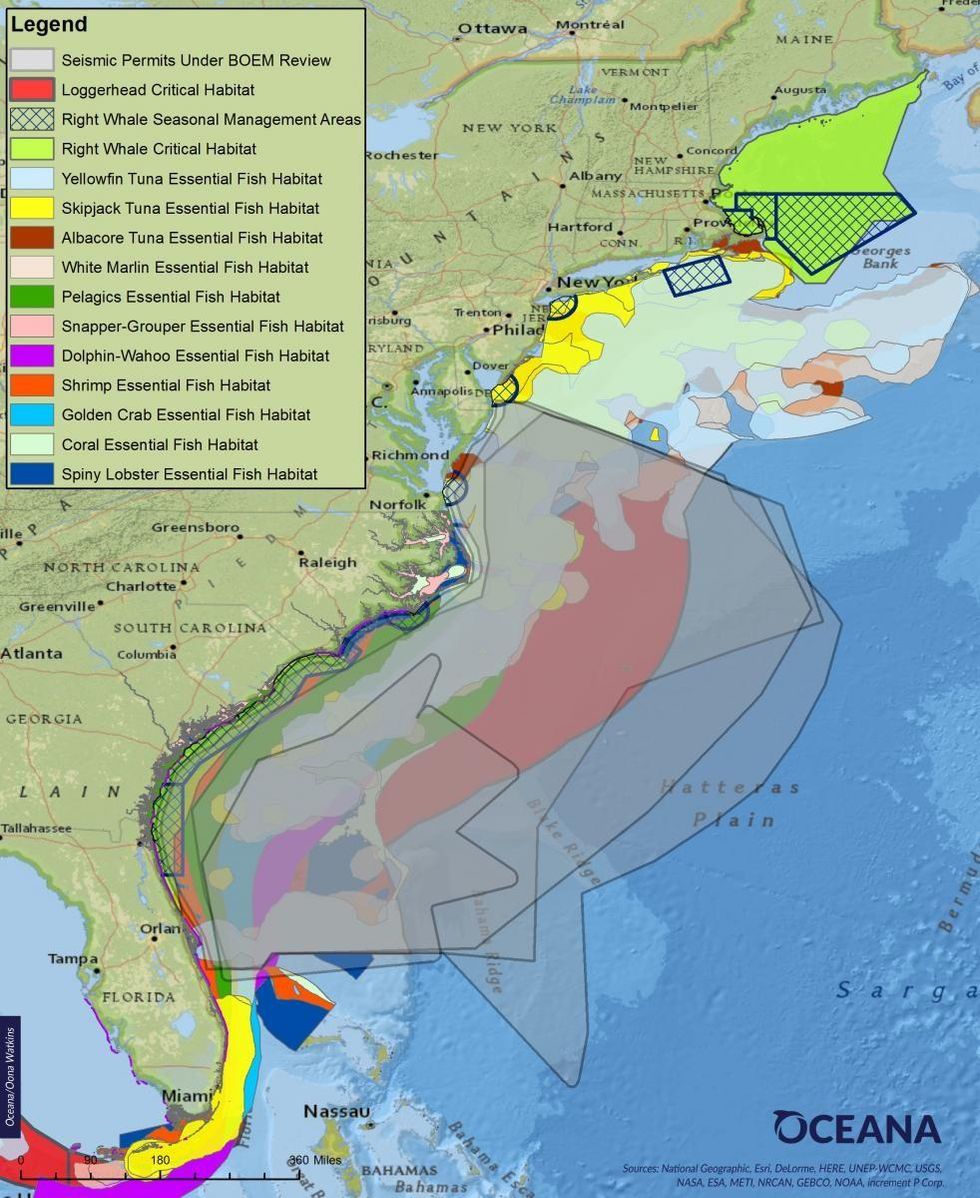
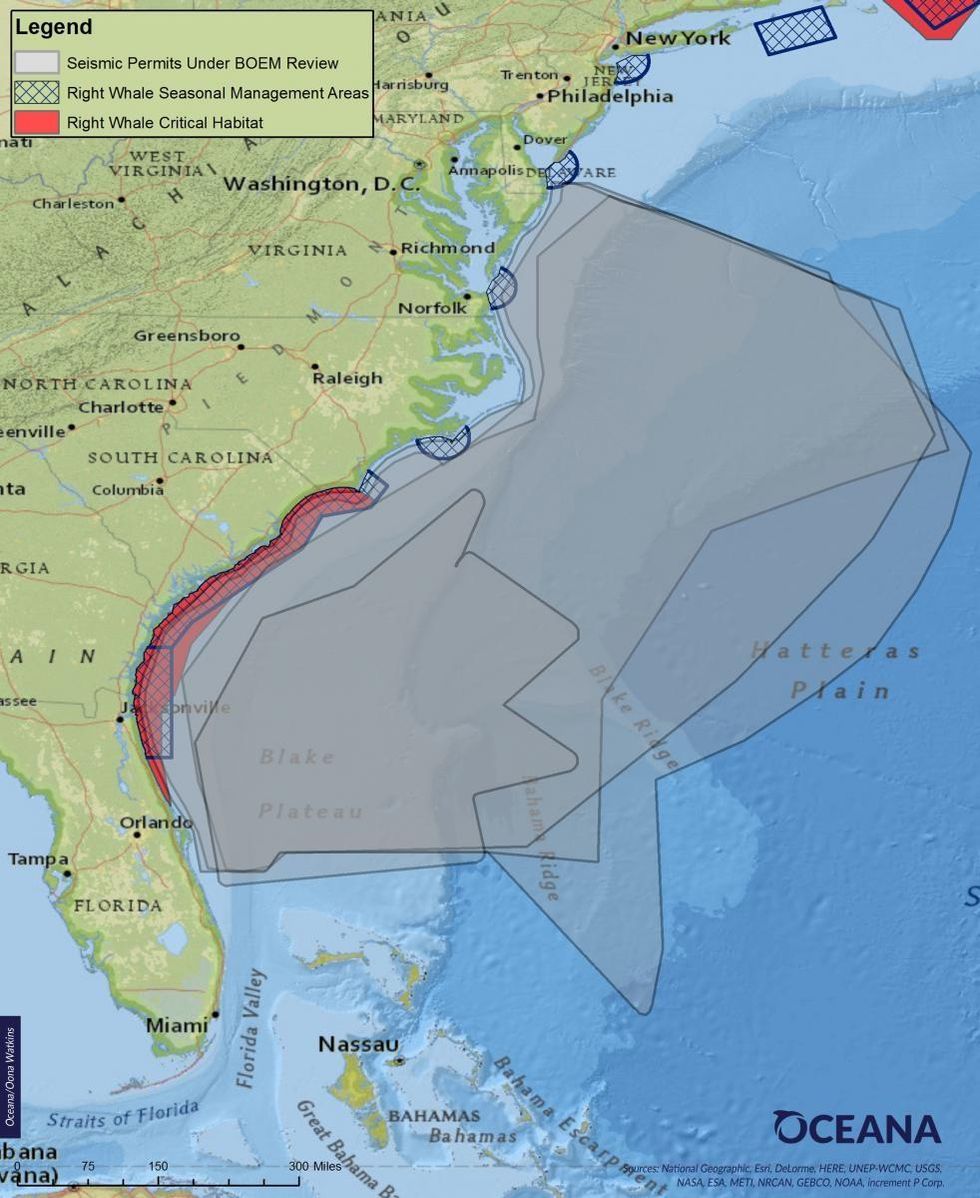
But, as a new set of maps from ocean conservation group Oceana shows, "entire marine communities" in those waters from Delaware to Florida are still under threat.
That's because fossil fuel exploration using seismic airgun blasting--a process known to cause harm to marine life--is still a possibility. Currently, as ThinkProgress reported,
there are eight applications to conduct seismic testing making their way through the federal permitting process. The National Marine Fisheries Service, part of NOAA, is currently considering issuing Incidental Harassment Authorizations. There will be a 30-day public comment period on the IHAs before they go back to the Bureau of Ocean Energy Management, which will decide whether to approve the permits.
Despite the testing's expenses and the administration's reversal, "none of the companies that have sought the seismic permits have withdrawn their applications to the federal Bureau of Ocean Energy Management yet," Tideland News reported.
Here's how the process works: In order to find fossil fuel deposits beneath the ocean floors, the "airguns are towed behind ships and shoot loud blasts of compressed air through the water that travel miles into the seabed, which reflect back information about buried oil and gas deposits," Oceana explains. The blasts are "repeated every ten seconds, 24 hours a day, for days to weeks at a time."
The Center for Biological Diversity describes the blasting as "actually a blunt-force weapon," as it emits "the loudest human sounds in the ocean, short of those made by explosives."
Oceana's new maps show that the areas covered in the pending applications to do the seismic testing include areas critical to threatened or endangered species, like the loggerhead turtle and North Atlantic right whale, in addition to being necessary for commercial and recreational fish stocks.
"We know that the noise from seismic airguns is of special concern to marine life, including fish, turtles and whales, which depend on sound for communication and survival," said Dr. Ingrid Biedron, marine scientist at Oceana.
"Numerous studies demonstrate the negative impacts that seismic airgun noise has on ocean ecosystems, including reduced catch rates of fish, stress response in crabs, decline in sperm whale feeding calls, and the silencing of bowhead whales. Documented impacts to bowhead whales, closely related to North Atlantic right whales, are especially alarming because the proposed seismic airgun testing in the Atlantic would take place in and around critical habitat for North Atlantic right whales, including the species' only known calving ground," she added.
One year ago, 75 marine scientists sent a letter (pdf) to President Obama to express concern over seismic blasting along the Atlantic, writing, "Opening the U.S. east coast to seismic airgun exploration poses an unacceptable risk of serious harm to marine life at the species and population levels, the full extent of which will not be understood until long after the harm occurs."
However, as the Guardian reported, "BOEM said the applications will go ahead as they are separate from the decision to rule out drilling in the Atlantic. The federal agency said the testing could be used for other scientific purposes and would only be allowed if there is 'negligible impact' upon marine mammals."
For Claire Douglass, campaign director at Oceana, permitting the blasting at all is too risky.
"With offshore drilling off the table in the Atlantic, there is absolutely no reason to risk the damage that would be caused by unnecessary seismic airgun blasting in the region," she said. "The noise from seismic airgun blasting is so loud that it can be heard up to 2,500 miles from the source, which is approximately the distance from Washington, D.C. to Las Vegas."
"The government is knowingly putting entire marine communities at risk by opening up the Atlantic to seismic airgun blasting," she added. "We urge the Obama administration to stop seismic airgun blasting in the Atlantic before it's too late."
When the Obama administration announced earlier this month that it was reversing its plans to open the mid- and south-Atlantic to oil and gas drilling, environmental groups cheered.
But, as a new set of maps from ocean conservation group Oceana shows, "entire marine communities" in those waters from Delaware to Florida are still under threat.
That's because fossil fuel exploration using seismic airgun blasting--a process known to cause harm to marine life--is still a possibility. Currently, as ThinkProgress reported,
there are eight applications to conduct seismic testing making their way through the federal permitting process. The National Marine Fisheries Service, part of NOAA, is currently considering issuing Incidental Harassment Authorizations. There will be a 30-day public comment period on the IHAs before they go back to the Bureau of Ocean Energy Management, which will decide whether to approve the permits.
Despite the testing's expenses and the administration's reversal, "none of the companies that have sought the seismic permits have withdrawn their applications to the federal Bureau of Ocean Energy Management yet," Tideland News reported.
Here's how the process works: In order to find fossil fuel deposits beneath the ocean floors, the "airguns are towed behind ships and shoot loud blasts of compressed air through the water that travel miles into the seabed, which reflect back information about buried oil and gas deposits," Oceana explains. The blasts are "repeated every ten seconds, 24 hours a day, for days to weeks at a time."
The Center for Biological Diversity describes the blasting as "actually a blunt-force weapon," as it emits "the loudest human sounds in the ocean, short of those made by explosives."
Oceana's new maps show that the areas covered in the pending applications to do the seismic testing include areas critical to threatened or endangered species, like the loggerhead turtle and North Atlantic right whale, in addition to being necessary for commercial and recreational fish stocks.
"We know that the noise from seismic airguns is of special concern to marine life, including fish, turtles and whales, which depend on sound for communication and survival," said Dr. Ingrid Biedron, marine scientist at Oceana.
"Numerous studies demonstrate the negative impacts that seismic airgun noise has on ocean ecosystems, including reduced catch rates of fish, stress response in crabs, decline in sperm whale feeding calls, and the silencing of bowhead whales. Documented impacts to bowhead whales, closely related to North Atlantic right whales, are especially alarming because the proposed seismic airgun testing in the Atlantic would take place in and around critical habitat for North Atlantic right whales, including the species' only known calving ground," she added.
One year ago, 75 marine scientists sent a letter (pdf) to President Obama to express concern over seismic blasting along the Atlantic, writing, "Opening the U.S. east coast to seismic airgun exploration poses an unacceptable risk of serious harm to marine life at the species and population levels, the full extent of which will not be understood until long after the harm occurs."
However, as the Guardian reported, "BOEM said the applications will go ahead as they are separate from the decision to rule out drilling in the Atlantic. The federal agency said the testing could be used for other scientific purposes and would only be allowed if there is 'negligible impact' upon marine mammals."
For Claire Douglass, campaign director at Oceana, permitting the blasting at all is too risky.
"With offshore drilling off the table in the Atlantic, there is absolutely no reason to risk the damage that would be caused by unnecessary seismic airgun blasting in the region," she said. "The noise from seismic airgun blasting is so loud that it can be heard up to 2,500 miles from the source, which is approximately the distance from Washington, D.C. to Las Vegas."
"The government is knowingly putting entire marine communities at risk by opening up the Atlantic to seismic airgun blasting," she added. "We urge the Obama administration to stop seismic airgun blasting in the Atlantic before it's too late."
When the Obama administration announced earlier this month that it was reversing its plans to open the mid- and south-Atlantic to oil and gas drilling, environmental groups cheered.
But, as a new set of maps from ocean conservation group Oceana shows, "entire marine communities" in those waters from Delaware to Florida are still under threat.
That's because fossil fuel exploration using seismic airgun blasting--a process known to cause harm to marine life--is still a possibility. Currently, as ThinkProgress reported,
there are eight applications to conduct seismic testing making their way through the federal permitting process. The National Marine Fisheries Service, part of NOAA, is currently considering issuing Incidental Harassment Authorizations. There will be a 30-day public comment period on the IHAs before they go back to the Bureau of Ocean Energy Management, which will decide whether to approve the permits.
Despite the testing's expenses and the administration's reversal, "none of the companies that have sought the seismic permits have withdrawn their applications to the federal Bureau of Ocean Energy Management yet," Tideland News reported.
Here's how the process works: In order to find fossil fuel deposits beneath the ocean floors, the "airguns are towed behind ships and shoot loud blasts of compressed air through the water that travel miles into the seabed, which reflect back information about buried oil and gas deposits," Oceana explains. The blasts are "repeated every ten seconds, 24 hours a day, for days to weeks at a time."
The Center for Biological Diversity describes the blasting as "actually a blunt-force weapon," as it emits "the loudest human sounds in the ocean, short of those made by explosives."
Oceana's new maps show that the areas covered in the pending applications to do the seismic testing include areas critical to threatened or endangered species, like the loggerhead turtle and North Atlantic right whale, in addition to being necessary for commercial and recreational fish stocks.
"We know that the noise from seismic airguns is of special concern to marine life, including fish, turtles and whales, which depend on sound for communication and survival," said Dr. Ingrid Biedron, marine scientist at Oceana.
"Numerous studies demonstrate the negative impacts that seismic airgun noise has on ocean ecosystems, including reduced catch rates of fish, stress response in crabs, decline in sperm whale feeding calls, and the silencing of bowhead whales. Documented impacts to bowhead whales, closely related to North Atlantic right whales, are especially alarming because the proposed seismic airgun testing in the Atlantic would take place in and around critical habitat for North Atlantic right whales, including the species' only known calving ground," she added.
One year ago, 75 marine scientists sent a letter (pdf) to President Obama to express concern over seismic blasting along the Atlantic, writing, "Opening the U.S. east coast to seismic airgun exploration poses an unacceptable risk of serious harm to marine life at the species and population levels, the full extent of which will not be understood until long after the harm occurs."
However, as the Guardian reported, "BOEM said the applications will go ahead as they are separate from the decision to rule out drilling in the Atlantic. The federal agency said the testing could be used for other scientific purposes and would only be allowed if there is 'negligible impact' upon marine mammals."
For Claire Douglass, campaign director at Oceana, permitting the blasting at all is too risky.
"With offshore drilling off the table in the Atlantic, there is absolutely no reason to risk the damage that would be caused by unnecessary seismic airgun blasting in the region," she said. "The noise from seismic airgun blasting is so loud that it can be heard up to 2,500 miles from the source, which is approximately the distance from Washington, D.C. to Las Vegas."
"The government is knowingly putting entire marine communities at risk by opening up the Atlantic to seismic airgun blasting," she added. "We urge the Obama administration to stop seismic airgun blasting in the Atlantic before it's too late."