

While the United States closed 2015 with a record high number of auto sales, Germany offered a potentially "transformative" transportation alternative by opening a stretch of a highway for bikes that is slated to take tens of thousands of cars off the road every day.
The stretch of the Radschnellweg RS1 open now, thanks to funding from the EU, the North Rhine-Westphalia state, and regional development group RVR, spans roughly 3 miles (5 kilometers). The full length of the highway--which still needs funding--will be 62 miles (100 kilometers.)
Fast Company reports: "The RS1 will be continuous, running not just between cities, but right through city centers." Agence France-Presse adds that the highway's "paths are lit and cleared of snow in winter," and that it
will connect 10 western cities including Duisburg, Bochum and Hamm and four universities, running largely along disused railroad tracks in the crumbling Ruhr industrial region.
Almost two million people live within two kilometers of the route and will be able to use sections for their daily commutes, said Martin Toennes of regional development group RVR.
Aided by booming demand for electric bikes, which take the sting out of uphill sections, the new track should take 50,000 cars off the roads every day, an RVR study predicts.
The German cities of Frankfurt, Munich, and Nuremburg are also looking into similar, though shorter routes, AFP adds.
Author Jay Walljasper, who writes about cities, community, sustainability and travel, told Common Dreams that the fact that this RS1 "BikeBahn" is "happening in Germany, home for better or worse of the modern freeway, is significant."
"Germany once trailed far behind Denmark and Holland on biking, but they are catching up fast," he said. "The Netherlands and Denmark both have inter-city bike trails now, but not on the scale of the BikeBahn. It feels transformative, and can capture the imagination of people everywhere."
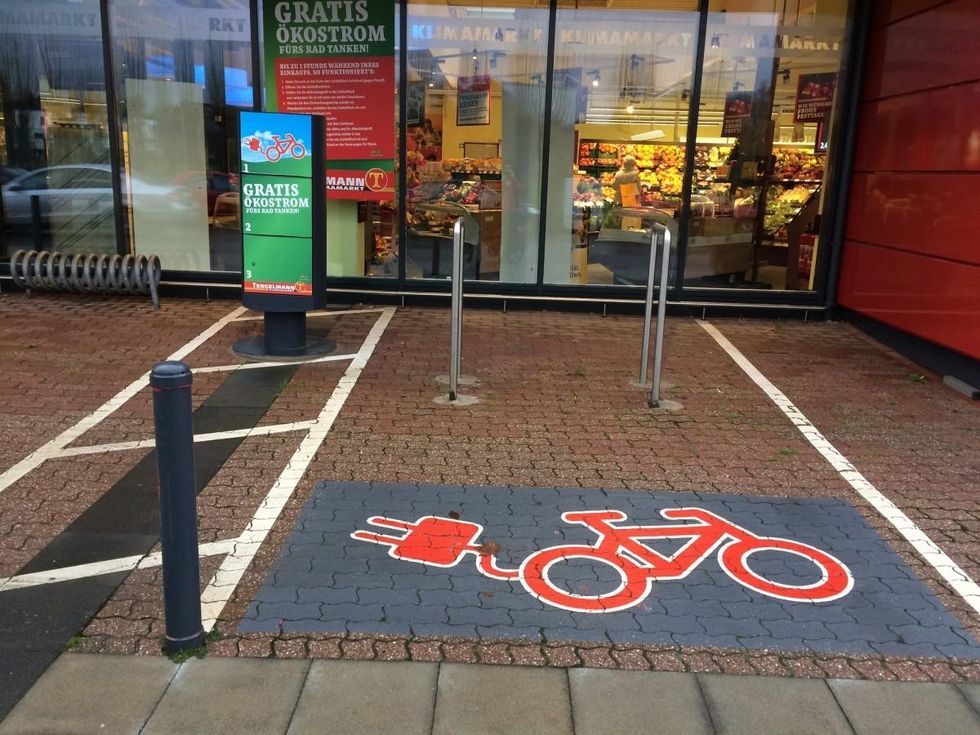
Matthew Schofield reported for McClatchy News this week on other parts of Europe also boosting cycling. "Berlin's goal is to have 1 of every 5 trips within the city to be made by bike before 2025. To help in this effort, city law offers a tax break that's equivalent to 53 U.S. cents for every mile a cyclist commutes. Last year, the city invested $16 million in bike infrastructure," Schofield wrote.
Germany's efforts, though, are actually not that remarkable in comparison to efforts by some other northern European cities, Schofield wrote, noting Oslo's efforts towards banning cars from its city's center. He also cites the recent study "Transport Transitions in Copenhagen: Comparing the Cost of Cars and Bicycles," which found that "when all aspects are included," the cost of a mile cycled is 14 cents, compared to 88 cents for a mile driven.
Co-author of that study Stefan Goessling told McClatchy that while that research focused on Copenhagen, "There is such a huge difference between bicycles and cars that it is unlikely results would be any different in other contexts."
Tech Insider reports, "If this first set of roadways [in Germany] is a success, the country that first invented highways could end up leading the charge a second time."
While the United States closed 2015 with a record high number of auto sales, Germany offered a potentially "transformative" transportation alternative by opening a stretch of a highway for bikes that is slated to take tens of thousands of cars off the road every day.
The stretch of the Radschnellweg RS1 open now, thanks to funding from the EU, the North Rhine-Westphalia state, and regional development group RVR, spans roughly 3 miles (5 kilometers). The full length of the highway--which still needs funding--will be 62 miles (100 kilometers.)
Fast Company reports: "The RS1 will be continuous, running not just between cities, but right through city centers." Agence France-Presse adds that the highway's "paths are lit and cleared of snow in winter," and that it
will connect 10 western cities including Duisburg, Bochum and Hamm and four universities, running largely along disused railroad tracks in the crumbling Ruhr industrial region.
Almost two million people live within two kilometers of the route and will be able to use sections for their daily commutes, said Martin Toennes of regional development group RVR.
Aided by booming demand for electric bikes, which take the sting out of uphill sections, the new track should take 50,000 cars off the roads every day, an RVR study predicts.
The German cities of Frankfurt, Munich, and Nuremburg are also looking into similar, though shorter routes, AFP adds.
Author Jay Walljasper, who writes about cities, community, sustainability and travel, told Common Dreams that the fact that this RS1 "BikeBahn" is "happening in Germany, home for better or worse of the modern freeway, is significant."
"Germany once trailed far behind Denmark and Holland on biking, but they are catching up fast," he said. "The Netherlands and Denmark both have inter-city bike trails now, but not on the scale of the BikeBahn. It feels transformative, and can capture the imagination of people everywhere."
Matthew Schofield reported for McClatchy News this week on other parts of Europe also boosting cycling. "Berlin's goal is to have 1 of every 5 trips within the city to be made by bike before 2025. To help in this effort, city law offers a tax break that's equivalent to 53 U.S. cents for every mile a cyclist commutes. Last year, the city invested $16 million in bike infrastructure," Schofield wrote.
Germany's efforts, though, are actually not that remarkable in comparison to efforts by some other northern European cities, Schofield wrote, noting Oslo's efforts towards banning cars from its city's center. He also cites the recent study "Transport Transitions in Copenhagen: Comparing the Cost of Cars and Bicycles," which found that "when all aspects are included," the cost of a mile cycled is 14 cents, compared to 88 cents for a mile driven.
Co-author of that study Stefan Goessling told McClatchy that while that research focused on Copenhagen, "There is such a huge difference between bicycles and cars that it is unlikely results would be any different in other contexts."
Tech Insider reports, "If this first set of roadways [in Germany] is a success, the country that first invented highways could end up leading the charge a second time."
While the United States closed 2015 with a record high number of auto sales, Germany offered a potentially "transformative" transportation alternative by opening a stretch of a highway for bikes that is slated to take tens of thousands of cars off the road every day.
The stretch of the Radschnellweg RS1 open now, thanks to funding from the EU, the North Rhine-Westphalia state, and regional development group RVR, spans roughly 3 miles (5 kilometers). The full length of the highway--which still needs funding--will be 62 miles (100 kilometers.)
Fast Company reports: "The RS1 will be continuous, running not just between cities, but right through city centers." Agence France-Presse adds that the highway's "paths are lit and cleared of snow in winter," and that it
will connect 10 western cities including Duisburg, Bochum and Hamm and four universities, running largely along disused railroad tracks in the crumbling Ruhr industrial region.
Almost two million people live within two kilometers of the route and will be able to use sections for their daily commutes, said Martin Toennes of regional development group RVR.
Aided by booming demand for electric bikes, which take the sting out of uphill sections, the new track should take 50,000 cars off the roads every day, an RVR study predicts.
The German cities of Frankfurt, Munich, and Nuremburg are also looking into similar, though shorter routes, AFP adds.
Author Jay Walljasper, who writes about cities, community, sustainability and travel, told Common Dreams that the fact that this RS1 "BikeBahn" is "happening in Germany, home for better or worse of the modern freeway, is significant."
"Germany once trailed far behind Denmark and Holland on biking, but they are catching up fast," he said. "The Netherlands and Denmark both have inter-city bike trails now, but not on the scale of the BikeBahn. It feels transformative, and can capture the imagination of people everywhere."
Matthew Schofield reported for McClatchy News this week on other parts of Europe also boosting cycling. "Berlin's goal is to have 1 of every 5 trips within the city to be made by bike before 2025. To help in this effort, city law offers a tax break that's equivalent to 53 U.S. cents for every mile a cyclist commutes. Last year, the city invested $16 million in bike infrastructure," Schofield wrote.
Germany's efforts, though, are actually not that remarkable in comparison to efforts by some other northern European cities, Schofield wrote, noting Oslo's efforts towards banning cars from its city's center. He also cites the recent study "Transport Transitions in Copenhagen: Comparing the Cost of Cars and Bicycles," which found that "when all aspects are included," the cost of a mile cycled is 14 cents, compared to 88 cents for a mile driven.
Co-author of that study Stefan Goessling told McClatchy that while that research focused on Copenhagen, "There is such a huge difference between bicycles and cars that it is unlikely results would be any different in other contexts."
Tech Insider reports, "If this first set of roadways [in Germany] is a success, the country that first invented highways could end up leading the charge a second time."