
Hundreds of women, including former "comfort women" or sex slaves, protested across the street from the Japanese Embassy in Seoul on Wednesday, decrying a recent reparations deal between Japan and South Korea addressing World War II atrocities.
Under an agreement that both nations described as "final and irreversible," Japan on Monday offered an apology and an $8.3 million settlement to 46 surviving South Korean women who were forced to become prostitutes serving Japanese soldiers during the 1930s and 1940s.
But the surviving victims say they were never consulted by officials as the agreement was negotiated. What's more, they argue, the deal falls far short of their demand that Japan admit legal responsibility for the wartime atrocities.
"We did nothing wrong," said one survivor, 88-year-old Lee Yong-su. "Japan took us to be comfort women and still tries to deny its crime."
"The fight is still on," she declared. "We will continue to fight to make Japan take formal legal responsibility and apologize so that victims who have already perished will have justice."

As human rights activist Cesar Chelala pointed out earlier this week, an International Commission of Jurists stated in November 1994: "It is indisputable that these women were forced, deceived, coerced and abducted to provide sexual services to the Japanese military ... [Japan] violated customary norms of international law concerning war crimes, crimes against humanity, slavery and the trafficking in women and children ... Japan should take full responsibility now, and make suitable restitution to the victims and their families."
The Korean Council for the Women Drafted for Military Sexual Slavery by Japan, an organization of survivors and their supporters, has staged a weekly rally for nearly 24 years to demand Japan's acknowledgement of its crimes, which affected an estimated 200,000 young women, the majority of them Koreans.
This week's rally swelled in response to the reparations deal, with people chanting, "Cancel the agreement!" Many also expressed opposition to Seoul's plan to try to remove a comfort women memorial statue from outside the embassy, with signs that read, "Say no to relocation of the statue!"
According to the Korea Herald:
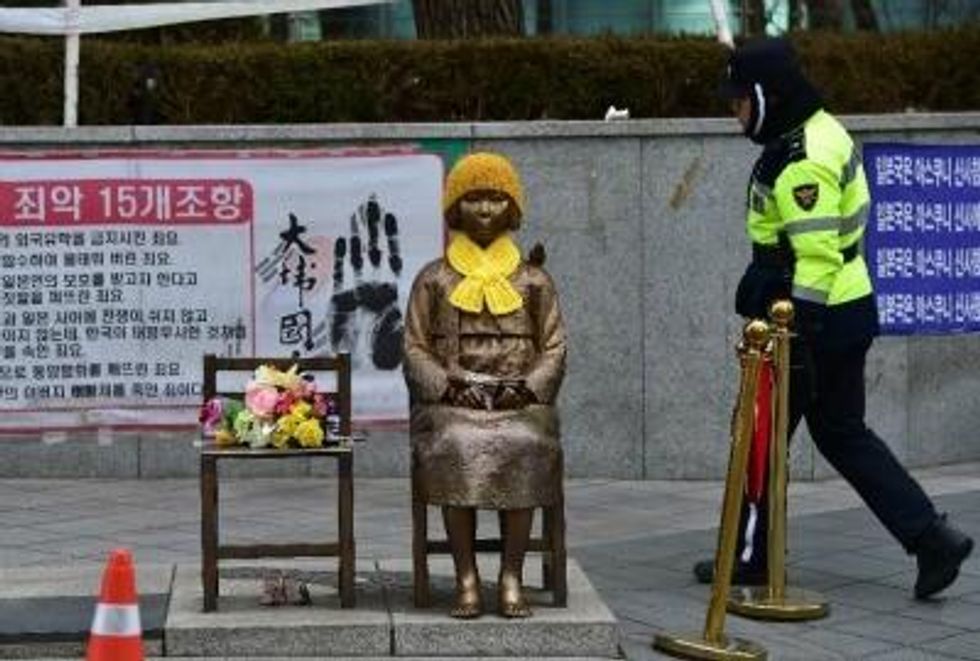
Many of the crowd were seen paying a tribute to the life-size bronze statue of a young girl representing a comfort women sitting in front of the Japanese Embassy. They put gloves, scarves and blankets next to the statue in a gesture to make it feel warm and less lonely.
The bronze statue, built in 2011 by victims and their supporters in front of the Japanese Embassy, has sparked fury from Tokyo, leading it to pressure Seoul to remove the statue.
South Korea has indicated it would try to relocate it through consultations with relevant civic groups as part of the deal, adding fuel to the public backlash.
In a survey conducted by pollster Realmeter, 66 percent of South Koreans opposed the relocation of the statute, while 19 percent favored it.
Reuters reports that the United States, "keen to see its Asian allies improve ties, welcomed the accord."
Hundreds of women, including former "comfort women" or sex slaves, protested across the street from the Japanese Embassy in Seoul on Wednesday, decrying a recent reparations deal between Japan and South Korea addressing World War II atrocities.
Under an agreement that both nations described as "final and irreversible," Japan on Monday offered an apology and an $8.3 million settlement to 46 surviving South Korean women who were forced to become prostitutes serving Japanese soldiers during the 1930s and 1940s.
But the surviving victims say they were never consulted by officials as the agreement was negotiated. What's more, they argue, the deal falls far short of their demand that Japan admit legal responsibility for the wartime atrocities.
"We did nothing wrong," said one survivor, 88-year-old Lee Yong-su. "Japan took us to be comfort women and still tries to deny its crime."
"The fight is still on," she declared. "We will continue to fight to make Japan take formal legal responsibility and apologize so that victims who have already perished will have justice."
As human rights activist Cesar Chelala pointed out earlier this week, an International Commission of Jurists stated in November 1994: "It is indisputable that these women were forced, deceived, coerced and abducted to provide sexual services to the Japanese military ... [Japan] violated customary norms of international law concerning war crimes, crimes against humanity, slavery and the trafficking in women and children ... Japan should take full responsibility now, and make suitable restitution to the victims and their families."
The Korean Council for the Women Drafted for Military Sexual Slavery by Japan, an organization of survivors and their supporters, has staged a weekly rally for nearly 24 years to demand Japan's acknowledgement of its crimes, which affected an estimated 200,000 young women, the majority of them Koreans.
This week's rally swelled in response to the reparations deal, with people chanting, "Cancel the agreement!" Many also expressed opposition to Seoul's plan to try to remove a comfort women memorial statue from outside the embassy, with signs that read, "Say no to relocation of the statue!"
According to the Korea Herald:
Many of the crowd were seen paying a tribute to the life-size bronze statue of a young girl representing a comfort women sitting in front of the Japanese Embassy. They put gloves, scarves and blankets next to the statue in a gesture to make it feel warm and less lonely.
The bronze statue, built in 2011 by victims and their supporters in front of the Japanese Embassy, has sparked fury from Tokyo, leading it to pressure Seoul to remove the statue.
South Korea has indicated it would try to relocate it through consultations with relevant civic groups as part of the deal, adding fuel to the public backlash.
In a survey conducted by pollster Realmeter, 66 percent of South Koreans opposed the relocation of the statute, while 19 percent favored it.
Reuters reports that the United States, "keen to see its Asian allies improve ties, welcomed the accord."
Hundreds of women, including former "comfort women" or sex slaves, protested across the street from the Japanese Embassy in Seoul on Wednesday, decrying a recent reparations deal between Japan and South Korea addressing World War II atrocities.
Under an agreement that both nations described as "final and irreversible," Japan on Monday offered an apology and an $8.3 million settlement to 46 surviving South Korean women who were forced to become prostitutes serving Japanese soldiers during the 1930s and 1940s.
But the surviving victims say they were never consulted by officials as the agreement was negotiated. What's more, they argue, the deal falls far short of their demand that Japan admit legal responsibility for the wartime atrocities.
"We did nothing wrong," said one survivor, 88-year-old Lee Yong-su. "Japan took us to be comfort women and still tries to deny its crime."
"The fight is still on," she declared. "We will continue to fight to make Japan take formal legal responsibility and apologize so that victims who have already perished will have justice."
As human rights activist Cesar Chelala pointed out earlier this week, an International Commission of Jurists stated in November 1994: "It is indisputable that these women were forced, deceived, coerced and abducted to provide sexual services to the Japanese military ... [Japan] violated customary norms of international law concerning war crimes, crimes against humanity, slavery and the trafficking in women and children ... Japan should take full responsibility now, and make suitable restitution to the victims and their families."
The Korean Council for the Women Drafted for Military Sexual Slavery by Japan, an organization of survivors and their supporters, has staged a weekly rally for nearly 24 years to demand Japan's acknowledgement of its crimes, which affected an estimated 200,000 young women, the majority of them Koreans.
This week's rally swelled in response to the reparations deal, with people chanting, "Cancel the agreement!" Many also expressed opposition to Seoul's plan to try to remove a comfort women memorial statue from outside the embassy, with signs that read, "Say no to relocation of the statue!"
According to the Korea Herald:
Many of the crowd were seen paying a tribute to the life-size bronze statue of a young girl representing a comfort women sitting in front of the Japanese Embassy. They put gloves, scarves and blankets next to the statue in a gesture to make it feel warm and less lonely.
The bronze statue, built in 2011 by victims and their supporters in front of the Japanese Embassy, has sparked fury from Tokyo, leading it to pressure Seoul to remove the statue.
South Korea has indicated it would try to relocate it through consultations with relevant civic groups as part of the deal, adding fuel to the public backlash.
In a survey conducted by pollster Realmeter, 66 percent of South Koreans opposed the relocation of the statute, while 19 percent favored it.
Reuters reports that the United States, "keen to see its Asian allies improve ties, welcomed the accord."