Despite having won federal recognition of the right to marry a partner of their choosing, lesbian, gay, bisexual, and transgender (LGBT) people continue to face the possibility of being fired or harassed at work because of their identity or sexual preference.
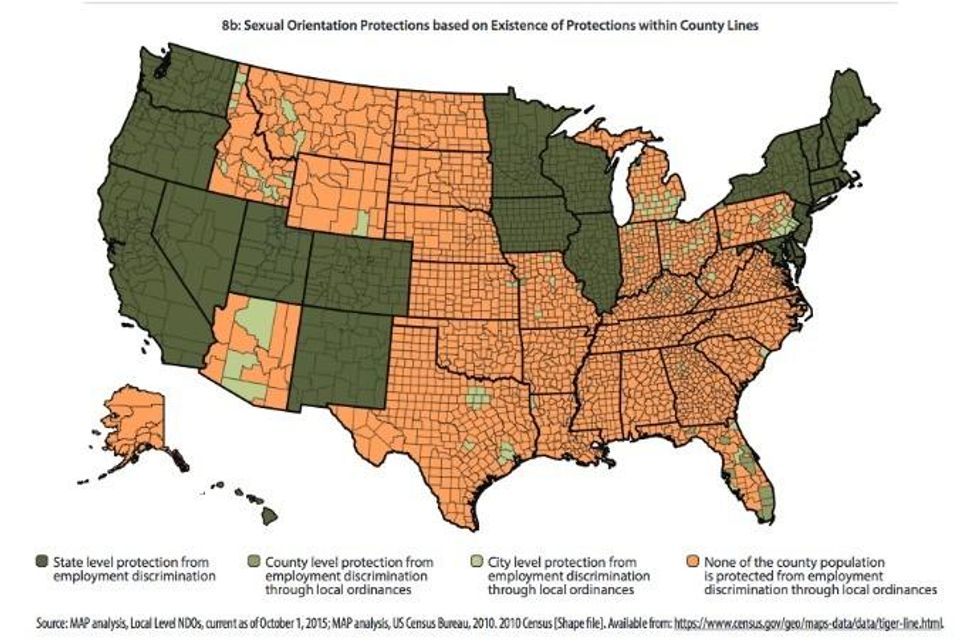
As much as 70 percent of the United States, geographically speaking, lacks any employment protections for LGBT workers, according to a study (pdf) released Tuesday by the equal rights think tank Movement Advancement Project (MAP).
Instead of nationally recognized protections, local governments seeking to prevent discrimination within their borders have enacted a patchwork of laws known as local non-discrimination ordinances (NDO).
Nineteen states have enacted workplace protections and, combining the coverage provided by those and other local NDOs, currently, "more than 170 million Americans are living in areas with laws that explicitly protect them from being fired based on their sexual orientation, and more than 157 million are explicitly protected from discrimination based on their gender identity," according to the MAP study.
However, huge gaps remain.
"There is a deep rural-urban divide when it comes to non-discrimination protections for LGBT people," said Ineke Mushovic, executive director of MAP. "Vast geographic stretches in this country--mostly in rural areas--lack LGBT-inclusive nondiscrimination laws." Mushovic said that an LGBT person is "50 times more likely to be covered by local laws if he or she lives in an urban rather than a rural area" in a state that lacks protections.
For the most part, MAP found statewide protections "exist in clusters of generally more progressive states in the west, Midwest, and Northeast," while LGBT people in the Plains states and South are still largely left vulnerable.
This summer, the Workplace Equality Act was introduced to Congress. While the bill—which amends the Civil Rights Act of 1964 to include sex, sexual orientation, and gender identity—enjoys widespread support, it faces a steep hurdle in the Republican-dominated legislature.
According to a recent poll by the advocacy group the Human Rights Campaign, two-thirds of LGBT respondents said they had experienced discrimination in their lives. And in June, 59 percent said they would be less likely to support a candidate for President who opposed a federal LGBT non-discrimination bill.
"Our country's most basic promise of equal treatment under the law will never be real if you fear losing your job, being kicked out of your home, denied access to healthcare or turned away from a business because of who you are," said James Esseks, director of the ACLU's LGBT Project, upon introduction of the Equality Act. He added that the "lack of clear and explicit federal protections... in core areas of American life [is] unacceptable."
Despite having won federal recognition of the right to marry a partner of their choosing, lesbian, gay, bisexual, and transgender (LGBT) people continue to face the possibility of being fired or harassed at work because of their identity or sexual preference.
As much as 70 percent of the United States, geographically speaking, lacks any employment protections for LGBT workers, according to a study (pdf) released Tuesday by the equal rights think tank Movement Advancement Project (MAP).
Instead of nationally recognized protections, local governments seeking to prevent discrimination within their borders have enacted a patchwork of laws known as local non-discrimination ordinances (NDO).
Nineteen states have enacted workplace protections and, combining the coverage provided by those and other local NDOs, currently, "more than 170 million Americans are living in areas with laws that explicitly protect them from being fired based on their sexual orientation, and more than 157 million are explicitly protected from discrimination based on their gender identity," according to the MAP study.
However, huge gaps remain.
"There is a deep rural-urban divide when it comes to non-discrimination protections for LGBT people," said Ineke Mushovic, executive director of MAP. "Vast geographic stretches in this country--mostly in rural areas--lack LGBT-inclusive nondiscrimination laws." Mushovic said that an LGBT person is "50 times more likely to be covered by local laws if he or she lives in an urban rather than a rural area" in a state that lacks protections.
For the most part, MAP found statewide protections "exist in clusters of generally more progressive states in the west, Midwest, and Northeast," while LGBT people in the Plains states and South are still largely left vulnerable.
This summer, the Workplace Equality Act was introduced to Congress. While the bill—which amends the Civil Rights Act of 1964 to include sex, sexual orientation, and gender identity—enjoys widespread support, it faces a steep hurdle in the Republican-dominated legislature.
According to a recent poll by the advocacy group the Human Rights Campaign, two-thirds of LGBT respondents said they had experienced discrimination in their lives. And in June, 59 percent said they would be less likely to support a candidate for President who opposed a federal LGBT non-discrimination bill.
"Our country's most basic promise of equal treatment under the law will never be real if you fear losing your job, being kicked out of your home, denied access to healthcare or turned away from a business because of who you are," said James Esseks, director of the ACLU's LGBT Project, upon introduction of the Equality Act. He added that the "lack of clear and explicit federal protections... in core areas of American life [is] unacceptable."
Despite having won federal recognition of the right to marry a partner of their choosing, lesbian, gay, bisexual, and transgender (LGBT) people continue to face the possibility of being fired or harassed at work because of their identity or sexual preference.
As much as 70 percent of the United States, geographically speaking, lacks any employment protections for LGBT workers, according to a study (pdf) released Tuesday by the equal rights think tank Movement Advancement Project (MAP).
Instead of nationally recognized protections, local governments seeking to prevent discrimination within their borders have enacted a patchwork of laws known as local non-discrimination ordinances (NDO).
Nineteen states have enacted workplace protections and, combining the coverage provided by those and other local NDOs, currently, "more than 170 million Americans are living in areas with laws that explicitly protect them from being fired based on their sexual orientation, and more than 157 million are explicitly protected from discrimination based on their gender identity," according to the MAP study.
However, huge gaps remain.
"There is a deep rural-urban divide when it comes to non-discrimination protections for LGBT people," said Ineke Mushovic, executive director of MAP. "Vast geographic stretches in this country--mostly in rural areas--lack LGBT-inclusive nondiscrimination laws." Mushovic said that an LGBT person is "50 times more likely to be covered by local laws if he or she lives in an urban rather than a rural area" in a state that lacks protections.
For the most part, MAP found statewide protections "exist in clusters of generally more progressive states in the west, Midwest, and Northeast," while LGBT people in the Plains states and South are still largely left vulnerable.
This summer, the Workplace Equality Act was introduced to Congress. While the bill—which amends the Civil Rights Act of 1964 to include sex, sexual orientation, and gender identity—enjoys widespread support, it faces a steep hurdle in the Republican-dominated legislature.
According to a recent poll by the advocacy group the Human Rights Campaign, two-thirds of LGBT respondents said they had experienced discrimination in their lives. And in June, 59 percent said they would be less likely to support a candidate for President who opposed a federal LGBT non-discrimination bill.
"Our country's most basic promise of equal treatment under the law will never be real if you fear losing your job, being kicked out of your home, denied access to healthcare or turned away from a business because of who you are," said James Esseks, director of the ACLU's LGBT Project, upon introduction of the Equality Act. He added that the "lack of clear and explicit federal protections... in core areas of American life [is] unacceptable."