SUBSCRIBE TO OUR FREE NEWSLETTER
Daily news & progressive opinion—funded by the people, not the corporations—delivered straight to your inbox.
5
#000000
#FFFFFF
To donate by check, phone, or other method, see our More Ways to Give page.
A groundbreaking new study is confirming what green campaigners have long argued: in order to stave off climate disaster, the majority of fossil fuel deposits around the world--including 92 percent of U.S. coal, all Arctic oil and gas, and a majority of Canadian tar sands--must stay "in the ground."
The research is a boost to world-wide green campaigns, from the bid to stop the Keystone XL pipeline to grassroots protest against Arctic drilling.
The new findings were published in the journal Nature and authored by Christophe McGlade and Paul Ekins, both of whom hail from the University College London.
They write, "Policy makers have generally agreed that the average global temperature rise caused by greenhouse gas emissions should not exceed 2 degC above the average global temperature of pre-industrial times."
The researchers explain that they employed a "single integrated assessment model that contains estimates of the quantities, locations and nature of the world's oil, gas and coal reserves and resources" to determine what it would take to stay below this limit.
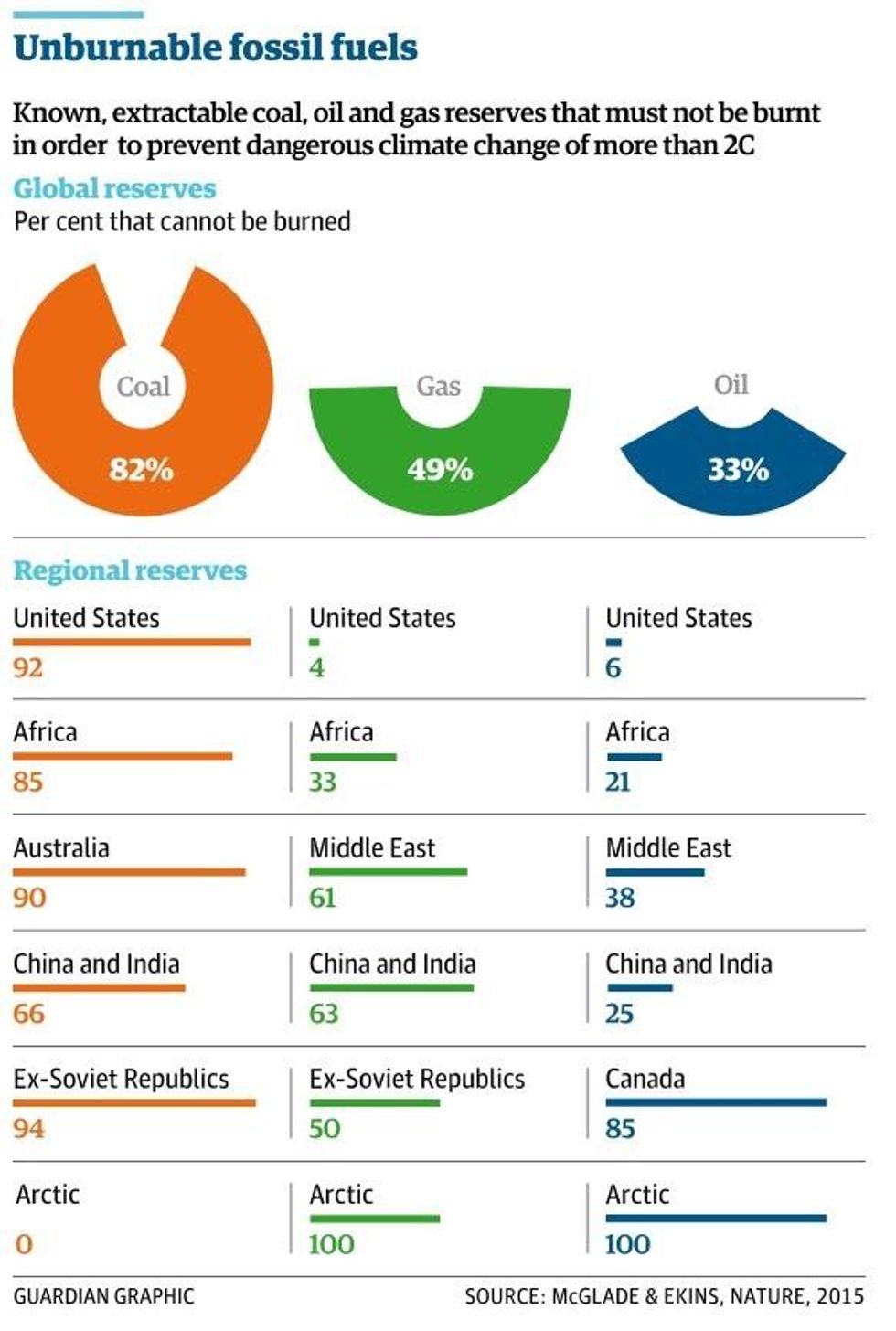
"Our results suggest that, globally, a third of oil reserves, half of gas reserves and over 80 per cent of current coal reserves should remain unused from 2010 to 2050 in order to meet the target of 2 degC," the researchers explain.
While this is not the first study to note that fossil fuels are being dangerously over-exploited, the research is unique in that it pinpoints the national locations of specific reserves that must remain untapped.
The scientists find that 92 percent of U.S. coal reserves, and 100 percent of Arctic gas and oil, and 90 percent of Australian coal reserves, must be left alone. In addition, 100 percent of Arctic oil and gas must remain beneath the earth. Furthermore, most Canadian tar sands must remain unexploited, the study concludes.
This graphic created by the Guardian summarizes other location-specific findings by researchers:
The researchers note that their findings, ultimately, mean that, despite the industry drive for exploitation, staving off disaster requires a different course. "[P]olicy markers' instincts to exploit rapidly and completely their territorial fossil fuels are, in aggregate, inconsistent with their commitments to this temperature limit."
A groundbreaking new study is confirming what green campaigners have long argued: in order to stave off climate disaster, the majority of fossil fuel deposits around the world--including 92 percent of U.S. coal, all Arctic oil and gas, and a majority of Canadian tar sands--must stay "in the ground."
The research is a boost to world-wide green campaigns, from the bid to stop the Keystone XL pipeline to grassroots protest against Arctic drilling.
The new findings were published in the journal Nature and authored by Christophe McGlade and Paul Ekins, both of whom hail from the University College London.
They write, "Policy makers have generally agreed that the average global temperature rise caused by greenhouse gas emissions should not exceed 2 degC above the average global temperature of pre-industrial times."
The researchers explain that they employed a "single integrated assessment model that contains estimates of the quantities, locations and nature of the world's oil, gas and coal reserves and resources" to determine what it would take to stay below this limit.
"Our results suggest that, globally, a third of oil reserves, half of gas reserves and over 80 per cent of current coal reserves should remain unused from 2010 to 2050 in order to meet the target of 2 degC," the researchers explain.
While this is not the first study to note that fossil fuels are being dangerously over-exploited, the research is unique in that it pinpoints the national locations of specific reserves that must remain untapped.
The scientists find that 92 percent of U.S. coal reserves, and 100 percent of Arctic gas and oil, and 90 percent of Australian coal reserves, must be left alone. In addition, 100 percent of Arctic oil and gas must remain beneath the earth. Furthermore, most Canadian tar sands must remain unexploited, the study concludes.
This graphic created by the Guardian summarizes other location-specific findings by researchers:
The researchers note that their findings, ultimately, mean that, despite the industry drive for exploitation, staving off disaster requires a different course. "[P]olicy markers' instincts to exploit rapidly and completely their territorial fossil fuels are, in aggregate, inconsistent with their commitments to this temperature limit."
A groundbreaking new study is confirming what green campaigners have long argued: in order to stave off climate disaster, the majority of fossil fuel deposits around the world--including 92 percent of U.S. coal, all Arctic oil and gas, and a majority of Canadian tar sands--must stay "in the ground."
The research is a boost to world-wide green campaigns, from the bid to stop the Keystone XL pipeline to grassroots protest against Arctic drilling.
The new findings were published in the journal Nature and authored by Christophe McGlade and Paul Ekins, both of whom hail from the University College London.
They write, "Policy makers have generally agreed that the average global temperature rise caused by greenhouse gas emissions should not exceed 2 degC above the average global temperature of pre-industrial times."
The researchers explain that they employed a "single integrated assessment model that contains estimates of the quantities, locations and nature of the world's oil, gas and coal reserves and resources" to determine what it would take to stay below this limit.
"Our results suggest that, globally, a third of oil reserves, half of gas reserves and over 80 per cent of current coal reserves should remain unused from 2010 to 2050 in order to meet the target of 2 degC," the researchers explain.
While this is not the first study to note that fossil fuels are being dangerously over-exploited, the research is unique in that it pinpoints the national locations of specific reserves that must remain untapped.
The scientists find that 92 percent of U.S. coal reserves, and 100 percent of Arctic gas and oil, and 90 percent of Australian coal reserves, must be left alone. In addition, 100 percent of Arctic oil and gas must remain beneath the earth. Furthermore, most Canadian tar sands must remain unexploited, the study concludes.
This graphic created by the Guardian summarizes other location-specific findings by researchers:
The researchers note that their findings, ultimately, mean that, despite the industry drive for exploitation, staving off disaster requires a different course. "[P]olicy markers' instincts to exploit rapidly and completely their territorial fossil fuels are, in aggregate, inconsistent with their commitments to this temperature limit."