
Inside the New York Fed: Secret Recordings and a Culture Clash
A confidential report and a fired examiner’s hidden recorder penetrate the cloistered world of Wall Street’s top regulator—and its history of deference to banks.
Barely a year removed from the devastation of the 2008 financial crisis, the president of the Federal Reserve Bank of New York faced a crossroads. Congress had set its sights on reform. The biggest banks in the nation had shown that their failure could threaten the entire financial system. Lawmakers wanted new safeguards.
The Federal Reserve, and, by dint of its location off Wall Street, the New York Fed, was the logical choice to head the effort. Except it had failed miserably in catching the meltdown.
New York Fed President William Dudley had to answer two questions quickly: Why had his institution blown it, and how could it do better? So he called in an outsider, a Columbia University finance professor named David Beim, and granted him unlimited access to investigate. In exchange, the results would remain secret.
After interviews with dozens of New York Fed employees, Beim learned something that surprised even him. The most daunting obstacle the New York Fed faced in overseeing the nation's biggest financial institutions was its own culture. The New York Fed had become too risk-averse and deferential to the banks it supervised. Its examiners feared contradicting bosses, who too often forced their findings into an institutional consensus that watered down much of what they did.
The report didn't only highlight problems. Beim provided a path forward. He urged the New York Fed to hire expert examiners who were unafraid to speak up and then encourage them to do so. It was essential, he said, to preventing the next crisis.
A year later, Congress gave the Federal Reserve even more oversight authority. And the New York Fed started hiring specialized examiners to station inside the too-big-to fail institutions, those that posed the most risk to the financial system.
One of the expert examiners it chose was Carmen Segarra.
Segarra appeared to be exactly what Beim ordered. Passionate and direct, schooled in the Ivy League and at the Sorbonne, she was a lawyer with more than 13 years of experience in compliance - the specialty of helping banks satisfy rules and regulations. The New York Fed placed her inside one of the biggest and, at the time, most controversial banks in the country, Goldman Sachs.
It did not go well. She was fired after only seven months.
As ProPublica reported last year, Segarra sued the New York Fed and her bosses, claiming she was retaliated against for refusing to back down from a negative finding about Goldman Sachs. A judge threw out the case this year without ruling on the merits, saying the facts didn't fit the statute under which she sued.
At the bottom of a document filed in the case, however, her lawyer disclosed a stunning fact: Segarra had made a series of audio recordings while at the New York Fed. Worried about what she was witnessing, Segarra wanted a record in case events were disputed. So she had purchased a tiny recorder at the Spy Store and began capturing what took place at Goldman and with her bosses.
Segarra ultimately recorded about 46 hours of meetings and conversations with her colleagues. Many of these events document key moments leading to her firing. But against the backdrop of the Beim report, they also offer an intimate study of the New York Fed's culture at a pivotal moment in its effort to become a more forceful financial supervisor. Fed deliberations, confidential by regulation, rarely become public.
The recordings make clear that some of the cultural obstacles Beim outlined in his report persisted almost three years after he handed his report to Dudley. They portray a New York Fed that is at times reluctant to push hard against Goldman and struggling to define its authority while integrating Segarra and a new corps of expert examiners into a reorganized supervisory scheme.
Segarra became a polarizing personality inside the New York Fed -- and a problem for her bosses -- in part because she was too outspoken and direct about the issues she saw at both Goldman and the Fed. Some colleagues found her abrasive and complained. Her unwillingness to conform set her on a collision course with higher-ups at the New York Fed and, ultimately, led to her undoing.
In a tense, 40-minute meeting recorded the week before she was fired, Segarra's boss repeatedly tries to persuade her to change her conclusion that Goldman was missing a policy to handle conflicts of interest. Segarra offered to review her evidence with higher-ups and told her boss she would accept being overruled once her findings were submitted. It wasn't enough.
"Why do you have to say there's no policy?" her boss said near the end of the grueling session.
"Professionally," Segarra responded, "I cannot agree."
The New York Fed disputes Segarra's claim that she was fired in retaliation.
"The decision to terminate Ms. Segarra's employment with the New York Fed was based entirely on performance grounds, not because she raised concerns as a member of any examination team about any institution," it said in a two-page statement responding to an extensive list of questions from ProPublica and This American Life.
The statement also defends the bank's record as regulator, saying it has taken steps to incorporate Beim's recommendations and "provides multiple venues and layers of recourse to help ensure that its employees freely express their views and concerns."
"The New York Fed," the statement says, "categorically rejects the allegations being made about the integrity of its supervision of financial institutions."
In the spring of 2009, New York Fed President William Dudley put together a team of eight senior staffers to help Beim in his inquiry. In many ways, this was familiar territory for Beim.
He had worked on Wall Street as a banker in the 1980s at Bankers Trust Company, assisting the firm through its transition from a retail to an investment bank. In 1997, the New York Fed hired Beim to study how it might improve its examination process. Beim recommended the Fed spend more time understanding the businesses it supervised. He also suggested a system of continuous monitoring rather than a single year-end examination.
Beim says his team in 2009 pursued a no-holds-barred investigation of the New York Fed. They were emboldened because the report was to remain an internal document, so there was no reason to hold back for fear of exposure. The words "Confidential Treatment Requested" ran across the bottom of the report.
"Nothing was off limits," says Beim. "I was told I could ask anyone any question. There were no restrictions."
In the end, his 27-page report laid bare a culture ruled by groupthink, where managers used consensus decision-making and layers of vetting to water down findings. Examiners feared to speak up lest they make a mistake or contradict higher-ups. Excessive secrecy stymied action and empowered gatekeepers, who used their authority to protect the banks they supervised.
"Our review of lessons learned from the crisis reveals a culture that is too risk-averse to respond quickly and flexibly to new challenges," the report stated. "A number of people believe that supervisors paid excessive deference to banks, and as a result they were less aggressive in finding issues or in following up on them in a forceful way."
One New York Fed employee, a supervisor, described his experience in terms of "regulatory capture," the phrase commonly used to describe a situation where banks co-opt regulators. Beim included the remark in a footnote. "Within three weeks on the job, I saw the capture set in," the manager stated.
Confronted with the quotation, senior officers at the Fed asked the professor to remove it from the report, according to Beim. "They didn't give an argument," Beim said in an interview. "They were embarrassed." He refused to change it.
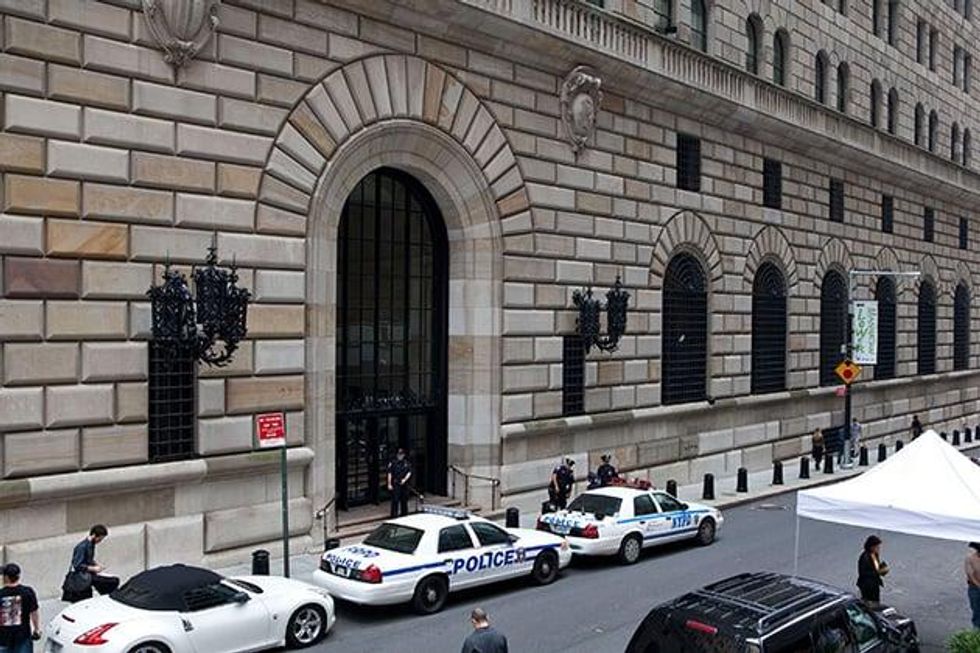
The entrance to the Federal Reserve Bank of New York. (Andrew Burton/Getty Images)
The Beim report made the case that the New York Fed needed a specific kind of culture to transform itself into an institution able to monitor complex financial firms and catch the kinds of risks that were capable of torpedoing the global economy.
That meant hiring "out-of-the-box thinkers," even at the risk of getting "disruptive personalities," the report said. It called for expert examiners who would be contrarian, ask difficult questions and challenge the prevailing orthodoxy. Managers should add categories like "willingness to speak up" and "willingness to contradict me" to annual employee evaluations. And senior Fed managers had to take the lead.
"The top has to articulate why we're going through this change, what the benefits are going to be and why it's so important that we're going to monitor everyone and make sure they stay on board," Beim said in an interview.
Beim handed the report to Dudley. The professor kept it in draft form to help maintain secrecy and because he thought the Fed president might request changes. Instead, Dudley thanked him and that was it. Beim never heard from him again about the matter, he said.
In 2011, the Financial Crisis Inquiry Commission, created by Congress to investigate the causes behind the economic calamity, publicly released hundreds of documents. Buried among them was Beim's report.
Because of the report's candor, the release surprised Beim and New York Fed officials. Yet virtually no one else noticed.
Urgent. It's never been this bad.
Dear Common Dreams reader, It’s been nearly 30 years since I co-founded Common Dreams with my late wife, Lina Newhouser. We had the radical notion that journalism should serve the public good, not corporate profits. It was clear to us from the outset what it would take to build such a project. No paid advertisements. No corporate sponsors. No millionaire publisher telling us what to think or do. Many people said we wouldn't last a year, but we proved those doubters wrong. Together with a tremendous team of journalists and dedicated staff, we built an independent media outlet free from the constraints of profits and corporate control. Our mission from the outset was simple. To inform. To inspire. To ignite change for the common good. Building Common Dreams was not easy. Our survival was never guaranteed. When you take on the most powerful forces—Wall Street greed, fossil fuel industry destruction, Big Tech lobbyists, and uber-rich oligarchs who have spent billions upon billions rigging the economy and democracy in their favor—the only bulwark you have is supporters who believe in your work. But here’s the urgent message from me today. It’s never been this bad out there. And it’s never been this hard to keep us going. At the very moment Common Dreams is most needed and doing some of its best and most important work, the threats we face are intensifying. Right now, with just four days to go in our Spring Campaign, we are not even halfway to our goal. When everyone does the little they can afford, we are strong. But if that support retreats or dries up, so do we. Can you make a gift right now to make sure Common Dreams not only survives but thrives? There is no backup plan or rainy day fund. There is only you. —Craig Brown, Co-founder |
Barely a year removed from the devastation of the 2008 financial crisis, the president of the Federal Reserve Bank of New York faced a crossroads. Congress had set its sights on reform. The biggest banks in the nation had shown that their failure could threaten the entire financial system. Lawmakers wanted new safeguards.
The Federal Reserve, and, by dint of its location off Wall Street, the New York Fed, was the logical choice to head the effort. Except it had failed miserably in catching the meltdown.
New York Fed President William Dudley had to answer two questions quickly: Why had his institution blown it, and how could it do better? So he called in an outsider, a Columbia University finance professor named David Beim, and granted him unlimited access to investigate. In exchange, the results would remain secret.
After interviews with dozens of New York Fed employees, Beim learned something that surprised even him. The most daunting obstacle the New York Fed faced in overseeing the nation's biggest financial institutions was its own culture. The New York Fed had become too risk-averse and deferential to the banks it supervised. Its examiners feared contradicting bosses, who too often forced their findings into an institutional consensus that watered down much of what they did.
The report didn't only highlight problems. Beim provided a path forward. He urged the New York Fed to hire expert examiners who were unafraid to speak up and then encourage them to do so. It was essential, he said, to preventing the next crisis.
A year later, Congress gave the Federal Reserve even more oversight authority. And the New York Fed started hiring specialized examiners to station inside the too-big-to fail institutions, those that posed the most risk to the financial system.
One of the expert examiners it chose was Carmen Segarra.
Segarra appeared to be exactly what Beim ordered. Passionate and direct, schooled in the Ivy League and at the Sorbonne, she was a lawyer with more than 13 years of experience in compliance - the specialty of helping banks satisfy rules and regulations. The New York Fed placed her inside one of the biggest and, at the time, most controversial banks in the country, Goldman Sachs.
It did not go well. She was fired after only seven months.
As ProPublica reported last year, Segarra sued the New York Fed and her bosses, claiming she was retaliated against for refusing to back down from a negative finding about Goldman Sachs. A judge threw out the case this year without ruling on the merits, saying the facts didn't fit the statute under which she sued.
At the bottom of a document filed in the case, however, her lawyer disclosed a stunning fact: Segarra had made a series of audio recordings while at the New York Fed. Worried about what she was witnessing, Segarra wanted a record in case events were disputed. So she had purchased a tiny recorder at the Spy Store and began capturing what took place at Goldman and with her bosses.
Segarra ultimately recorded about 46 hours of meetings and conversations with her colleagues. Many of these events document key moments leading to her firing. But against the backdrop of the Beim report, they also offer an intimate study of the New York Fed's culture at a pivotal moment in its effort to become a more forceful financial supervisor. Fed deliberations, confidential by regulation, rarely become public.
The recordings make clear that some of the cultural obstacles Beim outlined in his report persisted almost three years after he handed his report to Dudley. They portray a New York Fed that is at times reluctant to push hard against Goldman and struggling to define its authority while integrating Segarra and a new corps of expert examiners into a reorganized supervisory scheme.
Segarra became a polarizing personality inside the New York Fed -- and a problem for her bosses -- in part because she was too outspoken and direct about the issues she saw at both Goldman and the Fed. Some colleagues found her abrasive and complained. Her unwillingness to conform set her on a collision course with higher-ups at the New York Fed and, ultimately, led to her undoing.
In a tense, 40-minute meeting recorded the week before she was fired, Segarra's boss repeatedly tries to persuade her to change her conclusion that Goldman was missing a policy to handle conflicts of interest. Segarra offered to review her evidence with higher-ups and told her boss she would accept being overruled once her findings were submitted. It wasn't enough.
"Why do you have to say there's no policy?" her boss said near the end of the grueling session.
"Professionally," Segarra responded, "I cannot agree."
The New York Fed disputes Segarra's claim that she was fired in retaliation.
"The decision to terminate Ms. Segarra's employment with the New York Fed was based entirely on performance grounds, not because she raised concerns as a member of any examination team about any institution," it said in a two-page statement responding to an extensive list of questions from ProPublica and This American Life.
The statement also defends the bank's record as regulator, saying it has taken steps to incorporate Beim's recommendations and "provides multiple venues and layers of recourse to help ensure that its employees freely express their views and concerns."
"The New York Fed," the statement says, "categorically rejects the allegations being made about the integrity of its supervision of financial institutions."
In the spring of 2009, New York Fed President William Dudley put together a team of eight senior staffers to help Beim in his inquiry. In many ways, this was familiar territory for Beim.
He had worked on Wall Street as a banker in the 1980s at Bankers Trust Company, assisting the firm through its transition from a retail to an investment bank. In 1997, the New York Fed hired Beim to study how it might improve its examination process. Beim recommended the Fed spend more time understanding the businesses it supervised. He also suggested a system of continuous monitoring rather than a single year-end examination.
Beim says his team in 2009 pursued a no-holds-barred investigation of the New York Fed. They were emboldened because the report was to remain an internal document, so there was no reason to hold back for fear of exposure. The words "Confidential Treatment Requested" ran across the bottom of the report.
"Nothing was off limits," says Beim. "I was told I could ask anyone any question. There were no restrictions."
In the end, his 27-page report laid bare a culture ruled by groupthink, where managers used consensus decision-making and layers of vetting to water down findings. Examiners feared to speak up lest they make a mistake or contradict higher-ups. Excessive secrecy stymied action and empowered gatekeepers, who used their authority to protect the banks they supervised.
"Our review of lessons learned from the crisis reveals a culture that is too risk-averse to respond quickly and flexibly to new challenges," the report stated. "A number of people believe that supervisors paid excessive deference to banks, and as a result they were less aggressive in finding issues or in following up on them in a forceful way."
One New York Fed employee, a supervisor, described his experience in terms of "regulatory capture," the phrase commonly used to describe a situation where banks co-opt regulators. Beim included the remark in a footnote. "Within three weeks on the job, I saw the capture set in," the manager stated.
Confronted with the quotation, senior officers at the Fed asked the professor to remove it from the report, according to Beim. "They didn't give an argument," Beim said in an interview. "They were embarrassed." He refused to change it.
The entrance to the Federal Reserve Bank of New York. (Andrew Burton/Getty Images)
The Beim report made the case that the New York Fed needed a specific kind of culture to transform itself into an institution able to monitor complex financial firms and catch the kinds of risks that were capable of torpedoing the global economy.
That meant hiring "out-of-the-box thinkers," even at the risk of getting "disruptive personalities," the report said. It called for expert examiners who would be contrarian, ask difficult questions and challenge the prevailing orthodoxy. Managers should add categories like "willingness to speak up" and "willingness to contradict me" to annual employee evaluations. And senior Fed managers had to take the lead.
"The top has to articulate why we're going through this change, what the benefits are going to be and why it's so important that we're going to monitor everyone and make sure they stay on board," Beim said in an interview.
Beim handed the report to Dudley. The professor kept it in draft form to help maintain secrecy and because he thought the Fed president might request changes. Instead, Dudley thanked him and that was it. Beim never heard from him again about the matter, he said.
In 2011, the Financial Crisis Inquiry Commission, created by Congress to investigate the causes behind the economic calamity, publicly released hundreds of documents. Buried among them was Beim's report.
Because of the report's candor, the release surprised Beim and New York Fed officials. Yet virtually no one else noticed.
Barely a year removed from the devastation of the 2008 financial crisis, the president of the Federal Reserve Bank of New York faced a crossroads. Congress had set its sights on reform. The biggest banks in the nation had shown that their failure could threaten the entire financial system. Lawmakers wanted new safeguards.
The Federal Reserve, and, by dint of its location off Wall Street, the New York Fed, was the logical choice to head the effort. Except it had failed miserably in catching the meltdown.
New York Fed President William Dudley had to answer two questions quickly: Why had his institution blown it, and how could it do better? So he called in an outsider, a Columbia University finance professor named David Beim, and granted him unlimited access to investigate. In exchange, the results would remain secret.
After interviews with dozens of New York Fed employees, Beim learned something that surprised even him. The most daunting obstacle the New York Fed faced in overseeing the nation's biggest financial institutions was its own culture. The New York Fed had become too risk-averse and deferential to the banks it supervised. Its examiners feared contradicting bosses, who too often forced their findings into an institutional consensus that watered down much of what they did.
The report didn't only highlight problems. Beim provided a path forward. He urged the New York Fed to hire expert examiners who were unafraid to speak up and then encourage them to do so. It was essential, he said, to preventing the next crisis.
A year later, Congress gave the Federal Reserve even more oversight authority. And the New York Fed started hiring specialized examiners to station inside the too-big-to fail institutions, those that posed the most risk to the financial system.
One of the expert examiners it chose was Carmen Segarra.
Segarra appeared to be exactly what Beim ordered. Passionate and direct, schooled in the Ivy League and at the Sorbonne, she was a lawyer with more than 13 years of experience in compliance - the specialty of helping banks satisfy rules and regulations. The New York Fed placed her inside one of the biggest and, at the time, most controversial banks in the country, Goldman Sachs.
It did not go well. She was fired after only seven months.
As ProPublica reported last year, Segarra sued the New York Fed and her bosses, claiming she was retaliated against for refusing to back down from a negative finding about Goldman Sachs. A judge threw out the case this year without ruling on the merits, saying the facts didn't fit the statute under which she sued.
At the bottom of a document filed in the case, however, her lawyer disclosed a stunning fact: Segarra had made a series of audio recordings while at the New York Fed. Worried about what she was witnessing, Segarra wanted a record in case events were disputed. So she had purchased a tiny recorder at the Spy Store and began capturing what took place at Goldman and with her bosses.
Segarra ultimately recorded about 46 hours of meetings and conversations with her colleagues. Many of these events document key moments leading to her firing. But against the backdrop of the Beim report, they also offer an intimate study of the New York Fed's culture at a pivotal moment in its effort to become a more forceful financial supervisor. Fed deliberations, confidential by regulation, rarely become public.
The recordings make clear that some of the cultural obstacles Beim outlined in his report persisted almost three years after he handed his report to Dudley. They portray a New York Fed that is at times reluctant to push hard against Goldman and struggling to define its authority while integrating Segarra and a new corps of expert examiners into a reorganized supervisory scheme.
Segarra became a polarizing personality inside the New York Fed -- and a problem for her bosses -- in part because she was too outspoken and direct about the issues she saw at both Goldman and the Fed. Some colleagues found her abrasive and complained. Her unwillingness to conform set her on a collision course with higher-ups at the New York Fed and, ultimately, led to her undoing.
In a tense, 40-minute meeting recorded the week before she was fired, Segarra's boss repeatedly tries to persuade her to change her conclusion that Goldman was missing a policy to handle conflicts of interest. Segarra offered to review her evidence with higher-ups and told her boss she would accept being overruled once her findings were submitted. It wasn't enough.
"Why do you have to say there's no policy?" her boss said near the end of the grueling session.
"Professionally," Segarra responded, "I cannot agree."
The New York Fed disputes Segarra's claim that she was fired in retaliation.
"The decision to terminate Ms. Segarra's employment with the New York Fed was based entirely on performance grounds, not because she raised concerns as a member of any examination team about any institution," it said in a two-page statement responding to an extensive list of questions from ProPublica and This American Life.
The statement also defends the bank's record as regulator, saying it has taken steps to incorporate Beim's recommendations and "provides multiple venues and layers of recourse to help ensure that its employees freely express their views and concerns."
"The New York Fed," the statement says, "categorically rejects the allegations being made about the integrity of its supervision of financial institutions."
In the spring of 2009, New York Fed President William Dudley put together a team of eight senior staffers to help Beim in his inquiry. In many ways, this was familiar territory for Beim.
He had worked on Wall Street as a banker in the 1980s at Bankers Trust Company, assisting the firm through its transition from a retail to an investment bank. In 1997, the New York Fed hired Beim to study how it might improve its examination process. Beim recommended the Fed spend more time understanding the businesses it supervised. He also suggested a system of continuous monitoring rather than a single year-end examination.
Beim says his team in 2009 pursued a no-holds-barred investigation of the New York Fed. They were emboldened because the report was to remain an internal document, so there was no reason to hold back for fear of exposure. The words "Confidential Treatment Requested" ran across the bottom of the report.
"Nothing was off limits," says Beim. "I was told I could ask anyone any question. There were no restrictions."
In the end, his 27-page report laid bare a culture ruled by groupthink, where managers used consensus decision-making and layers of vetting to water down findings. Examiners feared to speak up lest they make a mistake or contradict higher-ups. Excessive secrecy stymied action and empowered gatekeepers, who used their authority to protect the banks they supervised.
"Our review of lessons learned from the crisis reveals a culture that is too risk-averse to respond quickly and flexibly to new challenges," the report stated. "A number of people believe that supervisors paid excessive deference to banks, and as a result they were less aggressive in finding issues or in following up on them in a forceful way."
One New York Fed employee, a supervisor, described his experience in terms of "regulatory capture," the phrase commonly used to describe a situation where banks co-opt regulators. Beim included the remark in a footnote. "Within three weeks on the job, I saw the capture set in," the manager stated.
Confronted with the quotation, senior officers at the Fed asked the professor to remove it from the report, according to Beim. "They didn't give an argument," Beim said in an interview. "They were embarrassed." He refused to change it.
The entrance to the Federal Reserve Bank of New York. (Andrew Burton/Getty Images)
The Beim report made the case that the New York Fed needed a specific kind of culture to transform itself into an institution able to monitor complex financial firms and catch the kinds of risks that were capable of torpedoing the global economy.
That meant hiring "out-of-the-box thinkers," even at the risk of getting "disruptive personalities," the report said. It called for expert examiners who would be contrarian, ask difficult questions and challenge the prevailing orthodoxy. Managers should add categories like "willingness to speak up" and "willingness to contradict me" to annual employee evaluations. And senior Fed managers had to take the lead.
"The top has to articulate why we're going through this change, what the benefits are going to be and why it's so important that we're going to monitor everyone and make sure they stay on board," Beim said in an interview.
Beim handed the report to Dudley. The professor kept it in draft form to help maintain secrecy and because he thought the Fed president might request changes. Instead, Dudley thanked him and that was it. Beim never heard from him again about the matter, he said.
In 2011, the Financial Crisis Inquiry Commission, created by Congress to investigate the causes behind the economic calamity, publicly released hundreds of documents. Buried among them was Beim's report.
Because of the report's candor, the release surprised Beim and New York Fed officials. Yet virtually no one else noticed.

