SUBSCRIBE TO OUR FREE NEWSLETTER
Daily news & progressive opinion—funded by the people, not the corporations—delivered straight to your inbox.
5
#000000
#FFFFFF
To donate by check, phone, or other method, see our More Ways to Give page.
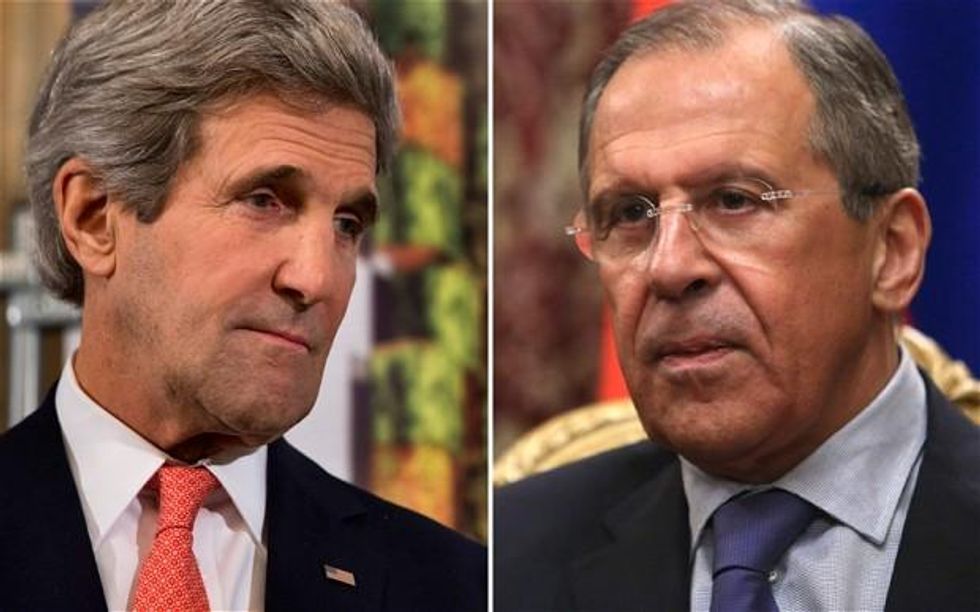
Tensions appeared to remain high as Lavrov outlined a set of high stakes conditions Russia expects to have met in the negotiation, including the allotment of "extensive autonomous powers" independent of Kiev for ethnic Russian regions of eastern and southern Ukraine, the Guardian reports.
Meanwhile, the U.S. ordered General Philip Breedlove, NATO's Supreme Allied Commander in Europe and the head of the U.S. military's European Command, to turn back early from a trip to Washington and return to his post, citing concerns over a "lack of transparency and intent from Russian leadership about their military movements across the border," a Pentagon spokesman said.
In an appearance on Russian television, Lavrov said Moscow's terms also include a pledge from Ukraine's new leaders that they will not seek to join NATO.
The eastward expansion of NATO, as it has advanced into Eastern Europe, the Baltic and the Caucasus - "not to mention former Soviet Central Asia," Eric Margolis writes this week, has been a main source of tension between the two countries.
"Unsubtle US efforts to bring ex-Russian Ukraine and the vital Sevastopol naval base in Crimea under NATO control - no doubt to punish Russia for supporting Syria and Iran - proved the last straw for the Kremlin," Margolis writes. "In Ukraine and Crimea we are now seeing the results of overly aggressive Western geopolitics."
While Lavrov has maintained that Russia has no intention of invading Ukraine, neither Kerry nor Lavrov "made any substantive comment" at a press conference before the talks began Sunday night, and it was "unclear what response the US and its EU partners would make to the Russian demands," the Guardian reports.
Before heading into the meeting Lavrov told reporters: "Good luck and good night."
______________________
Tensions appeared to remain high as Lavrov outlined a set of high stakes conditions Russia expects to have met in the negotiation, including the allotment of "extensive autonomous powers" independent of Kiev for ethnic Russian regions of eastern and southern Ukraine, the Guardian reports.
Meanwhile, the U.S. ordered General Philip Breedlove, NATO's Supreme Allied Commander in Europe and the head of the U.S. military's European Command, to turn back early from a trip to Washington and return to his post, citing concerns over a "lack of transparency and intent from Russian leadership about their military movements across the border," a Pentagon spokesman said.
In an appearance on Russian television, Lavrov said Moscow's terms also include a pledge from Ukraine's new leaders that they will not seek to join NATO.
The eastward expansion of NATO, as it has advanced into Eastern Europe, the Baltic and the Caucasus - "not to mention former Soviet Central Asia," Eric Margolis writes this week, has been a main source of tension between the two countries.
"Unsubtle US efforts to bring ex-Russian Ukraine and the vital Sevastopol naval base in Crimea under NATO control - no doubt to punish Russia for supporting Syria and Iran - proved the last straw for the Kremlin," Margolis writes. "In Ukraine and Crimea we are now seeing the results of overly aggressive Western geopolitics."
While Lavrov has maintained that Russia has no intention of invading Ukraine, neither Kerry nor Lavrov "made any substantive comment" at a press conference before the talks began Sunday night, and it was "unclear what response the US and its EU partners would make to the Russian demands," the Guardian reports.
Before heading into the meeting Lavrov told reporters: "Good luck and good night."
______________________
Tensions appeared to remain high as Lavrov outlined a set of high stakes conditions Russia expects to have met in the negotiation, including the allotment of "extensive autonomous powers" independent of Kiev for ethnic Russian regions of eastern and southern Ukraine, the Guardian reports.
Meanwhile, the U.S. ordered General Philip Breedlove, NATO's Supreme Allied Commander in Europe and the head of the U.S. military's European Command, to turn back early from a trip to Washington and return to his post, citing concerns over a "lack of transparency and intent from Russian leadership about their military movements across the border," a Pentagon spokesman said.
In an appearance on Russian television, Lavrov said Moscow's terms also include a pledge from Ukraine's new leaders that they will not seek to join NATO.
The eastward expansion of NATO, as it has advanced into Eastern Europe, the Baltic and the Caucasus - "not to mention former Soviet Central Asia," Eric Margolis writes this week, has been a main source of tension between the two countries.
"Unsubtle US efforts to bring ex-Russian Ukraine and the vital Sevastopol naval base in Crimea under NATO control - no doubt to punish Russia for supporting Syria and Iran - proved the last straw for the Kremlin," Margolis writes. "In Ukraine and Crimea we are now seeing the results of overly aggressive Western geopolitics."
While Lavrov has maintained that Russia has no intention of invading Ukraine, neither Kerry nor Lavrov "made any substantive comment" at a press conference before the talks began Sunday night, and it was "unclear what response the US and its EU partners would make to the Russian demands," the Guardian reports.
Before heading into the meeting Lavrov told reporters: "Good luck and good night."
______________________