SUBSCRIBE TO OUR FREE NEWSLETTER
Daily news & progressive opinion—funded by the people, not the corporations—delivered straight to your inbox.
5
#000000
#FFFFFF
To donate by check, phone, or other method, see our More Ways to Give page.
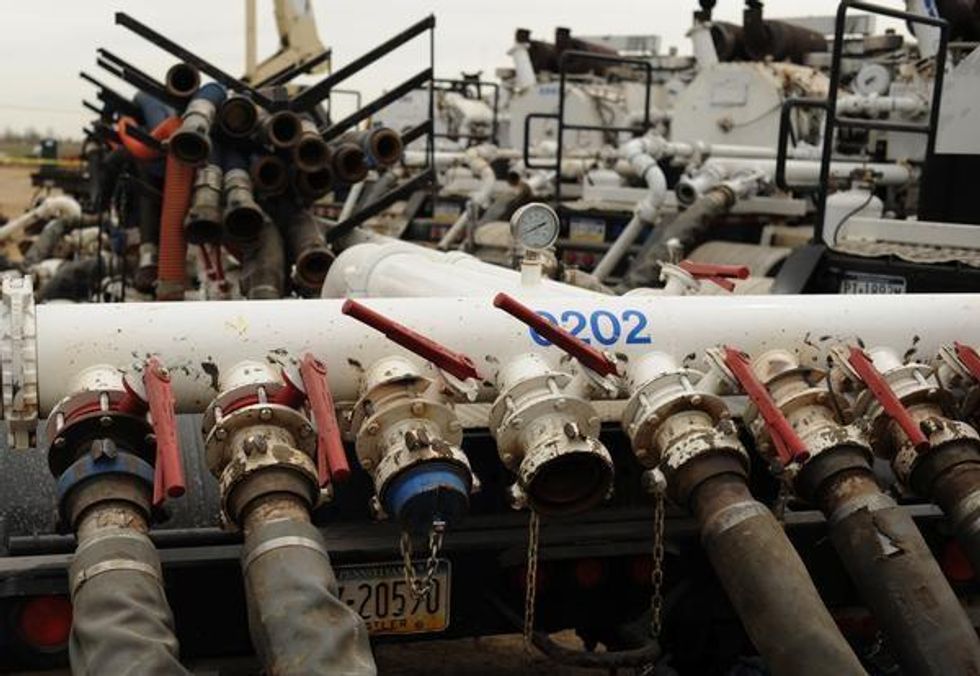
So finds a study released Monday in The Endocrine Society's journal Endocrinology, in which U.S. scientists analyzed surface and ground water samples from Garfield County, Colorado--a fracking hotspot that is home to over 10,000 natural gas wells--focusing on "sites with drilling spills or accidents," according to an announcement of the findings.
The scientists discovered that samples near drilling sites contained "moderate to high" levels of endocrine-disrupting chemicals (EDCs)--which can alter the functioning of the endocrine system and are linked to cancer, birth defects, infertility and other disorders.
"We found more endocrine-disrupting activity in the water close to drilling locations that had experienced spills than at control sites. This could raise the risk of reproductive, metabolic, neurological and other diseases, especially in children who are exposed to EDCs," said one of the study's authors, Susan C. Nagel, PhD, of the University of Missouri School of Medicine.
Samples taken from the Colorado River, which collects drainage from fracking sites, also had "moderate levels" of EDCs.
"More than 700 chemicals are used in the fracking process, and many of them disturb hormone function," said Nagel. "With fracking on the rise, populations may face greater health risks from increased endocrine-disrupting chemical exposure."
The findings follow a February study from United Nations Environment Program (UNEP) and the World Health Organization (WHO), which finds that endocrine-related illnesses are increasingly posing a threat to global public health due to the increase of synthetic chemicals in the environment.
_____________________
So finds a study released Monday in The Endocrine Society's journal Endocrinology, in which U.S. scientists analyzed surface and ground water samples from Garfield County, Colorado--a fracking hotspot that is home to over 10,000 natural gas wells--focusing on "sites with drilling spills or accidents," according to an announcement of the findings.
The scientists discovered that samples near drilling sites contained "moderate to high" levels of endocrine-disrupting chemicals (EDCs)--which can alter the functioning of the endocrine system and are linked to cancer, birth defects, infertility and other disorders.
"We found more endocrine-disrupting activity in the water close to drilling locations that had experienced spills than at control sites. This could raise the risk of reproductive, metabolic, neurological and other diseases, especially in children who are exposed to EDCs," said one of the study's authors, Susan C. Nagel, PhD, of the University of Missouri School of Medicine.
Samples taken from the Colorado River, which collects drainage from fracking sites, also had "moderate levels" of EDCs.
"More than 700 chemicals are used in the fracking process, and many of them disturb hormone function," said Nagel. "With fracking on the rise, populations may face greater health risks from increased endocrine-disrupting chemical exposure."
The findings follow a February study from United Nations Environment Program (UNEP) and the World Health Organization (WHO), which finds that endocrine-related illnesses are increasingly posing a threat to global public health due to the increase of synthetic chemicals in the environment.
_____________________
So finds a study released Monday in The Endocrine Society's journal Endocrinology, in which U.S. scientists analyzed surface and ground water samples from Garfield County, Colorado--a fracking hotspot that is home to over 10,000 natural gas wells--focusing on "sites with drilling spills or accidents," according to an announcement of the findings.
The scientists discovered that samples near drilling sites contained "moderate to high" levels of endocrine-disrupting chemicals (EDCs)--which can alter the functioning of the endocrine system and are linked to cancer, birth defects, infertility and other disorders.
"We found more endocrine-disrupting activity in the water close to drilling locations that had experienced spills than at control sites. This could raise the risk of reproductive, metabolic, neurological and other diseases, especially in children who are exposed to EDCs," said one of the study's authors, Susan C. Nagel, PhD, of the University of Missouri School of Medicine.
Samples taken from the Colorado River, which collects drainage from fracking sites, also had "moderate levels" of EDCs.
"More than 700 chemicals are used in the fracking process, and many of them disturb hormone function," said Nagel. "With fracking on the rise, populations may face greater health risks from increased endocrine-disrupting chemical exposure."
The findings follow a February study from United Nations Environment Program (UNEP) and the World Health Organization (WHO), which finds that endocrine-related illnesses are increasingly posing a threat to global public health due to the increase of synthetic chemicals in the environment.
_____________________