SUBSCRIBE TO OUR FREE NEWSLETTER
Daily news & progressive opinion—funded by the people, not the corporations—delivered straight to your inbox.
5
#000000
#FFFFFF
To donate by check, phone, or other method, see our More Ways to Give page.
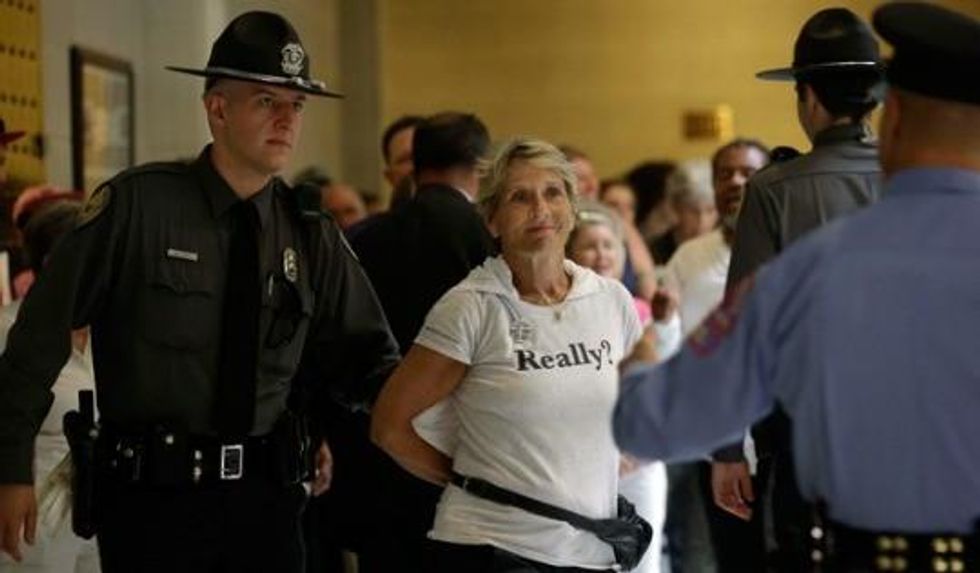
At the hearing of Saladin Muammad, a U.S. Army veteran and labor activist arrested on May 13 while at a Moral Monday protest, General Assembly Police Chief Jeff Weaver testified that he received advanced intelligence reports from officers about protesters' plans ahead of events in which arrests were made.
Raleigh Police Department Chief Cassandra Deck-Brown confirmed some of Weaver's statements to the Associated Press Monday night.
Deck-Brown told AP over the phone that a plain-clothes officer attended two meetings at the Davie Street Presbyterian Church on May 6 and May 13 at the height of the Moral Monday protests.
"The purpose of the officer's presence was to determine how many people were expecting to be arrested to allow the department to gauge the sufficiency of the logistical support, such as transport vehicles, available at the Legislative Building," Deck-Brown told AP.
As Weaver testified that his department had targeted "anarchists" in the region and collected intelligence on them, there was "a murmur of disbelief among the many lawyers attending the Wake County District Court hearing," the News & Observer reports.
Weaver said his officers, who worked with Raleigh city police, scanned the many Moral Monday rallies for who they believed might be anarchists.
State NAACP president Rev. William Barber said that news of the Raleigh police behavior was concerning.
"It's not like we were planning a bank heist," Barber said after learning of the surveillance. "Mostly what we did was pray and sing."
"I am upset they felt they needed to infiltrate the way they did," Johnson said. "There was nothing to hide."
Over 940 protesters were arrested over the course of 13 consecutive Moral Monday protests, with more Moral Mondays promised in the future. The protests arose in widespread anger over a Republican-led take-over of North Carolina legislature, which has included massive budget cuts in the form of attacks on public education, voting rights and labor rights alongside generous tax breaks for the wealthy.
At the hearing of Saladin Muammad, a U.S. Army veteran and labor activist arrested on May 13 while at a Moral Monday protest, General Assembly Police Chief Jeff Weaver testified that he received advanced intelligence reports from officers about protesters' plans ahead of events in which arrests were made.
Raleigh Police Department Chief Cassandra Deck-Brown confirmed some of Weaver's statements to the Associated Press Monday night.
Deck-Brown told AP over the phone that a plain-clothes officer attended two meetings at the Davie Street Presbyterian Church on May 6 and May 13 at the height of the Moral Monday protests.
"The purpose of the officer's presence was to determine how many people were expecting to be arrested to allow the department to gauge the sufficiency of the logistical support, such as transport vehicles, available at the Legislative Building," Deck-Brown told AP.
As Weaver testified that his department had targeted "anarchists" in the region and collected intelligence on them, there was "a murmur of disbelief among the many lawyers attending the Wake County District Court hearing," the News & Observer reports.
Weaver said his officers, who worked with Raleigh city police, scanned the many Moral Monday rallies for who they believed might be anarchists.
State NAACP president Rev. William Barber said that news of the Raleigh police behavior was concerning.
"It's not like we were planning a bank heist," Barber said after learning of the surveillance. "Mostly what we did was pray and sing."
"I am upset they felt they needed to infiltrate the way they did," Johnson said. "There was nothing to hide."
Over 940 protesters were arrested over the course of 13 consecutive Moral Monday protests, with more Moral Mondays promised in the future. The protests arose in widespread anger over a Republican-led take-over of North Carolina legislature, which has included massive budget cuts in the form of attacks on public education, voting rights and labor rights alongside generous tax breaks for the wealthy.
At the hearing of Saladin Muammad, a U.S. Army veteran and labor activist arrested on May 13 while at a Moral Monday protest, General Assembly Police Chief Jeff Weaver testified that he received advanced intelligence reports from officers about protesters' plans ahead of events in which arrests were made.
Raleigh Police Department Chief Cassandra Deck-Brown confirmed some of Weaver's statements to the Associated Press Monday night.
Deck-Brown told AP over the phone that a plain-clothes officer attended two meetings at the Davie Street Presbyterian Church on May 6 and May 13 at the height of the Moral Monday protests.
"The purpose of the officer's presence was to determine how many people were expecting to be arrested to allow the department to gauge the sufficiency of the logistical support, such as transport vehicles, available at the Legislative Building," Deck-Brown told AP.
As Weaver testified that his department had targeted "anarchists" in the region and collected intelligence on them, there was "a murmur of disbelief among the many lawyers attending the Wake County District Court hearing," the News & Observer reports.
Weaver said his officers, who worked with Raleigh city police, scanned the many Moral Monday rallies for who they believed might be anarchists.
State NAACP president Rev. William Barber said that news of the Raleigh police behavior was concerning.
"It's not like we were planning a bank heist," Barber said after learning of the surveillance. "Mostly what we did was pray and sing."
"I am upset they felt they needed to infiltrate the way they did," Johnson said. "There was nothing to hide."
Over 940 protesters were arrested over the course of 13 consecutive Moral Monday protests, with more Moral Mondays promised in the future. The protests arose in widespread anger over a Republican-led take-over of North Carolina legislature, which has included massive budget cuts in the form of attacks on public education, voting rights and labor rights alongside generous tax breaks for the wealthy.