
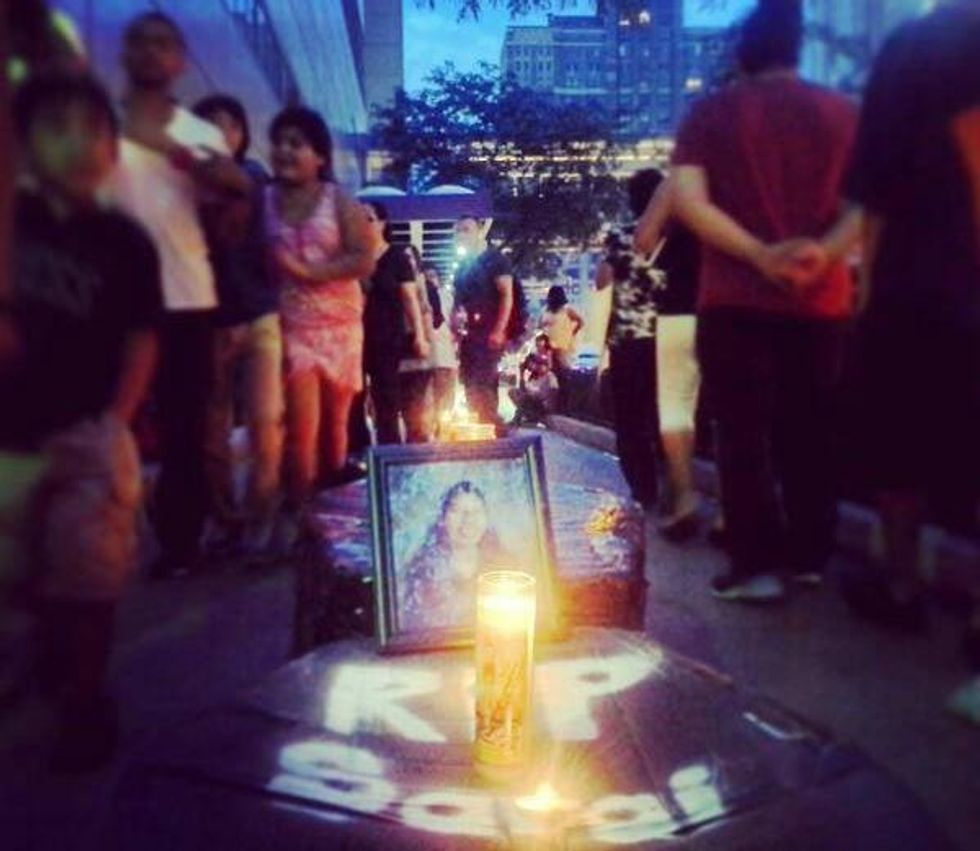
The procession was not just symbolic: it commemorated the life of Sarai Rodriguez, a 25-year-old woman who was reportedly denied a kidney transplant by Northwestern Memorial Hospital because she was undocumented and uninsured, causing her death Friday. They carried a casket marked with Rodriguez's name, which they attempted to deliver to hospital administrators.
The loss of Rodriguez illustrated the unspeakably high stakes of this Chicago group's fight. The action followed an 11-day hunger strike, along with pickets and vigils calling for equal access to life-saving health care regardless of documented or economic status.
"We just lost somebody who Northwestern University has refused to treat," Jose Landaverde, one of the organizers of Fighting for Our Lives, told Common Dreams. "She died because she didn't have documents, and she didn't have health insurance."
"Her struggle and her death remind us that every day people in need of organ transplants are turned away by hospitals --not just the undocumented, but also the poor, the uninsured and the elderly are left to die," Landaverde said in a statement.
"This is a national issue," he told Common Dreams. "Health care is a human right, regardless of poverty, race, or legal status. This is a situation of life and death. We have hope that, one day, everyone will have health care."
Landaverde told Common Dreams that 14 undocumented people in need of organ transplants, and their loved ones, have organized for over a year for access to health care, recently launching an 11-day hunger strike--the second time in the past year this group has gone without food in attempt to save their lives.
In a public statement released Tuesday, the group announced that in response to their public campaign, "Northwestern Memorial Hospital called two transplant patients of the original fourteen and offered to evaluate them for a seat on the transplant wait list, the same way as they would any other patient. Blanca Gomez, a patient and activist, was called on Monday after the protest and offered an appointment within two weeks."
However, protesters say that despite these gains, they have grown frustrated with stalled negotiations with hospital administrators who seem more interested in preventing bad publicity than giving all of them fair treatment.
Northwestern Memorial Hospital claims that it does not consider residency status when considering patients for organ transplants, but it has admitted that it takes into account factors that affect the "long-term stability of a transplanted organ," including ability to pay.
Yet, undocumented people in need of life-saving transplants say that without a social security number or insurance, it is in practice near impossible to obtain health insurance and meet the financial bar set by organ transplant boards. They are not eligible for Medicare or Medicaid and are excluded from coverage under Obamacare.
"They deny us, and they require a Social Security number or insurance," Gomez, who has needed a new kidney for two years, told the Daily Northwestern. "That's not fair that they put paper over our lives."
A study by Harvard University found that lack of health insurance makes it extremely difficult to get an organ transplant: while uninsured people constitute 17 percent of organ donors in 2003, they only constitute 1 percent of organ recipients.
The protesters vow that the campaign will not end until all 14 of them receive the life-saving health care they are fighting for. "We'll keep going back until [the hospitals] are willing to negotiate more," declared Landaverde.
"They denied Sarai her humanity and her life," said Oscar Balbuena, who recently went on hunger strike on behalf of his mother who needs a transplant, at Sunday's procession. "But she is with us today demanding to be heard."
_____________________
The procession was not just symbolic: it commemorated the life of Sarai Rodriguez, a 25-year-old woman who was reportedly denied a kidney transplant by Northwestern Memorial Hospital because she was undocumented and uninsured, causing her death Friday. They carried a casket marked with Rodriguez's name, which they attempted to deliver to hospital administrators.
The loss of Rodriguez illustrated the unspeakably high stakes of this Chicago group's fight. The action followed an 11-day hunger strike, along with pickets and vigils calling for equal access to life-saving health care regardless of documented or economic status.
"We just lost somebody who Northwestern University has refused to treat," Jose Landaverde, one of the organizers of Fighting for Our Lives, told Common Dreams. "She died because she didn't have documents, and she didn't have health insurance."
"Her struggle and her death remind us that every day people in need of organ transplants are turned away by hospitals --not just the undocumented, but also the poor, the uninsured and the elderly are left to die," Landaverde said in a statement.
"This is a national issue," he told Common Dreams. "Health care is a human right, regardless of poverty, race, or legal status. This is a situation of life and death. We have hope that, one day, everyone will have health care."
Landaverde told Common Dreams that 14 undocumented people in need of organ transplants, and their loved ones, have organized for over a year for access to health care, recently launching an 11-day hunger strike--the second time in the past year this group has gone without food in attempt to save their lives.
In a public statement released Tuesday, the group announced that in response to their public campaign, "Northwestern Memorial Hospital called two transplant patients of the original fourteen and offered to evaluate them for a seat on the transplant wait list, the same way as they would any other patient. Blanca Gomez, a patient and activist, was called on Monday after the protest and offered an appointment within two weeks."
However, protesters say that despite these gains, they have grown frustrated with stalled negotiations with hospital administrators who seem more interested in preventing bad publicity than giving all of them fair treatment.
Northwestern Memorial Hospital claims that it does not consider residency status when considering patients for organ transplants, but it has admitted that it takes into account factors that affect the "long-term stability of a transplanted organ," including ability to pay.
Yet, undocumented people in need of life-saving transplants say that without a social security number or insurance, it is in practice near impossible to obtain health insurance and meet the financial bar set by organ transplant boards. They are not eligible for Medicare or Medicaid and are excluded from coverage under Obamacare.
"They deny us, and they require a Social Security number or insurance," Gomez, who has needed a new kidney for two years, told the Daily Northwestern. "That's not fair that they put paper over our lives."
A study by Harvard University found that lack of health insurance makes it extremely difficult to get an organ transplant: while uninsured people constitute 17 percent of organ donors in 2003, they only constitute 1 percent of organ recipients.
The protesters vow that the campaign will not end until all 14 of them receive the life-saving health care they are fighting for. "We'll keep going back until [the hospitals] are willing to negotiate more," declared Landaverde.
"They denied Sarai her humanity and her life," said Oscar Balbuena, who recently went on hunger strike on behalf of his mother who needs a transplant, at Sunday's procession. "But she is with us today demanding to be heard."
_____________________
The procession was not just symbolic: it commemorated the life of Sarai Rodriguez, a 25-year-old woman who was reportedly denied a kidney transplant by Northwestern Memorial Hospital because she was undocumented and uninsured, causing her death Friday. They carried a casket marked with Rodriguez's name, which they attempted to deliver to hospital administrators.
The loss of Rodriguez illustrated the unspeakably high stakes of this Chicago group's fight. The action followed an 11-day hunger strike, along with pickets and vigils calling for equal access to life-saving health care regardless of documented or economic status.
"We just lost somebody who Northwestern University has refused to treat," Jose Landaverde, one of the organizers of Fighting for Our Lives, told Common Dreams. "She died because she didn't have documents, and she didn't have health insurance."
"Her struggle and her death remind us that every day people in need of organ transplants are turned away by hospitals --not just the undocumented, but also the poor, the uninsured and the elderly are left to die," Landaverde said in a statement.
"This is a national issue," he told Common Dreams. "Health care is a human right, regardless of poverty, race, or legal status. This is a situation of life and death. We have hope that, one day, everyone will have health care."
Landaverde told Common Dreams that 14 undocumented people in need of organ transplants, and their loved ones, have organized for over a year for access to health care, recently launching an 11-day hunger strike--the second time in the past year this group has gone without food in attempt to save their lives.
In a public statement released Tuesday, the group announced that in response to their public campaign, "Northwestern Memorial Hospital called two transplant patients of the original fourteen and offered to evaluate them for a seat on the transplant wait list, the same way as they would any other patient. Blanca Gomez, a patient and activist, was called on Monday after the protest and offered an appointment within two weeks."
However, protesters say that despite these gains, they have grown frustrated with stalled negotiations with hospital administrators who seem more interested in preventing bad publicity than giving all of them fair treatment.
Northwestern Memorial Hospital claims that it does not consider residency status when considering patients for organ transplants, but it has admitted that it takes into account factors that affect the "long-term stability of a transplanted organ," including ability to pay.
Yet, undocumented people in need of life-saving transplants say that without a social security number or insurance, it is in practice near impossible to obtain health insurance and meet the financial bar set by organ transplant boards. They are not eligible for Medicare or Medicaid and are excluded from coverage under Obamacare.
"They deny us, and they require a Social Security number or insurance," Gomez, who has needed a new kidney for two years, told the Daily Northwestern. "That's not fair that they put paper over our lives."
A study by Harvard University found that lack of health insurance makes it extremely difficult to get an organ transplant: while uninsured people constitute 17 percent of organ donors in 2003, they only constitute 1 percent of organ recipients.
The protesters vow that the campaign will not end until all 14 of them receive the life-saving health care they are fighting for. "We'll keep going back until [the hospitals] are willing to negotiate more," declared Landaverde.
"They denied Sarai her humanity and her life," said Oscar Balbuena, who recently went on hunger strike on behalf of his mother who needs a transplant, at Sunday's procession. "But she is with us today demanding to be heard."
_____________________