
US Resumes Trend of Drone Attacks on Yemen
Sunday's attack marks second drone strike on country in less than a week
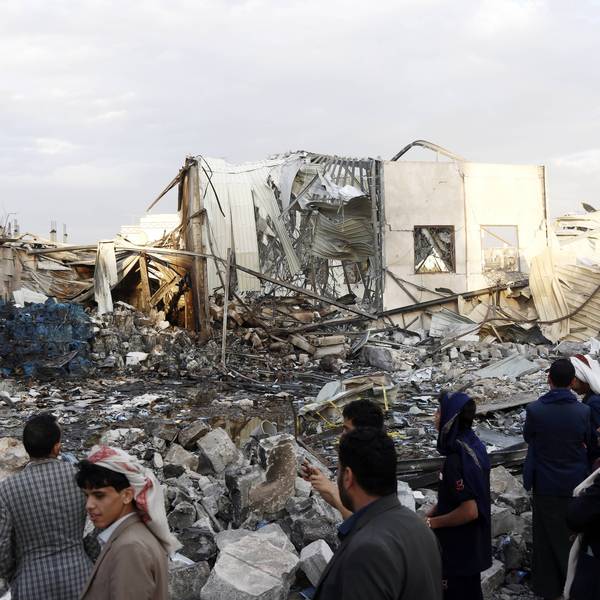
A US drone strike in Yemen killed two people described in corporate media as suspected al Qaeda militants on Sunday, the second such attack in the country in less than a week.
The strike hit a house in Wadi Adeeda in the Marib province, east of the capital, which was reportedly storing weapons.
Agence France-Presse adds: "A tribal source said the strike was followed by ground clashes in which two Yemeni soldiers and a militant were killed."
The two strikes in the past several days break a nearly three-month lull in US drone strikes on Yemen.
Following the April 17 drone strike on the Yemeni village of Wessab, Farea Al-Muslimi, a youth activist and writer originally from there, provided via Twitter a counter-narrative to the justifications of drone strikes.
In an op-ed in Al-Monitor the following day, he questions why a drone strike was necessary at all.
In an area like Wessab, there is nothing easier than capturing a man like al-Radmi. Two police officers would have been more than capable of arresting him. [...]
...was it really necessary to conduct an operation that costs hundreds of thousands of dollars, while two soldiers could have captured the target? [...]
If al-Radmi was a target, an arrest would have been simple. He was not some elusive figure, hiding far from the reach of the central authority. He lived a few hours from Sanaa and less than a kilometer away from government headquarters.
Al-Muslimi adds that "The 'collateral damage' of drones cannot just be measured in corpses," as they are counterproductive and are terrorizing and traumatizing a generation.
... it is tempting to conclude that the US has no interest in a measured response to terrorism. It is difficult not to think it doesn't matter to them whether they terrorize (and radicalize) entire populations as they check another name off their "kill list."
The Bureau of Investigative Journalism estimates that as many as 45 civilians have been killed by confirmed US drone strikes on Yemen since 2002.
An Urgent Message From Our Co-Founder
Dear Common Dreams reader, It’s been nearly 30 years since I co-founded Common Dreams with my late wife, Lina Newhouser. We had the radical notion that journalism should serve the public good, not corporate profits. It was clear to us from the outset what it would take to build such a project. No paid advertisements. No corporate sponsors. No millionaire publisher telling us what to think or do. Many people said we wouldn't last a year, but we proved those doubters wrong. Together with a tremendous team of journalists and dedicated staff, we built an independent media outlet free from the constraints of profits and corporate control. Our mission has always been simple: To inform. To inspire. To ignite change for the common good. Building Common Dreams was not easy. Our survival was never guaranteed. When you take on the most powerful forces—Wall Street greed, fossil fuel industry destruction, Big Tech lobbyists, and uber-rich oligarchs who have spent billions upon billions rigging the economy and democracy in their favor—the only bulwark you have is supporters who believe in your work. But here’s the urgent message from me today. It's never been this bad out there. And it's never been this hard to keep us going. At the very moment Common Dreams is most needed, the threats we face are intensifying. We need your support now more than ever. We don't accept corporate advertising and never will. We don't have a paywall because we don't think people should be blocked from critical news based on their ability to pay. Everything we do is funded by the donations of readers like you. When everyone does the little they can afford, we are strong. But if that support retreats or dries up, so do we. Will you donate now to make sure Common Dreams not only survives but thrives? —Craig Brown, Co-founder |
A US drone strike in Yemen killed two people described in corporate media as suspected al Qaeda militants on Sunday, the second such attack in the country in less than a week.
The strike hit a house in Wadi Adeeda in the Marib province, east of the capital, which was reportedly storing weapons.
Agence France-Presse adds: "A tribal source said the strike was followed by ground clashes in which two Yemeni soldiers and a militant were killed."
The two strikes in the past several days break a nearly three-month lull in US drone strikes on Yemen.
Following the April 17 drone strike on the Yemeni village of Wessab, Farea Al-Muslimi, a youth activist and writer originally from there, provided via Twitter a counter-narrative to the justifications of drone strikes.
In an op-ed in Al-Monitor the following day, he questions why a drone strike was necessary at all.
In an area like Wessab, there is nothing easier than capturing a man like al-Radmi. Two police officers would have been more than capable of arresting him. [...]
...was it really necessary to conduct an operation that costs hundreds of thousands of dollars, while two soldiers could have captured the target? [...]
If al-Radmi was a target, an arrest would have been simple. He was not some elusive figure, hiding far from the reach of the central authority. He lived a few hours from Sanaa and less than a kilometer away from government headquarters.
Al-Muslimi adds that "The 'collateral damage' of drones cannot just be measured in corpses," as they are counterproductive and are terrorizing and traumatizing a generation.
... it is tempting to conclude that the US has no interest in a measured response to terrorism. It is difficult not to think it doesn't matter to them whether they terrorize (and radicalize) entire populations as they check another name off their "kill list."
The Bureau of Investigative Journalism estimates that as many as 45 civilians have been killed by confirmed US drone strikes on Yemen since 2002.
A US drone strike in Yemen killed two people described in corporate media as suspected al Qaeda militants on Sunday, the second such attack in the country in less than a week.
The strike hit a house in Wadi Adeeda in the Marib province, east of the capital, which was reportedly storing weapons.
Agence France-Presse adds: "A tribal source said the strike was followed by ground clashes in which two Yemeni soldiers and a militant were killed."
The two strikes in the past several days break a nearly three-month lull in US drone strikes on Yemen.
Following the April 17 drone strike on the Yemeni village of Wessab, Farea Al-Muslimi, a youth activist and writer originally from there, provided via Twitter a counter-narrative to the justifications of drone strikes.
In an op-ed in Al-Monitor the following day, he questions why a drone strike was necessary at all.
In an area like Wessab, there is nothing easier than capturing a man like al-Radmi. Two police officers would have been more than capable of arresting him. [...]
...was it really necessary to conduct an operation that costs hundreds of thousands of dollars, while two soldiers could have captured the target? [...]
If al-Radmi was a target, an arrest would have been simple. He was not some elusive figure, hiding far from the reach of the central authority. He lived a few hours from Sanaa and less than a kilometer away from government headquarters.
Al-Muslimi adds that "The 'collateral damage' of drones cannot just be measured in corpses," as they are counterproductive and are terrorizing and traumatizing a generation.
... it is tempting to conclude that the US has no interest in a measured response to terrorism. It is difficult not to think it doesn't matter to them whether they terrorize (and radicalize) entire populations as they check another name off their "kill list."
The Bureau of Investigative Journalism estimates that as many as 45 civilians have been killed by confirmed US drone strikes on Yemen since 2002.