

SUBSCRIBE TO OUR FREE NEWSLETTER
Daily news & progressive opinion—funded by the people, not the corporations—delivered straight to your inbox.
5
#000000
#FFFFFF
To donate by check, phone, or other method, see our More Ways to Give page.
Daily news & progressive opinion—funded by the people, not the corporations—delivered straight to your inbox.
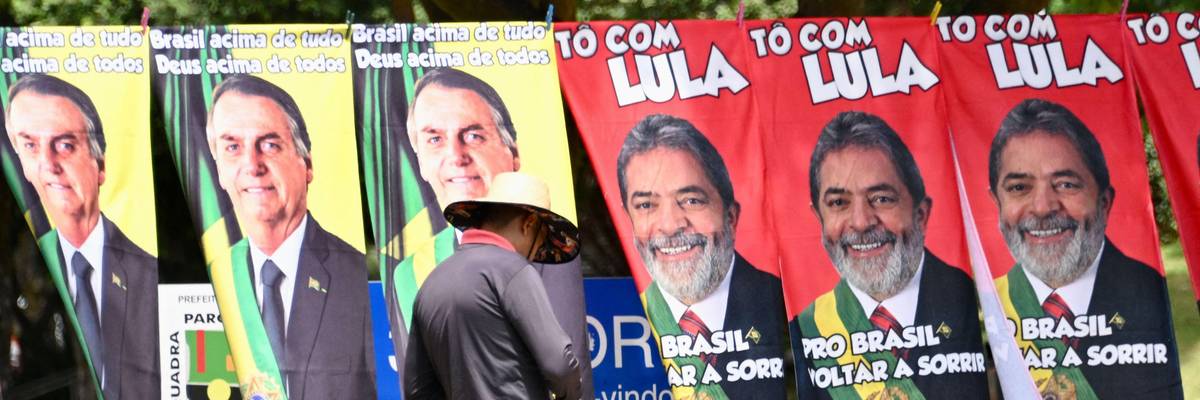
Towels with the images of presidential candidates Jair Bolsonaro and Luiz Inacio Lula da Silva are seen for sale at a street in Brasilia, on September 27, 2022. (Photo: Evaristo SA/AFP via Getty Images)
Authoritarianism, once seen as a trend to watch, can now be considered an invasive species. It has been on the rise in different parts of the globe, fueled, among other things, by anti-rights rhetoric that is pervasive, deceptive and coordinated, and made visible through disinformation campaigns, attacks on journalists and constant erosion of civic space. It continues to spread.
Brazilian civic space needs to be protected to ensure that journalists, activists and human rights defenders don't become an endangered species.
In Latin America, democracy has been rapidly deteriorating. In a meeting of freedom of expression groups during the COLPIN Forum 2021, civil society--including a majority of IFEX members--expressed serious concern with this situation, stating that "[t]he ascendancy of authoritarianisms, both right and left, has deepened in most of our countries, putting the foundations of democracy at stake. We have verified that, in the framework of the pandemic, these authoritarian expressions have been a source of manipulation and disinformation and have increased the practices of concealment and obstacles to access to information. In this framework, we can see the existence of regimes in the region, where the rule of law is practically non-existent and where a totalitarian logic prevails that asphyxiates any citizen expression. Journalism in exile has multiplied in the region."
Authoritarianism is not new to Latin America. It has followed the region's history and has recently re-emerged with strength as a response to voters showing frustration with old-school parties, particularly in countries plagued by corruption, insecurity and economic inequality. Tools provided by technology have catalyzed the reach and influence of a discourse that exploits these fears, offering shallow alternatives. The result are regimes characterized by individualistic and populistic leaders, the breaking of constitutional norms, and abuses of power.
Civil society has for long faced this long-standing threat. Maybe that is why Latin America is one of the regions in the world where the highest number of killings of journalists and human rights defenders has been reported. During January 2022 alone, 20 human rights defenders and four journalists were killed across the region. The numbers today are much higher.
It is in the midst of this regional and global context that, on October 2, Brazil elections will take place. The polls follow a fierce campaign that has had polarization at its center. Polarization has been fomented and augmented by tactics and techniques that build on the abusive use of new and emerging technology, but which weaponizes old narratives rooted in prejudice, racism, misogyny and a total non-acceptance of 'the other.' Values like diversity and plurality have been attacked, along with those who defend them.
The signs are clear--Brazil has been seeing a dramatic decline in civil liberties in the last years. During his current campaign, Bolsonaro is attacking institutions, discrediting the electoral process and fiercely promoting weaponization and guns. There is no doubt that the future of democracy in Brazil will be decided in early October.
Brazil, as Latin America's largest economy and the fourth-largest democracy in the world, is the canary in the coal mine, and one could argue that it is the future of global democracy that is at stake in the upcoming pools. Not only of democracy, but of human rights and environmental sustainability.
So, what's next for Brazil?
There is no simple answer to that question. Even if Bolsonaro is not re-elected, the challenges ahead are gigantic. But if he wins, the authoritarian project wins. And Brazil will become another pin in the map, an additional territory where the roots of authoritarianism grow deeper and more entrenched.
Brazilian civic space needs to be protected to ensure that journalists, activists and human rights defenders don't become an endangered species. We need to defend democracy by promoting freedom of expression and strengthening civil society.
Civil society groups and journalists have a critical role to play--they have been exposing and correcting weaponized disinformation that aims to mislead voters and suppress voting during elections in every region of the world.
In Brazil, IFEX members--the Brazilian Association for Investigative Journalism and Artigo19--have been working to ensure the safety of journalists, the right to protest, the right to information and the right to participation. They have, for example, requested presidential candidates' commitment to freedom of expression; they have been promoting fact-checking initiatives; have worked to incentive participation and information about the electoral process amongst the youth; and have promoted debate and discussion about issues central to our current democratic struggles, such as disinformation, hate speech, transparency, political violence and social media.
What they need now is our attention and support. They need to know they are not alone and that we will be watching the polls and their aftermath in early October. IFEX members throughout the region and beyond have shown their solidarity through a concerted social media campaign that calls to: #DefendJournalism #ProtectCivicSpace in Brazil. If not, the authoritarianism playbook will continue to proliferate across the map.
Don't be silent. Let's keep our eyes on Brazil and support the frontline work of those defending democracy. Join us in this call!
Dear Common Dreams reader, It’s been nearly 30 years since I co-founded Common Dreams with my late wife, Lina Newhouser. We had the radical notion that journalism should serve the public good, not corporate profits. It was clear to us from the outset what it would take to build such a project. No paid advertisements. No corporate sponsors. No millionaire publisher telling us what to think or do. Many people said we wouldn't last a year, but we proved those doubters wrong. Together with a tremendous team of journalists and dedicated staff, we built an independent media outlet free from the constraints of profits and corporate control. Our mission has always been simple: To inform. To inspire. To ignite change for the common good. Building Common Dreams was not easy. Our survival was never guaranteed. When you take on the most powerful forces—Wall Street greed, fossil fuel industry destruction, Big Tech lobbyists, and uber-rich oligarchs who have spent billions upon billions rigging the economy and democracy in their favor—the only bulwark you have is supporters who believe in your work. But here’s the urgent message from me today. It's never been this bad out there. And it's never been this hard to keep us going. At the very moment Common Dreams is most needed, the threats we face are intensifying. We need your support now more than ever. We don't accept corporate advertising and never will. We don't have a paywall because we don't think people should be blocked from critical news based on their ability to pay. Everything we do is funded by the donations of readers like you. When everyone does the little they can afford, we are strong. But if that support retreats or dries up, so do we. Will you donate now to make sure Common Dreams not only survives but thrives? —Craig Brown, Co-founder |
Authoritarianism, once seen as a trend to watch, can now be considered an invasive species. It has been on the rise in different parts of the globe, fueled, among other things, by anti-rights rhetoric that is pervasive, deceptive and coordinated, and made visible through disinformation campaigns, attacks on journalists and constant erosion of civic space. It continues to spread.
Brazilian civic space needs to be protected to ensure that journalists, activists and human rights defenders don't become an endangered species.
In Latin America, democracy has been rapidly deteriorating. In a meeting of freedom of expression groups during the COLPIN Forum 2021, civil society--including a majority of IFEX members--expressed serious concern with this situation, stating that "[t]he ascendancy of authoritarianisms, both right and left, has deepened in most of our countries, putting the foundations of democracy at stake. We have verified that, in the framework of the pandemic, these authoritarian expressions have been a source of manipulation and disinformation and have increased the practices of concealment and obstacles to access to information. In this framework, we can see the existence of regimes in the region, where the rule of law is practically non-existent and where a totalitarian logic prevails that asphyxiates any citizen expression. Journalism in exile has multiplied in the region."
Authoritarianism is not new to Latin America. It has followed the region's history and has recently re-emerged with strength as a response to voters showing frustration with old-school parties, particularly in countries plagued by corruption, insecurity and economic inequality. Tools provided by technology have catalyzed the reach and influence of a discourse that exploits these fears, offering shallow alternatives. The result are regimes characterized by individualistic and populistic leaders, the breaking of constitutional norms, and abuses of power.
Civil society has for long faced this long-standing threat. Maybe that is why Latin America is one of the regions in the world where the highest number of killings of journalists and human rights defenders has been reported. During January 2022 alone, 20 human rights defenders and four journalists were killed across the region. The numbers today are much higher.
It is in the midst of this regional and global context that, on October 2, Brazil elections will take place. The polls follow a fierce campaign that has had polarization at its center. Polarization has been fomented and augmented by tactics and techniques that build on the abusive use of new and emerging technology, but which weaponizes old narratives rooted in prejudice, racism, misogyny and a total non-acceptance of 'the other.' Values like diversity and plurality have been attacked, along with those who defend them.
The signs are clear--Brazil has been seeing a dramatic decline in civil liberties in the last years. During his current campaign, Bolsonaro is attacking institutions, discrediting the electoral process and fiercely promoting weaponization and guns. There is no doubt that the future of democracy in Brazil will be decided in early October.
Brazil, as Latin America's largest economy and the fourth-largest democracy in the world, is the canary in the coal mine, and one could argue that it is the future of global democracy that is at stake in the upcoming pools. Not only of democracy, but of human rights and environmental sustainability.
So, what's next for Brazil?
There is no simple answer to that question. Even if Bolsonaro is not re-elected, the challenges ahead are gigantic. But if he wins, the authoritarian project wins. And Brazil will become another pin in the map, an additional territory where the roots of authoritarianism grow deeper and more entrenched.
Brazilian civic space needs to be protected to ensure that journalists, activists and human rights defenders don't become an endangered species. We need to defend democracy by promoting freedom of expression and strengthening civil society.
Civil society groups and journalists have a critical role to play--they have been exposing and correcting weaponized disinformation that aims to mislead voters and suppress voting during elections in every region of the world.
In Brazil, IFEX members--the Brazilian Association for Investigative Journalism and Artigo19--have been working to ensure the safety of journalists, the right to protest, the right to information and the right to participation. They have, for example, requested presidential candidates' commitment to freedom of expression; they have been promoting fact-checking initiatives; have worked to incentive participation and information about the electoral process amongst the youth; and have promoted debate and discussion about issues central to our current democratic struggles, such as disinformation, hate speech, transparency, political violence and social media.
What they need now is our attention and support. They need to know they are not alone and that we will be watching the polls and their aftermath in early October. IFEX members throughout the region and beyond have shown their solidarity through a concerted social media campaign that calls to: #DefendJournalism #ProtectCivicSpace in Brazil. If not, the authoritarianism playbook will continue to proliferate across the map.
Don't be silent. Let's keep our eyes on Brazil and support the frontline work of those defending democracy. Join us in this call!
Authoritarianism, once seen as a trend to watch, can now be considered an invasive species. It has been on the rise in different parts of the globe, fueled, among other things, by anti-rights rhetoric that is pervasive, deceptive and coordinated, and made visible through disinformation campaigns, attacks on journalists and constant erosion of civic space. It continues to spread.
Brazilian civic space needs to be protected to ensure that journalists, activists and human rights defenders don't become an endangered species.
In Latin America, democracy has been rapidly deteriorating. In a meeting of freedom of expression groups during the COLPIN Forum 2021, civil society--including a majority of IFEX members--expressed serious concern with this situation, stating that "[t]he ascendancy of authoritarianisms, both right and left, has deepened in most of our countries, putting the foundations of democracy at stake. We have verified that, in the framework of the pandemic, these authoritarian expressions have been a source of manipulation and disinformation and have increased the practices of concealment and obstacles to access to information. In this framework, we can see the existence of regimes in the region, where the rule of law is practically non-existent and where a totalitarian logic prevails that asphyxiates any citizen expression. Journalism in exile has multiplied in the region."
Authoritarianism is not new to Latin America. It has followed the region's history and has recently re-emerged with strength as a response to voters showing frustration with old-school parties, particularly in countries plagued by corruption, insecurity and economic inequality. Tools provided by technology have catalyzed the reach and influence of a discourse that exploits these fears, offering shallow alternatives. The result are regimes characterized by individualistic and populistic leaders, the breaking of constitutional norms, and abuses of power.
Civil society has for long faced this long-standing threat. Maybe that is why Latin America is one of the regions in the world where the highest number of killings of journalists and human rights defenders has been reported. During January 2022 alone, 20 human rights defenders and four journalists were killed across the region. The numbers today are much higher.
It is in the midst of this regional and global context that, on October 2, Brazil elections will take place. The polls follow a fierce campaign that has had polarization at its center. Polarization has been fomented and augmented by tactics and techniques that build on the abusive use of new and emerging technology, but which weaponizes old narratives rooted in prejudice, racism, misogyny and a total non-acceptance of 'the other.' Values like diversity and plurality have been attacked, along with those who defend them.
The signs are clear--Brazil has been seeing a dramatic decline in civil liberties in the last years. During his current campaign, Bolsonaro is attacking institutions, discrediting the electoral process and fiercely promoting weaponization and guns. There is no doubt that the future of democracy in Brazil will be decided in early October.
Brazil, as Latin America's largest economy and the fourth-largest democracy in the world, is the canary in the coal mine, and one could argue that it is the future of global democracy that is at stake in the upcoming pools. Not only of democracy, but of human rights and environmental sustainability.
So, what's next for Brazil?
There is no simple answer to that question. Even if Bolsonaro is not re-elected, the challenges ahead are gigantic. But if he wins, the authoritarian project wins. And Brazil will become another pin in the map, an additional territory where the roots of authoritarianism grow deeper and more entrenched.
Brazilian civic space needs to be protected to ensure that journalists, activists and human rights defenders don't become an endangered species. We need to defend democracy by promoting freedom of expression and strengthening civil society.
Civil society groups and journalists have a critical role to play--they have been exposing and correcting weaponized disinformation that aims to mislead voters and suppress voting during elections in every region of the world.
In Brazil, IFEX members--the Brazilian Association for Investigative Journalism and Artigo19--have been working to ensure the safety of journalists, the right to protest, the right to information and the right to participation. They have, for example, requested presidential candidates' commitment to freedom of expression; they have been promoting fact-checking initiatives; have worked to incentive participation and information about the electoral process amongst the youth; and have promoted debate and discussion about issues central to our current democratic struggles, such as disinformation, hate speech, transparency, political violence and social media.
What they need now is our attention and support. They need to know they are not alone and that we will be watching the polls and their aftermath in early October. IFEX members throughout the region and beyond have shown their solidarity through a concerted social media campaign that calls to: #DefendJournalism #ProtectCivicSpace in Brazil. If not, the authoritarianism playbook will continue to proliferate across the map.
Don't be silent. Let's keep our eyes on Brazil and support the frontline work of those defending democracy. Join us in this call!

