SUBSCRIBE TO OUR FREE NEWSLETTER
Daily news & progressive opinion—funded by the people, not the corporations—delivered straight to your inbox.
5
#000000
#FFFFFF
To donate by check, phone, or other method, see our More Ways to Give page.
Daily news & progressive opinion—funded by the people, not the corporations—delivered straight to your inbox.
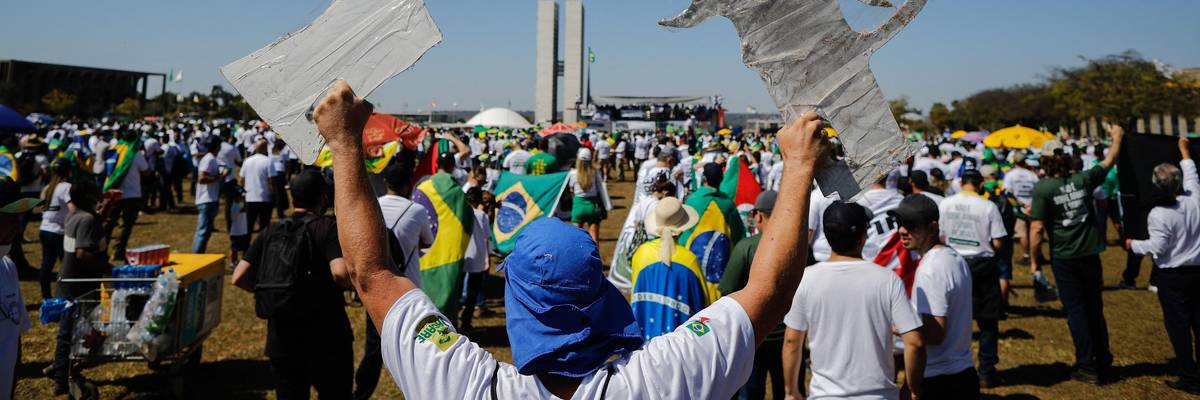
A man holds two signals in the shape of a gun during a pro-gun demonstration in support of Brazilian President Jair Bolsonaro in Brasilia, on July 9, 2021. (Photo: Sergio Lima /AFP via Getty Images)
When doing fieldwork for my book on Brazilian social movements in 2010, I heard many people express a kind of qualified support for the outgoing Luiz Inacio Lula da Silva administration.
Lofty goals, from eradicating hunger, to challenging US-backed free-market reforms, propelled the former steelworker and labor leader into power when first elected in 2002. Not dashing such hopes, his government performed well over two consecutive terms, cutting extreme poverty, halting the destruction of the Amazon, and overseeing eight continuous years of economic growth, despite serving while an extensive vote-buying scandal took place and his administration reaped the financial benefits of a commodity export boom that did nothing to oppose U.S. economic prescriptions.
Even though Lula left power with a high approval rating, Brazilians were still seeking a leader to confront issues such as corruption.
Bolsonaro has normalized violence in ways that are unhealthy for democracy.
Fast forward to 2022, and Lula is again riding a wave of support in his bid to serve a third time as Brazil's President. Elections are slated for October 2nd.
This time, however, his support is based more on fear than hope.
The source of this fear is Jair Bolsonaro, the rightwing incumbent, who since winning the Presidential election in 2018, has normalized violence in ways that are unhealthy for democracy.
For instance, Bolsonaro has praised the Brazilian military dictatorship that tortured and disappeared leftists when in power from 1964 to 1985. Legislatively, he has supported efforts to liberalize gun ownership. Openly ridiculing LGBTQ+ Brazilians has also been part of Bolsonaro's vitriolic communication practices. Jean Wyllys, Brazil's first openly gay congressperson, resigned from Congress and fled the country in 2019 after receiving death threats from Bolsonaro supporters. Meanwhile, over the past four years, the right-wing politician's adherents have routinely practiced politically-motivated violence to intimidate opponents.
Bolsonaro did not make Brazil violent, as much as stoke existing anxieties and divisions.
For instance, armed confrontations between gangs of armed drug traffickers have been a problem in the country for decades. The police, facing such problems, often resorted to torture and killing, especially of lower-income, Afro-Brazilians who live in the urban periphery. Middle-class Brazilians sought to protect themselves by contracting private security forces in their neighborhoods and for their businesses. Bolsonaro counted on their support in 2018.
Brazil's economic elite, who back Bolsonaro due to his privatization agenda and lax enforcement of environmental laws in the Amazon, have historically used violence to forward their interests.
Large landowners specifically have killed social movement activists who stood in the way of their economic agendas. High profile killings include the labor organizer, Chico Mendes in 1988, as well as the American nun, Dorothy Stang, in 2005.
Blaming the left not only for political reaons but for what he sees as cultural corruption, Bolsonaro received support in his bid for the presidency in 2018 from Brazil's growing Evangelical Christian community. Upwards of 1/3 of the country's population as of 2022, 70% Evangelicals voted for Bolsonaro in 2018. Despite seeing his support among this religious group drop, many still see him as tough on crime, a supporter of traditional family values, and dedicated to rooting out corruption.
Bolsonaro became an outspoken figure concerning corruption during the impeachment, and subsequent removal of Lula's successor, Dilma Rousseff in 2016. In uncovering the largest corruption scandal in Brazilian history, Operation Car Wash (Operacao Lava Jato), discovered a system of kickbacks between Brazilian politicians and officials in the state-run oil company, Petrobras. Never finding evidence tying Dilma to the scandal did not stop Bolsonaro from doing so, leading to her ouster as he portrayed himself as a crusader for law and order.
Overall, Bolsonaro's initiatives have not succeeded. Corruption has worsened since 2018, with Bolsonaro himself under investigation, as members of his cabinet have been arrested for graft. The country's murder rate has fallen, but this trend began before taking power, and is attributed to drug gang professionalization and information-sharing between police forces. Furthermore, many grew disaffected with Bolsonaro's botched response to the COVID-19 pandemic, with Brazil experiencing the second highest number of deaths in absolute terms.
The other issue is with the normalization of violence within Brazilian society.
Democracy is built on controlled conflict, that is, parties compete with one another for power in elections. The deal among participants is that winners take power, as losers agree to try again later.
When violence in addition to the ballot becomes a tool to seek power, the agreement between competitors breaks down. If violence is normalized enough, then the actions of politicians are mirrored by their supporters.
Such dynamics are currently on display in the US. Here, Trump's vitriolic, violent rhetoric on the campaign trail and throughout his time in power played no small part surrounding the events that took place in Charlottesville in 2017 and motivating people to take part in the January 6th insurrection.
In Brazil, the political violence has a much deeper history. Those that support its use, also, are more prevalent in civil society. Those in Bolsonaro's camp are quite comfortable with its use.
The danger for democracy is not the prospect of a potential military coup, however unlikely, in the event of a Bolsonaro loss. The deeper problem is if groups see problem resolution and political expression as best done through the barrel of a gun, instead of by means of discussion. Returning Lula to power through a legitimate electoral victory may not resolve Brazil's long, troubled history with violence. But in blocking Bolsonaro from returning to office, Lula's return will give Brazilian society some space to heal and move forward.
Dear Common Dreams reader, It’s been nearly 30 years since I co-founded Common Dreams with my late wife, Lina Newhouser. We had the radical notion that journalism should serve the public good, not corporate profits. It was clear to us from the outset what it would take to build such a project. No paid advertisements. No corporate sponsors. No millionaire publisher telling us what to think or do. Many people said we wouldn't last a year, but we proved those doubters wrong. Together with a tremendous team of journalists and dedicated staff, we built an independent media outlet free from the constraints of profits and corporate control. Our mission has always been simple: To inform. To inspire. To ignite change for the common good. Building Common Dreams was not easy. Our survival was never guaranteed. When you take on the most powerful forces—Wall Street greed, fossil fuel industry destruction, Big Tech lobbyists, and uber-rich oligarchs who have spent billions upon billions rigging the economy and democracy in their favor—the only bulwark you have is supporters who believe in your work. But here’s the urgent message from me today. It's never been this bad out there. And it's never been this hard to keep us going. At the very moment Common Dreams is most needed, the threats we face are intensifying. We need your support now more than ever. We don't accept corporate advertising and never will. We don't have a paywall because we don't think people should be blocked from critical news based on their ability to pay. Everything we do is funded by the donations of readers like you. When everyone does the little they can afford, we are strong. But if that support retreats or dries up, so do we. Will you donate now to make sure Common Dreams not only survives but thrives? —Craig Brown, Co-founder |
When doing fieldwork for my book on Brazilian social movements in 2010, I heard many people express a kind of qualified support for the outgoing Luiz Inacio Lula da Silva administration.
Lofty goals, from eradicating hunger, to challenging US-backed free-market reforms, propelled the former steelworker and labor leader into power when first elected in 2002. Not dashing such hopes, his government performed well over two consecutive terms, cutting extreme poverty, halting the destruction of the Amazon, and overseeing eight continuous years of economic growth, despite serving while an extensive vote-buying scandal took place and his administration reaped the financial benefits of a commodity export boom that did nothing to oppose U.S. economic prescriptions.
Even though Lula left power with a high approval rating, Brazilians were still seeking a leader to confront issues such as corruption.
Bolsonaro has normalized violence in ways that are unhealthy for democracy.
Fast forward to 2022, and Lula is again riding a wave of support in his bid to serve a third time as Brazil's President. Elections are slated for October 2nd.
This time, however, his support is based more on fear than hope.
The source of this fear is Jair Bolsonaro, the rightwing incumbent, who since winning the Presidential election in 2018, has normalized violence in ways that are unhealthy for democracy.
For instance, Bolsonaro has praised the Brazilian military dictatorship that tortured and disappeared leftists when in power from 1964 to 1985. Legislatively, he has supported efforts to liberalize gun ownership. Openly ridiculing LGBTQ+ Brazilians has also been part of Bolsonaro's vitriolic communication practices. Jean Wyllys, Brazil's first openly gay congressperson, resigned from Congress and fled the country in 2019 after receiving death threats from Bolsonaro supporters. Meanwhile, over the past four years, the right-wing politician's adherents have routinely practiced politically-motivated violence to intimidate opponents.
Bolsonaro did not make Brazil violent, as much as stoke existing anxieties and divisions.
For instance, armed confrontations between gangs of armed drug traffickers have been a problem in the country for decades. The police, facing such problems, often resorted to torture and killing, especially of lower-income, Afro-Brazilians who live in the urban periphery. Middle-class Brazilians sought to protect themselves by contracting private security forces in their neighborhoods and for their businesses. Bolsonaro counted on their support in 2018.
Brazil's economic elite, who back Bolsonaro due to his privatization agenda and lax enforcement of environmental laws in the Amazon, have historically used violence to forward their interests.
Large landowners specifically have killed social movement activists who stood in the way of their economic agendas. High profile killings include the labor organizer, Chico Mendes in 1988, as well as the American nun, Dorothy Stang, in 2005.
Blaming the left not only for political reaons but for what he sees as cultural corruption, Bolsonaro received support in his bid for the presidency in 2018 from Brazil's growing Evangelical Christian community. Upwards of 1/3 of the country's population as of 2022, 70% Evangelicals voted for Bolsonaro in 2018. Despite seeing his support among this religious group drop, many still see him as tough on crime, a supporter of traditional family values, and dedicated to rooting out corruption.
Bolsonaro became an outspoken figure concerning corruption during the impeachment, and subsequent removal of Lula's successor, Dilma Rousseff in 2016. In uncovering the largest corruption scandal in Brazilian history, Operation Car Wash (Operacao Lava Jato), discovered a system of kickbacks between Brazilian politicians and officials in the state-run oil company, Petrobras. Never finding evidence tying Dilma to the scandal did not stop Bolsonaro from doing so, leading to her ouster as he portrayed himself as a crusader for law and order.
Overall, Bolsonaro's initiatives have not succeeded. Corruption has worsened since 2018, with Bolsonaro himself under investigation, as members of his cabinet have been arrested for graft. The country's murder rate has fallen, but this trend began before taking power, and is attributed to drug gang professionalization and information-sharing between police forces. Furthermore, many grew disaffected with Bolsonaro's botched response to the COVID-19 pandemic, with Brazil experiencing the second highest number of deaths in absolute terms.
The other issue is with the normalization of violence within Brazilian society.
Democracy is built on controlled conflict, that is, parties compete with one another for power in elections. The deal among participants is that winners take power, as losers agree to try again later.
When violence in addition to the ballot becomes a tool to seek power, the agreement between competitors breaks down. If violence is normalized enough, then the actions of politicians are mirrored by their supporters.
Such dynamics are currently on display in the US. Here, Trump's vitriolic, violent rhetoric on the campaign trail and throughout his time in power played no small part surrounding the events that took place in Charlottesville in 2017 and motivating people to take part in the January 6th insurrection.
In Brazil, the political violence has a much deeper history. Those that support its use, also, are more prevalent in civil society. Those in Bolsonaro's camp are quite comfortable with its use.
The danger for democracy is not the prospect of a potential military coup, however unlikely, in the event of a Bolsonaro loss. The deeper problem is if groups see problem resolution and political expression as best done through the barrel of a gun, instead of by means of discussion. Returning Lula to power through a legitimate electoral victory may not resolve Brazil's long, troubled history with violence. But in blocking Bolsonaro from returning to office, Lula's return will give Brazilian society some space to heal and move forward.
When doing fieldwork for my book on Brazilian social movements in 2010, I heard many people express a kind of qualified support for the outgoing Luiz Inacio Lula da Silva administration.
Lofty goals, from eradicating hunger, to challenging US-backed free-market reforms, propelled the former steelworker and labor leader into power when first elected in 2002. Not dashing such hopes, his government performed well over two consecutive terms, cutting extreme poverty, halting the destruction of the Amazon, and overseeing eight continuous years of economic growth, despite serving while an extensive vote-buying scandal took place and his administration reaped the financial benefits of a commodity export boom that did nothing to oppose U.S. economic prescriptions.
Even though Lula left power with a high approval rating, Brazilians were still seeking a leader to confront issues such as corruption.
Bolsonaro has normalized violence in ways that are unhealthy for democracy.
Fast forward to 2022, and Lula is again riding a wave of support in his bid to serve a third time as Brazil's President. Elections are slated for October 2nd.
This time, however, his support is based more on fear than hope.
The source of this fear is Jair Bolsonaro, the rightwing incumbent, who since winning the Presidential election in 2018, has normalized violence in ways that are unhealthy for democracy.
For instance, Bolsonaro has praised the Brazilian military dictatorship that tortured and disappeared leftists when in power from 1964 to 1985. Legislatively, he has supported efforts to liberalize gun ownership. Openly ridiculing LGBTQ+ Brazilians has also been part of Bolsonaro's vitriolic communication practices. Jean Wyllys, Brazil's first openly gay congressperson, resigned from Congress and fled the country in 2019 after receiving death threats from Bolsonaro supporters. Meanwhile, over the past four years, the right-wing politician's adherents have routinely practiced politically-motivated violence to intimidate opponents.
Bolsonaro did not make Brazil violent, as much as stoke existing anxieties and divisions.
For instance, armed confrontations between gangs of armed drug traffickers have been a problem in the country for decades. The police, facing such problems, often resorted to torture and killing, especially of lower-income, Afro-Brazilians who live in the urban periphery. Middle-class Brazilians sought to protect themselves by contracting private security forces in their neighborhoods and for their businesses. Bolsonaro counted on their support in 2018.
Brazil's economic elite, who back Bolsonaro due to his privatization agenda and lax enforcement of environmental laws in the Amazon, have historically used violence to forward their interests.
Large landowners specifically have killed social movement activists who stood in the way of their economic agendas. High profile killings include the labor organizer, Chico Mendes in 1988, as well as the American nun, Dorothy Stang, in 2005.
Blaming the left not only for political reaons but for what he sees as cultural corruption, Bolsonaro received support in his bid for the presidency in 2018 from Brazil's growing Evangelical Christian community. Upwards of 1/3 of the country's population as of 2022, 70% Evangelicals voted for Bolsonaro in 2018. Despite seeing his support among this religious group drop, many still see him as tough on crime, a supporter of traditional family values, and dedicated to rooting out corruption.
Bolsonaro became an outspoken figure concerning corruption during the impeachment, and subsequent removal of Lula's successor, Dilma Rousseff in 2016. In uncovering the largest corruption scandal in Brazilian history, Operation Car Wash (Operacao Lava Jato), discovered a system of kickbacks between Brazilian politicians and officials in the state-run oil company, Petrobras. Never finding evidence tying Dilma to the scandal did not stop Bolsonaro from doing so, leading to her ouster as he portrayed himself as a crusader for law and order.
Overall, Bolsonaro's initiatives have not succeeded. Corruption has worsened since 2018, with Bolsonaro himself under investigation, as members of his cabinet have been arrested for graft. The country's murder rate has fallen, but this trend began before taking power, and is attributed to drug gang professionalization and information-sharing between police forces. Furthermore, many grew disaffected with Bolsonaro's botched response to the COVID-19 pandemic, with Brazil experiencing the second highest number of deaths in absolute terms.
The other issue is with the normalization of violence within Brazilian society.
Democracy is built on controlled conflict, that is, parties compete with one another for power in elections. The deal among participants is that winners take power, as losers agree to try again later.
When violence in addition to the ballot becomes a tool to seek power, the agreement between competitors breaks down. If violence is normalized enough, then the actions of politicians are mirrored by their supporters.
Such dynamics are currently on display in the US. Here, Trump's vitriolic, violent rhetoric on the campaign trail and throughout his time in power played no small part surrounding the events that took place in Charlottesville in 2017 and motivating people to take part in the January 6th insurrection.
In Brazil, the political violence has a much deeper history. Those that support its use, also, are more prevalent in civil society. Those in Bolsonaro's camp are quite comfortable with its use.
The danger for democracy is not the prospect of a potential military coup, however unlikely, in the event of a Bolsonaro loss. The deeper problem is if groups see problem resolution and political expression as best done through the barrel of a gun, instead of by means of discussion. Returning Lula to power through a legitimate electoral victory may not resolve Brazil's long, troubled history with violence. But in blocking Bolsonaro from returning to office, Lula's return will give Brazilian society some space to heal and move forward.