SUBSCRIBE TO OUR FREE NEWSLETTER
Daily news & progressive opinion—funded by the people, not the corporations—delivered straight to your inbox.
5
#000000
#FFFFFF
To donate by check, phone, or other method, see our More Ways to Give page.
Daily news & progressive opinion—funded by the people, not the corporations—delivered straight to your inbox.
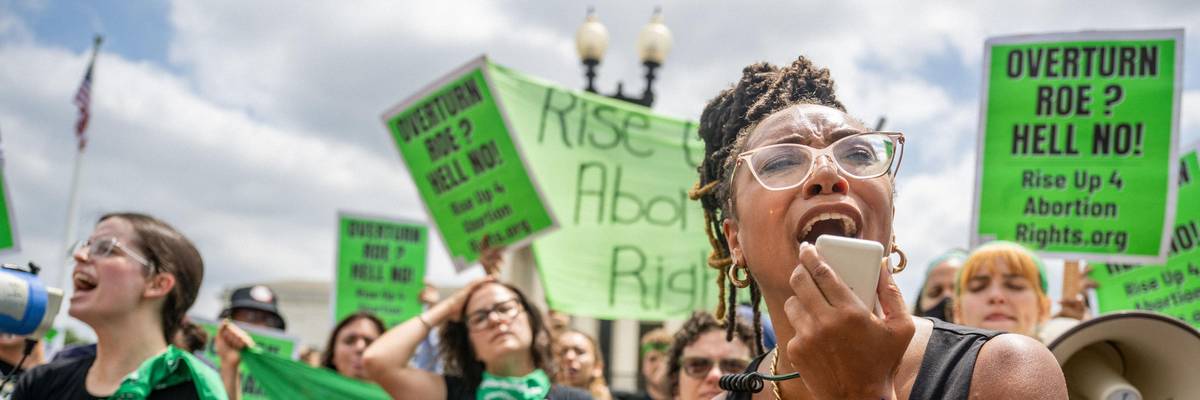
Abortion rights demonstrator Elizabeth White leads a chant in response to the Dobbs v Jackson Women's Health Organization ruling in front of the U.S. Supreme Court on June 24, 2022 in Washington, DC. (Photo: Brandon Bell/Getty Images)
Since the Supreme Court overturned Roe v. Wade, as we long feared, we've been forced to navigate a new legal landscape. The terrain for people seeking abortions is changing almost daily, and abortion care is increasingly threatened for more communities. In this new era, increased attention has been paid to when the "wave" of criminalization will begin for those providing or seeking abortion care. Prosecutors have declared they won't enforce laws and journalists have reported on possible police surveillance of period tracker apps. Yet, these responses are disconnected from what reproductive rights and justice advocates know about criminalization, and they are out of line with what I found in my research.
Over the last decade, I've been steeped in research and advocacy challenging the criminalization of people for pregnancy outcomes and self-managed abortions - abortions managed outside of the medical system. While abortion medication made self-managed abortions more accessible and safer, criminalization has always been an issue.
In fact, over the last two years, I've documented 61 cases from the years 2000 to 2020 in which people have been criminally investigated or arrested for self-managing their own abortion or helping someone else do so; the majority of these cases exclusively involved abortion medication. Our team analyzed publicly-reported case details to better understand exactly how the criminalization of self-managed abortion happens.
We've understood for years what it looks like when people are stigmatized for their healthcare decisions and what it means when the criminal system intervenes in this process. The future of abortion criminalization is an extension of our current criminal system, one built on injustice that dehumanizes people at every turn.
The criminalization of self-managed abortion reinforces that the criminal system targets those already experiencing unjust and racist societal structures. People who are already targets of state violence because of their race, income status, or being further along in their pregnancy have been the main targets of the 61 investigations we've documented. These communities are and have been most at risk for being restricted from accessing clinical care because of law or policy.
Though there has been a lot of focus on period tracker apps in recent months, we didn't find a single instance of an app like that being used in a case. This doesn't imply that state surveillance of data isn't a cause for concern, but what we've seen is that even less sophisticated forms of data and technology - text messages and Google histories - were wielded as evidence in some of these cases.
Instead, the biggest privacy threat is other people. Law enforcement were most often contacted by healthcare professionals - people that individuals reached out to when they were in need of care during or after their abortions. This breakdown of trust and ethics in these patient-doctor relationships is alarming. When healthcare workers police their patients, it can instill fear and push them away from care.
Investigations occurred in 26 states despite the fact that only seven states historically criminalized self-managed abortion; today that number is just three (Nevada, South Carolina, and Oklahoma). This means that overzealous police and prosecutors have circumvented the law's parameters in many states, subtly using criminal laws not meant to apply to allegations of self-managed abortion. Strikingly, regardless of whether these became the final charges, law enforcement considered applying murder or homicide charges in 43% of all 61 cases. These considerations happened twice as frequently in cases involving people of color compared to non-Hispanic white individuals. Racism and stigma infiltrated these investigations and further entrenched them in a crushing criminal process.
Ultimately, the majority of cases proceeded and most often concluded in a guilty plea - unsurprising given how most cases are resolved in the criminal system. But almost a quarter of the cases were dropped or dismissed by either the prosecutor or court. This should motivate advocates and trained criminal defenders to force a review of the charges so clients aren't wrongly convicted.
For anyone entangled in the criminal process, the harm lasts. Conviction or not, several people lost custody of their children temporarily or permanently. In one case, while local authorities declined to prosecute the woman after acknowledging the self-managed abortion was not unlawful, they still turned her over to immigration authorities for deportation.
Criminalization of self-managed abortion has already altered the lives of so many families. Because of abortion stigma, state actors have used their power to funnel people into systems of surveillance and control. The cases from the last twenty years show us what happens when racist and unjust systems take hold of abortion legality. Today, in the absence of Roe, as we are likely to see more and more cases of abortion criminalization, the law still matters and advocates must demand its full protection.
Dear Common Dreams reader, It’s been nearly 30 years since I co-founded Common Dreams with my late wife, Lina Newhouser. We had the radical notion that journalism should serve the public good, not corporate profits. It was clear to us from the outset what it would take to build such a project. No paid advertisements. No corporate sponsors. No millionaire publisher telling us what to think or do. Many people said we wouldn't last a year, but we proved those doubters wrong. Together with a tremendous team of journalists and dedicated staff, we built an independent media outlet free from the constraints of profits and corporate control. Our mission has always been simple: To inform. To inspire. To ignite change for the common good. Building Common Dreams was not easy. Our survival was never guaranteed. When you take on the most powerful forces—Wall Street greed, fossil fuel industry destruction, Big Tech lobbyists, and uber-rich oligarchs who have spent billions upon billions rigging the economy and democracy in their favor—the only bulwark you have is supporters who believe in your work. But here’s the urgent message from me today. It's never been this bad out there. And it's never been this hard to keep us going. At the very moment Common Dreams is most needed, the threats we face are intensifying. We need your support now more than ever. We don't accept corporate advertising and never will. We don't have a paywall because we don't think people should be blocked from critical news based on their ability to pay. Everything we do is funded by the donations of readers like you. When everyone does the little they can afford, we are strong. But if that support retreats or dries up, so do we. Will you donate now to make sure Common Dreams not only survives but thrives? —Craig Brown, Co-founder |
Since the Supreme Court overturned Roe v. Wade, as we long feared, we've been forced to navigate a new legal landscape. The terrain for people seeking abortions is changing almost daily, and abortion care is increasingly threatened for more communities. In this new era, increased attention has been paid to when the "wave" of criminalization will begin for those providing or seeking abortion care. Prosecutors have declared they won't enforce laws and journalists have reported on possible police surveillance of period tracker apps. Yet, these responses are disconnected from what reproductive rights and justice advocates know about criminalization, and they are out of line with what I found in my research.
Over the last decade, I've been steeped in research and advocacy challenging the criminalization of people for pregnancy outcomes and self-managed abortions - abortions managed outside of the medical system. While abortion medication made self-managed abortions more accessible and safer, criminalization has always been an issue.
In fact, over the last two years, I've documented 61 cases from the years 2000 to 2020 in which people have been criminally investigated or arrested for self-managing their own abortion or helping someone else do so; the majority of these cases exclusively involved abortion medication. Our team analyzed publicly-reported case details to better understand exactly how the criminalization of self-managed abortion happens.
We've understood for years what it looks like when people are stigmatized for their healthcare decisions and what it means when the criminal system intervenes in this process. The future of abortion criminalization is an extension of our current criminal system, one built on injustice that dehumanizes people at every turn.
The criminalization of self-managed abortion reinforces that the criminal system targets those already experiencing unjust and racist societal structures. People who are already targets of state violence because of their race, income status, or being further along in their pregnancy have been the main targets of the 61 investigations we've documented. These communities are and have been most at risk for being restricted from accessing clinical care because of law or policy.
Though there has been a lot of focus on period tracker apps in recent months, we didn't find a single instance of an app like that being used in a case. This doesn't imply that state surveillance of data isn't a cause for concern, but what we've seen is that even less sophisticated forms of data and technology - text messages and Google histories - were wielded as evidence in some of these cases.
Instead, the biggest privacy threat is other people. Law enforcement were most often contacted by healthcare professionals - people that individuals reached out to when they were in need of care during or after their abortions. This breakdown of trust and ethics in these patient-doctor relationships is alarming. When healthcare workers police their patients, it can instill fear and push them away from care.
Investigations occurred in 26 states despite the fact that only seven states historically criminalized self-managed abortion; today that number is just three (Nevada, South Carolina, and Oklahoma). This means that overzealous police and prosecutors have circumvented the law's parameters in many states, subtly using criminal laws not meant to apply to allegations of self-managed abortion. Strikingly, regardless of whether these became the final charges, law enforcement considered applying murder or homicide charges in 43% of all 61 cases. These considerations happened twice as frequently in cases involving people of color compared to non-Hispanic white individuals. Racism and stigma infiltrated these investigations and further entrenched them in a crushing criminal process.
Ultimately, the majority of cases proceeded and most often concluded in a guilty plea - unsurprising given how most cases are resolved in the criminal system. But almost a quarter of the cases were dropped or dismissed by either the prosecutor or court. This should motivate advocates and trained criminal defenders to force a review of the charges so clients aren't wrongly convicted.
For anyone entangled in the criminal process, the harm lasts. Conviction or not, several people lost custody of their children temporarily or permanently. In one case, while local authorities declined to prosecute the woman after acknowledging the self-managed abortion was not unlawful, they still turned her over to immigration authorities for deportation.
Criminalization of self-managed abortion has already altered the lives of so many families. Because of abortion stigma, state actors have used their power to funnel people into systems of surveillance and control. The cases from the last twenty years show us what happens when racist and unjust systems take hold of abortion legality. Today, in the absence of Roe, as we are likely to see more and more cases of abortion criminalization, the law still matters and advocates must demand its full protection.
Since the Supreme Court overturned Roe v. Wade, as we long feared, we've been forced to navigate a new legal landscape. The terrain for people seeking abortions is changing almost daily, and abortion care is increasingly threatened for more communities. In this new era, increased attention has been paid to when the "wave" of criminalization will begin for those providing or seeking abortion care. Prosecutors have declared they won't enforce laws and journalists have reported on possible police surveillance of period tracker apps. Yet, these responses are disconnected from what reproductive rights and justice advocates know about criminalization, and they are out of line with what I found in my research.
Over the last decade, I've been steeped in research and advocacy challenging the criminalization of people for pregnancy outcomes and self-managed abortions - abortions managed outside of the medical system. While abortion medication made self-managed abortions more accessible and safer, criminalization has always been an issue.
In fact, over the last two years, I've documented 61 cases from the years 2000 to 2020 in which people have been criminally investigated or arrested for self-managing their own abortion or helping someone else do so; the majority of these cases exclusively involved abortion medication. Our team analyzed publicly-reported case details to better understand exactly how the criminalization of self-managed abortion happens.
We've understood for years what it looks like when people are stigmatized for their healthcare decisions and what it means when the criminal system intervenes in this process. The future of abortion criminalization is an extension of our current criminal system, one built on injustice that dehumanizes people at every turn.
The criminalization of self-managed abortion reinforces that the criminal system targets those already experiencing unjust and racist societal structures. People who are already targets of state violence because of their race, income status, or being further along in their pregnancy have been the main targets of the 61 investigations we've documented. These communities are and have been most at risk for being restricted from accessing clinical care because of law or policy.
Though there has been a lot of focus on period tracker apps in recent months, we didn't find a single instance of an app like that being used in a case. This doesn't imply that state surveillance of data isn't a cause for concern, but what we've seen is that even less sophisticated forms of data and technology - text messages and Google histories - were wielded as evidence in some of these cases.
Instead, the biggest privacy threat is other people. Law enforcement were most often contacted by healthcare professionals - people that individuals reached out to when they were in need of care during or after their abortions. This breakdown of trust and ethics in these patient-doctor relationships is alarming. When healthcare workers police their patients, it can instill fear and push them away from care.
Investigations occurred in 26 states despite the fact that only seven states historically criminalized self-managed abortion; today that number is just three (Nevada, South Carolina, and Oklahoma). This means that overzealous police and prosecutors have circumvented the law's parameters in many states, subtly using criminal laws not meant to apply to allegations of self-managed abortion. Strikingly, regardless of whether these became the final charges, law enforcement considered applying murder or homicide charges in 43% of all 61 cases. These considerations happened twice as frequently in cases involving people of color compared to non-Hispanic white individuals. Racism and stigma infiltrated these investigations and further entrenched them in a crushing criminal process.
Ultimately, the majority of cases proceeded and most often concluded in a guilty plea - unsurprising given how most cases are resolved in the criminal system. But almost a quarter of the cases were dropped or dismissed by either the prosecutor or court. This should motivate advocates and trained criminal defenders to force a review of the charges so clients aren't wrongly convicted.
For anyone entangled in the criminal process, the harm lasts. Conviction or not, several people lost custody of their children temporarily or permanently. In one case, while local authorities declined to prosecute the woman after acknowledging the self-managed abortion was not unlawful, they still turned her over to immigration authorities for deportation.
Criminalization of self-managed abortion has already altered the lives of so many families. Because of abortion stigma, state actors have used their power to funnel people into systems of surveillance and control. The cases from the last twenty years show us what happens when racist and unjust systems take hold of abortion legality. Today, in the absence of Roe, as we are likely to see more and more cases of abortion criminalization, the law still matters and advocates must demand its full protection.