SUBSCRIBE TO OUR FREE NEWSLETTER
Daily news & progressive opinion—funded by the people, not the corporations—delivered straight to your inbox.
5
#000000
#FFFFFF
To donate by check, phone, or other method, see our More Ways to Give page.


Daily news & progressive opinion—funded by the people, not the corporations—delivered straight to your inbox.

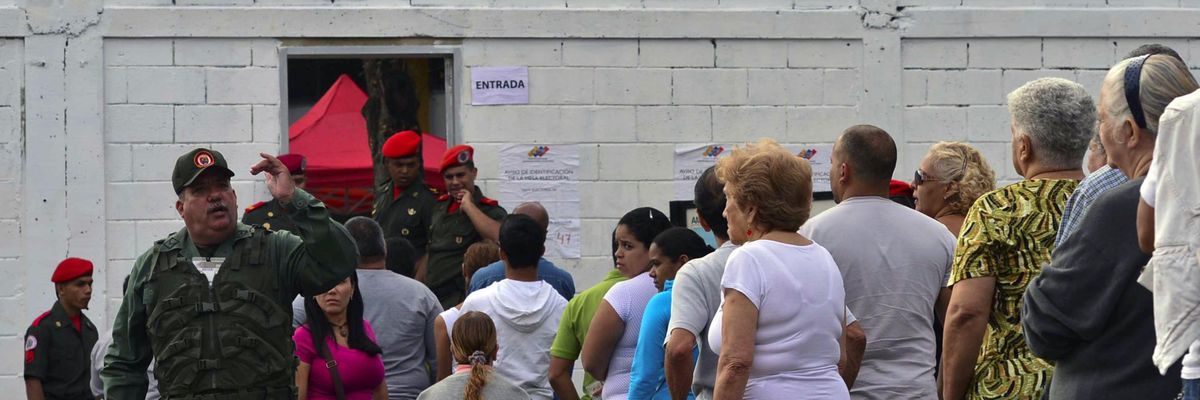
Venezuelans line up to vote at a Caracas polling station on election day. (Photo: Globovision/flickr/cc)
Last month I followed Colombia's elections very closely. Unlike many of my countrymen, I'm very passionate about the history and affairs of our closest neighbor. To be completely honest, I thought Petro was not going to make it.
How can voters be convinced, or regained, with the wear and tear that comes with 20 years in power? And is this still Hugo Chavez's political project?
Weeks later, I'm still happy as well as convinced that his triumph would not have been possible without his running mate. Francia Marquez is an Afro-Colombian activist who was born into poverty in the Cauca region, took the fight to mining corporations and is now in the Narino Presidential Palace.
Up next, the elections in Brazil are circled on my calendar. Lula's campaign has a "back to the future" vibe to it, it's a great reminder that politics, like life itself, can be full of surprises. The unexpected might be just around the corner.
Some suggest Lula's second go-round will be tougher, that he will be forced into making concessions, etc. But I think there are reasons to be hopeful. There's a horizon that becomes clearer as the Bolsonaro nightmare comes to an end.
But then, like a bad omen, a specific date pops up in my head: 2024. That year, barring unforeseen circumstances, Venezuela will hold its most unpredictable presidential elections ever. It's even hard to picture them.
In recent weeks, I've started to pay more attention to opinion polls. Two in particular stood out to me, the ones by Datincorp and Delphos (though I know they have a historical anti-Chavista bias). The former stated that 63 percent of those polled want a president that is neither from Chavista or opposition ranks. The latter claimed 48.3 percent don't trust any political party.
The data rang familiar. Yet 10 years ago, 80 percent of Venezuelans identified either as opposition or (mostly) Chavista. More than that, the battle lines were clear and we were determined to defend our trench. That is hardly the case today, certainly not with a similar intensity.
One way or another, it seems most people have the same immediate goals: securing minimal conditions to live peacefully. In such a scenario, many analysts see fertile ground for the emergence of an "independent" or "outsider" figure, which usually are hardly one thing or the other. However, perhaps because of the polarization we're so used to, it doesn't seem all that probable.
I have no idea what is going to happen, but what really bothers me is not knowing what I want to happen. For one, I'm absolutely sure I don't want any of the opposition "leaders" anywhere near Miraflores Palace. On the other hand, I feel that institutional Chavismo needs to change its way of doing politics. I write this down, read it again and I'm scared that I don't want to erase it.
But I'm not sure I would welcome six more years like the ones we've been through. It's not blasphemy, rather a sort of natural exhaustion. In the past three elections, the ruling Socialist Party (PSUV) ran on a platform that it is the only political outfit with the ability to run a country devastated by the crisis and the US blockade.
At the end of the day, it is the only bloc that mobilized to ensure, at the very least, subsidized food bags for the people and that the lights stayed on, barely. Meanwhile Guaido stole our assets abroad while calling for sanctions and foreign invasions.
As I think about it, this official line of reasoning has been used to justify liberal-style economic adjustments and claim they are the only alternative.
Now, how long can this discourse last? When can we start to demand more than a little order amidst the chaos? Will that be enough to win in 2024? It's very possible. But is this what we deserve or fight for? In a recent televised broadcast, a communal leader told the president it was "time to move from resistance to emancipation." Is the government ready to do so?
The internal political conflict has subsided and we are even witnessing a renewed dialogue with the US. This means some of Chavismo's main arguments are weakened: "the coup-plotting opposition and US intervention make governing impossible." If that is out the window, what then? An accelerated economic recovery would be quite handy for an electoral campaign.
On the opposition side, the Unitary Platform, a hodgepodge of parties, has begun registration for "open primaries" to define a unified candidate from this hardline sector for the 2024 contest. Still, the "interim government" circus carries on at the same time.
For its part, Chavismo retains a 4 million-strong electoral base but this in itself does not assure victory. If the opposition does not run split like in recent votes, Chavismo needs to fight to regain the ground it has lost ever since securing 7.5 million votes in 2013.
Question is, is that possible? What's the strategy? How can voters be convinced, or regained, with the wear and tear that comes with 20 years in power? And is this still Hugo Chavez's political project? Even I want to be persuaded!
Dear Common Dreams reader, It’s been nearly 30 years since I co-founded Common Dreams with my late wife, Lina Newhouser. We had the radical notion that journalism should serve the public good, not corporate profits. It was clear to us from the outset what it would take to build such a project. No paid advertisements. No corporate sponsors. No millionaire publisher telling us what to think or do. Many people said we wouldn't last a year, but we proved those doubters wrong. Together with a tremendous team of journalists and dedicated staff, we built an independent media outlet free from the constraints of profits and corporate control. Our mission has always been simple: To inform. To inspire. To ignite change for the common good. Building Common Dreams was not easy. Our survival was never guaranteed. When you take on the most powerful forces—Wall Street greed, fossil fuel industry destruction, Big Tech lobbyists, and uber-rich oligarchs who have spent billions upon billions rigging the economy and democracy in their favor—the only bulwark you have is supporters who believe in your work. But here’s the urgent message from me today. It's never been this bad out there. And it's never been this hard to keep us going. At the very moment Common Dreams is most needed, the threats we face are intensifying. We need your support now more than ever. We don't accept corporate advertising and never will. We don't have a paywall because we don't think people should be blocked from critical news based on their ability to pay. Everything we do is funded by the donations of readers like you. When everyone does the little they can afford, we are strong. But if that support retreats or dries up, so do we. Will you donate now to make sure Common Dreams not only survives but thrives? —Craig Brown, Co-founder |
Last month I followed Colombia's elections very closely. Unlike many of my countrymen, I'm very passionate about the history and affairs of our closest neighbor. To be completely honest, I thought Petro was not going to make it.
How can voters be convinced, or regained, with the wear and tear that comes with 20 years in power? And is this still Hugo Chavez's political project?
Weeks later, I'm still happy as well as convinced that his triumph would not have been possible without his running mate. Francia Marquez is an Afro-Colombian activist who was born into poverty in the Cauca region, took the fight to mining corporations and is now in the Narino Presidential Palace.
Up next, the elections in Brazil are circled on my calendar. Lula's campaign has a "back to the future" vibe to it, it's a great reminder that politics, like life itself, can be full of surprises. The unexpected might be just around the corner.
Some suggest Lula's second go-round will be tougher, that he will be forced into making concessions, etc. But I think there are reasons to be hopeful. There's a horizon that becomes clearer as the Bolsonaro nightmare comes to an end.
But then, like a bad omen, a specific date pops up in my head: 2024. That year, barring unforeseen circumstances, Venezuela will hold its most unpredictable presidential elections ever. It's even hard to picture them.
In recent weeks, I've started to pay more attention to opinion polls. Two in particular stood out to me, the ones by Datincorp and Delphos (though I know they have a historical anti-Chavista bias). The former stated that 63 percent of those polled want a president that is neither from Chavista or opposition ranks. The latter claimed 48.3 percent don't trust any political party.
The data rang familiar. Yet 10 years ago, 80 percent of Venezuelans identified either as opposition or (mostly) Chavista. More than that, the battle lines were clear and we were determined to defend our trench. That is hardly the case today, certainly not with a similar intensity.
One way or another, it seems most people have the same immediate goals: securing minimal conditions to live peacefully. In such a scenario, many analysts see fertile ground for the emergence of an "independent" or "outsider" figure, which usually are hardly one thing or the other. However, perhaps because of the polarization we're so used to, it doesn't seem all that probable.
I have no idea what is going to happen, but what really bothers me is not knowing what I want to happen. For one, I'm absolutely sure I don't want any of the opposition "leaders" anywhere near Miraflores Palace. On the other hand, I feel that institutional Chavismo needs to change its way of doing politics. I write this down, read it again and I'm scared that I don't want to erase it.
But I'm not sure I would welcome six more years like the ones we've been through. It's not blasphemy, rather a sort of natural exhaustion. In the past three elections, the ruling Socialist Party (PSUV) ran on a platform that it is the only political outfit with the ability to run a country devastated by the crisis and the US blockade.
At the end of the day, it is the only bloc that mobilized to ensure, at the very least, subsidized food bags for the people and that the lights stayed on, barely. Meanwhile Guaido stole our assets abroad while calling for sanctions and foreign invasions.
As I think about it, this official line of reasoning has been used to justify liberal-style economic adjustments and claim they are the only alternative.
Now, how long can this discourse last? When can we start to demand more than a little order amidst the chaos? Will that be enough to win in 2024? It's very possible. But is this what we deserve or fight for? In a recent televised broadcast, a communal leader told the president it was "time to move from resistance to emancipation." Is the government ready to do so?
The internal political conflict has subsided and we are even witnessing a renewed dialogue with the US. This means some of Chavismo's main arguments are weakened: "the coup-plotting opposition and US intervention make governing impossible." If that is out the window, what then? An accelerated economic recovery would be quite handy for an electoral campaign.
On the opposition side, the Unitary Platform, a hodgepodge of parties, has begun registration for "open primaries" to define a unified candidate from this hardline sector for the 2024 contest. Still, the "interim government" circus carries on at the same time.
For its part, Chavismo retains a 4 million-strong electoral base but this in itself does not assure victory. If the opposition does not run split like in recent votes, Chavismo needs to fight to regain the ground it has lost ever since securing 7.5 million votes in 2013.
Question is, is that possible? What's the strategy? How can voters be convinced, or regained, with the wear and tear that comes with 20 years in power? And is this still Hugo Chavez's political project? Even I want to be persuaded!
Last month I followed Colombia's elections very closely. Unlike many of my countrymen, I'm very passionate about the history and affairs of our closest neighbor. To be completely honest, I thought Petro was not going to make it.
How can voters be convinced, or regained, with the wear and tear that comes with 20 years in power? And is this still Hugo Chavez's political project?
Weeks later, I'm still happy as well as convinced that his triumph would not have been possible without his running mate. Francia Marquez is an Afro-Colombian activist who was born into poverty in the Cauca region, took the fight to mining corporations and is now in the Narino Presidential Palace.
Up next, the elections in Brazil are circled on my calendar. Lula's campaign has a "back to the future" vibe to it, it's a great reminder that politics, like life itself, can be full of surprises. The unexpected might be just around the corner.
Some suggest Lula's second go-round will be tougher, that he will be forced into making concessions, etc. But I think there are reasons to be hopeful. There's a horizon that becomes clearer as the Bolsonaro nightmare comes to an end.
But then, like a bad omen, a specific date pops up in my head: 2024. That year, barring unforeseen circumstances, Venezuela will hold its most unpredictable presidential elections ever. It's even hard to picture them.
In recent weeks, I've started to pay more attention to opinion polls. Two in particular stood out to me, the ones by Datincorp and Delphos (though I know they have a historical anti-Chavista bias). The former stated that 63 percent of those polled want a president that is neither from Chavista or opposition ranks. The latter claimed 48.3 percent don't trust any political party.
The data rang familiar. Yet 10 years ago, 80 percent of Venezuelans identified either as opposition or (mostly) Chavista. More than that, the battle lines were clear and we were determined to defend our trench. That is hardly the case today, certainly not with a similar intensity.
One way or another, it seems most people have the same immediate goals: securing minimal conditions to live peacefully. In such a scenario, many analysts see fertile ground for the emergence of an "independent" or "outsider" figure, which usually are hardly one thing or the other. However, perhaps because of the polarization we're so used to, it doesn't seem all that probable.
I have no idea what is going to happen, but what really bothers me is not knowing what I want to happen. For one, I'm absolutely sure I don't want any of the opposition "leaders" anywhere near Miraflores Palace. On the other hand, I feel that institutional Chavismo needs to change its way of doing politics. I write this down, read it again and I'm scared that I don't want to erase it.
But I'm not sure I would welcome six more years like the ones we've been through. It's not blasphemy, rather a sort of natural exhaustion. In the past three elections, the ruling Socialist Party (PSUV) ran on a platform that it is the only political outfit with the ability to run a country devastated by the crisis and the US blockade.
At the end of the day, it is the only bloc that mobilized to ensure, at the very least, subsidized food bags for the people and that the lights stayed on, barely. Meanwhile Guaido stole our assets abroad while calling for sanctions and foreign invasions.
As I think about it, this official line of reasoning has been used to justify liberal-style economic adjustments and claim they are the only alternative.
Now, how long can this discourse last? When can we start to demand more than a little order amidst the chaos? Will that be enough to win in 2024? It's very possible. But is this what we deserve or fight for? In a recent televised broadcast, a communal leader told the president it was "time to move from resistance to emancipation." Is the government ready to do so?
The internal political conflict has subsided and we are even witnessing a renewed dialogue with the US. This means some of Chavismo's main arguments are weakened: "the coup-plotting opposition and US intervention make governing impossible." If that is out the window, what then? An accelerated economic recovery would be quite handy for an electoral campaign.
On the opposition side, the Unitary Platform, a hodgepodge of parties, has begun registration for "open primaries" to define a unified candidate from this hardline sector for the 2024 contest. Still, the "interim government" circus carries on at the same time.
For its part, Chavismo retains a 4 million-strong electoral base but this in itself does not assure victory. If the opposition does not run split like in recent votes, Chavismo needs to fight to regain the ground it has lost ever since securing 7.5 million votes in 2013.
Question is, is that possible? What's the strategy? How can voters be convinced, or regained, with the wear and tear that comes with 20 years in power? And is this still Hugo Chavez's political project? Even I want to be persuaded!