SUBSCRIBE TO OUR FREE NEWSLETTER
Daily news & progressive opinion—funded by the people, not the corporations—delivered straight to your inbox.
5
#000000
#FFFFFF
To donate by check, phone, or other method, see our More Ways to Give page.
Daily news & progressive opinion—funded by the people, not the corporations—delivered straight to your inbox.
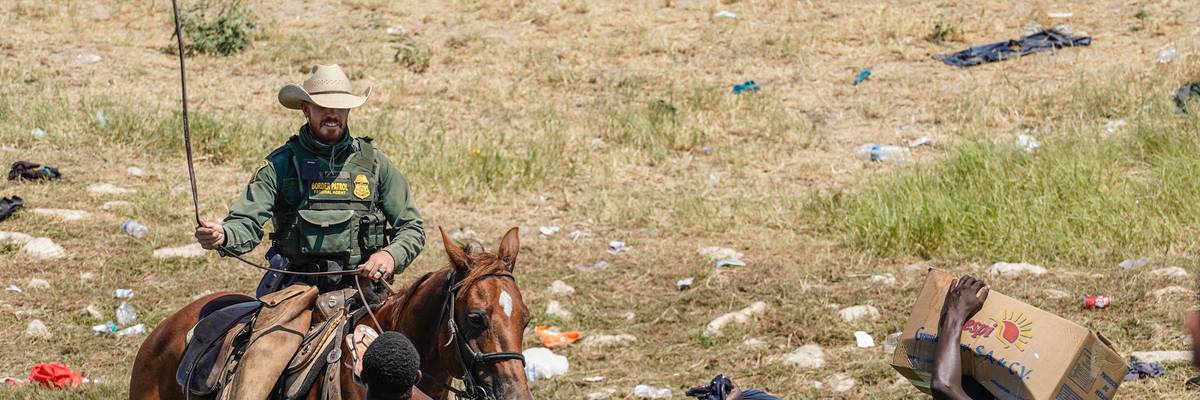
A United States Border Patrol agent on horseback uses the reins as he tries to stop Haitian migrants from entering an encampment on the banks of the Rio Grande near the Acuna Del Rio International Bridge in Del Rio, Texas on September 19, 2021. (Photo by PAUL RATJE/AFP via Getty Images)
I have two memories of Haiti. The first was in 1993. I had led a United Nations delegation to Haiti to ascertain the consequences of the embargo imposed by the U.N. The embargo intended to put pressure on the military-installed regime to restore president Jean-Bertrand Aristide to power.
I was with a number of other colleagues; we were staying at a hotel of relative luxury near the capital Port-Au-Prince. The hotel had a panoramic view of the city and its surroundings, but, being mostly dry land, it was not an attractive sight. There was a disconnection between the comfort of the hotel and the surrounding poverty.
One morning I took a walk around the hotel when I heard a murmur of children singing. I tried to locate where the sound was coming from, when I realized it came from a group of boys and girls on the way to school, their books hanging precariously from their school bags. All were immaculately dressed in white. This was quite a feat, given the difficulties in obtaining water. The children happily singing may have been a touch of magic in their lives; witnessing it, was certainly mine.
The second memory was when I went to assess the Pan American Health Organization's collaboration efforts with the government regarding public health. I was visiting a hospital in Port-au-Prince with a colleague when, all of a sudden, she asked me, "Did you see that?" Regrettably, I had. She was referring to a dead child covered by a sheet, flies buzzing around the corpse, seemingly abandoned in a hospital hallway. For days afterwards that sight was a recurring nightmare for me. It also was proof of the desperate state of Haiti's hospitals.
Today, the dire situation in Haiti has increased exponentially. The country has the combined negative effects of political and social violence, the economic crisis and the Covid-19 pandemic. Since the assassination of President Jovenel Moise in July 2021, there is continuous civil unrest and gang violence. Also, should a new resurgence of the infection occur, the country is unprepared to deal with it.
A month after Moise's assassination, on August 14, 2021, a magnitude 7.2 earthquake struck the Tiburon Peninsula, followed by Tropical Storm Grace. The natural disasters affected two million people; left 2,246 dead; more than 12,700 injured; at least 329 missing, and up to 26,000 displaced. The Haitian government estimates it needs $2 billion to recover from the earthquake. As of last February, donors have pledged only $600 million.
The country is undergoing a serious political and constitutional crisis. Prime Minister Ariel Henry, who had been appointed by Moise two days before his assassination, was found to have close links to a prime suspect in the assassination and to have maintained contact with him after the president's assassination.
At this time of crisis for the country, Human Rights Watch has denounced the deportation of Haitians back to Haiti by the U.S. and other countries. According to the International Organization for Migration (IOM), from January 1, 2021 through February 26, 2022, 25,765 people were returned to Haiti, including 4,674 children, who make up 18 percent of returnees.
"No government should return people to Haiti. And the United States, which accounts for the vast majority of returns, should end the unnecessary and illegitimate use of public health regulation for abusive expulsion of Haitians," stated Cesar Munoz, senior Americas researcher at Human Rights Watch. Munoz is referring to Title 42 of the U.S Public Health Services Law.
Title 42 is a clause which the Trump Administration began using in 2020 to prevent migrants from entering into the U.S. It grants the government the ability to take emergency action to stop immigrants from entering the U.S. on the premise that it will prevent the introduction of Covid-19. On March 11, the US Centers for Disease Control and Prevention (CDC) ceased its authorization of Title 42 expulsion authority regarding unaccompanied children.
Is there is a future for Haiti? Unlike those who look on with despair at the difficulties the country is facing, Haiti's human resources could be the foundation of a new revitalized society that would address the crises imposed by inept governments and foreign powers' interference. Haiti needs economic and technical help, and effective financial assistance judiciously provided. The Haitian people deserve no less.
Dear Common Dreams reader, It’s been nearly 30 years since I co-founded Common Dreams with my late wife, Lina Newhouser. We had the radical notion that journalism should serve the public good, not corporate profits. It was clear to us from the outset what it would take to build such a project. No paid advertisements. No corporate sponsors. No millionaire publisher telling us what to think or do. Many people said we wouldn't last a year, but we proved those doubters wrong. Together with a tremendous team of journalists and dedicated staff, we built an independent media outlet free from the constraints of profits and corporate control. Our mission has always been simple: To inform. To inspire. To ignite change for the common good. Building Common Dreams was not easy. Our survival was never guaranteed. When you take on the most powerful forces—Wall Street greed, fossil fuel industry destruction, Big Tech lobbyists, and uber-rich oligarchs who have spent billions upon billions rigging the economy and democracy in their favor—the only bulwark you have is supporters who believe in your work. But here’s the urgent message from me today. It's never been this bad out there. And it's never been this hard to keep us going. At the very moment Common Dreams is most needed, the threats we face are intensifying. We need your support now more than ever. We don't accept corporate advertising and never will. We don't have a paywall because we don't think people should be blocked from critical news based on their ability to pay. Everything we do is funded by the donations of readers like you. When everyone does the little they can afford, we are strong. But if that support retreats or dries up, so do we. Will you donate now to make sure Common Dreams not only survives but thrives? —Craig Brown, Co-founder |
I have two memories of Haiti. The first was in 1993. I had led a United Nations delegation to Haiti to ascertain the consequences of the embargo imposed by the U.N. The embargo intended to put pressure on the military-installed regime to restore president Jean-Bertrand Aristide to power.
I was with a number of other colleagues; we were staying at a hotel of relative luxury near the capital Port-Au-Prince. The hotel had a panoramic view of the city and its surroundings, but, being mostly dry land, it was not an attractive sight. There was a disconnection between the comfort of the hotel and the surrounding poverty.
One morning I took a walk around the hotel when I heard a murmur of children singing. I tried to locate where the sound was coming from, when I realized it came from a group of boys and girls on the way to school, their books hanging precariously from their school bags. All were immaculately dressed in white. This was quite a feat, given the difficulties in obtaining water. The children happily singing may have been a touch of magic in their lives; witnessing it, was certainly mine.
The second memory was when I went to assess the Pan American Health Organization's collaboration efforts with the government regarding public health. I was visiting a hospital in Port-au-Prince with a colleague when, all of a sudden, she asked me, "Did you see that?" Regrettably, I had. She was referring to a dead child covered by a sheet, flies buzzing around the corpse, seemingly abandoned in a hospital hallway. For days afterwards that sight was a recurring nightmare for me. It also was proof of the desperate state of Haiti's hospitals.
Today, the dire situation in Haiti has increased exponentially. The country has the combined negative effects of political and social violence, the economic crisis and the Covid-19 pandemic. Since the assassination of President Jovenel Moise in July 2021, there is continuous civil unrest and gang violence. Also, should a new resurgence of the infection occur, the country is unprepared to deal with it.
A month after Moise's assassination, on August 14, 2021, a magnitude 7.2 earthquake struck the Tiburon Peninsula, followed by Tropical Storm Grace. The natural disasters affected two million people; left 2,246 dead; more than 12,700 injured; at least 329 missing, and up to 26,000 displaced. The Haitian government estimates it needs $2 billion to recover from the earthquake. As of last February, donors have pledged only $600 million.
The country is undergoing a serious political and constitutional crisis. Prime Minister Ariel Henry, who had been appointed by Moise two days before his assassination, was found to have close links to a prime suspect in the assassination and to have maintained contact with him after the president's assassination.
At this time of crisis for the country, Human Rights Watch has denounced the deportation of Haitians back to Haiti by the U.S. and other countries. According to the International Organization for Migration (IOM), from January 1, 2021 through February 26, 2022, 25,765 people were returned to Haiti, including 4,674 children, who make up 18 percent of returnees.
"No government should return people to Haiti. And the United States, which accounts for the vast majority of returns, should end the unnecessary and illegitimate use of public health regulation for abusive expulsion of Haitians," stated Cesar Munoz, senior Americas researcher at Human Rights Watch. Munoz is referring to Title 42 of the U.S Public Health Services Law.
Title 42 is a clause which the Trump Administration began using in 2020 to prevent migrants from entering into the U.S. It grants the government the ability to take emergency action to stop immigrants from entering the U.S. on the premise that it will prevent the introduction of Covid-19. On March 11, the US Centers for Disease Control and Prevention (CDC) ceased its authorization of Title 42 expulsion authority regarding unaccompanied children.
Is there is a future for Haiti? Unlike those who look on with despair at the difficulties the country is facing, Haiti's human resources could be the foundation of a new revitalized society that would address the crises imposed by inept governments and foreign powers' interference. Haiti needs economic and technical help, and effective financial assistance judiciously provided. The Haitian people deserve no less.
I have two memories of Haiti. The first was in 1993. I had led a United Nations delegation to Haiti to ascertain the consequences of the embargo imposed by the U.N. The embargo intended to put pressure on the military-installed regime to restore president Jean-Bertrand Aristide to power.
I was with a number of other colleagues; we were staying at a hotel of relative luxury near the capital Port-Au-Prince. The hotel had a panoramic view of the city and its surroundings, but, being mostly dry land, it was not an attractive sight. There was a disconnection between the comfort of the hotel and the surrounding poverty.
One morning I took a walk around the hotel when I heard a murmur of children singing. I tried to locate where the sound was coming from, when I realized it came from a group of boys and girls on the way to school, their books hanging precariously from their school bags. All were immaculately dressed in white. This was quite a feat, given the difficulties in obtaining water. The children happily singing may have been a touch of magic in their lives; witnessing it, was certainly mine.
The second memory was when I went to assess the Pan American Health Organization's collaboration efforts with the government regarding public health. I was visiting a hospital in Port-au-Prince with a colleague when, all of a sudden, she asked me, "Did you see that?" Regrettably, I had. She was referring to a dead child covered by a sheet, flies buzzing around the corpse, seemingly abandoned in a hospital hallway. For days afterwards that sight was a recurring nightmare for me. It also was proof of the desperate state of Haiti's hospitals.
Today, the dire situation in Haiti has increased exponentially. The country has the combined negative effects of political and social violence, the economic crisis and the Covid-19 pandemic. Since the assassination of President Jovenel Moise in July 2021, there is continuous civil unrest and gang violence. Also, should a new resurgence of the infection occur, the country is unprepared to deal with it.
A month after Moise's assassination, on August 14, 2021, a magnitude 7.2 earthquake struck the Tiburon Peninsula, followed by Tropical Storm Grace. The natural disasters affected two million people; left 2,246 dead; more than 12,700 injured; at least 329 missing, and up to 26,000 displaced. The Haitian government estimates it needs $2 billion to recover from the earthquake. As of last February, donors have pledged only $600 million.
The country is undergoing a serious political and constitutional crisis. Prime Minister Ariel Henry, who had been appointed by Moise two days before his assassination, was found to have close links to a prime suspect in the assassination and to have maintained contact with him after the president's assassination.
At this time of crisis for the country, Human Rights Watch has denounced the deportation of Haitians back to Haiti by the U.S. and other countries. According to the International Organization for Migration (IOM), from January 1, 2021 through February 26, 2022, 25,765 people were returned to Haiti, including 4,674 children, who make up 18 percent of returnees.
"No government should return people to Haiti. And the United States, which accounts for the vast majority of returns, should end the unnecessary and illegitimate use of public health regulation for abusive expulsion of Haitians," stated Cesar Munoz, senior Americas researcher at Human Rights Watch. Munoz is referring to Title 42 of the U.S Public Health Services Law.
Title 42 is a clause which the Trump Administration began using in 2020 to prevent migrants from entering into the U.S. It grants the government the ability to take emergency action to stop immigrants from entering the U.S. on the premise that it will prevent the introduction of Covid-19. On March 11, the US Centers for Disease Control and Prevention (CDC) ceased its authorization of Title 42 expulsion authority regarding unaccompanied children.
Is there is a future for Haiti? Unlike those who look on with despair at the difficulties the country is facing, Haiti's human resources could be the foundation of a new revitalized society that would address the crises imposed by inept governments and foreign powers' interference. Haiti needs economic and technical help, and effective financial assistance judiciously provided. The Haitian people deserve no less.