SUBSCRIBE TO OUR FREE NEWSLETTER
Daily news & progressive opinion—funded by the people, not the corporations—delivered straight to your inbox.
5
#000000
#FFFFFF
To donate by check, phone, or other method, see our More Ways to Give page.
Daily news & progressive opinion—funded by the people, not the corporations—delivered straight to your inbox.
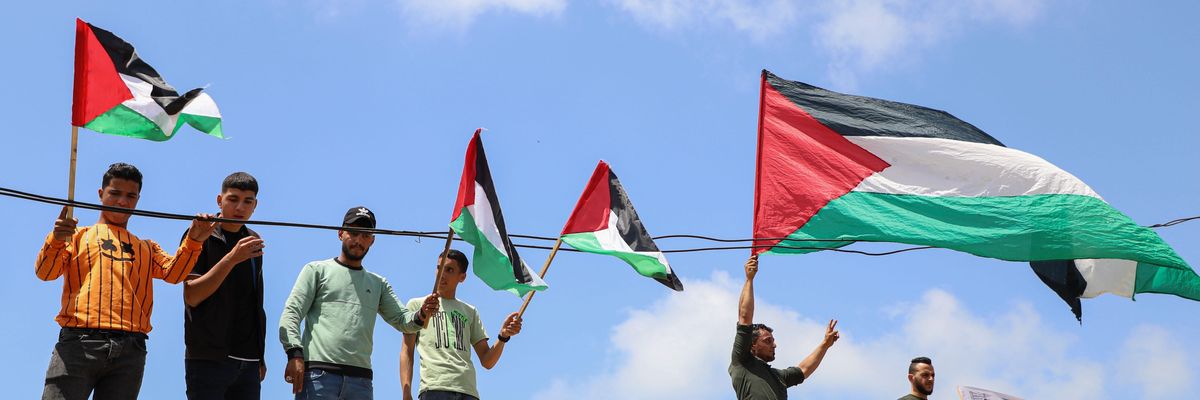
Palestinian people attend a demonstration marking the 74th anniversary of Nakba Day in Gaza City, on May 15, 2022. (Photo: Rizek Abdeljawad/Xinhua via Getty Images)
Israel's coalition government of right-wing Prime Minister Naftali Bennett is on the verge of collapse, which is unsurprising. Israeli politics, after all, is among the most fractious in the world, and this particular coalition was born out of the obsessive desire to dethrone Israel's former leader, Benjamin Netanyahu.
The constant need to feed the insatiable appetite of the country's powerful right-wing constituency keeps pushing Israel's right-wing parties further to the right.
While Netanyahu was successfully ousted in June 2021, Bennett's coalition has been left to contend with the painful reality that its odd political components have very little in common.
On April 6, Israeli lawmaker Ildit Salman defected from the coalition, leaving Bennett and his temporary allies wrangling with the fact that their Knesset (Israel's Parliament) coalition no longer has a majority. Now that the Knesset count stands at 60-60, a single defection could potentially send Israelis back to the voting booth, which has been quite habitual recently.
Two current Bennett allies, Abir Kara and Bir Orbach, are possible defectors. Even Bennett's old Bayit Yehudi (Jewish Home) partner, Ayelet Shaked, could ultimately betray him, once his coalition ship begins sinking. And it is.
Both Bennett and Shaked left the Jewish Home in 2018 to form Yamina. Although the latter won only seven seats in the March 2021 elections, the far-right party proved to be the kingmaker, which allowed the anti-Netanyahu coalition to be formed. The only alternative to this current coalition would have been a government in which Netanyahu and Bennett would alternate the prime minister post. Though Bennett is a protege of Netanyahu, the current prime minister knew too well that his former boss cannot be trusted.
So, instead, Bennett opted to join a hotchpotch coalition of political desperados, each joining an unlikely government for simply having no other option. For example, Yesh Atid (17 seats), and Kahol Lavan (8 seats), once part of the Blue and White center-right coalition, betrayed their political base by joining far-right Yamina and, consequently, leaving behind Telem of Moshe Yalon, which now has no Knesset representation.
The same can be said of Labor (7 seats) and Meretz (6 seats) who, earlier, were the backbone of the Israeli political establishment - in 1992 they had 56 seats combined. Losing faith in their own political base, they opted to join their supposed ideological nemesis, instead of enduring the painstaking process of breathing life into a dying camp.
The captivating part of the story is the United Arab List of Mansour Abbas, which is rightly perceived to have betrayed its Arab base in Israel and its own Palestinian people everywhere else. As the Israeli army is cracking down on Palestinian communities throughout historic Palestine, including Al-Aqsa Mosque and the Naqab - Mansour Abbas' own base - this strange political creature remains committed to Bennett, though nervous about future possibilities, especially that the nature of the Israeli attacks on Palestinians are increasingly shifting towards a religious war.
Consequently, it is hard to imagine that Bennett's government could realistically survive till 2025. In fact, it is quite rare in Israeli politics that any government coalition has served its full four-year term. Still, Israel's historic political instability is worsening. In fact, Bennett's government is the outcome of an agonizing political process that saw Israeli voters cast their votes in four different general elections in only two years.
Perhaps, what is keeping Bennett's coalition together, though precariously, is the menacing image of Netanyahu, the current opposition leader, sinisterly watching from across the Knesset aisles while waiting for the right opportunity to pounce. Some Israeli analysts even argue that the defection of MK Salman was largely instigated by the abuse and intimidation she received from Netanyahu's Likud party, which saw her as a traitor to their right-wing agenda.
Regardless of the fate of Bennett's government, Israel's political crisis will continue indefinitely, and there are reasons for this.
Though the Israeli right has dominated the country's politics for many years, especially since 1996, it remains fractious and opportunistic. The constant need to feed the insatiable appetite of the country's powerful right-wing constituency keeps pushing Israel's right-wing parties further to the right. They are merely united around such values as the racial and religious supremacy of Israeli Jews, their hate for Palestinians and Arabs, the desire to expand the illegal Jewish settlements and the rejection of any mediated solution that would provide Palestinians with their basic human rights.
The left in Israel is, frankly, not a left at all. It is recognized as such, largely because of its 'peace-process' legacy, which died with the assassination of Labor Minister Yitzhak Rabi, in 1995. Tellingly, Rabin was not a peacenik but one of Israel's most militant and violent leaders. However, the erroneous association, linking any Israeli leader with the 'peace process', automatically classified that individual as a 'leftist'. According to Israeli analyst Oz Aruch, this also applied to Ariel Sharon. The name of the late notorious Israeli prime minister and Army General is associated with the Sabra and Shatila massacre, along with other horrific episodes.
Without a real ideology and without a 'peace process,' or even the desire to engage in one, the Israeli left has become irrelevant.
The same applies to the center which, by definition, is the political camp that occupies the space between the right and the left. With the right being in constant redefinition and the left having no strong ideological base, the Israeli center has proven equally hopeless. The outcome of the April 2019 elections, when the center coalition Blue and White obtained 35 seats, should have been a watershed moment for Israel's political center. This ultimately culminated to nil, and eventually led to the collapse of Blue and White itself.
While this is taking place in Israel, the Palestinian body politic has been slowly reanimating. Though Palestinian Arab parties in Israel remain divided, and Palestinian groups in the occupied territories are yet to find their common ground, Palestinian communities, especially the younger generations, have been articulating a new political discourse. With grassroots leaderships, they are coordinating their actions from occupied Jerusalem to Gaza, to the Naqab to the West Bank and to Palestinian communities in Israel itself.
For the first time in many years, Israel finds itself in a position where it is no longer the only party that is shaping events or determining outcomes in the country. Therefore, Israeli political instability will worsen. Contrastingly, Palestinians are finally becoming a factor in Israeli politics and, through their popular resistance, can mobilize to put pressure on Israel as has been the case in recent years.
Israel is now facing the dilemma of either ignoring this new Palestinian factor, at its own peril, or accepting the inescapable fact that Israel can never enjoy stability while Palestinians remain occupied, confined and oppressed.
Dear Common Dreams reader, It’s been nearly 30 years since I co-founded Common Dreams with my late wife, Lina Newhouser. We had the radical notion that journalism should serve the public good, not corporate profits. It was clear to us from the outset what it would take to build such a project. No paid advertisements. No corporate sponsors. No millionaire publisher telling us what to think or do. Many people said we wouldn't last a year, but we proved those doubters wrong. Together with a tremendous team of journalists and dedicated staff, we built an independent media outlet free from the constraints of profits and corporate control. Our mission has always been simple: To inform. To inspire. To ignite change for the common good. Building Common Dreams was not easy. Our survival was never guaranteed. When you take on the most powerful forces—Wall Street greed, fossil fuel industry destruction, Big Tech lobbyists, and uber-rich oligarchs who have spent billions upon billions rigging the economy and democracy in their favor—the only bulwark you have is supporters who believe in your work. But here’s the urgent message from me today. It's never been this bad out there. And it's never been this hard to keep us going. At the very moment Common Dreams is most needed, the threats we face are intensifying. We need your support now more than ever. We don't accept corporate advertising and never will. We don't have a paywall because we don't think people should be blocked from critical news based on their ability to pay. Everything we do is funded by the donations of readers like you. When everyone does the little they can afford, we are strong. But if that support retreats or dries up, so do we. Will you donate now to make sure Common Dreams not only survives but thrives? —Craig Brown, Co-founder |
Israel's coalition government of right-wing Prime Minister Naftali Bennett is on the verge of collapse, which is unsurprising. Israeli politics, after all, is among the most fractious in the world, and this particular coalition was born out of the obsessive desire to dethrone Israel's former leader, Benjamin Netanyahu.
The constant need to feed the insatiable appetite of the country's powerful right-wing constituency keeps pushing Israel's right-wing parties further to the right.
While Netanyahu was successfully ousted in June 2021, Bennett's coalition has been left to contend with the painful reality that its odd political components have very little in common.
On April 6, Israeli lawmaker Ildit Salman defected from the coalition, leaving Bennett and his temporary allies wrangling with the fact that their Knesset (Israel's Parliament) coalition no longer has a majority. Now that the Knesset count stands at 60-60, a single defection could potentially send Israelis back to the voting booth, which has been quite habitual recently.
Two current Bennett allies, Abir Kara and Bir Orbach, are possible defectors. Even Bennett's old Bayit Yehudi (Jewish Home) partner, Ayelet Shaked, could ultimately betray him, once his coalition ship begins sinking. And it is.
Both Bennett and Shaked left the Jewish Home in 2018 to form Yamina. Although the latter won only seven seats in the March 2021 elections, the far-right party proved to be the kingmaker, which allowed the anti-Netanyahu coalition to be formed. The only alternative to this current coalition would have been a government in which Netanyahu and Bennett would alternate the prime minister post. Though Bennett is a protege of Netanyahu, the current prime minister knew too well that his former boss cannot be trusted.
So, instead, Bennett opted to join a hotchpotch coalition of political desperados, each joining an unlikely government for simply having no other option. For example, Yesh Atid (17 seats), and Kahol Lavan (8 seats), once part of the Blue and White center-right coalition, betrayed their political base by joining far-right Yamina and, consequently, leaving behind Telem of Moshe Yalon, which now has no Knesset representation.
The same can be said of Labor (7 seats) and Meretz (6 seats) who, earlier, were the backbone of the Israeli political establishment - in 1992 they had 56 seats combined. Losing faith in their own political base, they opted to join their supposed ideological nemesis, instead of enduring the painstaking process of breathing life into a dying camp.
The captivating part of the story is the United Arab List of Mansour Abbas, which is rightly perceived to have betrayed its Arab base in Israel and its own Palestinian people everywhere else. As the Israeli army is cracking down on Palestinian communities throughout historic Palestine, including Al-Aqsa Mosque and the Naqab - Mansour Abbas' own base - this strange political creature remains committed to Bennett, though nervous about future possibilities, especially that the nature of the Israeli attacks on Palestinians are increasingly shifting towards a religious war.
Consequently, it is hard to imagine that Bennett's government could realistically survive till 2025. In fact, it is quite rare in Israeli politics that any government coalition has served its full four-year term. Still, Israel's historic political instability is worsening. In fact, Bennett's government is the outcome of an agonizing political process that saw Israeli voters cast their votes in four different general elections in only two years.
Perhaps, what is keeping Bennett's coalition together, though precariously, is the menacing image of Netanyahu, the current opposition leader, sinisterly watching from across the Knesset aisles while waiting for the right opportunity to pounce. Some Israeli analysts even argue that the defection of MK Salman was largely instigated by the abuse and intimidation she received from Netanyahu's Likud party, which saw her as a traitor to their right-wing agenda.
Regardless of the fate of Bennett's government, Israel's political crisis will continue indefinitely, and there are reasons for this.
Though the Israeli right has dominated the country's politics for many years, especially since 1996, it remains fractious and opportunistic. The constant need to feed the insatiable appetite of the country's powerful right-wing constituency keeps pushing Israel's right-wing parties further to the right. They are merely united around such values as the racial and religious supremacy of Israeli Jews, their hate for Palestinians and Arabs, the desire to expand the illegal Jewish settlements and the rejection of any mediated solution that would provide Palestinians with their basic human rights.
The left in Israel is, frankly, not a left at all. It is recognized as such, largely because of its 'peace-process' legacy, which died with the assassination of Labor Minister Yitzhak Rabi, in 1995. Tellingly, Rabin was not a peacenik but one of Israel's most militant and violent leaders. However, the erroneous association, linking any Israeli leader with the 'peace process', automatically classified that individual as a 'leftist'. According to Israeli analyst Oz Aruch, this also applied to Ariel Sharon. The name of the late notorious Israeli prime minister and Army General is associated with the Sabra and Shatila massacre, along with other horrific episodes.
Without a real ideology and without a 'peace process,' or even the desire to engage in one, the Israeli left has become irrelevant.
The same applies to the center which, by definition, is the political camp that occupies the space between the right and the left. With the right being in constant redefinition and the left having no strong ideological base, the Israeli center has proven equally hopeless. The outcome of the April 2019 elections, when the center coalition Blue and White obtained 35 seats, should have been a watershed moment for Israel's political center. This ultimately culminated to nil, and eventually led to the collapse of Blue and White itself.
While this is taking place in Israel, the Palestinian body politic has been slowly reanimating. Though Palestinian Arab parties in Israel remain divided, and Palestinian groups in the occupied territories are yet to find their common ground, Palestinian communities, especially the younger generations, have been articulating a new political discourse. With grassroots leaderships, they are coordinating their actions from occupied Jerusalem to Gaza, to the Naqab to the West Bank and to Palestinian communities in Israel itself.
For the first time in many years, Israel finds itself in a position where it is no longer the only party that is shaping events or determining outcomes in the country. Therefore, Israeli political instability will worsen. Contrastingly, Palestinians are finally becoming a factor in Israeli politics and, through their popular resistance, can mobilize to put pressure on Israel as has been the case in recent years.
Israel is now facing the dilemma of either ignoring this new Palestinian factor, at its own peril, or accepting the inescapable fact that Israel can never enjoy stability while Palestinians remain occupied, confined and oppressed.
Israel's coalition government of right-wing Prime Minister Naftali Bennett is on the verge of collapse, which is unsurprising. Israeli politics, after all, is among the most fractious in the world, and this particular coalition was born out of the obsessive desire to dethrone Israel's former leader, Benjamin Netanyahu.
The constant need to feed the insatiable appetite of the country's powerful right-wing constituency keeps pushing Israel's right-wing parties further to the right.
While Netanyahu was successfully ousted in June 2021, Bennett's coalition has been left to contend with the painful reality that its odd political components have very little in common.
On April 6, Israeli lawmaker Ildit Salman defected from the coalition, leaving Bennett and his temporary allies wrangling with the fact that their Knesset (Israel's Parliament) coalition no longer has a majority. Now that the Knesset count stands at 60-60, a single defection could potentially send Israelis back to the voting booth, which has been quite habitual recently.
Two current Bennett allies, Abir Kara and Bir Orbach, are possible defectors. Even Bennett's old Bayit Yehudi (Jewish Home) partner, Ayelet Shaked, could ultimately betray him, once his coalition ship begins sinking. And it is.
Both Bennett and Shaked left the Jewish Home in 2018 to form Yamina. Although the latter won only seven seats in the March 2021 elections, the far-right party proved to be the kingmaker, which allowed the anti-Netanyahu coalition to be formed. The only alternative to this current coalition would have been a government in which Netanyahu and Bennett would alternate the prime minister post. Though Bennett is a protege of Netanyahu, the current prime minister knew too well that his former boss cannot be trusted.
So, instead, Bennett opted to join a hotchpotch coalition of political desperados, each joining an unlikely government for simply having no other option. For example, Yesh Atid (17 seats), and Kahol Lavan (8 seats), once part of the Blue and White center-right coalition, betrayed their political base by joining far-right Yamina and, consequently, leaving behind Telem of Moshe Yalon, which now has no Knesset representation.
The same can be said of Labor (7 seats) and Meretz (6 seats) who, earlier, were the backbone of the Israeli political establishment - in 1992 they had 56 seats combined. Losing faith in their own political base, they opted to join their supposed ideological nemesis, instead of enduring the painstaking process of breathing life into a dying camp.
The captivating part of the story is the United Arab List of Mansour Abbas, which is rightly perceived to have betrayed its Arab base in Israel and its own Palestinian people everywhere else. As the Israeli army is cracking down on Palestinian communities throughout historic Palestine, including Al-Aqsa Mosque and the Naqab - Mansour Abbas' own base - this strange political creature remains committed to Bennett, though nervous about future possibilities, especially that the nature of the Israeli attacks on Palestinians are increasingly shifting towards a religious war.
Consequently, it is hard to imagine that Bennett's government could realistically survive till 2025. In fact, it is quite rare in Israeli politics that any government coalition has served its full four-year term. Still, Israel's historic political instability is worsening. In fact, Bennett's government is the outcome of an agonizing political process that saw Israeli voters cast their votes in four different general elections in only two years.
Perhaps, what is keeping Bennett's coalition together, though precariously, is the menacing image of Netanyahu, the current opposition leader, sinisterly watching from across the Knesset aisles while waiting for the right opportunity to pounce. Some Israeli analysts even argue that the defection of MK Salman was largely instigated by the abuse and intimidation she received from Netanyahu's Likud party, which saw her as a traitor to their right-wing agenda.
Regardless of the fate of Bennett's government, Israel's political crisis will continue indefinitely, and there are reasons for this.
Though the Israeli right has dominated the country's politics for many years, especially since 1996, it remains fractious and opportunistic. The constant need to feed the insatiable appetite of the country's powerful right-wing constituency keeps pushing Israel's right-wing parties further to the right. They are merely united around such values as the racial and religious supremacy of Israeli Jews, their hate for Palestinians and Arabs, the desire to expand the illegal Jewish settlements and the rejection of any mediated solution that would provide Palestinians with their basic human rights.
The left in Israel is, frankly, not a left at all. It is recognized as such, largely because of its 'peace-process' legacy, which died with the assassination of Labor Minister Yitzhak Rabi, in 1995. Tellingly, Rabin was not a peacenik but one of Israel's most militant and violent leaders. However, the erroneous association, linking any Israeli leader with the 'peace process', automatically classified that individual as a 'leftist'. According to Israeli analyst Oz Aruch, this also applied to Ariel Sharon. The name of the late notorious Israeli prime minister and Army General is associated with the Sabra and Shatila massacre, along with other horrific episodes.
Without a real ideology and without a 'peace process,' or even the desire to engage in one, the Israeli left has become irrelevant.
The same applies to the center which, by definition, is the political camp that occupies the space between the right and the left. With the right being in constant redefinition and the left having no strong ideological base, the Israeli center has proven equally hopeless. The outcome of the April 2019 elections, when the center coalition Blue and White obtained 35 seats, should have been a watershed moment for Israel's political center. This ultimately culminated to nil, and eventually led to the collapse of Blue and White itself.
While this is taking place in Israel, the Palestinian body politic has been slowly reanimating. Though Palestinian Arab parties in Israel remain divided, and Palestinian groups in the occupied territories are yet to find their common ground, Palestinian communities, especially the younger generations, have been articulating a new political discourse. With grassroots leaderships, they are coordinating their actions from occupied Jerusalem to Gaza, to the Naqab to the West Bank and to Palestinian communities in Israel itself.
For the first time in many years, Israel finds itself in a position where it is no longer the only party that is shaping events or determining outcomes in the country. Therefore, Israeli political instability will worsen. Contrastingly, Palestinians are finally becoming a factor in Israeli politics and, through their popular resistance, can mobilize to put pressure on Israel as has been the case in recent years.
Israel is now facing the dilemma of either ignoring this new Palestinian factor, at its own peril, or accepting the inescapable fact that Israel can never enjoy stability while Palestinians remain occupied, confined and oppressed.