SUBSCRIBE TO OUR FREE NEWSLETTER
Daily news & progressive opinion—funded by the people, not the corporations—delivered straight to your inbox.
5
#000000
#FFFFFF
To donate by check, phone, or other method, see our More Ways to Give page.
Daily news & progressive opinion—funded by the people, not the corporations—delivered straight to your inbox.
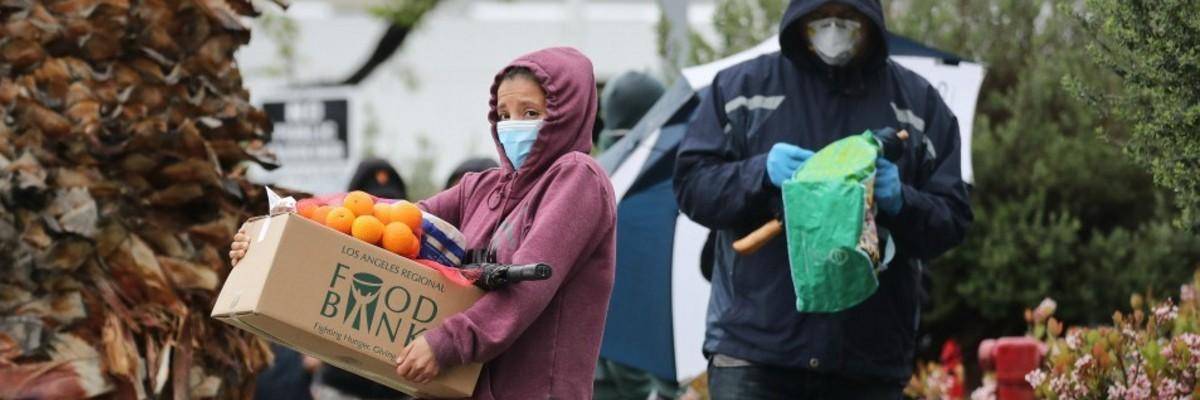
A recipient carries a box of food as others wait in line at a Food Bank distribution for those in need as the coronavirus pandemic continues on April 9, 2020 in Van Nuys, California. (Photo: Mario Tama/Getty Images)
As our country approaches 1 million deaths from COVID-19, it can feel impossible to wrap our heads around such a devastating figure. But it's essential if we want to treat the pre-existing conditions that made it so deadly.
When a public health crisis runs headlong into systemic inequities in wages, wealth, and health care, the result is mass death among those the system is rigged against.
In the beginning, many thought the pandemic would be "a great equalizer," since the virus doesn't distinguish between rich and poor. But the tragic reality is that our economic and public health systems do discriminate.
A coalition of researchers convened by the Poor People's Campaign recently published a report making this reality plain.
The researchers define poverty to include all those living up to 200 percent of the official poverty measure, which has long been considered too low to capture those who struggle the hardest to make ends meet.
Using this measure, they found that COVID-19 death rates in poorer U.S. counties were nearly double those wealthier counties.
The gap was even bigger during the worst phases of the pandemic. During the dark winter of 2020-2021, four and a half times as many people in poorer counties died. During the Delta phase, that number shot up to five times.
Vaccination rates tend to be somewhat greater in wealthier counties, but this study looked at counties where vaccination rates topped more than 85 percent. So vaccination can't account for the disparity.
What can account for it is poverty. The over 300 counties with the highest death rates had average poverty rates of 45 percent.
These counties include 30 million Americans of every color. Latinx Americans make up about a quarter of their population, while their Black population is about double the national average. What's more, these counties are home to nearly 30 percent of all Indigenous people in the United States.
They're also home to many poor whites. Although COVID-related deaths fell disproportionately on people of color, these poorer white people suffered the most deaths.
Experts and impacted people testified recently about these findings in Washington, D.C.
"At times, our county's rate of COVID hospitalizations and deaths led the nation," said Bruce Grau of Wausau, Wisconsin. "In the first six months of the pandemic, nearly all of the residents in just one nursing home died penniless and alone."
"Because I don't have money, it was 17 days before they told me I had COVID," testified Tyrone Gardner of Goldsboro, North Carolina. "We were slaughtered for the almighty dollar, and we won't be sacrificed anymore," declared Pamela Garrison of West Virginia.
"It was hard for us to get the vaccine," recalled Vanessa Nosie, a member of the Apache Stronghold in New Mexico. "Our lives aren't valued. They look at us like it doesn't hurt that we don't survive."
"The findings of this report reveal intentional decisions to not focus on the poor," summed up Reverend WIlliam Barber, co-chair of the Poor People's Campaign. "We cannot say that this is because of individual choices or behaviors."
Instead, he declared, "something deeper is at work: systems that prey on the poor--poor white people and poor people of color."
The lessons of this pandemic are brutal and myriad. One of its most important is that when a public health crisis runs headlong into systemic inequities in wages, wealth, and health care, the result is mass death among those the system is rigged against.
The Poor People's Campaign has been mobilizing Americans across the country to un-rig this system. "This data is a wake-up call for this nation to heed the calls of the Poor People's Campaign," said John Cavanagh of the Institute for Policy Studies.
This summer, the campaign is organizing a mass mobilization of poor and low-income people in Washington, D.C. to fight back. On June 18, thousands of poor people and their allies will arrive in the capital, calling on lawmakers to treat the pre-existing conditions of a pandemic that's killed nearly 1 million Americans.
They welcome all to join them.
Dear Common Dreams reader, It’s been nearly 30 years since I co-founded Common Dreams with my late wife, Lina Newhouser. We had the radical notion that journalism should serve the public good, not corporate profits. It was clear to us from the outset what it would take to build such a project. No paid advertisements. No corporate sponsors. No millionaire publisher telling us what to think or do. Many people said we wouldn't last a year, but we proved those doubters wrong. Together with a tremendous team of journalists and dedicated staff, we built an independent media outlet free from the constraints of profits and corporate control. Our mission has always been simple: To inform. To inspire. To ignite change for the common good. Building Common Dreams was not easy. Our survival was never guaranteed. When you take on the most powerful forces—Wall Street greed, fossil fuel industry destruction, Big Tech lobbyists, and uber-rich oligarchs who have spent billions upon billions rigging the economy and democracy in their favor—the only bulwark you have is supporters who believe in your work. But here’s the urgent message from me today. It's never been this bad out there. And it's never been this hard to keep us going. At the very moment Common Dreams is most needed, the threats we face are intensifying. We need your support now more than ever. We don't accept corporate advertising and never will. We don't have a paywall because we don't think people should be blocked from critical news based on their ability to pay. Everything we do is funded by the donations of readers like you. When everyone does the little they can afford, we are strong. But if that support retreats or dries up, so do we. Will you donate now to make sure Common Dreams not only survives but thrives? —Craig Brown, Co-founder |
As our country approaches 1 million deaths from COVID-19, it can feel impossible to wrap our heads around such a devastating figure. But it's essential if we want to treat the pre-existing conditions that made it so deadly.
When a public health crisis runs headlong into systemic inequities in wages, wealth, and health care, the result is mass death among those the system is rigged against.
In the beginning, many thought the pandemic would be "a great equalizer," since the virus doesn't distinguish between rich and poor. But the tragic reality is that our economic and public health systems do discriminate.
A coalition of researchers convened by the Poor People's Campaign recently published a report making this reality plain.
The researchers define poverty to include all those living up to 200 percent of the official poverty measure, which has long been considered too low to capture those who struggle the hardest to make ends meet.
Using this measure, they found that COVID-19 death rates in poorer U.S. counties were nearly double those wealthier counties.
The gap was even bigger during the worst phases of the pandemic. During the dark winter of 2020-2021, four and a half times as many people in poorer counties died. During the Delta phase, that number shot up to five times.
Vaccination rates tend to be somewhat greater in wealthier counties, but this study looked at counties where vaccination rates topped more than 85 percent. So vaccination can't account for the disparity.
What can account for it is poverty. The over 300 counties with the highest death rates had average poverty rates of 45 percent.
These counties include 30 million Americans of every color. Latinx Americans make up about a quarter of their population, while their Black population is about double the national average. What's more, these counties are home to nearly 30 percent of all Indigenous people in the United States.
They're also home to many poor whites. Although COVID-related deaths fell disproportionately on people of color, these poorer white people suffered the most deaths.
Experts and impacted people testified recently about these findings in Washington, D.C.
"At times, our county's rate of COVID hospitalizations and deaths led the nation," said Bruce Grau of Wausau, Wisconsin. "In the first six months of the pandemic, nearly all of the residents in just one nursing home died penniless and alone."
"Because I don't have money, it was 17 days before they told me I had COVID," testified Tyrone Gardner of Goldsboro, North Carolina. "We were slaughtered for the almighty dollar, and we won't be sacrificed anymore," declared Pamela Garrison of West Virginia.
"It was hard for us to get the vaccine," recalled Vanessa Nosie, a member of the Apache Stronghold in New Mexico. "Our lives aren't valued. They look at us like it doesn't hurt that we don't survive."
"The findings of this report reveal intentional decisions to not focus on the poor," summed up Reverend WIlliam Barber, co-chair of the Poor People's Campaign. "We cannot say that this is because of individual choices or behaviors."
Instead, he declared, "something deeper is at work: systems that prey on the poor--poor white people and poor people of color."
The lessons of this pandemic are brutal and myriad. One of its most important is that when a public health crisis runs headlong into systemic inequities in wages, wealth, and health care, the result is mass death among those the system is rigged against.
The Poor People's Campaign has been mobilizing Americans across the country to un-rig this system. "This data is a wake-up call for this nation to heed the calls of the Poor People's Campaign," said John Cavanagh of the Institute for Policy Studies.
This summer, the campaign is organizing a mass mobilization of poor and low-income people in Washington, D.C. to fight back. On June 18, thousands of poor people and their allies will arrive in the capital, calling on lawmakers to treat the pre-existing conditions of a pandemic that's killed nearly 1 million Americans.
They welcome all to join them.
As our country approaches 1 million deaths from COVID-19, it can feel impossible to wrap our heads around such a devastating figure. But it's essential if we want to treat the pre-existing conditions that made it so deadly.
When a public health crisis runs headlong into systemic inequities in wages, wealth, and health care, the result is mass death among those the system is rigged against.
In the beginning, many thought the pandemic would be "a great equalizer," since the virus doesn't distinguish between rich and poor. But the tragic reality is that our economic and public health systems do discriminate.
A coalition of researchers convened by the Poor People's Campaign recently published a report making this reality plain.
The researchers define poverty to include all those living up to 200 percent of the official poverty measure, which has long been considered too low to capture those who struggle the hardest to make ends meet.
Using this measure, they found that COVID-19 death rates in poorer U.S. counties were nearly double those wealthier counties.
The gap was even bigger during the worst phases of the pandemic. During the dark winter of 2020-2021, four and a half times as many people in poorer counties died. During the Delta phase, that number shot up to five times.
Vaccination rates tend to be somewhat greater in wealthier counties, but this study looked at counties where vaccination rates topped more than 85 percent. So vaccination can't account for the disparity.
What can account for it is poverty. The over 300 counties with the highest death rates had average poverty rates of 45 percent.
These counties include 30 million Americans of every color. Latinx Americans make up about a quarter of their population, while their Black population is about double the national average. What's more, these counties are home to nearly 30 percent of all Indigenous people in the United States.
They're also home to many poor whites. Although COVID-related deaths fell disproportionately on people of color, these poorer white people suffered the most deaths.
Experts and impacted people testified recently about these findings in Washington, D.C.
"At times, our county's rate of COVID hospitalizations and deaths led the nation," said Bruce Grau of Wausau, Wisconsin. "In the first six months of the pandemic, nearly all of the residents in just one nursing home died penniless and alone."
"Because I don't have money, it was 17 days before they told me I had COVID," testified Tyrone Gardner of Goldsboro, North Carolina. "We were slaughtered for the almighty dollar, and we won't be sacrificed anymore," declared Pamela Garrison of West Virginia.
"It was hard for us to get the vaccine," recalled Vanessa Nosie, a member of the Apache Stronghold in New Mexico. "Our lives aren't valued. They look at us like it doesn't hurt that we don't survive."
"The findings of this report reveal intentional decisions to not focus on the poor," summed up Reverend WIlliam Barber, co-chair of the Poor People's Campaign. "We cannot say that this is because of individual choices or behaviors."
Instead, he declared, "something deeper is at work: systems that prey on the poor--poor white people and poor people of color."
The lessons of this pandemic are brutal and myriad. One of its most important is that when a public health crisis runs headlong into systemic inequities in wages, wealth, and health care, the result is mass death among those the system is rigged against.
The Poor People's Campaign has been mobilizing Americans across the country to un-rig this system. "This data is a wake-up call for this nation to heed the calls of the Poor People's Campaign," said John Cavanagh of the Institute for Policy Studies.
This summer, the campaign is organizing a mass mobilization of poor and low-income people in Washington, D.C. to fight back. On June 18, thousands of poor people and their allies will arrive in the capital, calling on lawmakers to treat the pre-existing conditions of a pandemic that's killed nearly 1 million Americans.
They welcome all to join them.