SUBSCRIBE TO OUR FREE NEWSLETTER
Daily news & progressive opinion—funded by the people, not the corporations—delivered straight to your inbox.
5
#000000
#FFFFFF
To donate by check, phone, or other method, see our More Ways to Give page.
Daily news & progressive opinion—funded by the people, not the corporations—delivered straight to your inbox.
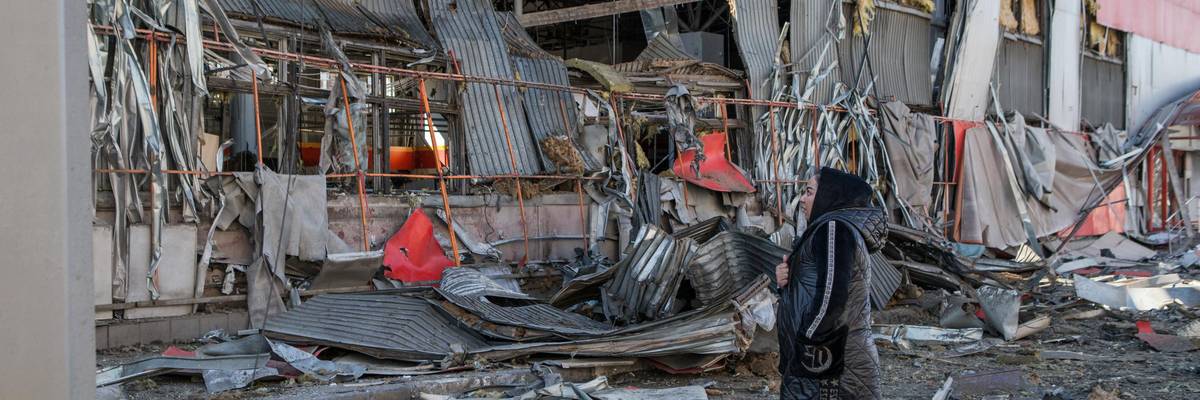
Businesses in Kharkiv, Ukraine are shown after being bombed by Russian artillery on March 15, 2022. (Photo: Andrea Carrubba/Anadolu Agency via Getty Images)
Russian forces have used cluster munitions in populated areas of Ukraine at least two dozen times since they started the invasion of that country on February 24, 2022, said UN rights chief Michelle Bachelet. Some cluster munitions may lie dormant for decades, thus posing danger for generations of civilians. Studies of cluster munitions use have found that between one-quarter and two-thirds of the victims are children.
By banning these weapons, leading powers would prove that irrationality and wanton cruelty don't always guide their actions.
Jeff Abramson, from the Arms Control Association told me, "As the swift attention to and increasing condemnation of Russia's use of cluster munitions makes clear, these weapons are simply unacceptable. All countries should ban them." As of March 7, 15 States have condemned the use of cluster bombs.
In addition, the cluster munition attacks have also been condemned by the President of the Convention on Cluster Munitions, the NATO Secretary-General, the UN Human Rights Commissioner and the Cluster Munition Coalition (including Amnesty International, Human Rights Watch, Mines Advisory Group, Norwegian People's Aid, and PAX).
These attacks may constitute war crimes, since they were carried out in violation of accepted international rules of war. "Using cluster munitions in populated areas shows a brazen and callous disregard for people's lives," said Steve Goose, arms director at Human Rights Watch.
Cluster bombs eject explosive bomblets (little bombs) designed to kill indiscriminately and destroy vehicles over a wide expanse. Unexploded bomblets can continue killing or maiming civilians long after a conflict has ended, and are very costly to find and remove.
Nations that ratify the Convention on Cluster Munitions adopted in Dublin, Ireland, in May 2008, are prohibited from using them. This Convention entered into force and became binding international law on 1 August 2010. The Convention on Cluster Munitions "bans the stockpiling, use and transfer of virtually all existing cluster bombs, and provides for the clearing up of unexploded munitions."
As of 10 February 2022, a total of 123 states had joined the Convention, 110 as states parties and 13 as signatories. Many of the world's major military powers, including the United States, Russia, Brazil and China, are not signatories of that treaty. The treaty's obligations became legally binding after 30 states ratified the convention, and subsequently for all other ratifying states.
In May 2008, then-Acting Assistant Secretary of State for Political-Military Affairs Stephen Mull stated that the U.S. military relies on cluster munitions as an important part of their defense strategy. "U.S. forces simply cannot fight by design or by doctrine without holding out at least the possibility of using cluster munitions," he said, neglecting the brutality of their use.
Since the creation of the United Nations in 1945, at least 31 nations have produced cluster munitions, among them China, France, Germany, Israel, Italy, Japan, North Korea, Russia, the United Kingdom and the United States. As of September 2018, at least 57 countries have stockpiles of cluster munitions.
More than one hundred countries have agreed in principle that their stockpiles of cluster munitions should be destroyed. However, at least 17 countries have used cluster munitions in recent times. Among those countries are France, Iran, Iraq, Israel, Libya, Netherlands, Russia, Saudi Arabia, South Africa, Sudan, Syria, the United Kingdom, and the United States.
Because of the high number of civilians killed or maimed by these munitions their use has been condemned by many human rights groups and organizations such as the United Nations, the Red Cross, Human Rights Watch, Amnesty International, the Cluster Munition Coalition and Doctors Without Borders.
Since 2005, Handicap International has collected hundreds of thousands of signatures to support its campaign to ban these weapons. It says that 98 percent of their recorded cluster munitions casualties are civilians, and 27 percent among them are children. "Cluster bombs reveal the perverse use of technology," told me recently Carlos Duguech, an Argentinian peace activist.
That children and innocent civilians can be indiscriminately killed by these dangerous weapons makes it urgent the need for all countries to ban them permanently. It can be argued that, in these irrational times, banning cluster bombs is not a priority. On the contrary, by banning these weapons, leading powers would prove that irrationality and wanton cruelty don't always guide their actions.
Dear Common Dreams reader, It’s been nearly 30 years since I co-founded Common Dreams with my late wife, Lina Newhouser. We had the radical notion that journalism should serve the public good, not corporate profits. It was clear to us from the outset what it would take to build such a project. No paid advertisements. No corporate sponsors. No millionaire publisher telling us what to think or do. Many people said we wouldn't last a year, but we proved those doubters wrong. Together with a tremendous team of journalists and dedicated staff, we built an independent media outlet free from the constraints of profits and corporate control. Our mission has always been simple: To inform. To inspire. To ignite change for the common good. Building Common Dreams was not easy. Our survival was never guaranteed. When you take on the most powerful forces—Wall Street greed, fossil fuel industry destruction, Big Tech lobbyists, and uber-rich oligarchs who have spent billions upon billions rigging the economy and democracy in their favor—the only bulwark you have is supporters who believe in your work. But here’s the urgent message from me today. It's never been this bad out there. And it's never been this hard to keep us going. At the very moment Common Dreams is most needed, the threats we face are intensifying. We need your support now more than ever. We don't accept corporate advertising and never will. We don't have a paywall because we don't think people should be blocked from critical news based on their ability to pay. Everything we do is funded by the donations of readers like you. When everyone does the little they can afford, we are strong. But if that support retreats or dries up, so do we. Will you donate now to make sure Common Dreams not only survives but thrives? —Craig Brown, Co-founder |
Russian forces have used cluster munitions in populated areas of Ukraine at least two dozen times since they started the invasion of that country on February 24, 2022, said UN rights chief Michelle Bachelet. Some cluster munitions may lie dormant for decades, thus posing danger for generations of civilians. Studies of cluster munitions use have found that between one-quarter and two-thirds of the victims are children.
By banning these weapons, leading powers would prove that irrationality and wanton cruelty don't always guide their actions.
Jeff Abramson, from the Arms Control Association told me, "As the swift attention to and increasing condemnation of Russia's use of cluster munitions makes clear, these weapons are simply unacceptable. All countries should ban them." As of March 7, 15 States have condemned the use of cluster bombs.
In addition, the cluster munition attacks have also been condemned by the President of the Convention on Cluster Munitions, the NATO Secretary-General, the UN Human Rights Commissioner and the Cluster Munition Coalition (including Amnesty International, Human Rights Watch, Mines Advisory Group, Norwegian People's Aid, and PAX).
These attacks may constitute war crimes, since they were carried out in violation of accepted international rules of war. "Using cluster munitions in populated areas shows a brazen and callous disregard for people's lives," said Steve Goose, arms director at Human Rights Watch.
Cluster bombs eject explosive bomblets (little bombs) designed to kill indiscriminately and destroy vehicles over a wide expanse. Unexploded bomblets can continue killing or maiming civilians long after a conflict has ended, and are very costly to find and remove.
Nations that ratify the Convention on Cluster Munitions adopted in Dublin, Ireland, in May 2008, are prohibited from using them. This Convention entered into force and became binding international law on 1 August 2010. The Convention on Cluster Munitions "bans the stockpiling, use and transfer of virtually all existing cluster bombs, and provides for the clearing up of unexploded munitions."
As of 10 February 2022, a total of 123 states had joined the Convention, 110 as states parties and 13 as signatories. Many of the world's major military powers, including the United States, Russia, Brazil and China, are not signatories of that treaty. The treaty's obligations became legally binding after 30 states ratified the convention, and subsequently for all other ratifying states.
In May 2008, then-Acting Assistant Secretary of State for Political-Military Affairs Stephen Mull stated that the U.S. military relies on cluster munitions as an important part of their defense strategy. "U.S. forces simply cannot fight by design or by doctrine without holding out at least the possibility of using cluster munitions," he said, neglecting the brutality of their use.
Since the creation of the United Nations in 1945, at least 31 nations have produced cluster munitions, among them China, France, Germany, Israel, Italy, Japan, North Korea, Russia, the United Kingdom and the United States. As of September 2018, at least 57 countries have stockpiles of cluster munitions.
More than one hundred countries have agreed in principle that their stockpiles of cluster munitions should be destroyed. However, at least 17 countries have used cluster munitions in recent times. Among those countries are France, Iran, Iraq, Israel, Libya, Netherlands, Russia, Saudi Arabia, South Africa, Sudan, Syria, the United Kingdom, and the United States.
Because of the high number of civilians killed or maimed by these munitions their use has been condemned by many human rights groups and organizations such as the United Nations, the Red Cross, Human Rights Watch, Amnesty International, the Cluster Munition Coalition and Doctors Without Borders.
Since 2005, Handicap International has collected hundreds of thousands of signatures to support its campaign to ban these weapons. It says that 98 percent of their recorded cluster munitions casualties are civilians, and 27 percent among them are children. "Cluster bombs reveal the perverse use of technology," told me recently Carlos Duguech, an Argentinian peace activist.
That children and innocent civilians can be indiscriminately killed by these dangerous weapons makes it urgent the need for all countries to ban them permanently. It can be argued that, in these irrational times, banning cluster bombs is not a priority. On the contrary, by banning these weapons, leading powers would prove that irrationality and wanton cruelty don't always guide their actions.
Russian forces have used cluster munitions in populated areas of Ukraine at least two dozen times since they started the invasion of that country on February 24, 2022, said UN rights chief Michelle Bachelet. Some cluster munitions may lie dormant for decades, thus posing danger for generations of civilians. Studies of cluster munitions use have found that between one-quarter and two-thirds of the victims are children.
By banning these weapons, leading powers would prove that irrationality and wanton cruelty don't always guide their actions.
Jeff Abramson, from the Arms Control Association told me, "As the swift attention to and increasing condemnation of Russia's use of cluster munitions makes clear, these weapons are simply unacceptable. All countries should ban them." As of March 7, 15 States have condemned the use of cluster bombs.
In addition, the cluster munition attacks have also been condemned by the President of the Convention on Cluster Munitions, the NATO Secretary-General, the UN Human Rights Commissioner and the Cluster Munition Coalition (including Amnesty International, Human Rights Watch, Mines Advisory Group, Norwegian People's Aid, and PAX).
These attacks may constitute war crimes, since they were carried out in violation of accepted international rules of war. "Using cluster munitions in populated areas shows a brazen and callous disregard for people's lives," said Steve Goose, arms director at Human Rights Watch.
Cluster bombs eject explosive bomblets (little bombs) designed to kill indiscriminately and destroy vehicles over a wide expanse. Unexploded bomblets can continue killing or maiming civilians long after a conflict has ended, and are very costly to find and remove.
Nations that ratify the Convention on Cluster Munitions adopted in Dublin, Ireland, in May 2008, are prohibited from using them. This Convention entered into force and became binding international law on 1 August 2010. The Convention on Cluster Munitions "bans the stockpiling, use and transfer of virtually all existing cluster bombs, and provides for the clearing up of unexploded munitions."
As of 10 February 2022, a total of 123 states had joined the Convention, 110 as states parties and 13 as signatories. Many of the world's major military powers, including the United States, Russia, Brazil and China, are not signatories of that treaty. The treaty's obligations became legally binding after 30 states ratified the convention, and subsequently for all other ratifying states.
In May 2008, then-Acting Assistant Secretary of State for Political-Military Affairs Stephen Mull stated that the U.S. military relies on cluster munitions as an important part of their defense strategy. "U.S. forces simply cannot fight by design or by doctrine without holding out at least the possibility of using cluster munitions," he said, neglecting the brutality of their use.
Since the creation of the United Nations in 1945, at least 31 nations have produced cluster munitions, among them China, France, Germany, Israel, Italy, Japan, North Korea, Russia, the United Kingdom and the United States. As of September 2018, at least 57 countries have stockpiles of cluster munitions.
More than one hundred countries have agreed in principle that their stockpiles of cluster munitions should be destroyed. However, at least 17 countries have used cluster munitions in recent times. Among those countries are France, Iran, Iraq, Israel, Libya, Netherlands, Russia, Saudi Arabia, South Africa, Sudan, Syria, the United Kingdom, and the United States.
Because of the high number of civilians killed or maimed by these munitions their use has been condemned by many human rights groups and organizations such as the United Nations, the Red Cross, Human Rights Watch, Amnesty International, the Cluster Munition Coalition and Doctors Without Borders.
Since 2005, Handicap International has collected hundreds of thousands of signatures to support its campaign to ban these weapons. It says that 98 percent of their recorded cluster munitions casualties are civilians, and 27 percent among them are children. "Cluster bombs reveal the perverse use of technology," told me recently Carlos Duguech, an Argentinian peace activist.
That children and innocent civilians can be indiscriminately killed by these dangerous weapons makes it urgent the need for all countries to ban them permanently. It can be argued that, in these irrational times, banning cluster bombs is not a priority. On the contrary, by banning these weapons, leading powers would prove that irrationality and wanton cruelty don't always guide their actions.